
The assembly point moved on Tuesday because the south lot became a laydown yard. The company's safety manual says every program is reviewed each December. So which date counts? For the emergency plan, Tuesday: the plan changed, and under 29 CFR 1926.35(e)(2)(iii) it's reviewed with the crew now. Each OSHA program has its own trigger. Two have an annual one. The others follow the work.
OSHA sets no single update frequency for written safety programs. The bloodborne pathogens plan is reviewed and updated at least annually under 29 CFR 1910.1030(c)(1)(iv), and the construction silica plan is reviewed at least annually under 1926.1153(g)(2). The HazCom program under 1910.1200(e) is maintained as the workplace changes, with no annual interval.
At a glance: Annual by rule: bloodborne pathogens plan (1910.1030(c)(1)(iv)); construction silica plan (1926.1153(g)(2)); LOTO procedure inspection, general industry (1910.147(c)(6)(i)). When things change: HazCom program (1910.1200(e)(1)); respiratory program (1910.134(c)(1)); emergency action plan, reviewed with employees when it changes (1910.38(f); 1926.35(e)(2)). Separate dates: fit tests (1910.134(f)(2)), respirator retraining ((k)(5)), HCS 2024 deadlines (1910.1200(j)). A December review for every binder is company policy.
How often each program is reviewed, standard by standard
| Program | Scope | Review or update rule | What the annual date doesn't cover |
|---|---|---|---|
| Hazard communication | General industry; construction through 1926.59 | Maintain the program, 1910.1200(e)(1); no annual interval | The chemical list kept current under (e)(1)(i); training for new hazards under (h)(1) |
| Bloodborne pathogens exposure control plan | Employers with occupational exposure under 1910.1030 | Review and update at least annually, and whenever tasks, procedures or positions with exposure change, 1910.1030(c)(1)(iv) | Changes in exposure between annual reviews |
| Silica written exposure control plan | Construction under 1926.1153 | Review and evaluate effectiveness at least annually, update as necessary, 1926.1153(g)(2) | Controls that fit the tasks the crew is doing now |
| Respiratory protection program | General industry; construction through 1926.103 | Update as necessary for workplace changes affecting respirator use, 1910.134(c)(1); evaluate implementation as necessary, (l)(1) | Fit testing (f)(2) and training (k)(5) on their own schedules |
| Emergency action plan | Where a particular standard requires one | Review with employees at the triggers of 1910.38(f) or 1926.35(e)(2) and (e)(3); no annual interval | Reviewing a changed plan with the people it covers |
| Energy control procedure | General industry under 1910.147; construction excluded | Inspect at least annually, correct deviations, certify, 1910.147(c)(6) | An inspection of how the procedure is used, not a new revision date |
OSHA uses different verbs because these are different duties. A fit test card doesn't say whether the respiratory program covers last month's new grinding task. A new revision number doesn't say anyone inspected a lockout procedure.
One more thing the table doesn't say: an evacuation drill. Neither 1910.38 nor 1926.35 mentions one. The emergency action plan is reviewed with people at the moments listed, and a drill, however useful, comes from a state plan, a local fire code, a contract or your own program.
How HazComFast keeps versions and reviews
HazComFast keeps every written plan as a series of versions. Each new version records what changed, the reason for the revision and who created it, and the version in effect stays in the history. Any earlier version can be compared with the one in effect, with what was added in green, and restoring an old version creates a new one without overwriting anything.
Only one version is in effect at a time. Two people publishing at the same moment get two different version numbers, and the version being replaced is marked with its replacement date in the same step. When the office and the jobsite edit the same plan, the second person to save sees "Someone saved a newer version of this document while you were editing." and chooses, "Keep my changes" or "Load the saved version". Nothing is overwritten without that choice, and unsaved text stays on the device as a draft you can restore. That holds for the HazCom program and the emergency action, fire prevention and fall protection plans.
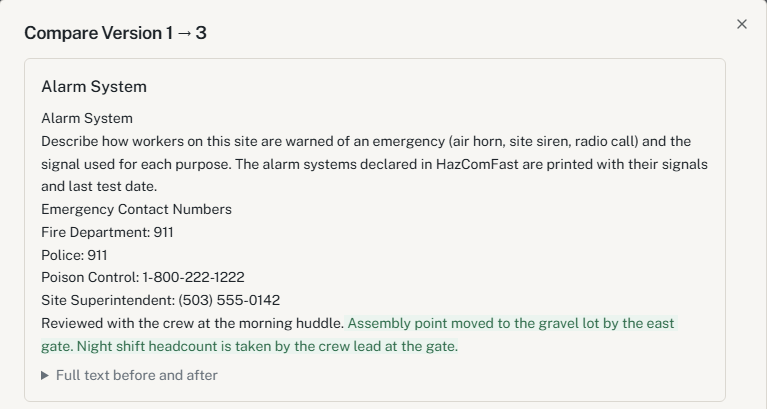
The review date is labeled for what it is. On the emergency action, fire prevention and fall protection plans, the next management review reads "Internal policy — not an OSHA requirement". You choose the interval in months in Settings, or turn periodic reviews off and review when something changes. A management review with no change is recorded with "Attest review without changes": what was reviewed, an optional signature, no new version.
On the employee side, each version has its own count, such as "34/37 employees acknowledged reading v4", and crews you go through the plan with in person are recorded as in-person reviews. And when 29 CFR 1910.1200 changes after your HazCom program was last reviewed, the program says so, names the change and links to the notice.
The HazCom program follows the products
29 CFR 1910.1200(e)(1) requires employers to "develop, implement, and maintain at each workplace" a written hazard communication program. Paragraph (e) sets no review date. OSHA's March 2014 fact sheet, Steps to an Effective Hazard Communication Program (OSHA 3696), recommends reassessing the program periodically so it stays current and relevant. That's guidance.
Maintaining means the program follows the products. A painting crew brings a new coating to the job: check its product identifier against the SDS and add it to the list of hazardous chemicals required by 1910.1200(e)(1)(i). Then compare its hazards with what the crew has been trained on. Under 1910.1200(h)(1), training is due when a new chemical hazard the employees haven't been trained about enters their work area. A new brand of the same solvent usually isn't one.
Put the HCS 2024 dates on the calendar as their own lines. Under 1910.1200(j)(2)(ii), employers update labeling, the written program and training for substances by November 20, 2026. Under (j)(3)(ii), the date for mixtures is May 19, 2028. The HazCom guide covers the rest of the program.
The two exposure control plans with an annual review
Bloodborne pathogens. For an employer with occupational exposure, 1910.1030(c)(1)(iv) says the plan "shall be reviewed and updated at least annually and whenever necessary" to reflect new or modified tasks and procedures that affect exposure and new or revised positions with exposure. The review covers changes in technology that eliminate or reduce exposure ((c)(1)(iv)(A)), and documents each year the consideration and use of commercially available, effective safer medical devices ((c)(1)(iv)(B)).
Construction silica. 1926.1153(g)(2) requires the employer to "review and evaluate the effectiveness of the written exposure control plan at least annually and update it as necessary." A review can conclude the controls still fit. It still has to happen.
Before a concrete crew starts a new grinding task, check its task description and controls in the plan against 1926.1153(g)(1)(i) and (ii), and the housekeeping and access restrictions under (g)(1)(iii) and (iv). The competent person's frequent and regular inspections under (g)(4) go on whatever the review date says. The silica control plan guide covers the task-by-task content.
The respiratory program follows the work
1910.134(c)(1) requires the written program to be updated as necessary to reflect changes in workplace conditions that affect respirator use. Under 1910.134(l)(1), the employer evaluates the workplace as necessary to make sure the program is implemented and working, and under (l)(2) regularly consults the employees who wear respirators and corrects the problems they raise.
Fit testing is a separate clock: before first use, whenever a different facepiece is used, and at least annually under 1910.134(f)(2). So is retraining, annual under (k)(5) and sooner when training is outdated or knowledge falls short. Construction applies 1910.134 through 1926.103. The respiratory protection guide separates these duties in more detail.
Emergency action plans: reviewed with people when they change
An emergency action plan is required when another standard requires one (1910.38(a); 1926.35(a)). Where it is, 1910.38(f) requires a review with each employee covered when the plan is developed or the employee is first assigned, when their responsibilities change, and when the plan changes. Construction has the same three triggers in 1926.35(e)(2), plus the review on initial assignment of the parts the employee must know, in (e)(3).
The crew whose assembly point moved on Tuesday hears about it on Tuesday. Replacing the binder copy in the office doesn't reach them. How often to review an emergency action plan covers the three moments in detail.
LOTO: an annual inspection of each procedure
1910.147(c)(6)(i) requires each energy control procedure to be inspected at least annually to make sure the procedure and the standard are being followed, with deviations corrected under (c)(6)(i)(B). The certification under (c)(6)(ii) names the machine, the date, the employees included and the inspector.
That's a general industry rule. Construction employment is excluded by 1910.147(a)(1)(ii)(A), so a contractor's annual lockout inspection is company policy, and worth calling that.
Two dates per plan
Keep two dates on each plan: the next scheduled review, and the date of the last change in the field. They answer different questions. The scheduled review can be months away when a fence closes the crew's usual exit, and the change can't wait for it.
Write change summaries someone can use. "Updated plan" tells the night foreman nothing. "Assembly point moved to the gravel lot by the east gate; night shift headcount taken by the crew lead at the gate" tells them what changed and who it affects.
Every version, every review, every acknowledgment
Write your HazCom program free, or keep your written plans in HazComFast with each version compared, each review dated and each employee's acknowledgment counted.
Related: How often must the emergency action plan be reviewed? · Write an OSHA HazCom program in 10 minutes · Silica Table 1 control plan guide
Sources & verification: 29 CFR 1910.1200(e)(1), (h)(1), (j)(2)(ii), (j)(3)(ii); 1910.1030(c)(1)(iv); 1926.1153(g)(1), (g)(2), (g)(4); 1910.134(c)(1), (f)(2), (k)(5), (l)(1), (l)(2); 1926.103; 1910.38(a), (f); 1926.35(a), (e)(2), (e)(3); 1910.147(a)(1)(ii)(A), (c)(6); OSHA 3696 (March 2014). General guidance, not legal advice.*
Frequently Asked Questions
Does OSHA require every written safety program to be updated annually?
No. The bloodborne pathogens exposure control plan is reviewed and updated at least annually under 29 CFR 1910.1030(c)(1)(iv), and the construction silica plan is reviewed and evaluated at least annually under 1926.1153(g)(2). The HazCom program under 1910.1200(e) is maintained, with no annual interval, and the others change with the work.
How often must a written HazCom program be updated?
Whenever the workplace changes. 29 CFR 1910.1200(e)(1) requires the employer to develop, implement and maintain the program, including the list of hazardous chemicals known to be present. Training follows new chemical hazards under 1910.1200(h)(1), and the HCS 2024 dates in 1910.1200(j) are separate deadlines: November 20, 2026 for substances, May 19, 2028 for mixtures.
Does an unchanged silica plan still need an annual review?
Yes. 29 CFR 1926.1153(g)(2) requires the employer to review and evaluate the effectiveness of the written exposure control plan at least annually and update it as necessary. A review that finds the controls still fit the work is a completed review.
Is the respiratory protection program on the fit test calendar?
No. 29 CFR 1910.134(c)(1) requires the program to be updated as necessary when workplace conditions affecting respirator use change. Fit testing at least annually under 1910.134(f)(2) and annual retraining under (k)(5) are separate duties with their own dates.
When must employees review a changed emergency action plan?
When the plan changes, under 29 CFR 1910.38(f)(3) in general industry and 1926.35(e)(2)(iii) in construction, along with initial assignment and changes to the employee's own responsibilities. These rules apply where a particular OSHA standard requires an emergency action plan.
Does the annual LOTO inspection apply to construction?
No. 29 CFR 1910.147(c)(6)(i) requires at least annual inspection of each energy control procedure within that standard's scope, and 1910.147(a)(1)(ii)(A) excludes construction employment. A contractor can adopt an annual inspection as company policy.
Site-wide regulatory figures such as compliance dates and penalty amounts come from our regulatory source-of-truth modules, last checked against the eCFR, OSHA.gov, and the Federal Register on October 5, 2026. Last reviewed October 13, 2026.
About This Article
Published by: HazComFast
Published: October 13, 2026
Last Updated: October 13, 2026
- https://www.osha.gov/laws-regs/regulations/standardnumber/1910/1910.1200
- https://www.osha.gov/laws-regs/regulations/standardnumber/1910/1910.1030
- https://www.osha.gov/laws-regs/regulations/standardnumber/1910/1910.134
- https://www.osha.gov/laws-regs/regulations/standardnumber/1926/1926.1153
- https://www.osha.gov/laws-regs/regulations/standardnumber/1926/1926.35
- https://www.osha.gov/laws-regs/regulations/standardnumber/1910/1910.147
- https://www.osha.gov/sites/default/files/publications/OSHA3696.pdf
This content is for informational purposes only and does not constitute legal advice.