
The template came from a trade association website and has your company name on the cover now. Page four says "See attached chemical inventory". Nothing is attached. An OSHA compliance officer won't read the cover. They'll read page four, because their own instructions tell them to. OSHA's HazCom inspection directive, CPL 02-02-079, was revised for the 2024 standard and took effect on May 19, 2026. It lists, item by item, what the written program has to address. That list is the best way to finish a downloaded template.
OSHA's HazCom inspection directive, CPL 02-02-079 (effective May 19, 2026), tells compliance officers to review the written program for the chemical inventory, non-routine tasks and unlabeled pipes, multi-employer methods, access to the program, labeling, safety data sheets and training, under 29 CFR 1910.1200(e) to (h), and to check that each is implemented.
At a glance: The directive: CPL 02-02-079, HCS 2024 edition, signed April 30, 2026, effective May 19, 2026, replacing the July 2015 edition. The officer checks the program covers and implements 1910.1200(e), (f), (g) and (h). Inventory with SDS identifiers, all chemicals present ((e)(1)(i)). Non-routine tasks and unlabeled pipes ((e)(1)(ii)). Contractors ((e)(2)). Labels, SDSs, training, each with a responsible person and a method. A missing element is cited on its own paragraph.
The list compliance officers work from
Chapter X of the directive, "Inspection Guidelines", has a section on the written program. Its item 4 says the compliance officer "must review the written program to ascertain whether all applicable requirements of paragraph (e), (f), (g), and (h) are covered and have been implemented in the workplace". Then it lists what the program must address:
| Program element | What the directive lists | Rule |
|---|---|---|
| Chemical inventory | A product identifier for each chemical that aligns with the SDS and the label; for the whole facility or by work area; all chemicals present, even stored and not in use | 29 CFR 1910.1200(e)(1)(i) |
| Non-routine tasks and unlabeled pipes | The methods used to inform employees of the hazards of non-routine tasks and of chemicals in unlabeled pipes in their work areas | 1910.1200(e)(1)(ii) |
| Multi-employer worksites | Methods to give other employers on-site access to SDSs, to inform them of precautions, and to explain the labeling system | 1910.1200(e)(2)(i) to (iii) |
| Access to the program | Available on request to employees, their representatives, NIOSH and OSHA, under 1910.1020 | 1910.1200(e)(4) |
| Labels | Who is responsible for labeling; the labeling system; any alternative for workplace containers; how label information is reviewed and updated | 1910.1200(f) |
| Safety data sheets | Who obtains and maintains them; how they're kept and retrieved, with a backup if electronic access fails; what to do if an SDS doesn't arrive with the first shipment, seems incomplete, or may not be current | 1910.1200(g) |
| Training | Who trains; how; the required content of (h)(1) to (h)(3) in a language and at a literacy level employees understand; training at initial assignment, for new hazards, and for chemicals used by other employers | 1910.1200(h) |
Two things stand out. Several items ask for a person, by role or name: who labels, who keeps the SDSs, who trains. And several ask for a procedure, not a promise: what happens when the SDS is missing, when access fails, when a new hazard arrives.
Where do downloaded templates fall short?
Most templates are written to fit any company, which means they describe none. These sentences read as complete until someone has to act on them:
| Template wording | What the directive asks for instead |
|---|---|
| "SDSs are available from management." | Where the sheets are kept, how employees reach them on each shift, and the backup when the primary route fails |
| "See the attached chemical inventory." | The actual list, with each product identifier matching its SDS and label, stored products included |
| "Employees are informed before non-routine tasks." | The method: who briefs the crew, when, with what information, before the tank is opened |
| "Contractors must follow our HazCom policy." | How other employers learn where your SDSs are, what precautions to take, and how to read your labels |
| "Training is provided as needed." | Who trains, how, in which language, at initial assignment and when a new hazard is introduced |
Take one product from the gang box and walk it through the program: its name on the list, its label, its SDS, the training the crew got on it. If the trail breaks, that's the paragraph to finish.
Then test the SDS route with someone who didn't write it. Under 29 CFR 1910.1200(g)(8), sheets are readily accessible during each work shift, and electronic access is allowed only when nothing stands between the employee and the sheet. The directive gives examples of barriers for the program itself: a locked room, a locked cabinet, a locked computer. If the night foreman's answer depends on a password they don't have, the program describes a route that doesn't exist.
"Reviewed annually": what your downloaded program promises
Templates come with sentences nobody chose. "This program will be reviewed and updated annually." "Training is conducted by video." "SDSs are kept in the office binder." Each one is a promise your company signs. If the annual review never happened, the program says, in your own words, that it isn't being followed.
1910.1200(e)(1) asks the employer to "develop, implement, and maintain" the program. It sets no review date: the words "annual", "annually" and "review" don't appear in paragraph (e). Choose a review commitment you'll keep, such as at each change, every year or every 18 months, and write that. Then go through the other defaults the same way: the training method, where the SDSs are, who keeps the chemical list.
In HazComFast, the printed program only says what you chose. You pick the training method and the review commitment, at each change, every year, or every set number of months, and "reviewed and updated annually" is never printed by default. SDS management is described in four fields, where the sheets are kept, access on each shift, the backup, and remote jobsites, and nothing prints for a field left empty. The certification page isn't printed while a required element is missing, and the message names what's missing.
How a gap becomes a citation
The directive's citation guidelines, item 5, are worth reading before an inspection, not after.
A deficient element is cited on its own paragraph. The directive's example: an employer with a written program but no chemical inventory is cited under 1910.1200(e)(1)(i). Violations of paragraph (e) are generally grouped with the elements they concern, and with related violations of (f), (g) and (h), since (e)(1) is the paragraph about developing, implementing and maintaining the program.
An employer that has done nothing to comply can be cited for (e), (f), (g) and (h) as separate items with separate penalties, normally (e)(1), (f)(6), (g)(1), and (h)(2) and (h)(3).
On multi-employer sites, the directive is specific. A general contractor whose employees are exposed to other employers' chemicals needs its own program and training, even if it uses no hazardous chemicals itself. And each of the three methods of (e)(2) is cited separately when it's missing. The directive also notes that an employer doesn't have to hand SDSs to the other employers, only tell them where the sheets are kept, for example in the general contractor's trailer. The subcontractor HazCom guide covers that part of the program.
How HazComFast fills the blanks a template leaves
In HazComFast, the written program is built from what you already record. The chemical list in your program comes from each jobsite's inventory, under the product name on its SDS. Remove a product and the program tells you the list is out of date, with a button to rebuild it, and the PDF always prints the current inventory. The program also counts the days to the HCS 2024 date for substances, November 20, 2026, and explains what 1910.1200(j)(2)(ii) asks for by then.
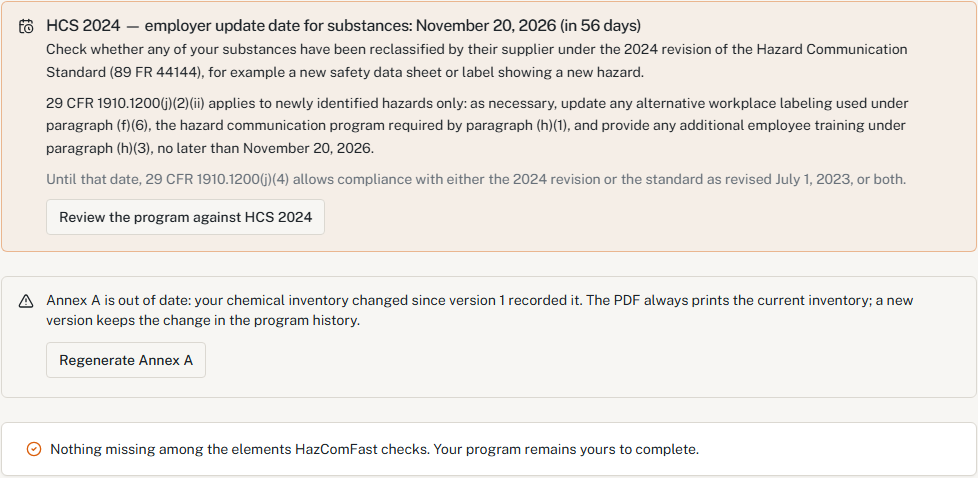
The sections a template leaves vague are the ones the program won't let you skip. It can't be saved until it describes where safety data sheets are kept, how employees reach them during each work shift, what happens if that access fails, and how employees on other jobsites reach them, under 1910.1200(g)(8) and (g)(9). The unlabeled-pipes half of 1910.1200(e)(1)(ii) has its own section, and the program won't publish while it's empty.

Write the program in English and Spanish. Each section shows whether its translation is current, and the PDF prints both languages from the same revision.
The PDF is made to be read in the site binder. It keeps your paragraphs, bulleted lists and bold, a heading never sits alone at the bottom of a page, and every page, cover included, carries "Page X of N". The table of contents points to the page each section actually starts on, so the person the inspector asks can open it at labels or at SDS access without leafing through.
A program that describes your workplace
Generate a HazCom program free, or build it in HazComFast from your inventory, with the sections an inspector reads first required before it saves.
Related: How to prepare for an OSHA HazCom inspection · Secondary container labels · The chemical inventory template · How often to update a written safety program
Sources & verification: OSHA Instruction CPL 02-02-079, Inspection Procedures for the Hazard Communication Standard (HCS 2024), signed April 30, 2026, effective May 19, 2026, Chapter X, section E, items 1 to 5 (read 2026-10-13); 29 CFR 1910.1200(e), (f), (g)(8), (g)(9), (h), (j)(2)(ii); 29 CFR 1926.59. General guidance, not legal advice.*
Frequently Asked Questions
Can I use a downloaded template for my written HazCom program?
Yes, as a starting point. 29 CFR 1910.1200(e)(3) lets an employer rely on an existing program if it meets the criteria of paragraph (e). The finished program still has to describe how your workplace meets the labeling, SDS and training requirements, with your chemical list and your methods for non-routine tasks, under 1910.1200(e)(1).
What does an OSHA inspector look for in the written program?
OSHA's directive CPL 02-02-079 (HCS 2024, effective May 19, 2026) tells compliance officers to check that the program covers paragraphs (e), (f), (g) and (h) of 29 CFR 1910.1200 and that it's implemented: the inventory, non-routine tasks and unlabeled pipes, multi-employer methods, access to the program, labeling, SDSs and training.
Does the chemical list need the exact product identifier from the SDS?
Yes. 29 CFR 1910.1200(e)(1)(i) requires the list to use a product identifier referenced on the appropriate SDS, and the directive adds that it should align with the SDS and the label and include every chemical present, even in storage.
What happens if one part of the program is missing?
Under the directive's citation guidelines, a deficient element is cited on its own paragraph, for example 1910.1200(e)(1)(i) when there is no chemical inventory. An employer that has done nothing is normally cited for (e)(1), (f)(6), (g)(1) and (h)(2) and (h)(3) as separate items.
Does OSHA require an annual rewrite or a signature on the HazCom program?
No. 29 CFR 1910.1200(e) requires the program to be developed, implemented and maintained, with no annual interval and no signature requirement. The HCS 2024 dates in 1910.1200(j) are separate: programs updated for new information by November 20, 2026 for substances and May 19, 2028 for mixtures.
Site-wide regulatory figures such as compliance dates and penalty amounts come from our regulatory source-of-truth modules, last checked against the eCFR, OSHA.gov, and the Federal Register on October 5, 2026. Last reviewed October 14, 2026.
About This Article
Published by: HazComFast
Published: October 13, 2026
Last Updated: October 14, 2026
This content is for informational purposes only and does not constitute legal advice.