
The coating's SDS lists several hazards. One classification calls for Warning; another calls for Danger. The label printer gives you a single signal-word field, and a foreman needs the label for a decanted container. Printing both words might seem cautious. Under OSHA's standardized label rules, it is the wrong answer.
29 CFR 1910.1200 Appendix C, C.2.1.1 states: "If the signal word 'Danger' is included, the signal word 'Warning' shall not appear." The second word drops off the label. The product's other hazards stay on it.
When a product's hazard classifications call for both Danger and Warning, the label shows Danger: Appendix C to 29 CFR 1910.1200, C.2.1.1, says Warning shall not appear when Danger is included. The hazard statements of every applicable class stay on the label, and contradictory SDS information goes back to the supplier.
At a glance: Danger wins on the label (Appendix C, C.2.1.1). Each class and category has its own signal word (C.4), so one product can carry both. Every applicable hazard statement stays (C.2.2.1). Pictograms have their own precedence rules (C.2.1.2 to C.2.1.4). Read the product-level label elements in Section 2, not an ingredient line. A real contradiction between label and SDS is the supplier's to fix. Workplace containers: full elements or the (f)(6)(ii) alternative.
Why does one product carry two signal words?
A product can have several hazard classifications: it burns, it's harmful if it gets into the lungs, it irritates the eyes. Each class and category has its assigned label elements in Appendix C, C.4. Read them one by one and both words show up.
Take a mineral spirits blend. Appendix C assigns Warning to flammable liquids Category 3 and Danger to aspiration hazard Category 1. On the label, the two come together under Danger. The flammability doesn't go away. Its hazard statement, "Flammable liquid and vapor", stays, and so does the flame pictogram.
Category numbers don't compare across classes. Category 3 for flammability says nothing about how Category 1 for aspiration ranks against it. Each class has its own scale, and the precedence rule decides the signal word.
How HazComFast shows it
In HazComFast, the product page puts the signal word above the pictograms and the hazard classes it comes from, each with its category. When the classes call for both words, the page shows Danger and keeps every class listed, so the person preparing a label sees why it's Danger and what else the label has to say. Each block says where its values came from, read from the SDS or changed by a person, and who reviewed them.
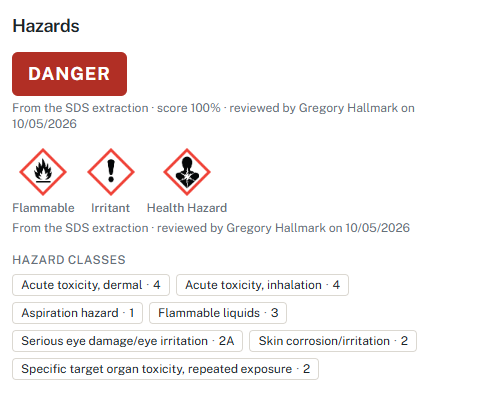
When the hazard codes alone don't settle a category, HazComFast says so and lets the SDS decide. It never guesses a pictogram. And before workplace labels print, each product's hazard information is checked: a product with no pictogram, signal word or hazard statement on file won't print, and neither will one whose pictograms don't match its hazard statements. The screen names the product and what to correct.
Read Section 2 before copying a word
Section 2 of the SDS, hazard identification, carries the product's classification and its label elements, including the signal word, under Appendix D to 1910.1200. Look for the product-level label elements, not a table that discusses each classification separately or an ingredient.
A "Danger" in a line about one component in Section 3 isn't the product's signal word. A mixture is classified as a mixture. Copy the word from the product's label elements.
Check the product identifier first. The container in your hand and the SDS in your library have to be the same product: compare the label with Section 1. A different grade or an older formulation explains many "contradictions", and precedence can't fix a wrong document.
When the SDS contradicts itself
Several class-specific signal words on one SDS are normal. These aren't:
- two different overall signal words in the label elements of the same SDS;
- a shipped container labeled Warning when the current SDS for that product says Danger in its label elements.
Write down exactly what disagrees and ask the supplier which classification and label elements apply to the product and revision you have. The precedence rule settles which of two valid words appears. It doesn't decide whether a classification is right, and choosing Danger because it sounds safer doesn't answer the supplier's question. Keep the received SDS as it came. Under 1910.1200(g)(5), the accuracy of an SDS belongs to whoever prepares it, and editing a supplier's SDS makes it yours.
What stays on the label once Warning is gone
Everything else that applies. Appendix C, C.2.2.1 requires the text of every applicable hazard statement, and allows combining statements when all the hazards are still conveyed. A Danger label for an aspiration hazard still carries the flammability and the irritation.
Pictograms have their own rules in C.2.1.2 to C.2.1.4: when the skull and crossbones applies, the exclamation mark doesn't appear for acute toxicity, for example. Don't remove a pictogram because Warning came off. The GHS label requirements guide covers all six label elements.
Precautionary statements follow C.2.4, which covers their selection, their conditions and how they can be consolidated. A code such as P210 isn't the statement. The worker needs the text: "Keep away from heat, hot surfaces, sparks, open flames and other ignition sources. No smoking." Check that conditional phrases and the preparer's choices in brackets were filled in, not printed as a list with slashes.
The precedence rules in one table:
| When the classifications call for | The label shows | Appendix C |
|---|---|---|
| Danger for one class and Warning for another | Danger only | C.2.1.1 |
| The skull and crossbones, and the exclamation mark for acute toxicity | The skull and crossbones only | C.2.1.2 |
| The corrosive pictogram, and the exclamation mark for skin or eye irritation | The corrosive pictogram only | C.2.1.3 |
| The health hazard pictogram for respiratory sensitization, and the exclamation mark for skin sensitization or irritation | The health hazard pictogram only | C.2.1.4 |
| Several hazard statements | The text of every applicable statement | C.2.2.1 |
Workplace containers: two methods
29 CFR 1910.1200(f)(6) gives two ways to label a workplace container. Under (f)(6)(i), the same elements as a shipped label, signal word included. Under (f)(6)(ii), the product identifier and words, pictures, symbols or a combination that give general information about the hazards, together with other information immediately available to employees that gives the specific physical and health hazards.
If you use the full elements, apply the precedence rule. If you use the alternative, judge it as a system: the container's marking plus the information employees can reach right away. The secondary container guide covers both. The immediate-use exception of 1910.1200(f)(8) is narrower than most people think: a portable container filled from a labeled one, used only by the person who filled it, within the shift.
Whatever the method, workplace labels are legible, in English, and prominently displayed under 1910.1200(f)(10), with other languages allowed alongside. Look at the label at its printed size before it goes on a quart bottle. Construction follows the same rules through 1926.59.
The right signal word, and everything else on the label
Make a GHS label free, or print workplace labels from HazComFast, where each product's hazards are checked before the print starts.
Related: The supplier's SDS has an error · GHS label requirements · Secondary container labels
Sources & verification: 29 CFR 1910.1200(f)(6), (f)(8), (f)(10), (g)(5); Appendix C, C.2.1.1 to C.2.1.4, C.2.2.1, C.2.4, C.4; Appendix D, Sections 1 to 3; 29 CFR 1926.59. General guidance, not legal advice.*
Frequently Asked Questions
Which signal word goes on the label when both Danger and Warning apply?
Danger. Appendix C to 29 CFR 1910.1200, C.2.1.1, says that if the signal word Danger is included, the signal word Warning shall not appear. The hazard statements of the classes that called for Warning stay on the label.
Why does an SDS list both signal words?
Because each hazard class and category has its own assigned label elements in Appendix C to 29 CFR 1910.1200, C.4. A product classified as a flammable liquid Category 3 (Warning) and an aspiration hazard Category 1 (Danger) carries both assignments; the label shows Danger.
Can I drop the Warning-level hazard statements once Danger is on the label?
No. Appendix C to 29 CFR 1910.1200, C.2.2.1, requires the text of every applicable hazard statement, with combinations allowed when all hazards are still conveyed. Precedence removes the second signal word, not the hazards.
Does every secondary container need a signal word?
Not under every method. 29 CFR 1910.1200(f)(6)(i) allows the full shipped-label elements, and (f)(6)(ii) allows the product identifier with words, pictures, symbols or a combination giving general hazard information, backed by immediately available specific information. If you use the full elements, apply the precedence rule.
Does the precedence rule apply on construction sites?
Yes. 29 CFR 1926.59 applies the requirements of 1910.1200 to construction, including Appendix C. Workplace containers on a jobsite have the same two labeling methods under 1910.1200(f)(6).
Site-wide regulatory figures such as compliance dates and penalty amounts come from our regulatory source-of-truth modules, last checked against the eCFR, OSHA.gov, and the Federal Register on October 5, 2026. Last reviewed October 14, 2026.
About This Article
Published by: HazComFast
Published: October 13, 2026
Last Updated: October 14, 2026
This content is for informational purposes only and does not constitute legal advice.