SDS Management: what OSHA requires, and how to actually keep up
Under OSHA's Hazard Communication Standard, you must have a Safety Data Sheet for every hazardous chemical in your workplace, keep each one in the required 16-section format, make them readily accessible to workers during every shift, and update them as new hazard information arrives. Missing, outdated, or inaccessible SDSs are cited under 1910.1200(g)(1) and (g)(8), and Hazard Communication ranked second on OSHA's FY2025 list of most-cited standards.
Verified against osha.gov · July 18, 2026
At a glance
Who needs an SDS
Every employer must have an SDS for each hazardous chemical they use; manufacturers and importers must obtain or develop one for each chemical they produce or import
1910.1200(g)(1)The format
A standardized 16-section SDS in a fixed order — sections 1–11 and 16 are OSHA-mandated; 12–15 are not enforced by OSHA
1910.1200(g)(2), App DAccess
"Readily accessible" to employees during each work shift when they are in their work area — paper or electronic, with no barrier
1910.1200(g)(8)First shipment
The manufacturer/importer must provide the SDS with the first shipment of a chemical, and again if it is updated
1910.1200(g)(6)–(7)Updates
New significant hazard information must be added to the SDS within 3 months of the manufacturer becoming aware of it
1910.1200(g)(5)Retention
An SDS can serve as an exposure record — kept 30 years under 1910.1020, or replaced by a substitute record of the chemical's identity, use, and dates
1910.1020(d)(1)(ii)Hazard Communication (1910.1200) was the #2 most-cited OSHA standard nationwide in FY2025 (OSHA Top 10 Most Frequently Cited Standards), and SDS failures — no SDS for a chemical on site, outdated sheets, or SDSs a worker can't actually reach — are among the most common HazCom citations.
Is your SDS library compliant?
Four checks that decide whether your SDS library would survive an inspection — access, currency, completeness, and the inventory link. Answer them to score your library and see the top fixes. Runs on the same engine as our full SDS Gap Analyzer.
Are SDSs readily accessible to workers in their work area during each shift, with no barriers to immediate access (for example, without having to ask a supervisor)?
Are your SDSs revised after January 2023 (or otherwise updated for GHS Rev 7 / HCS 2024)?
Do your SDSs match the chemicals actually on site, and are they complete (all 16 sections)?
Do you maintain an up-to-date chemical inventory for this worksite, linked to SDSs and accessible to workers?
Answer the four checks to score your SDS-library health and see the top fixes.
0/4 answered
The four SDS duties, in one place
OSHA's SDS requirement in paragraph (g) is really four obligations. Get all four and your library is defensible; miss any one and it's a citation.
Obtain one for every chemical
Have an SDS for each hazardous chemical you use. Manufacturers and importers must obtain or develop the SDS and supply it with the first shipment; you must make a reasonable effort to get any you're missing.
(g)(1), (g)(6)Keep the 16-section format
Each SDS must contain the standardized 16 sections in order. If Section 2's classification or Section 8's exposure limits are blank or wrong, the sheet isn't complete.
(g)(2)Make it readily accessible
Workers must be able to reach the SDS immediately during their shift, in their work area, with no barrier — a locked office, a login they don't have, or no signal all fail the test.
1910.1200(g)(8)Keep it current
Replace outdated sheets. Suppliers must add new significant hazard information within 3 months, and the HCS 2024 update to GHS Rev 7 is driving a wave of reissued SDSs right now.
1910.1200(g)(5)The 16 sections — and which ones OSHA enforces
Every SDS follows the same 16-section order so a worker finds first-aid in Section 4 and PPE in Section 8 on any sheet. A detail that surprises people: OSHA only enforces the content of sections 1–11 and 16. Sections 12–15 may appear but their content falls under other agencies (EPA, DOT), so OSHA does not enforce it (Appendix D).
Identification
Product identifier, supplier, emergency phone, recommended use
Hazard(s) identification
GHS class/category, signal word, pictograms, hazard & precautionary statements
Composition / information on ingredients
First-aid measures
Fire-fighting measures
Accidental release measures
Handling and storage
Exposure controls / personal protection
Exposure limits (PEL/TLV) and the PPE that Section 8 drives
Physical and chemical properties
Stability and reactivity
Toxicological information
Ecological information
Under EPA's domain, not OSHA-enforced
Disposal considerations
EPA / RCRA
Transport information
DOT
Regulatory information
Other information
Includes the SDS preparation / last-revision date
“Readily accessible” is where SDSs get cited
“The employer shall maintain in the workplace copies of the required safety data sheets for each hazardous chemical, and shall ensure that they are readily accessible during each work shift to employees when they are in their work area(s).”
Paper binders
Compliant, but they fall out of date, get left in the trailer, and can't be searched. One binder for a 40-acre site isn't “in the work area.”
Cloud-only apps
Fully legal — until the signal drops. In a basement, a tank, or a rural site, an app that must fetch the sheet from the cloud isn't “readily accessible” at the moment it's needed.
Offline + QR
The jobsite's SDS live on the phone, and a QR code on each container opens its sheet in seconds. When the signal drops, the copy on the phone still opens. That is the access OSHA's test demands.
This is exactly what HazComFast is built for. Every SDS is searchable, current, on a QR code on the container, and loaded onto the crew's phones for dead zones — so “readily accessible” holds the day an inspector asks, not just when there's Wi-Fi.
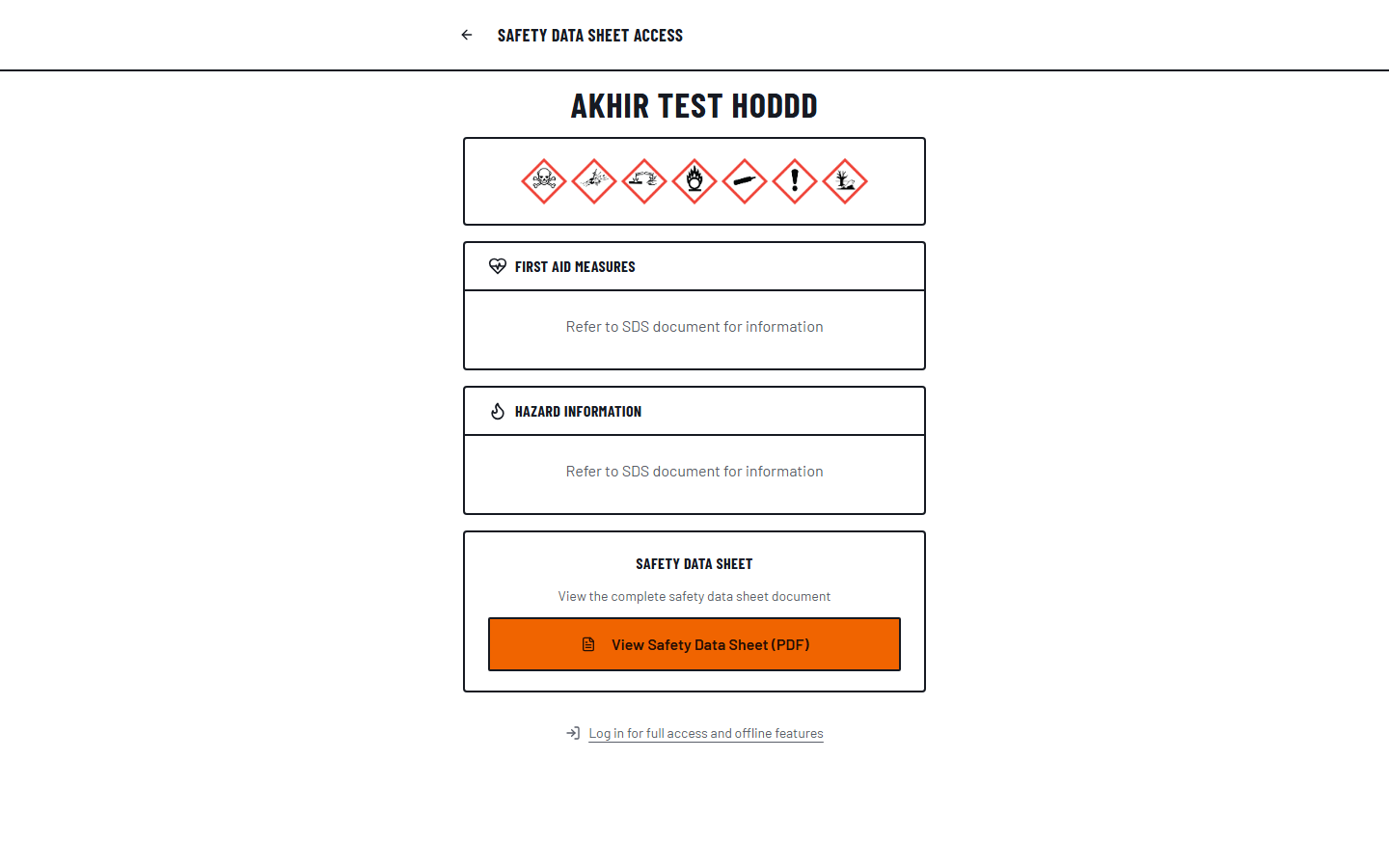
A scanned QR opens one sheet — not your whole chemical library
“Readily accessible” shouldn't mean “publicly browsable”. Your chemical inventory says a lot about your operations — and most SDS tools trade privacy for convenience: one link, and anyone holding it can walk the entire list.
Container QR → that product's SDS
A worker scans the label and gets the sheet for that chemical — pictograms, first aid, full PDF — no account, no app install. The code is scoped to the product it's printed for: it doesn't unlock the rest of the library.
Guest links → the jobsites you choose
Give an auditor or a GC read-only access limited to the sites you pick, with an expiry date. Workers, meanwhile, see the sheets for the jobsites they're assigned to.
Field access stays instant. Scope is enforced server-side, on every request — not by hiding buttons.
Keeping SDSs current: the HCS 2024 wave
OSHA's 2024 Hazard Communication update aligns primarily with GHS Revision 7, and suppliers are reissuing SDSs and labels to match. A sheet isn't “current” just because you have it — Section 2 has to reflect the classifications now in force. On January 15, 2026 OSHA extended every HCS 2024 compliance date by four months (FR Doc 2026-00653); the dates below are the current, extended ones, and during the transition you may comply with the previous standard, the updated standard, or both. The compliance dates:
- May 19, 2026
Manufacturers — substances
Chemical manufacturers, importers, and distributors must comply for substances: updated SDSs and labels reflecting GHS Rev 7.
- November 20, 2026
Employers — substances
Employers must update their alternative workplace labels, the written program, and worker training for substances, and provide access to the updated SDSs.
- November 19, 2027
Manufacturers — mixtures
The same manufacturer obligations extend to mixtures.
- May 19, 2028
Employers — mixtures
Employers finish the transition for mixtures — labels, program, and training.
Track which products still need updated sheets with the SDS Gap Analyzer and the GHS Rev 7 Transition Wizard.
The 10-point SDS library self-audit
The interactive check above scores four dimensions; this is the full walk-the-site version — print it, carry it, and tick each box. Every item is what an OSHA compliance officer actually tests, tied to the paragraph that governs it.
- An SDS is on file for every hazardous chemical actually in use on site. 1910.1200(g)(1)
- Each SDS matches the product identifier on the container exactly (right formulation, not a near-match). 1910.1200(g)(2)
- Each sheet is complete — all 16 sections, with sections 1–11 and 16 filled in. 1910.1200(g)(2), App D
- SDSs are readily accessible every shift, at the point of work, with no barrier (no locked office, no login wall). 1910.1200(g)(8)
- Electronic access has an offline/backup path that works in dead zones and power outages. (g)(8) — interpretation letters
- Sheets are current — replaced as suppliers reissue them for GHS Rev 7 / HCS 2024. 1910.1200(g)(5)
- Every missing sheet has a documented, dated written request to the supplier. 1910.1200(g)(6)
- Exempt items (consumer-use products, articles, personal food/drugs) aren't cluttering the library as false gaps. 1910.1200(b)(6)
- Workers can retrieve the right SDS unaided — they're trained on the system. 1910.1200(h)
- SDSs kept as exposure records are retained for the required 30 years (or a substitute identity/use record is). 1910.1020
Score your library interactively with the check above or the full SDS Gap Analyzer. Any unchecked box is a citation waiting to happen — and exactly what HazComFast keeps closed for you.
Key facts
- You need an SDS for every hazardous chemical in the workplace — and each must be readily accessible during every work shift, not locked in a supervisor's office (1910.1200(g)(8)).
- OSHA enforces the content of SDS sections 1–11 and 16; sections 12–15 (ecological, disposal, transport, regulatory) may be included but their content is not OSHA-enforced (Appendix D).
- A manufacturer must add new significant hazard information to an SDS within 3 months of becoming aware of it (1910.1200(g)(5)).
- Electronic SDS access is allowed when it is truly immediate; an app that needs a signal a worker doesn't have in a basement or dead zone is not “readily accessible.”
- An SDS can double as a 30-year exposure record under 1910.1020 — so retiring one isn't as simple as deleting it.
- Consumer products used for the purpose the manufacturer intended, with a duration and frequency of exposure no greater than a consumer's, are exempt under 1910.1200(b)(6)(ix) — but only if the item is a consumer product as the CPSA defines it, and the burden of showing that is yours. When in doubt, keep the SDS.
Tools, guides and the standard
Free tools
- SDS Gap Analyzer
Score your whole HazCom program across 8 categories.
- SDS QR Code Generator
Put instant SDS access on the container and the wall.
- SDS ROI Calculator
What paper binders really cost vs. digital.
- Chemical Inventory Template
The list that ties every SDS to a container and a label.
- Secondary Container Label Maker
Turn an SDS into a compliant workplace label.
In-depth guides
- HazCom citations decoded: the SDS (g) trap & the $16,550 penalty math
- How to read a Safety Data Sheet (all 16 sections)
- The 16 SDS sections explained
- Are digital SDSs legal? The OSHA rules
- Why offline SDS access matters
- Instant SDS access with QR codes on the jobsite
- Why cloud-only SDS apps fail in construction
- Read-proof: SDS confirmation signatures
- SDS management best practices
- Does every chemical need an SDS? The 1910.1200(b) exemptions
- The job ended: who can still ask for your SDS?
- Supplier won't provide an SDS? What to do (+ letter)
- Find the holes: an SDS library gap analysis
- Missing an SDS? Triage the gaps & handle the inspection
- Do SDSs expire? How often to update your binder
- SDS trade secrets & CBI (1910.1200(i))
- Automate SDS requests from subcontractors
- How paper SDS binders cost thousands
- What HazCom / SDS software actually costs
SDS management FAQ
Who is required to have Safety Data Sheets?
Every employer must have an SDS in the workplace for each hazardous chemical they use (29 CFR 1910.1200(g)(1)). Chemical manufacturers and importers must obtain or develop an SDS for each hazardous chemical they produce or import, and provide it to downstream distributors and employers with the first shipment.
How many sections does an SDS have, and are they all required?
An SDS has 16 sections in a fixed order (29 CFR 1910.1200(g)(2)). OSHA mandates the content of sections 1–11 and 16. Sections 12–15 (ecological, disposal, transport, and regulatory information) may be included but are not mandatory, because their content falls under other agencies such as EPA and DOT (Appendix D to 1910.1200).
What does “readily accessible” mean for SDSs?
Under 29 CFR 1910.1200(g)(8), SDSs must be maintained in the workplace and readily accessible to employees during each work shift when they are in their work area. Paper binders and electronic systems both qualify — the test is whether a worker can actually get to the sheet immediately, without a barrier like a locked office, a password they don't have, or a network connection that isn't available where they work.
Are electronic or digital SDSs legal under OSHA?
Yes. OSHA permits electronic SDS access as long as the sheets are readily accessible during each shift, there are no barriers to access, workers are trained to use the system, and there is a reliable backup for system or power failures. The most common failure mode is a cloud-only app in a low-signal jobsite — offline access solves it.
How long do I have to keep an SDS?
There is no fixed SDS retention period in the HazCom standard itself, but an SDS commonly serves as an employee exposure record under 29 CFR 1910.1020, which requires exposure records to be kept for 30 years. You may instead keep a substitute record of the chemical's identity, where and when it was used, for 30 years, and then retire the SDS.
How often must an SDS be updated?
The manufacturer or importer must add new and significant information about a chemical's hazards to the SDS within 3 months of becoming aware of it (29 CFR 1910.1200(g)(5)). Employers should request current SDSs from suppliers and replace outdated ones — especially as suppliers reissue sheets for the HCS 2024 update to GHS Revision 7.
What happens if a supplier won't send an SDS?
You must make a reasonable effort to obtain it. Request the SDS from the manufacturer, importer, or distributor in writing; if it still isn't provided, OSHA asks you to contact the nearest OSHA office. Document your requests — the effort is part of showing good-faith compliance.
What are the penalties for SDS violations?
SDS failures are cited under Hazard Communication (1910.1200), which ranked second on OSHA's FY2025 list of most-cited standards. Penalties reach $16,550 per serious violation at 2026 amounts (29 CFR 1903.15(d)), and missing or inaccessible SDSs, outdated sheets, and no SDS for a chemical on site are among the most frequent HazCom citations.
Sources
- osha.gov/laws-regs/regulations/standardnumber/1910/1910.1200
- osha.gov/laws-regs/regulations/standardnumber/1910/1910.1200AppD
- osha.gov/laws-regs/regulations/standardnumber/1910/1910.1020
- osha.gov/top10citedstandards
SDS requirements of 1910.1200(g) and the Appendix D section split verified against osha.gov on July 18, 2026. General guidance, not legal advice; OSHA-approved State Plans may impose additional requirements.
Get the Binder in Order Before the Inspector Arrives. Are You Ready?
OSHA does not give advance notice of inspections (29 CFR 1903.6). Get the binder in order before the opening conference, not during it.
Serious Violation
$16,550
per violation (max)
HazComFast Pro
$199/mo
10 jobsites, unlimited chemicals, unlimited workers
New sign-ups are paused. The free tools below need no account, and customers can log in as usual.
Your account keeps working as usual. Cancel anytime.