
The safety manual of the general contractor says "emergency action plan reviewed annually". Your site plan was signed fourteen months ago. The superintendent wants to know if that's an OSHA violation. It isn't, by itself. OSHA never asked for a yearly review of the document. What it asks for is harder: that the plan be gone through with each person it covers, at three specific moments, and two of those moments happen on a jobsite far more often than once a year.
OSHA sets no calendar interval for reviewing an emergency action plan. 29 CFR 1910.38(f) and 29 CFR 1926.35(e)(2) require the employer to review the plan with each employee covered by it when the plan is developed or the employee is first assigned, when the employee's responsibilities under the plan change, and whenever the plan is changed.
At a glance: No annual date in 29 CFR 1910.38 or 1926.35. Review with each employee (1910.38(f); 1926.35(e)(2)): when the plan is developed or the employee is first assigned, when their responsibilities change, and when the plan changes. On initial assignment, the parts of the plan the employee must know (1926.35(e)(3)). Wardens trained before the plan is implemented (1926.35(e)(1)). The yearly review is a company or client rule. A HAZWOPER emergency response plan is the one that must be reviewed periodically and rehearsed (1926.65(l)(3)(iv), (v)).
The three moments OSHA names
The general industry and construction rules say the same thing in slightly different words.
| When | General industry | Construction |
|---|---|---|
| The plan is developed, or the employee is first assigned to a job | 29 CFR 1910.38(f)(1) | 29 CFR 1926.35(e)(2)(i) and (e)(3) |
| The employee's responsibilities under the plan change | 29 CFR 1910.38(f)(2) | 29 CFR 1926.35(e)(2)(ii) |
| The plan is changed | 29 CFR 1910.38(f)(3) | 29 CFR 1926.35(e)(2)(iii) |
The construction text adds one sentence worth reading twice. Under 29 CFR 1926.35(e)(3), the employer reviews with each employee, upon initial assignment, those parts of the plan the employee must know to protect themselves in an emergency. A new laborer on day one doesn't need the critical-operations procedure for the tower crane. They need the alarm, the exit, the assembly point and the name of the warden.
Two related duties sit next to the review. Before the plan is implemented, enough people must be designated and trained to assist in a safe and orderly evacuation (29 CFR 1926.35(e)(1); 1910.38(e) in general industry). And the written plan is kept at the workplace and made available for employee review (1926.35(e)(3); 1910.38(b)). An employer with 10 or fewer employees may communicate the plan orally.
All of this applies when a plan is required in the first place. Both 29 CFR 1910.38(a) and 1926.35(a) tie the plan to another OSHA standard that requires one. Which OSHA standards require an emergency action plan has the list.
In OSHA's text, "review" means a review with people
When a safety manager says "we review the EAP every year", they usually mean someone rereads the document and signs the cover page. That's a management review. It's useful. It's also not what 1910.38(f) describes, which is a review "with each employee covered by the plan".
The difference matters at an inspection. A plan with a fresh management signature and a crew that can't name its assembly point fails the rule. A plan last edited two years ago, gone through with each worker on arrival and again when the exit moved, meets it.
So keep two records, because they answer two different questions:
- The management review. Who reread the plan, when, and what they found. It answers "is the document still true?"
- The employee review. Which employee went through which version, and when. It answers the OSHA question, and it is the one an inspector asks a worker about in the field.
What "the plan is changed" means on a jobsite
In a plant, the emergency action plan can stay the same for years. On a jobsite it moves with the work. Each of these is a change to the plan, and under 29 CFR 1926.35(e)(2)(iii) each one calls for a review with the employees it affects:
- An exit closes because the stair tower is being poured, and evacuation goes to the east hoist instead.
- The assembly point moves off the lot that just became a laydown yard.
- A warden leaves the job, and a foreman from another trade takes the role.
- The air horn signal changes because the steel erector uses the same three blasts for something else.
- The internal phone number for reporting a fire changes with the new site office.
None of those needs a classroom. Five minutes at the morning huddle, with the new exit on the site map and a sign-in sheet, is a review. Write down the version and who was there.
The second moment, "the employee's responsibilities under the plan change", is the one people forget. The laborer who becomes the head-count person at the assembly point has a new role. Go over that role with them, on the day they get it.
The reviews people confuse with this one
Three other rules use similar words and get mixed in:
The HAZWOPER emergency response plan. On a hazardous waste site, 29 CFR 1926.65(l)(3)(iv) requires the emergency response plan to be rehearsed regularly, and (l)(3)(v) requires it to be reviewed periodically and amended to keep it current with changing site conditions. General industry has the same wording at 1910.120(l)(3)(iv) and (v). That plan is not the 1926.35 emergency action plan. An employer that evacuates its employees and lets none of them handle the emergency may provide an emergency action plan instead and is exempt from paragraph (l), under 1926.65(l)(1)(ii).
The fire prevention plan. In general industry, 29 CFR 1910.39(d) requires the employer to inform employees, upon initial assignment, of the fire hazards they are exposed to, and to review the parts of the fire prevention plan necessary for self-protection. Construction has its own duty at 29 CFR 1926.24: an effective fire protection and prevention program at the job site throughout all phases of the work.
Drills. Neither 1910.38 nor 1926.35 requires an evacuation drill. State plans and local fire codes can, and a drill is a good way to find out whether the review worked.
How many evacuation wardens?
The rules don't give a number. 29 CFR 1910.38(e) says the employer must "designate and train employees to assist in a safe and orderly evacuation of other employees," and 1926.35(e)(1) asks for "a sufficient number of persons." The figure people quote comes from OSHA's booklet How to Plan for Workplace Emergencies and Evacuations (OSHA 3088): "Generally, one warden for every 20 employees should be adequate, and the appropriate number of wardens should be available at all times during working hours." The same booklet says it "does not alter or determine compliance responsibilities."
So treat 1 for 20 as a starting point, then check it against the site. A 60-person job with one crew on the ground floor and two on upper decks needs a warden for each area, on each shift, and someone to cover when a warden is off. A review is a good moment to count them.
In HazComFast, when a plan names fewer than one warden per 20 employees, a warning says so, cites Publication 3088 as OSHA's general guidance, and says it isn't a requirement of the plan's rule. Nothing is blocked; the plan still exports.
A review schedule you can defend
This is a recommendation, not a rule. It covers the three OSHA moments and leaves room for whatever your client's contract adds.
- Day one on the site. Each new worker goes through the alarm, the exits, the assembly point, the warden and how to report an emergency. Record it with the version number.
- Every change to the plan. Update the plan first, create a new version, then go through the change with the crews it affects.
- Every new role. Warden, head count, critical operations, rescue or first aid: the person goes through their part the day they take it on.
- A management review once a year, as company policy. If nothing changed, record that someone checked and kept the plan as it is.
When an inspector asks a worker "where do you go if the horn sounds?", the answer and your records should match.
How HazComFast keeps the two reviews apart
In HazComFast, the emergency action plan shows the rule it rests on, quoted from 29 CFR 1926.35(a) for a construction company or 1910.38(a) for general industry, with the written-plan threshold. The next management review date is printed with its status in plain words: "Internal policy — not an OSHA requirement". You set the interval in months in Settings, or turn periodic reviews off, and the plans are then reviewed when something changes, with no due date and no reminder.
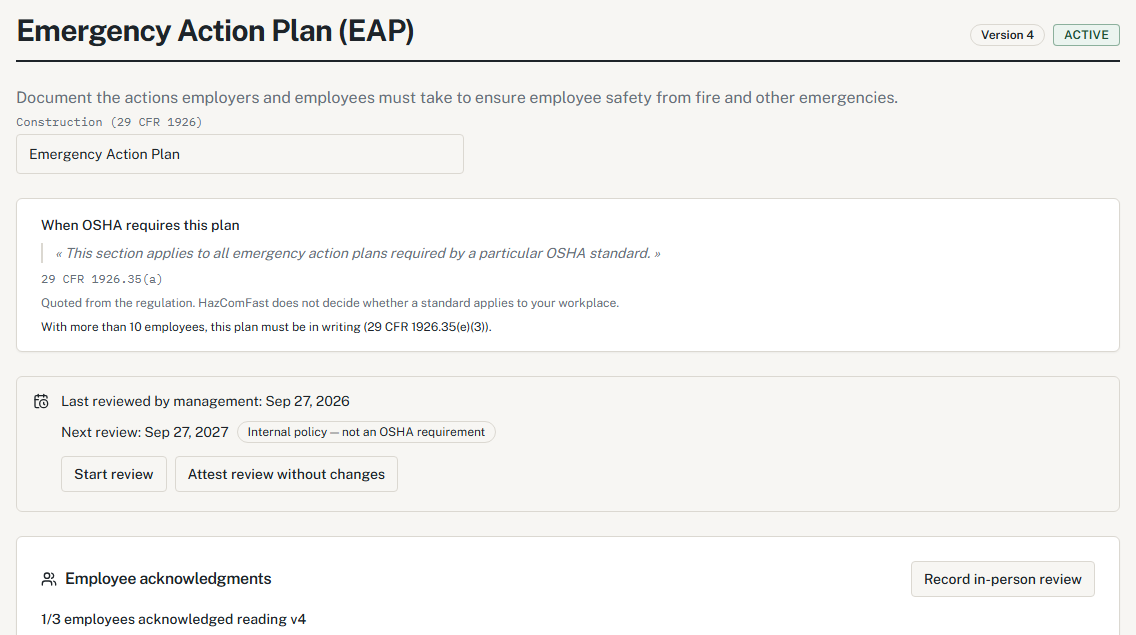
The employee side is a count per version: "34/37 employees acknowledged reading v4". An acknowledgment records that the employee read that version to the end, in the app, and the list shows who opened it without acknowledging. For crews you go through the plan with at the huddle, "Record in-person review" lets you select the employees, and the line says who recorded it.
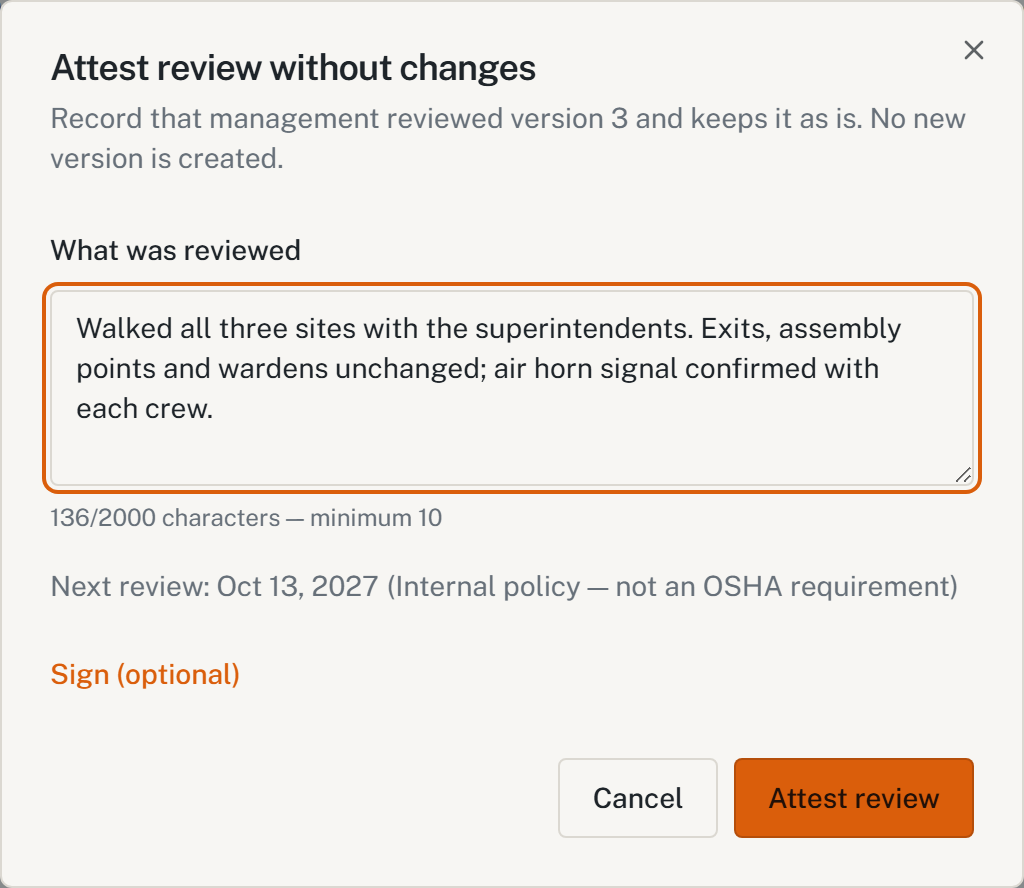
When management rereads the plan and changes nothing, "Attest review without changes" records what was reviewed, with an optional signature, and creates no new version. When something does change, a new version keeps the previous one in the history, with a summary of what changed and the reason: a scheduled review, a new chemical hazard, a change in the work, a regulatory update or a correction. Any earlier version can be compared with the one in effect, and restoring an old one creates a new version without overwriting anything.
Know who went through which version
Build your plan free, or keep it in HazComFast with each version, each acknowledgment and each management review on record.
Related: Emergency action plans for construction · Which OSHA standards require an emergency action plan? · Several jobsites, one emergency plan each · OSHA fire safety requirements
Sources & verification (read on the eCFR, edition of 2026-10-01): 29 CFR 1910.38(a), (b), (e) and (f); 29 CFR 1926.35(a) and (e)(1) to (e)(3); 29 CFR 1910.39(d); 29 CFR 1926.24; 29 CFR 1926.65(l)(1)(ii), (l)(3)(iv) and (v); 29 CFR 1910.120(l)(3)(iv) and (v). General guidance, not legal advice.*
Frequently Asked Questions
Does OSHA require an annual review of the emergency action plan?
No. Neither 29 CFR 1910.38 nor 29 CFR 1926.35 sets a calendar interval. They require the plan to be reviewed with each employee covered by it when the plan is developed or the employee is first assigned, when the employee's responsibilities under the plan change, and when the plan changes (1910.38(f); 1926.35(e)(2)). A yearly review is a company, client or insurer requirement, and a good habit.
What does OSHA mean by reviewing the plan?
Going over the plan with each employee it covers. 29 CFR 1910.38(f) says the employer must review the plan with each employee covered by it, and 29 CFR 1926.35(e)(3) adds that, on initial assignment, the employee reviews the parts of the plan they must know to protect themselves in an emergency. A manager rereading the document alone does not meet that duty.
When does a change to the plan trigger a new review with employees?
Whenever the plan is changed, under 29 CFR 1910.38(f)(3) and 1926.35(e)(2)(iii). On a jobsite that includes a moved exit or assembly point, a new evacuation warden, a new alarm signal or a new reporting number. Only the employees the change affects need to hear about the change itself, but each of them does.
Are evacuation drills required as part of the review?
Not by 29 CFR 1910.38 or 1926.35, which require review and training, not drills. A HAZWOPER emergency response plan is different: 29 CFR 1926.65(l)(3)(iv) and 1910.120(l)(3)(iv) require it to be rehearsed regularly, and (l)(3)(v) requires periodic review. State plans and local fire codes can add drills.
Does a small employer have to document the review?
An employer with 10 or fewer employees may communicate the plan orally (29 CFR 1910.38(b); 1926.35(e)(3)), and OSHA prescribes no review form. Keeping the date, the version and the names of the employees who went through it is still how you show the review happened.
Site-wide regulatory figures such as compliance dates and penalty amounts come from our regulatory source-of-truth modules, last checked against the eCFR, OSHA.gov, and the Federal Register on October 5, 2026. Last reviewed October 13, 2026.
About This Article
Published by: HazComFast
Published: October 13, 2026
Last Updated: October 13, 2026
- https://www.ecfr.gov/current/title-29/subtitle-B/chapter-XVII/part-1910/subpart-E/section-1910.38
- https://www.ecfr.gov/current/title-29/subtitle-B/chapter-XVII/part-1926/subpart-C/section-1926.35
- https://www.ecfr.gov/current/title-29/subtitle-B/chapter-XVII/part-1910/subpart-E/section-1910.39
- https://www.ecfr.gov/current/title-29/subtitle-B/chapter-XVII/part-1926/subpart-D/section-1926.65
This content is for informational purposes only and does not constitute legal advice.