A competent person must inspect an excavation daily: before work starts, as needed throughout the shift, and after every rainstorm or other hazard-increasing occurrence, under 29 CFR 1926.651(k)(1). OSHA sets no rainfall amount for the after-rain inspection, and these inspections are only required when employee exposure can reasonably be anticipated. When an inspection finds a hazard, exposed employees come out until the necessary precautions are taken, under 1926.651(k)(2).
The storm comes through at 11:40, while the pipe crew is eating lunch in the trucks. By 12:30 the sky is clear and water is standing at the low end of the trench. The foreman wants two more sticks of pipe laid before the end of the day. The question is whether a storm that short counts, and which paragraph says so.
It counts. 29 CFR 1926.651(k)(1) requires an inspection after every rainstorm and sets no amount of rain and no duration. That inspection has sat in paragraph (k) since January 2, 1990. A 1989 Review Commission decision, Capform Inc., quotes it as 1926.651(d), the number it carried before then, and today's (d) is a traffic vest rule. With water standing in the cut, a second rule applies as well: under 1926.651(h)(1), employees don't work in an excavation with accumulated water unless adequate precautions have been taken.
At a glance: Inspections are daily, before work and as needed during the shift, and again after every rainstorm or other hazard-increasing occurrence (1926.651(k)(1)). Subpart P contains no rainfall amount and no definition of rainstorm. Runoff from heavy rains has its own inspection in 1926.651(h)(3). Rain can change the soil classification under Appendix A. A hazard found takes exposed employees out first (1926.651(k)(2)). Paragraph (k) requires no written log. The after-rain inspection was 1926.651(d) before 1990, and today's (d) is a traffic vest rule.
When does 1926.651(k)(1) require the competent person to inspect?
Paragraph (k)(1) is four sentences long:
"Daily inspections of excavations, the adjacent areas, and protective systems shall be made by a competent person for evidence of a situation that could result in possible cave-ins, indications of failure of protective systems, hazardous atmospheres, or other hazardous conditions. An inspection shall be conducted by the competent person prior to the start of work and as needed throughout the shift. Inspections shall also be made after every rainstorm or other hazard increasing occurrence. These inspections are only required when employee exposure can be reasonably anticipated." (29 CFR 1926.651(k)(1))
Read it as a schedule and it has one fixed time and two moving ones. The fixed time is before work starts. The moving ones depend on the site. "As needed throughout the shift" follows the conditions. "After every rainstorm or other hazard increasing occurrence" follows the weather and whatever else the job throws at the walls. A competent person who looks once at 7:00 and leaves for the day has covered the first sentence and half of the second.
Subpart P defines the competent person in 1926.650(b): "one who is capable of identifying existing and predictable hazards in the surroundings, or working conditions which are unsanitary, hazardous, or dangerous to employees, and who has authorization to take prompt corrective measures to eliminate them." After a storm, both halves get tested. Spotting the crack behind the spoil pile is one. Keeping the crew on the bank until it's dealt with is the other. The competent person designation guide covers how an employer shows both.
OSHA has written that there is "no blanket requirement that a competent person be present at a construction jobsite at all times" (interpretation letter of August 5, 1992). The inspections in (k)(1) still need someone qualified to make them when they come due, and after a storm that can be an hour after lunch. Construction's general rule points the same way. 29 CFR 1926.20(b)(2) says the employer's prevention programs "shall provide for frequent and regular inspections of the job sites, materials, and equipment to be made by competent persons designated by the employers."
The triggers side by side, with what each text says and what it leaves out:
| What happened | Rule | What the text requires | Not in the text |
|---|---|---|---|
| Work is about to start | 1926.651(k)(1) | An inspection by the competent person prior to the start of work | A time of day, a form or a signature |
| Conditions change during the shift | 1926.651(k)(1) | Inspections "as needed throughout the shift" | A set interval |
| It rained | 1926.651(k)(1) | An inspection after every rainstorm | A rainfall amount, a duration or a definition of rainstorm |
| Something else raised the hazard | 1926.651(k)(1) | An inspection after any "hazard increasing occurrence" | A list of events |
| Heavy rain can run into the excavation | 1926.651(h)(3) | An inspection by a competent person, plus (h)(1) and (h)(2) on water | A definition of heavy |
| The soil got wet | Subpart P App. A (d)(2)(iii) and (c)(5) | Classification changed accordingly, reclassification as necessary | A deadline |
| The inspection found a hazard | 1926.651(k)(2) | Exposed employees removed until the necessary precautions are taken | A list of precautions |
How much rain triggers the after-rainstorm inspection?
None in the standard. Paragraph (k)(1) says "every rainstorm" and stops there. We looked for a number in the places OSHA would have put one:
- the definitions in 1926.650(b), 29 terms, none of which is rain, storm or "hazard increasing"
- the rest of Part 1926, where "rainstorm" appears only in 1926.651(k)(1) and "heavy rains" only in 1926.651(h)(3)
- the preamble to the 1989 final rule, 54 FR 45894 to 45991, which never uses "rainfall," "inches of rain" or "precipitation"
- the 1987 proposal at 52 FR 12288, same words, no number
- 19 of the 20 interpretation letters OSHA indexes under 1926.651 (the twentieth wouldn't load) and five more letters on 1926.651 and 1926.652
- directive CPL 02-00-165 (2021), the National Emphasis Program directive CPL 02-00-161, the OSHA Technical Manual (Section V, Chapter 2), OSHA publication 2226 and the trenching eTool
- the five Review Commission decisions we read
None of them puts a number on rain.
In one passage, OSHA's directive drops the word storm. CPL 02-00-165 says excavations "must also be inspected by a competent person after each rain and before employees are permitted to re-enter the excavation" (§ XI.9). The directive is non-binding, and the standard itself, 29 CFR 1926.651(k)(1), still says rainstorm. The directive gives OSHA's own reading for rain: an inspection, before the crew goes back in.
A rainfall threshold in a company procedure or in software is the employer's own setting. Use one if it gets the competent person to the trench sooner. A storm that falls under the number still calls for the inspection, because 29 CFR 1926.651(k)(1) applies after every rainstorm.
In states under federal OSHA, Part 1926 applies as written. An approved State Plan, such as Cal/OSHA or Oregon OSHA, can set its own rule. We read only the federal text for this article, so a job in a State Plan state needs that state's excavation rule checked as well.
Is the heavy-rain runoff inspection in 1926.651(h)(3) a separate rule?
Yes. It sits in paragraph (h), on water accumulation, and it's easy to read past:
"If excavation work interrupts the natural drainage of surface water (such as streams), diversion ditches, dikes, or other suitable means shall be used to prevent surface water from entering the excavation and to provide adequate drainage of the area adjacent to the excavation. Excavations subject to runoff from heavy rains will require an inspection by a competent person and compliance with paragraphs (h)(1) and (h)(2) of this section." (29 CFR 1926.651(h)(3))
Two things change from (k)(1). The trigger is the excavation's exposure to runoff, where (k)(1) is triggered by the storm itself. And the inspection brings two water rules with it. 29 CFR 1926.651(h)(1) says employees "shall not work in excavations in which there is accumulated water, or in excavations in which water is accumulating, unless adequate precautions have been taken to protect employees against the hazards posed by water accumulation." Those precautions "vary with each situation," and the text gives special support or shield systems, water removal, or a safety harness and lifeline as examples. 1926.651(h)(2) says water removal equipment and operations "shall be monitored by a competent person." OSHA's trenching eTool lists that monitoring among the competent person's duties.
The text puts no number on "heavy" either, and it gives the inspection no timing of its own. Its first sentence turns on the drainage: once the excavation interrupts the natural drainage of surface water, diversion ditches, dikes or other suitable means have to be used to keep that water out of the cut and to drain the area next to it. The trenching and excavation guide covers protective systems and access.
Does rain change the soil classification?
It can. Appendix A to Subpart P mentions rain in its thumb penetration test and has a general rule for any change. Where 29 CFR 1926.652(a)(1) calls for a protective system, the appendix applies when a sloping or benching system is designed under 1926.652(b)(2), when timber or aluminum hydraulic shoring is designed in accordance with Appendix C or D, and when other protective systems are selected from data prepared under 1926.652(c) that are predicated on its soil classification. The thumb penetration paragraph, (d)(2)(iii), contains this sentence: "If the excavation is later exposed to wetting influences (rain, flooding), the classification of the soil must be changed accordingly." Paragraph (c)(5) gives the general rule: "If, after classifying a deposit, the properties, factors, or conditions affecting its classification change in any way, the changes shall be evaluated by a competent person. The deposit shall be reclassified as necessary to reflect the changed circumstances."
Neither sets a deadline. The wetting sentence sits inside the description of one manual test, so whether it binds an employer who classified by another method is a question of reading. Paragraph (c)(5) has no such limit.
On the bank after a storm, Appendix A tells the competent person what to look at. The visual test in (d)(1)(vi) is to observe the adjacent area and the sides of the excavation "for evidence of surface water, water seeping from the sides of the excavation, or the location of the level of the water table." Type C includes, in item (iii), "Submerged soil or soil from which water is freely seeping." A wall classified Type B in the morning that has water freely seeping from it after the storm fits that description. In Appendix B, Table B-1 gives a maximum allowable slope of 1:1 for Type B and 1½:1 for Type C in excavations less than 20 feet deep. The trench geometry analysis shows what that does to the width at the top of the cut.
Do snow, wind or a thaw count as a "hazard increasing occurrence"?
The standard names one event, the rainstorm, and then adds "or other hazard increasing occurrence" with no list. Neither phrase is among the 29 terms defined in 1926.650(b).
OSHA's directive CPL 02-00-165 (2021) gives examples. Its § XI.12 says that under 1926.651(k)(1), inspections "should be conducted by a competent person whenever employee exposure can be reasonably anticipated," and its list includes: "After every rainstorm. After other events that could increase hazards, such as a snowstorm, windstorm, thaw, earthquake, etc." The directive is non-binding, and the list is written in "should."
The duty itself sits in the words of (k)(1), and it turns on what the event did to the excavation. The first sentence of (k)(1) says what the competent person looks for: evidence of a situation that could result in a possible cave-in, indications of failure of protective systems, hazardous atmospheres, or other hazardous conditions. An event that raised any of those in a trench where people will work fits the words of the rule, whether or not the directive names it.
When is the 1926.651(k)(1) inspection not required?
When nobody will be exposed. The last sentence of 29 CFR 1926.651(k)(1) reads: "These inspections are only required when employee exposure can be reasonably anticipated." If it rains on a Saturday and nobody will work in or around the trench until Monday, that sentence asks for no inspection on Saturday. Monday's inspection prior to the start of work is the one that finds what the weekend's rain did to the walls.
Depth doesn't limit it. Subpart P covers "all open excavations made in the earth's surface" (1926.650(a)), and paragraph (k) sets no minimum depth. Under 1926.652(a)(1)(ii), a trench less than 5 feet deep needs no protective system when "examination of the ground by a competent person provides no indication of a potential cave-in." In a shallow trench with no protective system, that examination is what the exception rests on, and rain can change what the ground shows.
What happens when the after-rain inspection finds a hazard?
Paragraph (k)(2) takes over:
"Where the competent person finds evidence of a situation that could result in a possible cave-in, indications of failure of protective systems, hazardous atmospheres, or other hazardous conditions, exposed employees shall be removed from the hazardous area until the necessary precautions have been taken to ensure their safety." (29 CFR 1926.651(k)(2))
OSHA's trenching eTool lists this among the competent person's duties: "Authorizing immediate removal of employees from the hazardous area where evidence of possible cave-in, failure of protective systems, hazardous atmospheres, or other hazardous conditions exists." It's the authority half of the 1926.650(b) definition, the "authorization to take prompt corrective measures." If the person who spots fresh slough at the toe of the wall has to call the office before pulling the crew out, that half is missing.
The old paragraph (d), as Capform quotes it, closed on the protective system: "and the protection against slides and cave-ins shall be increased if necessary." Today's 29 CFR 1926.651(k)(2) is written around the people in the trench. They leave the hazardous area and stay out until the necessary precautions have been taken.
29 CFR 1926.651(k) requires no written record. The 1989 preamble says "the Agency will not require the keeping of a written inspection log" (54 FR 45926), and CPL 02-00-165 notes that "there is no requirement for written documentation of daily inspections." The written daily trench inspection article covers what to write down when a contract or a company procedure asks for a record.
Why do some pages still quote 1926.651(d) for rainstorm inspections?
The rainstorm inspection was paragraph (d) until 1990, when it moved to 29 CFR 1926.651(k)(1). OSHA revised Subpart P in a final rule published October 31, 1989 (54 FR 45894), with an effective date of January 2, 1990. Before then, 29 CFR 1926.651(d) read: "Excavations shall be inspected by a competent person after every rainstorm or other hazard-increasing occurrence, and the protection against slides and cave-ins shall be increased if necessary." Capform Inc., a Review Commission decision of April 26, 1989 (OSHRC Docket 84-0556), quotes that text.
The preamble says the new provisions are similar to the proposed rule, which consolidated requirements from several paragraphs of the old Subpart P, the old paragraph (d) of 1926.651 among them (54 FR 45926), on the same page where it declines to require a written inspection log. The final text of 29 CFR 1926.651(k) is printed at 54 FR 45961.
Today's 1926.651(d) is a traffic rule: "Employees exposed to public vehicular traffic shall be provided with, and shall wear, warning vests or other suitable garments marked with or made of reflectorized or high-visibility material." A procedure or a training slide that sends the after-rain inspection to (d) is pointing at the vest rule. The current reference is 1926.651(k)(1).
What does HazComFast do with an excavation permit when rain is recorded?
In HazComFast, an excavation permit names its competent person and holds that person's inspections. Each inspection carries its trigger (Pre-shift, During shift, After rainstorm, After hazard event or Other), the inspector, and the time in the permit's time zone. Earlier inspections stay readable on the permit and in its PDF. If an active day passes with no inspection, the competent person is notified the next day.
Every 3 hours, for each active permit whose jobsite has map coordinates, HazComFast reads the nearest National Weather Service stations (api.weather.gov). When the rain they record reaches the threshold, the permit is suspended with the reason "Suspended: rain recorded at the jobsite" and the station reading is written on the permit. The competent person and the administrator are notified. The threshold is 0.01 inch by default. That number is a HazComFast setting, and OSHA sets none.
The resume stays refused until the competent person signs an After rainstorm inspection that finds no hazard. Only the competent person can authorize the resume, and an administrator who tries is refused. The resume asks for the corrective measures in writing and stamps them with the competent person's name and the time. When an inspection finds a hazard, the permit records the removal of exposed employees with its time and the permit is suspended. Resuming then takes the measures in writing and a new inspection with no hazard. The permit's PDF prints the inspections, the "Rainstorms and weather events" section and the resume.
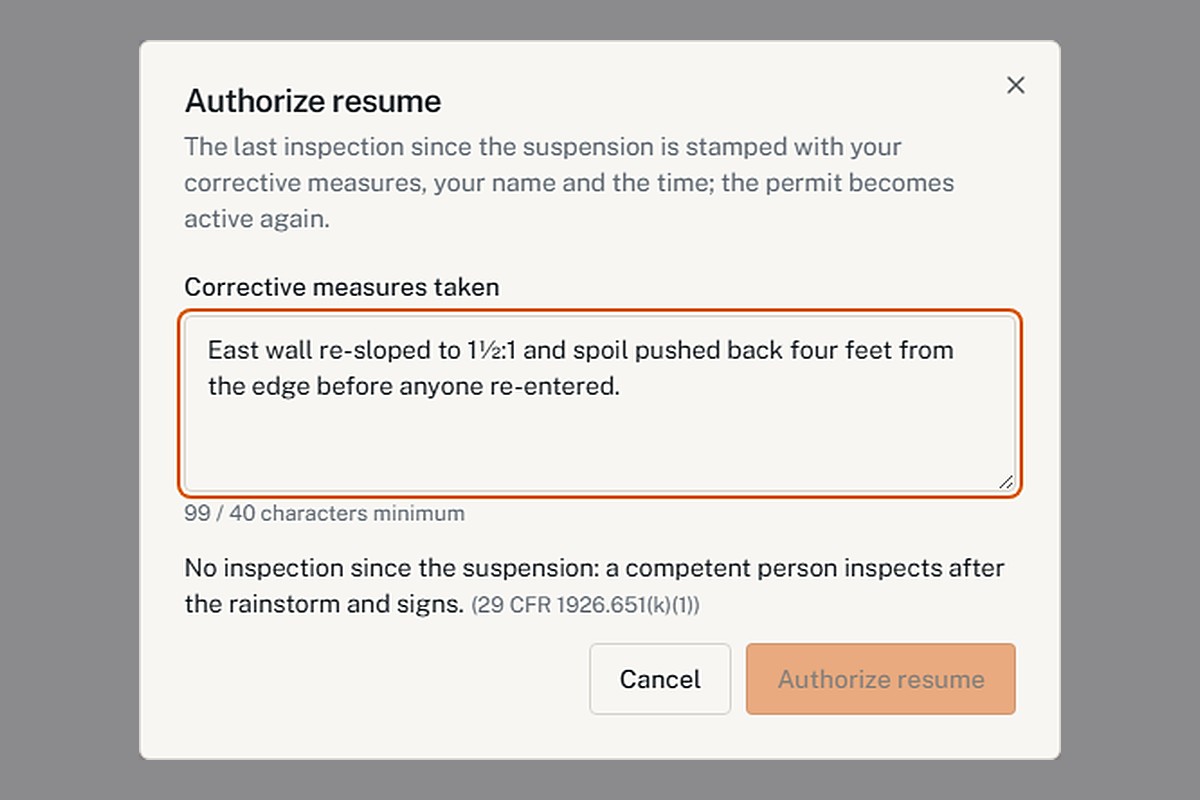
HazComFast reads weather stations and has no gauge at the trench, so a storm the stations don't record suspends nothing. A jobsite without map coordinates, or outside the stations' coverage, isn't watched. In either case 29 CFR 1926.651(k)(1) still requires the after-rain inspection whenever employee exposure can reasonably be anticipated.
To see it on an existing account, issue an excavation permit that names a competent person and press Suspend / Evacuate. Authorize resume stays refused until the competent person signs an inspection with no hazard, and the PDF then prints the inspection and the resume.
Before the next storm
The Trench Protective System Selector gives the maximum allowable slope by soil type and the width at the top of the cut. The Competent Person Designation Letter records the competent person's stop-work authority. Both are free and need no account.
Related: Written daily trench inspections · Trenching and excavation safety · Does OSHA certify competent persons? · The trench geometry problem
Sources & verification: 29 CFR 1926.20(b)(2); 1926.650(a) and (b); 1926.651(d), (h)(1) to (h)(3), (k)(1) and (k)(2); 1926.652(a)(1)(ii); Subpart P Appendix A (c)(5), (d)(1)(vi), (d)(2)(iii) and Type C; Appendix B, Table B-1; final rule 54 FR 45894 (October 31, 1989), pages 45926 and 45961; proposed rule 52 FR 12288 (April 15, 1987); OSHA directive CPL 02-00-165, § XI.9 and § XI.12; Capform Inc., OSHRC Docket 84-0556 (April 26, 1989); OSHA interpretation letter of August 5, 1992; OSHA trenching eTool. Regulatory text read on eCFR on October 19, 21 and 27, 2026. General guidance, not legal advice.
Frequently Asked Questions
How often must a competent person inspect an excavation under 1926.651(k)(1)?
Under 29 CFR 1926.651(k)(1), daily: before work starts, as needed throughout the shift, and after every rainstorm or other hazard-increasing occurrence. The inspection covers the excavation, the adjacent areas and the protective systems, and it is only required when employee exposure can reasonably be anticipated.
How much rain triggers an excavation inspection under OSHA?
OSHA sets no amount. 29 CFR 1926.651(k)(1) requires an inspection after every rainstorm and names no amount or duration of rain. Subpart P doesn't define rainstorm, and the 1989 preamble to the rule (54 FR 45894) contains no rainfall figure. A threshold on a checklist is the employer's own setting.
Is the heavy-rain runoff inspection the same as the after-rain inspection?
They are two provisions. 29 CFR 1926.651(h)(3) says excavations subject to runoff from heavy rains require an inspection by a competent person and compliance with (h)(1) and (h)(2), the rules on accumulated water and on water removal equipment. 1926.651(k)(1) applies after every rainstorm, with or without runoff.
Does 1926.651(k)(1) require a trench inspection after snow, wind or a thaw?
29 CFR 1926.651(k)(1) says “other hazard increasing occurrence” and lists no other events. OSHA's directive CPL 02-00-165 (2021) gives a snowstorm, windstorm, thaw and earthquake as examples, in “should” language. The duty itself comes from the words of the standard: an inspection after a hazard-increasing occurrence, when employee exposure can reasonably be anticipated.
Why does an OSHRC decision quote 1926.651(d) for rainstorm inspections?
Capform Inc. (OSHRC Docket 84-0556, April 26, 1989) quotes the excavation rule in force before January 2, 1990, when the after-rainstorm inspection sat in 1926.651(d). The 1989 final rule (54 FR 45894) consolidated it into 1926.651(k). Today's 29 CFR 1926.651(d) covers warning vests for employees exposed to public vehicular traffic.
Can the crew go back into the trench as soon as the rain stops?
29 CFR 1926.651(k)(1) requires an inspection after every rainstorm when employee exposure can reasonably be anticipated, and OSHA's directive CPL 02-00-165 says excavations must be inspected after each rain “before employees are permitted to re-enter the excavation.” If the competent person then finds evidence of a possible cave-in or another hazardous condition, 1926.651(k)(2) keeps exposed employees out of the hazardous area until the necessary precautions have been taken.
Site-wide regulatory figures such as compliance dates and penalty amounts come from our regulatory source-of-truth modules, last checked against the eCFR, OSHA.gov, and the Federal Register on October 19, 2026. Last reviewed October 27, 2026.
About This Article
Published by: HazComFast
Published: October 27, 2026
Last Updated: October 27, 2026
- https://www.ecfr.gov/current/title-29/subtitle-B/chapter-XVII/part-1926/subpart-P
- https://www.osha.gov/laws-regs/regulations/standardnumber/1926/1926.651
- https://www.osha.gov/laws-regs/regulations/standardnumber/1926/1926.650
- https://www.osha.gov/laws-regs/regulations/standardnumber/1926/1926SubpartPAppA
- https://www.govinfo.gov/content/pkg/FR-1989-10-31/pdf/FR-1989-10-31.pdf
- https://www.osha.gov/sites/default/files/enforcement/directives/CPL_02-00-165.pdf
- https://www.oshrc.gov/wp-content/uploads/84-0556.html
- https://www.osha.gov/laws-regs/standardinterpretations/1992-08-05-0
- https://www.osha.gov/etools/construction/trenching/competent-person
This content is for informational purposes only and does not constitute legal advice.