The Deadliest Hazard You Can't See Coming
Soil is heavy, and a trench wall fails in seconds. When it collapses, a worker is buried before anyone can react, and the same weight that causes the injury makes rescue slow and dangerous.
OSHA does not publish an annual trench-fatality count on its trenching page, so we do not quote one here; the figures that circulate in trade press are estimates. What OSHA does publish is the response: a National Emphasis Program on trenching and excavation (CPL 02-00-161), meaning inspectors actively seek out open excavations rather than waiting for a complaint.
Under OSHA's 29 CFR 1926 Subpart P, every worker in an excavation needs cave-in protection by sloping, benching, shoring, or shielding unless the excavation is entirely in stable rock or under 5 feet deep with no indication of a cave-in, a ladder, stairway, or ramp must be within 25 feet of lateral travel in trenches 4 feet or deeper, and a competent person inspects the excavation daily and after rain.
When Do OSHA Excavation Standards Apply?
29 CFR 1926 Subpart P applies to all open excavations made in the earth's surface (1926.650(a)), including:
- Trenches (narrow excavations, generally deeper than they are wide and no more than 15 feet wide at the bottom, 1926.650(b))
- Foundations and footings
- Utility installations (water, sewer, gas, electrical)
- Basement excavations
(Caisson work is governed separately under 29 CFR 1926 Subpart S, not Subpart P.)
Key Depth Triggers
| Depth | Requirement | CFR |
|---|---|---|
| 4 feet | Access/egress (ladder, stairway or ramp) in a trench, within 25 feet of lateral travel | 1926.651(c)(2) |
| Over 4 feet | Atmospheric testing before entry where a hazardous atmosphere could reasonably exist | 1926.651(g)(1)(i) |
| 5 feet | Cave-in protection required (unless the excavation is entirely in stable rock); below 5 feet, required unless a competent person finds no indication of a cave-in | 1926.652(a)(1) |
| Over 20 feet | Sloping/benching designed by a registered professional engineer | Subpart P App. B |
Soil Classification: The Foundation of Safety
The competent person classifies each soil and rock deposit as stable rock, Type A, Type B, or Type C, based on at least one visual and one manual analysis (Appendix A, (c)(1)-(2)). (Who counts as a competent person, and the four documents that prove a designation: see Does OSHA certify competent persons?.) Soil type determines the protective system required.
The Three Soil Types
| Type | Description | Slope Angle | Examples |
|---|---|---|---|
| Type A | Most stable, 1.5+ tsf; never fissured, vibrated, or previously disturbed | 53° (¾H:1V) | Clay, silty clay, caliche, hardpan |
| Type B | Medium stability, 0.5–1.5 tsf | 45° (1H:1V) | Silt, angular gravel, dry unstable rock |
| Type C | Least stable, 0.5 tsf or less | 34° (1½H:1V) | Sand, gravel, loamy sand, submerged soil, soil with water freely seeping |
Maximum sloping by soil type (1926 Subpart P, App. B)
Flatter cut = less stable soil (wider horizontal run per foot of depth). When in doubt, classify as Type C. Cave-in protection is required at 5 ft unless the trench is entirely in stable rock.
Classification Methods
- Visual test — Look for cracks, spalling, water seepage, layered soils (Appendix A, (d)(1))
- Manual tests (Appendix A, (d)(2)):
- Plasticity — Roll a moist sample into 1/8-inch threads; if a 2-inch thread holds from one end without tearing, the soil is cohesive
- Dry strength — Dry soil that crumbles into grains or powder is granular; clumps that break only with difficulty may be clay
- Thumb penetration — Type C soil at 0.5 tsf is easily penetrated several inches by the thumb; Type A at 1.5 tsf only with very great effort
⚠️ Good practice: When in doubt, classify as Type C. It's always safer to over-protect.
Protective Systems: 4 Options
1. Sloping (Cut Back the Walls)
Cut the trench walls at an angle that prevents collapse. The angle depends on soil type:
- Type A: ¾:1 ratio (53°)
- Type B: 1:1 ratio (45°)
- Type C: 1½:1 ratio (34°)
Best for: Open areas with room to slope, shallow to medium depth trenches.
2. Shoring (Support the Walls)
Install supports (hydraulic, pneumatic, or timber) to prevent wall movement:
- Hydraulic shores — fastest to install, adjustable
- Pneumatic shores — air-powered, lightweight
- Timber shoring — traditional, requires engineering for deep trenches
Best for: Urban areas with limited space, adjacent to structures or utilities.
3. Shielding (Trench Boxes)
Place a prefabricated steel or aluminum shield inside the trench:
- Workers are protected inside the shield, must be protected from cave-ins while entering and leaving it (1926.652(g)(1)(iii)), and may not be inside while it is installed, removed, or moved vertically (1926.652(g)(1)(iv))
- The shield must be installed so it cannot move laterally if a sudden load hits it (29 CFR 1926.652(g)(1)(ii))
- It must be used within the manufacturer's tabulated data, kept in written form at the jobsite while the system is built (1926.652(c)(2)(iii)); digging up to 2 feet below the shield is allowed only if it is designed for the full trench depth (1926.652(g)(2))
- Shields do NOT prevent cave-ins — they protect the workers inside when one happens
Best for: Utility work, pipeline installation, any trench with repetitive sections.
4. Benching (Step the Walls)
The option most crews forget. Instead of one continuous slope, the wall is cut into horizontal steps. Benching uses the same Appendix B geometry as sloping, and it comes with one hard limit worth memorising:
Benching is not an option in Type C soil. Appendix B gives Type C only simple slopes, or a shielded or supported lower portion; there is no benched configuration, because Type C has no cohesion to hold a vertical step face.
There is also a short-term option people miss in the other direction: a Type A excavation 12 feet or less deep that will be open 24 hours or less may be sloped at 1/2:1 (63°) instead of 3/4:1 — steeper, narrower, and legal, but only inside those two limits.
Best for: Wide excavations in Type A or B soil where you have room to step the wall but not to cut a full slope.
Competent Person Duties
The competent person carries the daily excavation duties. They must:
Before Work Begins:
- Classify soil type using visual and manual tests
- Select appropriate protective system
- Determine the estimated location of underground utilities and contact the utility owners before digging (1926.651(b)(1)-(2); call 811)
- Check for surface water, runoff, and drainage
- Verify access/egress locations (ladder within 25 feet)
During Work:
- Inspect the excavation, adjacent areas, and protective systems before work starts and as needed through the shift (1926.651(k)(1))
- Re-inspect after every rainstorm or other hazard-increasing occurrence (1926.651(k)(1))
- Monitor for atmospheric hazards (if applicable)
- Ensure spoil piles are 2+ feet from edge (1926.651(j)(2))
- Verify workers are inside protective system
Authority to Act:
The competent person must have authority to remove workers immediately when there is evidence of a possible cave-in, a failing protective system, a hazardous atmosphere, or another hazard (1926.651(k)(2)). No waiting for management approval.
Access and Egress Requirements
Workers in trenches 4 feet or deeper must have a stairway, ladder, ramp, or other safe means of egress within 25 feet of lateral travel (1926.651(c)(2)):
- Ladders — side rails extend at least 3 feet above the landing (1926.1053(b)(1))
- Ramps — structural ramps for employees designed by a competent person, ramps for equipment by a competent person qualified in structural design (1926.651(c)(1)(i))
- Stairways — for larger excavations
Never use the shoring system, trench box, or utility pipes as a means of access.
Atmospheric Hazards in Excavations
Test the atmosphere before entry when (1926.651(g)(1)(i)):
- The excavation is deeper than 4 feet and a hazardous atmosphere exists or could reasonably be expected
- Near landfills, fuel storage, or chemical sites
- In areas with decomposing organic material
- Near running engines or welding operations
Test For:
| Hazard | Threshold | Where the number comes from |
|---|---|---|
| Oxygen deficiency | Below 19.5% | 29 CFR 1926.651(g)(1)(i) |
| Flammable gas | Above 20% of the lower flammable limit | 29 CFR 1926.651(g)(1)(iii) |
| Carbon monoxide | 50 ppm, 8-hour TWA | Construction PEL, 29 CFR 1926.55 |
| Hydrogen sulfide | 10 ppm, 8-hour TWA | Construction PEL, 29 CFR 1926.55 |
Two of these are Subpart P numbers you can be cited against — 19.5% oxygen and 20% of the LEL. The gas-specific limits come from the construction exposure limits of 1926.55, and where controls such as ventilation are used, testing is repeated as often as needed to keep the atmosphere safe (1926.651(g)(1)(iv)).
Never run gas-powered equipment inside a trench — carbon monoxide accumulates rapidly in confined spaces.
What gets cited on an excavation
These are the Subpart P requirements an inspector checks first — each is a separate citable item, and a serious violation carries up to $16,550 at 2026 amounts (29 CFR 1903.15(d)). We do not publish a ranking of excavation citations: OSHA's Frequently Cited Standards data does not break Subpart P out that way, and any "#1 most cited" list you see for trenching is someone's estimate.
| What the inspector looks for | The requirement |
|---|---|
| Cave-in protection in a trench 5 ft or deeper | 29 CFR 1926.652(a)(1) |
| A competent person's daily inspection, and after rain | 29 CFR 1926.651(k)(1) |
| Ladder, stairway or ramp within 25 ft of lateral travel | 29 CFR 1926.651(c)(2) |
| Spoil and equipment kept at least 2 ft from the edge | 29 CFR 1926.651(j)(2) |
| Atmosphere tested before entry over 4 ft where a hazard could exist | 29 CFR 1926.651(g)(1)(i) |
Calculate your risk: Use our OSHA Fine Calculator to estimate total penalties.
Key Takeaways
- A trench wall fails in seconds, and OSHA runs a National Emphasis Program on trenching (CPL 02-00-161)
- Cave-in protection is required at 5 feet (sloping, benching, shoring, or shielding), and below that unless a competent person finds no sign of a cave-in
- A competent person must classify soil and inspect daily
- When in doubt on soil type, classify as Type C
- Spoil piles must be 2+ feet from the trench edge
- Access (ladders/ramps) must be within 25 feet of lateral travel in trenches 4 feet or deeper
- Call 811 before any excavation — hitting a gas line can be fatal
The permit that recites the rules so nobody has to remember them
The thresholds above fail in the field for a mundane reason: the person opening the permit at 6:45 a.m. has to remember which duty switches on at which depth. In HazComFast, the excavation permit does the reciting. Enter the depth and the form raises one alert per triggered duty — each with its own citation, because they are three different rules with three different trigger depths, not one:
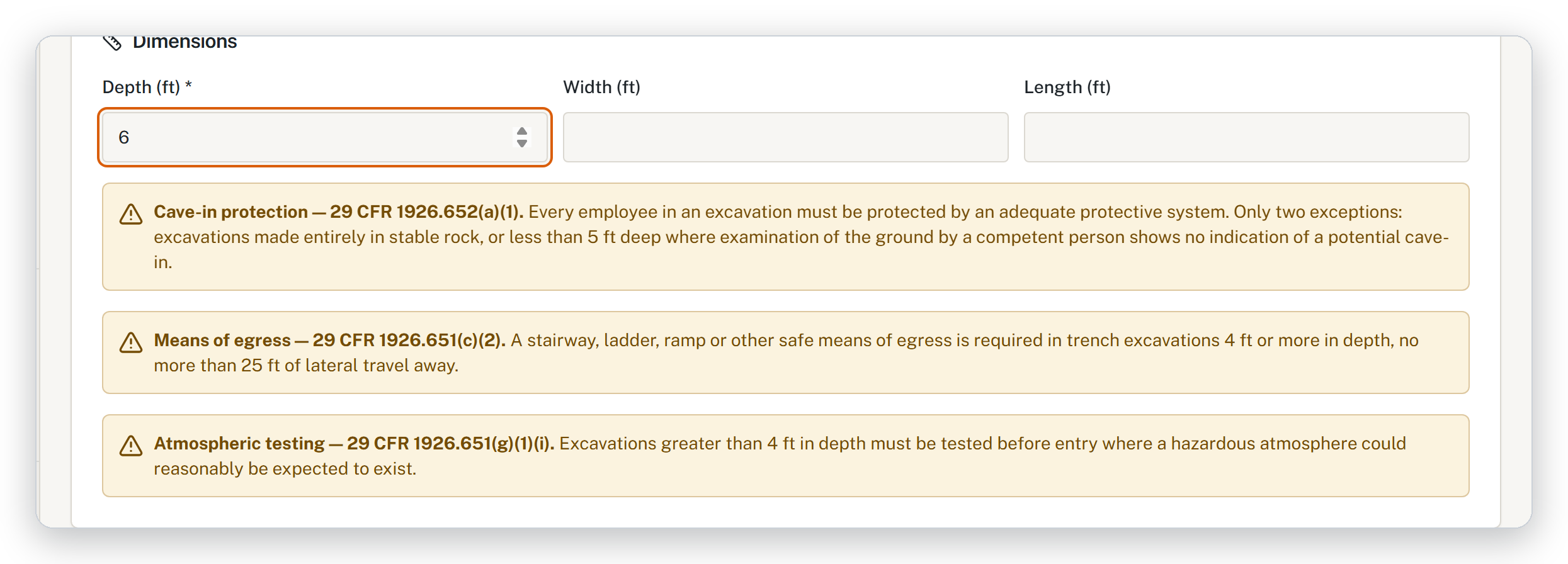
The permit also requires a named competent person with a current designation behind it — an excavation inspection signed on an expired or revoked designation is refused by the system, which is the designation-and-inspection link an inspector looks for. Use the free toolsLog in, or work the numbers first with the free Trench Protective System Selector.
The standards, tools & related reading
- The hub: Excavation & Trench Safety — slope it, shore it, or shield it · get your numbers with the Trench Protective System Selector
- The analysis: The trench geometry problem — what a legal slope actually costs in ground, computed from Table B-1
- The excavation standards: Excavations — 1926.651 · Protective Systems — 1926.652
- On the job: Job Hazard Analysis Builder · Weekly Site Safety Inspection · Toolbox Talk Generator
- Related hazards: Confined Space Entry Permits · Electrical Safety (utility strikes) · Fall Protection in Construction
- 2026 OSHA penalty schedule · penalties by state
Frequently Asked Questions
At what depth does OSHA require cave-in protection?
Under 29 CFR 1926.652(a)(1), every employee in an excavation must be protected from cave-ins by an adequate protective system (sloping, benching, shoring, or shielding), except where the excavation is entirely in stable rock, or is less than 5 feet deep and a competent person's examination of the ground shows no indication of a potential cave-in. Sloping or benching deeper than 20 feet must be designed by a registered professional engineer (Appendix B, Table B-1).
What is a competent person for excavation?
A competent person can identify existing and predictable hazards and is authorized to take prompt corrective measures (29 CFR 1926.32(f)). In excavation work that person classifies the soil (Appendix A to Subpart P, (c)(1)), inspects the excavation, adjacent areas, and protective systems daily, before work and as needed through the shift, and after every rainstorm or other hazard-increasing occurrence (1926.651(k)(1)), and removes exposed employees when there is evidence of a possible cave-in or other hazard (1926.651(k)(2)).
What are the three soil types in OSHA excavation standards?
Appendix A to 29 CFR 1926 Subpart P sorts deposits into stable rock and three soil types. Type A is cohesive soil with an unconfined compressive strength of 1.5 tsf or greater, but no soil is Type A if it is fissured, subject to vibration, or previously disturbed. Type B includes cohesive soil between 0.5 and 1.5 tsf and granular soils such as angular gravel and silt. Type C, the least stable, includes cohesive soil of 0.5 tsf or less, gravel, sand, and submerged soil or soil from which water is freely seeping.
How far from the edge must spoil piles be placed?
Under 29 CFR 1926.651(j)(2), excavated material (spoil) and equipment must be kept at least 2 feet from the edge of the excavation, or held back by retaining devices, or both, so that nothing falls or rolls in on the crew.
What is the maximum allowable slope for Type C soil?
Table B-1 of Appendix B to 29 CFR 1926 Subpart P sets the maximum allowable slope for Type C soil at 1½H:1V (34 degrees from horizontal), the flattest of the three. Type B is 1H:1V (45°) and Type A is ¾H:1V (53°), with a short-term 1/2H:1V (63°) allowed in Type A excavations 12 feet or less deep that stay open 24 hours or less.
OSHA figures and citations here come from our regulatory source-of-truth modules, last checked against the eCFR, OSHA.gov, and the Federal Register on October 5, 2026. Last reviewed October 6, 2026.
About This Article
Published by: HazComFast
Published: March 19, 2026
Last Updated: October 6, 2026
This content is for informational purposes only and does not constitute legal advice.