
Rain stops the trench crew at 1:30. The morning checklist is signed and clipped to the gang box. Before anyone climbs back down, the competent person inspects the excavation again, because 29 CFR 1926.651(k)(1) requires an inspection after every rainstorm. That's the part OSHA requires. The second signature on the checklist isn't. Paragraph (k) never asks for a written log, and the difference matters when someone hands you a form labeled "OSHA-required daily inspection".
OSHA requires a competent person to inspect excavations daily before work, as needed during the shift, and after every rainstorm or other hazard-increasing event, under 29 CFR 1926.651(k)(1). It prescribes no written log. If the inspection finds a hazard, exposed employees are removed until precautions are taken, under 1926.651(k)(2).
At a glance: Who: a competent person (1926.650(b)). When: before work, as needed during the shift, after every rainstorm or hazard-increasing event, when exposure can reasonably be anticipated (1926.651(k)(1)). What: the excavation, adjacent areas, protective systems. If a hazard is found: remove exposed employees until precautions are taken ((k)(2)). In writing? Not required by (k); often required by contracts and company procedures.
What 1926.651(k)(1) requires
The inspection covers three things: the excavation, the adjacent areas and the protective systems. The competent person looks for evidence of a situation that could result in a cave-in, indications of failure of protective systems, hazardous atmospheres, and other hazardous conditions. Looking at the trench floor from the edge doesn't cover that.
The timing has three triggers. Before work starts. As needed throughout the shift. After every rainstorm or other hazard-increasing occurrence. All three apply when employee exposure can reasonably be anticipated. "Once a day" is a summary people use, and it leaves out two of them.
There's no depth threshold in paragraph (k). A four-foot trench with a crew in it gets inspected. The trenching and excavation guide covers protective systems and access.
Who inspects
29 CFR 1926.650(b) defines the competent person as one who is capable of identifying existing and predictable hazards in the surroundings, or working conditions that are unsanitary, hazardous or dangerous to employees, and who has authorization to take prompt corrective measures to eliminate them. Two parts: the knowledge and the authority. A foreman who knows the soil but can't stop the work doesn't qualify. Neither does a manager with authority who can't read a trench wall.
OSHA doesn't certify competent persons; the employer designates them. The competent person designation guide covers what a designation should show.
After rain, and other changes
Rain is named in 1926.651(k)(1). The competent person looks again at the walls, the spoil, the protective system and the adjacent area before the crew returns. Water has its own rules in 1926.651(h): no work in excavations with accumulating water without adequate precautions, a competent person monitoring any water removal equipment under (h)(2), and inspection where heavy-rain runoff can reach the excavation under (h)(3).
Other changes call for a look too: a loaded dump truck parked near the edge, spoil pushed closer during the afternoon, water seeping in, a shoring member that moved. Spoil and equipment stay at least two feet back from the edge, or behind retaining devices, under 1926.651(j)(2). Where a hazardous atmosphere exists or could reasonably be expected, testing is required before employees enter excavations deeper than four feet, under 1926.651(g)(1)(i).
When the inspection finds a hazard
Under 29 CFR 1926.651(k)(2), when the competent person finds evidence of a possible cave-in, indications of failure of a protective system, a hazardous atmosphere or another hazardous condition, exposed employees are removed from the hazardous area until the necessary precautions have been taken. The authority to do that on the spot is part of the definition in 1926.650(b).
So the order is: find, remove, fix, then let the crew back in. If you write it down, write it in that order. A single "resolved" box doesn't tell the next shift whether the crew came out before the fix.
Is it required in writing?
Not by paragraph (k). It tells you which inspections happen and what follows when they find a hazard. It doesn't prescribe a form, a signature or how long to keep anything, and borrowing the five-year retention of the injury records under 1904.33 for trench notes mixes two unrelated rules.
Writing it down is still a good idea, and often a contract requirement. Owners and general contractors ask for daily excavation inspection records, and many company procedures require them. Label each requirement with its real source: the contract, the company, or a State Plan.
A useful note says:
| Note | Why it helps | Rule behind the work |
|---|---|---|
| Which excavation, date and time | Shows which inspection it was: before work, mid-shift, after rain | 1926.651(k)(1) |
| The competent person | Who assessed the conditions and had the authority to act | 1926.650(b) |
| The trigger | Why this inspection happened: start of shift, rain, a new load at the edge | 1926.651(k)(1) |
| What was found, and what was done | Whether exposure stopped before the fix | 1926.651(k)(2) |
| The protective system and adjacent area | What the inspection actually looked at | 1926.651(k)(1) |
OSHA's daily excavation checklist eTool is a good field aid for the competent person. Use it to support the inspection, not as proof the excavation is safe because every box is ticked.
How HazComFast keeps the daily inspection in front of the crew
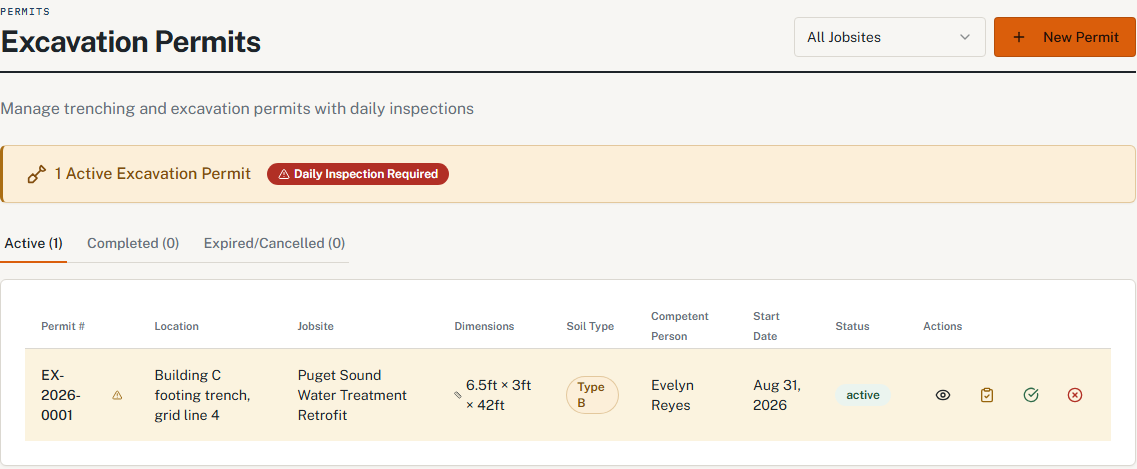
In HazComFast, each excavation has its permit, with its location, dimensions, soil type and the competent person named on it. The permits page shows how many excavations are active and flags "Daily Inspection Required" until today's inspection is recorded. "Record Daily Inspection" adds the competent person's note to the permit, with its date, so the morning check and the post-rain check sit with the excavation they belong to.
The trench, the soil, the competent person
Pick the protective system for a trench free, write the competent person's designation letter free, or keep each excavation permit and its daily inspections in HazComFast.
Related: Trenching and excavation safety · The trench geometry problem · Does OSHA certify competent persons?
Sources & verification: 29 CFR 1926.650(b); 1926.651(g)(1)(i), (h)(1) to (h)(3), (j)(2), (k)(1), (k)(2); 1904.33; OSHA daily excavation checklist eTool. General guidance, not legal advice.*
Frequently Asked Questions
Does federal OSHA require a signed daily trench inspection form?
No. 29 CFR 1926.651(k) requires competent-person inspections and the removal of exposed employees when hazards are found. It prescribes no written log, signature or retention period. An owner's contract, a State Plan or your own procedure can add one.
When must the competent person inspect the excavation?
Under 29 CFR 1926.651(k)(1): daily before work starts, as needed throughout the shift, and after every rainstorm or other hazard-increasing occurrence, whenever employee exposure can reasonably be anticipated. The inspection covers the excavation, the adjacent areas and the protective systems.
Does the morning inspection cover the afternoon after rain?
No. 29 CFR 1926.651(k)(1) calls for an inspection after every rainstorm, so the crew goes back in only after the competent person checks again. Excavations exposed to runoff from heavy rain also fall under 1926.651(h)(3).
Who counts as a competent person for trench inspections?
Under 29 CFR 1926.650(b), someone capable of identifying existing and predictable hazards in the surroundings or working conditions, and authorized to take prompt corrective measures to eliminate them. Both parts matter: knowing the hazards and having the authority to act.
What happens when the inspection finds a hazard?
Under 29 CFR 1926.651(k)(2), exposed employees are removed from the hazardous area until the necessary precautions have been taken. The removal comes first; writing it down comes after.
Site-wide regulatory figures such as compliance dates and penalty amounts come from our regulatory source-of-truth modules, last checked against the eCFR, OSHA.gov, and the Federal Register on October 5, 2026. Last reviewed October 13, 2026.
About This Article
Published by: HazComFast
Published: October 13, 2026
Last Updated: October 13, 2026
This content is for informational purposes only and does not constitute legal advice.