The prequalification form from the owner asks for "your OSHA-required emergency action plan". The question behind it is fair: is it required? For a lot of contractors and small shops the honest answer is that OSHA doesn't require one on its own. The emergency action plan rule only applies when another standard sends you to it. The work is knowing which standards do, and the list is shorter than most people think.
OSHA requires an emergency action plan only when another standard requires one, under 29 CFR 1910.38(a) and 1926.35(a). In general industry the portable fire extinguisher standard, 1910.157, is the most common trigger, along with process safety management, HAZWOPER, grain handling, fixed extinguishing systems and three chemical standards; in construction, MDA, PSM and HAZWOPER work.
At a glance: The duty starts in another standard: 1910.38(a), 1910.39(a), 1926.35(a). General industry: 1910.66(e)(9), 1910.119(n), 1910.120, 1910.157(a), (b)(1), (b)(2), 1910.160(c)(1), 1910.164(c)(3), 1910.272(d), 1910.1047(h)(1)(iii), 1910.1050(d)(1)(iii), 1910.1051(j). Construction: 1926.60(e)(1), 1926.64 (through 1910.119(n)), 1926.65(l)(1)(ii) and (q)(1). Fire protection in construction, 1926.150, requires no emergency action plan; 1926.24 requires a fire protection and prevention program.
The rule sits in another standard
Read 29 CFR 1910.38(a) closely: "An employer must have an emergency action plan whenever an OSHA standard in this part requires one." The fire prevention plan rule, 29 CFR 1910.39(a), is written the same way. The construction rule, 29 CFR 1926.35(a), "applies to all emergency action plans required by a particular OSHA standard."
So 1910.38 and 1926.35 describe the plan: its minimum elements, the alarm, the training, the review. They don't decide whether you need one. The standards below do.
General industry: the standards that require a plan
| Standard | When | What it requires |
|---|---|---|
| Powered platforms, 29 CFR 1910.66(e)(9) | Each kind of working platform operation | A written emergency action plan for power failure, equipment failure and other emergencies |
| Process safety management, 1910.119(n) | Processes with highly hazardous chemicals at or above threshold | An emergency action plan for the entire plant under 1910.38, with procedures for small releases |
| HAZWOPER, 1910.120(l)(1)(ii), (p)(8)(i), (q)(1) | Hazardous waste sites, TSD facilities, emergency response | An emergency response plan; an employer that evacuates and lets no employee help handle the emergency may provide an emergency action plan under 1910.38 instead |
| Portable fire extinguishers, 1910.157(a), (b)(1), (b)(2) | Depends on who may use them | See the next section |
| Fixed extinguishing systems, 1910.160(c)(1) | Areas protected by a total flooding system above the safe levels of 1910.162(b)(5) and (b)(6) | An emergency action plan for each such area |
| Fire detection systems, 1910.164(c)(3) | Alarms delayed more than 30 seconds | The delay addressed in an emergency action plan |
| Grain handling facilities, 1910.272(d) | Grain elevators, mills and similar facilities | An emergency action plan under 1910.38 |
| Ethylene oxide, 1910.1047(h)(1)(iii) | Workplaces where an EtO emergency is possible | A written emergency plan with the elements of 1910.38 and 1910.39 |
| Methylenedianiline, 1910.1050(d)(1)(iii) | Workplaces where an MDA emergency is possible | A written plan with alerting and evacuation, and the elements of 1910.38 and 1910.39 |
| 1,3-Butadiene, 1910.1051(j) | Workplaces where an emergency is possible | A written plan with the applicable elements of 1910.38, 1910.39 and 1910.120 |
Three of those, the chemical standards, require both plans at once: the emergency action plan and the fire prevention plan.
Portable extinguishers: the trigger most shops hit
29 CFR 1910.157 covers portable fire extinguishers provided for employee use. It gives the employer three ways to set them up, and two of them require written plans.
Everyone may use them. No plan is required by 1910.157. Then the full standard applies: placement and distribution under 1910.157(d), inspection, maintenance and testing under (e), hydrostatic testing under (f), and an educational program for employees under (g).
Only designated employees may use them. Under 1910.157(b)(2), an employer with an emergency action plan that names the only employees authorized to use the extinguishers, and requires everyone else in the fire area to evacuate immediately when the alarm sounds, is exempt from the distribution rules of paragraph (d). The plan is the condition for the exemption.
Nobody uses them, or there are none. Under 1910.157(a), extinguishers provided but not intended for employee use leave only paragraphs (e) and (f) in force, if the employer has an emergency action plan and a fire prevention plan. Under 1910.157(b)(1), an employer with a written fire safety policy requiring immediate and total evacuation at the alarm, both plans, and no extinguishers in the workplace is exempt from 1910.157 entirely, unless another Part 1910 standard requires an extinguisher.
In practice: if your answer to "who fights a small fire?" is "nobody, we get out", you need the two plans.
Construction: three standards
| Standard | When | What it requires |
|---|---|---|
| Methylenedianiline, 29 CFR 1926.60(e)(1) | Construction operations where an MDA emergency is possible | A written emergency plan that identifies escape routes at each site before the operation begins, with alerting, evacuation and the applicable elements of 1910.38 and 1910.39 |
| Process safety management, 1926.64 | Construction work on PSM-covered processes | 1926.64 sends you to 1910.119, whose paragraph (n) requires an emergency action plan for the entire plant |
| HAZWOPER, 1926.65(l)(1)(ii) and (q)(1) | Hazardous waste operations and emergency response | An emergency response plan, or an emergency action plan complying with 1926.35 when employees evacuate and none of them help handle the emergency |
What's not on the list matters as much. 29 CFR 1926.150 requires extinguishers on every jobsite, rated at least 2A for each 3,000 square feet, but it doesn't require an emergency action plan. 29 CFR 1926.24 requires an effective fire protection and prevention program at the job site, which is a different document. And 1926.150(e) requires an alarm system, such as a telephone system or a siren, that alerts employees and the local fire department, with the alarm code and reporting instructions posted at phones and employee entrances. That posting is required on every jobsite, plan or no plan.
When no standard requires one
Most general contractors still ask for an emergency action plan, and most owners write it into the contract. That's a contract requirement, and it's a reasonable one: a jobsite without a known assembly point and a named warden is a bad place to have a fire.
If you write a plan by choice, two things follow. It doesn't create an OSHA duty on its own. And once it exists, crews will follow what it says, so it has to be true: the right exits, the right numbers, the right names. The construction emergency action plan guide covers the six elements of 1926.35(b), and how often to review the plan covers keeping it current.
How HazComFast answers the question
HazComFast doesn't decide for you whether a standard applies. It asks, records your answer, and shows what follows from it, with the paragraph.
In "Standards that require an emergency plan", you answer the extinguisher questions first: are portable extinguishers available, do you have a written total-evacuation policy, and who may use them. Your answer is recorded as the paragraph it matches, such as "Recorded as 29 CFR 1910.157(b)(1)". Then you check the other standards that apply to your workplace. Set your company to 29 CFR 1910, 1926 or both in Settings and the list shows only the standards of your part.
Below the list, "What the recorded standards require" says which plan each standard requires: "Emergency action plan: required by 29 CFR 1910.157(b)(1)", "Fire prevention plan: required by 29 CFR 1910.157(b)(1)". With nothing recorded, it says so: no trigger recorded, and 1910.38(a) or 1926.35(a) applies only when a standard requires one. A construction company also sees that 29 CFR 1926.24 requires a fire protection program for construction work. Inspection Ready reads the same list when it checks your plans.
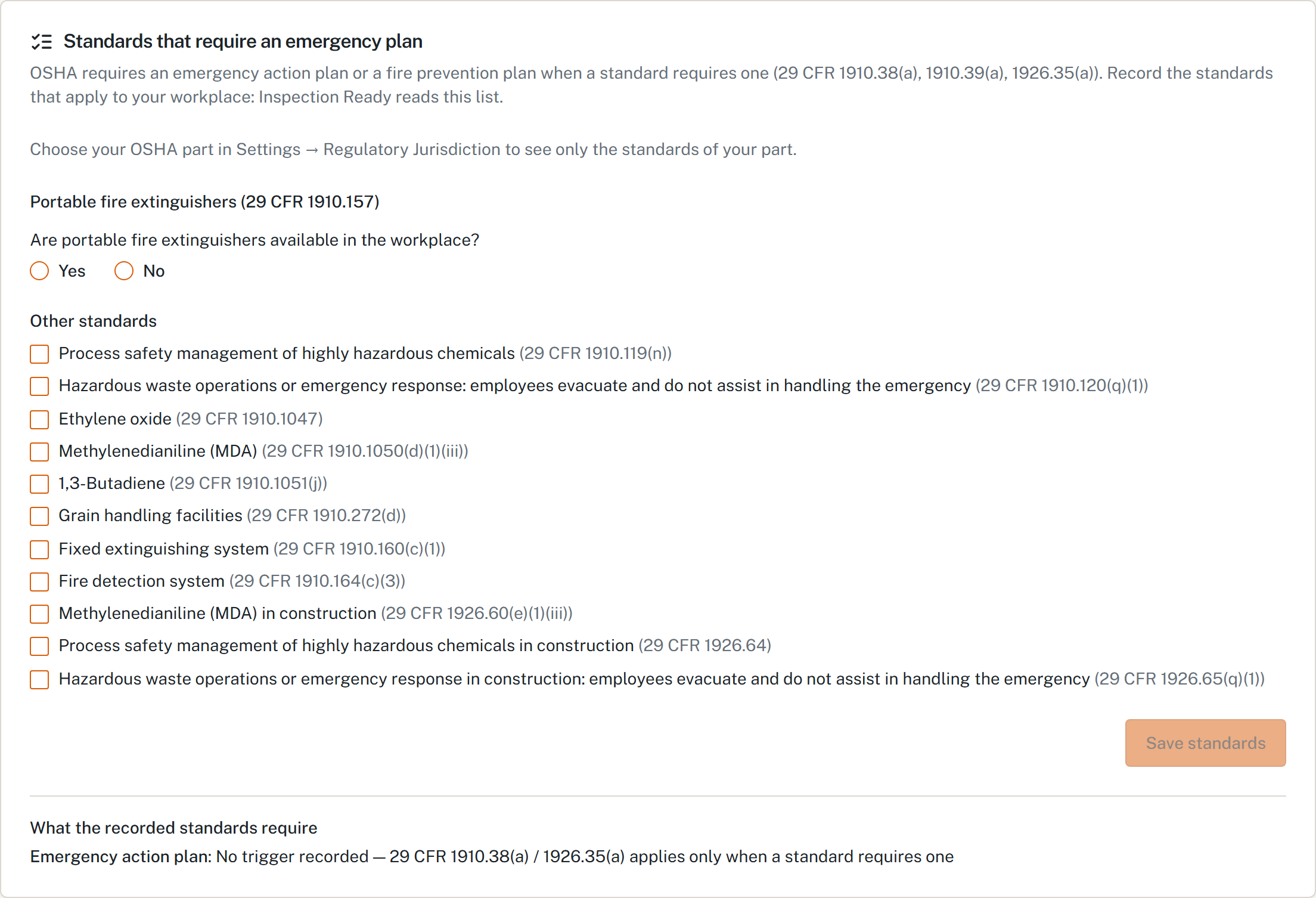
Only an administrator or a manager can change the list, and the date each standard was recorded is kept.
Start from the standard, then write the plan
Build an emergency action plan free, or record your standards in HazComFast and see which plans they require, with the paragraph.
Related: Emergency action plans for construction · How often must the plan be reviewed? · How many fire extinguishers does a jobsite need? · OSHA fire safety requirements
Sources & verification (read on the eCFR, edition of 2026-10-01): 29 CFR 1910.38(a), 1910.39(a), 1926.35(a); 1910.66(e)(9); 1910.119(n); 1910.120(l)(1)(ii), (p)(8)(i) and (q)(1); 1910.157(a), (b)(1), (b)(2), (d) to (g); 1910.160(c)(1); 1910.164(c)(3); 1910.272(d); 1910.1047(h)(1)(iii); 1910.1050(d)(1)(iii); 1910.1051(j); 1926.24; 1926.60(e)(1); 1926.64; 1926.65(l)(1)(ii) and (q)(1); 1926.150(c)(1) and (e). General guidance, not legal advice.*
Frequently Asked Questions
Does every employer need an emergency action plan?
No. 29 CFR 1910.38(a) says an employer must have an emergency action plan whenever an OSHA standard in Part 1910 requires one, and 29 CFR 1926.35(a) applies to emergency action plans required by a particular OSHA standard. The duty comes from another standard, such as 1910.157, 1910.119(n) or 1926.65.
Do portable fire extinguishers require an emergency action plan?
In general industry, they decide it. Under 29 CFR 1910.157(b)(1), an employer with no extinguishers and a total-evacuation policy needs an emergency action plan and a fire prevention plan to be exempt from 1910.157. Under 1910.157(b)(2), designating the only employees allowed to use extinguishers requires an emergency action plan. In construction, 29 CFR 1926.150 requires extinguishers but not an emergency action plan.
Which construction standards require an emergency action plan?
Three: methylenedianiline work under 29 CFR 1926.60(e)(1), which needs a written emergency plan with the applicable elements of 1910.38 and 1910.39; process safety management under 1926.64, which applies 1910.119 and its paragraph (n); and hazardous waste operations under 1926.65(l)(1)(ii) and (q)(1), when the employer evacuates instead of responding.
When is a fire prevention plan required?
When a standard requires one, under 29 CFR 1910.39(a). Examples are 1910.157(a) and (b)(1) for extinguishers, ethylene oxide at 1910.1047(h)(1)(iii), MDA at 1910.1050(d)(1)(iii) and 1,3-butadiene at 1910.1051(j). Construction has its own duty under 29 CFR 1926.24: an effective fire protection and prevention program at every job site.
If no standard requires one, should I still write an emergency action plan?
Usually yes, for practical reasons: general contractors and owners often ask for one, and 29 CFR 1926.150(e) still requires a jobsite alarm system with reporting instructions posted at phones and employee entrances. A plan written by choice doesn't create an OSHA duty, but once you have one, follow it.
Site-wide regulatory figures such as compliance dates and penalty amounts come from our regulatory source-of-truth modules, last checked against the eCFR, OSHA.gov, and the Federal Register on October 5, 2026. Last reviewed October 13, 2026.
About This Article
Published by: HazComFast
Published: October 13, 2026
Last Updated: October 13, 2026
- https://www.ecfr.gov/current/title-29/subtitle-B/chapter-XVII/part-1910/subpart-E/section-1910.38
- https://www.ecfr.gov/current/title-29/subtitle-B/chapter-XVII/part-1910/subpart-L/section-1910.157
- https://www.ecfr.gov/current/title-29/subtitle-B/chapter-XVII/part-1926/subpart-C/section-1926.35
- https://www.ecfr.gov/current/title-29/subtitle-B/chapter-XVII/part-1910/subpart-H/section-1910.119
- https://www.ecfr.gov/current/title-29/subtitle-B/chapter-XVII/part-1926/subpart-D/section-1926.65
This content is for informational purposes only and does not constitute legal advice.