Comprehensive Guide to OSHA Fire Safety Requirements: 2026 Compliance Standards
OSHA's fire safety rules sit in two places: general industry in 29 CFR 1910 Subparts E and L (exit routes, emergency and fire prevention plans, portable extinguishers), and construction in 29 CFR 1926 Subpart F (fire protection and prevention, starting with 1926.150). A serious violation of any of them carries a maximum penalty of $16,550, and a willful or repeated violation up to $165,514, per violation (29 CFR 1903.15(d)).
This guide takes the rules one by one: extinguishers and travel distances, exit routes, emergency action and fire prevention plans, hot work and flammable storage. The HazCom Compliance Scorer gives you a baseline before an inspector arrives.
1. Overview of OSHA Fire Safety Regulations
OSHA’s fire safety requirements are bifurcated between General Industry (29 CFR 1910) and Construction (29 CFR 1926). While there is significant overlap, construction safety managers must be particularly diligent about the transient nature of their jobsites, where fire hazards change daily as new materials arrive and hot work commences.
The primary regulatory pillars include:
- 29 CFR 1910 Subpart E: Exit Routes and Emergency Planning.
- 29 CFR 1910 Subpart L: Fire Protection (specifically extinguishers and standpipe systems).
- 29 CFR 1926 Subpart F: Fire Protection and Prevention specifically for the construction industry.
OSHA’s philosophy is built on a "layered defense" strategy: first, prevent the fire through proper storage and house-cleaning; second, detect the fire through alarms; and third, ensure safe egress for all occupants. For companies managing complex chemical inventories, the intersection of fire safety and the Hazard Communication Standard (HCS) is critical. You can evaluate your current standing using our How to Prepare for an OSHA HazCom Inspection guide to see how fire-related issues often trigger broader inspections.
2. Fire Prevention Plans (29 CFR 1910.39)
A Fire Prevention Plan (FPP) is not merely a suggestion; it is a mandatory document for many workplaces. Under 29 CFR 1910.39, an FPP must be in writing, kept in the workplace, and made available to employees for review. However, for employers with 10 or fewer employees, the plan may be communicated orally.
Core Components of an FPP
To be compliant, an FPP must include:
- A list of all major fire hazards, proper handling and storage procedures for hazardous materials, potential ignition sources, and the type of fire protection equipment necessary to control each major hazard.
- Procedures to control accumulations of flammable and combustible waste materials.
- Procedures for regular maintenance of safeguards installed on heat-producing equipment to prevent the accidental ignition of combustible materials.
- The name or job title of employees responsible for maintaining equipment to prevent or control sources of ignition or fires.
- The name or job title of employees responsible for the control of fuel source hazards.
Managing Fuel Sources
In the construction industry, fuel sources are often temporary. Whether it’s scrap lumber, oily rags, or piles of cardboard packaging, housekeeping is the first line of defense. On a construction site the fire rule is 29 CFR 1926.24 (a fire protection and prevention program at the job site), and combustible scrap and debris must be removed at regular intervals during construction (29 CFR 1926.25(b)).
If you are struggling to document these risks, the HazCom Program Generator can assist in integrating your fire prevention strategies with your broader chemical safety protocols.
3. Emergency Action Plans (29 CFR 1910.38)
While an FPP focuses on preventing the fire, the Emergency Action Plan (EAP) dictates what happens once a fire starts. Under 29 CFR 1910.38, the EAP is the master document for evacuation and life safety.
Minimum EAP Requirements
- Escape Procedures: Detailed route assignments and floor plans.
- Critical Operations: Procedures for employees who remain to operate critical plant operations before they evacuate.
- Accountability: Procedures to account for all employees after evacuation (the "muster point" protocol).
- Rescue/Medical Duties: Procedures for employees performing rescue or medical duties.
- Alarm Systems: The preferred means of reporting fires and other emergencies (manual pulls, radios, etc.).
Common Pitfalls in EAPs
The most frequent mistake noted in OSHA enforcement data is the failure to designate a "Person in Charge" for the muster point. Without a verified head count, firefighters may risk their lives entering a burning building to find an employee who is actually safe in the parking lot. Use our Inspection Action Plan Builder to ensure your EAP is tested and verified quarterly.
4. Fire Extinguisher Requirements (29 CFR 1910.157)
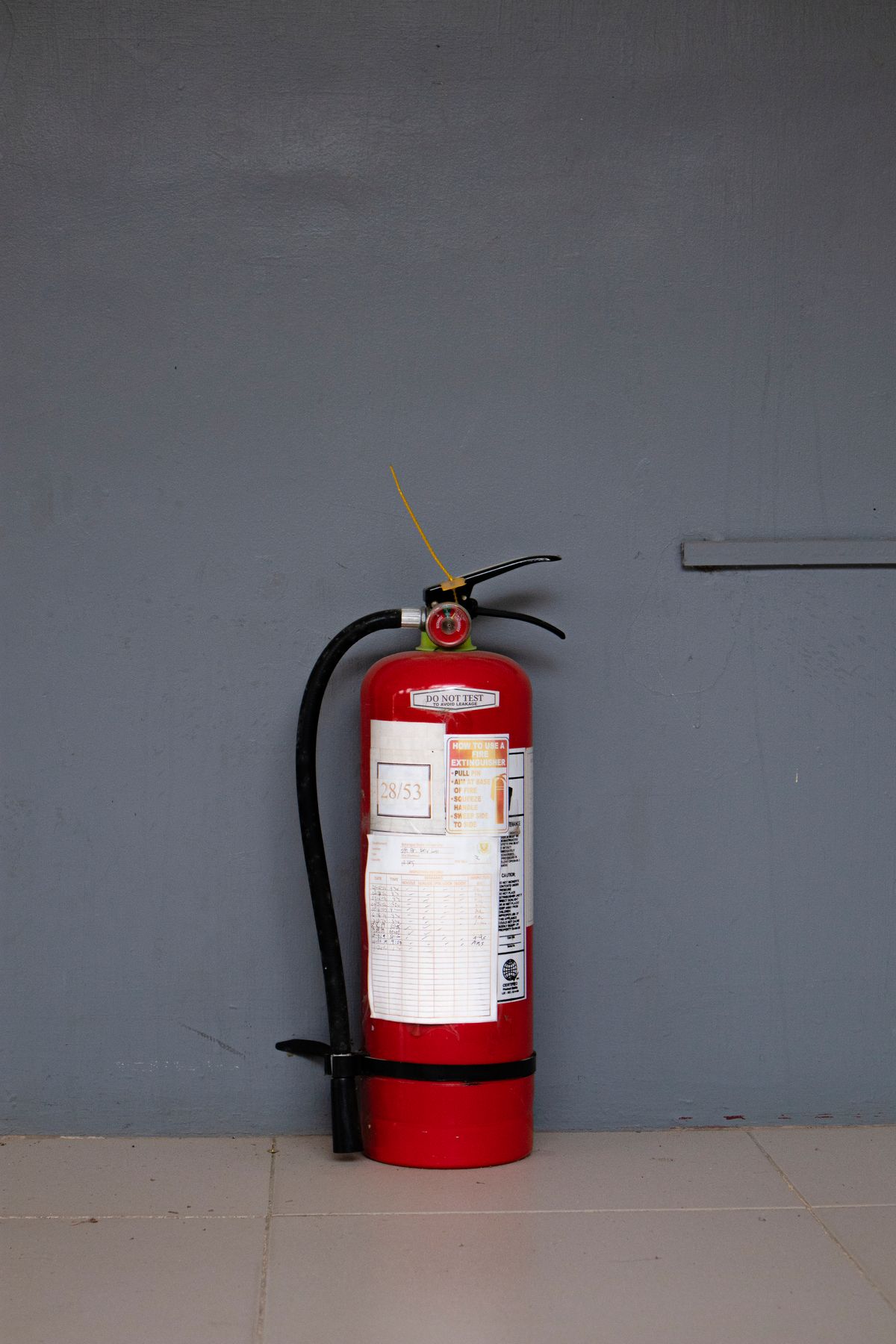
Portable fire extinguishers are the most visible component of fire safety, yet they are among the most frequently cited items during OSHA inspections. 29 CFR 1910.157 does not necessarily require all employers to have extinguishers; however, if you do provide them (and expect employees to use them), you must adhere to strict maintenance and training rules.
Extinguisher Placement and Travel Distance
OSHA specifies maximum travel distances based on the class of fire:
| Fire Class | Hazard Type | Max Travel Distance | Rule |
|---|---|---|---|
| Class A | Ordinary combustibles (wood, paper) | 75 feet | 1910.157(d)(2) |
| Class B | Flammable liquids/gases | 50 feet | 1910.157(d)(4) |
| Class C | Electrical equipment | Based on A or B hazard | 1910.157(d)(5) |
| Class D | Combustible metals | 75 feet | 1910.157(d)(6) |
1910.157(d) sets travel distances for Classes A, B, C and D only; kitchen (Class K) protection is governed by the building and fire codes your jurisdiction adopts.
Maximum travel distance to a fire extinguisher (1910.157)
Class C follows the underlying A or B hazard; Class D is 75 ft. Construction (1926.150) sets a separate ≤100-ft rule.
Maintenance Schedule
- Monthly Visual Inspection: Check for pressure, physical damage, and accessibility.
- Annual Maintenance: A professional "tear-down" or thorough check of the mechanical parts and extinguishing agent.
- Hydrostatic Testing: Required every 5 or 12 years depending on the shell type (e.g., dry chemical vs. CO2).
Employers must also provide educational programs to familiarize employees with the general principles of fire extinguisher use. Failures in this area often lead to "Serious" citations. You can document this training efficiently using the HazCom Training Record.
5. Exit Routes and Emergency Lighting (Subpart E)
29 CFR 1910.34 through 1910.37 constitutes the "Means of Egress" standard. In the event of a fire, the path to safety must be clear, unobstructed, and well-lit.
The Three Parts of an Exit Route
- Exit Access: The portion of an exit route that leads to an exit (e.g., a hallway).
- Exit: The portion separated from other spaces to provide a protected path of travel to the discharge (e.g., a fire-rated stairwell).
- Exit Discharge: The part of the route that leads directly outside or to a street, walkway, or open space.
Key Compliance Requirements
- Unobstructed Paths: Nothing—not even a temporary pallet—may block an exit route. OSHA has a "zero-tolerance" policy here.
- Lighting: Exit routes must be adequately lit so that an employee with normal vision can see along the route (1910.37(b)(1)), and exit signs must be illuminated to at least five foot-candles by a reliable light source (1910.37(b)(6)).
- Marking: Doors that could be mistaken for exits must be marked "Not an Exit" or labeled with their actual use (e.g., "Closet").
- Width: Exit routes must be at least 28 inches wide at all points.
A common violation involves propping fire doors open with doorstops or bricks. This voids the fire rating of the exit and is a frequent trigger for the OSHA Fine Calculator.
6. Hot Work Permits and Fire Watch
"Hot work" refers to any activity involving open flames or producing heat and/or sparks, such as welding, cutting, grinding, or brazing. This is a primary cause of industrial fires.
The Hot Work Permit System
A compliant Hot Work program includes:
- Site Clearance: Moving combustibles at least 35 feet away from the work area.
- Surface Preparation: Ensuring floors are swept clean and any wall openings are covered with fire-resistant shields.
- The Permit: A written authorization for a specific task, at a specific time, by a specific person.
Fire Watch Duty
Under 29 CFR 1910.252, a dedicated Fire Watch is required if:
- Combustibles are closer than 35 feet to the point of operation.
- Combustibles are more than 35 feet away but are easily ignited by sparks.
- Wall or floor openings within a 35-foot radius expose combustible material in adjacent areas.
- Combustible materials are adjacent to the opposite side of metal partitions, walls, ceilings, or roofs and are likely to be ignited by conduction or radiation.
How long the fire watch stays depends on which rule governs. OSHA general industry (1910.252(a)(2)(iii)) sets a floor of half an hour; OSHA construction (1926.352(e)) fixes no number at all, requiring a sufficient period to ensure no fire is possible; and NFPA 51B, the consensus standard, calls for a minimum of 60 minutes — a standard OSHA references but, in construction, does not incorporate by reference. For construction sites, utilizing a Confined Space Permit Generator often goes hand-in-hand with hot work planning to ensure multiple hazards are managed simultaneously.
7. Flammable and Combustible Liquid Storage
29 CFR 1910.106 regulates the storage, handling, and use of flammable liquids. OSHA revised these standards to align with the GHS (Globally Harmonized System), changing the terminology from "Flammable and Combustible" to "Flammable Liquids Categories 1-4."
Safety Can and Cabinet Requirements
- Storage Cabinets: No more than 60 gallons of Category 1, 2, or 3 flammable liquids, nor more than 120 gallons of Category 4 flammable liquids, may be stored in a single cabinet.
- Venting: OSHA does not strictly require cabinets to be vented, but if they are, they must be vented to the outdoors in a manner that doesn't compromise the cabinet's fire rating.
- Safety Cans: For transfer of flammable liquids, OSHA requires the use of FM-approved or UL-listed safety cans with spring-closing lids and spout covers.
Handling and Transfer
Static electricity is a major risk during liquid transfer. OSHA requires bonding and grounding when transferring Category 1 or 2 flammable liquids (or Category 3 with a flashpoint below 100°F) between containers.
Managing these chemicals requires accurate Safety Data Sheets (SDS). Use the SDS QR Code Generator to ensure that fire crews can instantly access chemical data in an emergency. Furthermore, ensuring containers are marked correctly with our GHS Label Generator is essential for compliance with both fire safety and HazCom standards.
8. Electrical Fire Prevention
Electrical malfunctions are the leading cause of non-residential fires. OSHA’s Subpart S (1910.301-399) outlines the preventative measures required to avoid electrical fires.
Areas of Concern
- Overloading Circuits: Using multiple power strips "daisy-chained" together is a common violation.
- Temporary Wiring: Flexible cords (extension cords) cannot be used as a substitute for fixed wiring. They are for temporary use and must be removed immediately after the task is finished.
- Working Clearances: OSHA requires a minimum of 36 inches of clear space in front of electrical panels to allow for quick access and prevent heat buildup.
- Hazardous Locations: In areas with flammable vapors or dust, "explosion-proof" electrical equipment is required to prevent sparks from igniting the atmosphere.
For electrical hazards, arc flash and GFCI protection, see Electrical Safety in Construction (Subpart K & NFPA 70E) guide.
9. Fire Alarm and Detection Systems
29 CFR 1910.164 and 1910.165 cover detection and alarm systems in general industry. These systems must be maintained in operating condition except during repairs or maintenance (1910.164(c)(1), 1910.165(d)(1)).
Alarm Requirements
- Audibility: The alarm must be capable of being perceived above ambient noise or light levels by all employees in the affected portions of the workplace (1910.165(b)(2)).
- Distinctive Signal: The fire alarm must be distinctive and recognizable as a signal to evacuate the building.
- Testing: In general industry, non-supervised employee alarm systems must be tested for reliability and adequacy every two months, using a different actuation device in each test (29 CFR 1910.165(d)(2)). Supervised employee alarm systems must be tested at least annually (1910.165(d)(4)). Fire detection systems must be tested and adjusted as often as needed to maintain proper reliability and operating condition (1910.164(c)(2)).
Employee Notification
If you rely on a public address system or verbal communication, it must be documented in the EAP. In construction, air horns are a common solution, but they must be accessible to all personnel. Consider using the Toolbox Talk Generator to train employees on what specific alarm sounds mean on your particular site.
10. Employee Fire Safety Training
Compliance is impossible without an informed workforce. OSHA requires training both at the time of hire and whenever the fire plan changes.
Training Checklist
- EAP Review: Where to go, how to get there, and how to report an emergency.
- Hazard Recognition: Training on the specific flammable materials in their work area.
- Extinguisher Use: Hands-on training if the employer expects them to use an extinguisher (re-training required annually).
- Self-Protection: When to fight a fire and when to evacuate immediately.
Documentation is how you show an OSHA inspector that training occurred. Use the HazCom Training Record to maintain a digital paper trail of all fire safety sessions.
11. Construction-Specific Fire Safety (1926 Subpart F)
Construction sites are inherently more dangerous due to the presence of temporary heating, bulk fuel storage, and shifting site layouts. 29 CFR 1926.150–1926.155 (Subpart F) provides the construction framework, and 29 CFR 1926.24 makes the employer responsible for an effective fire protection and prevention program at the job site.
Key Construction Differences
- Fire Extinguishers: A fire extinguisher, rated not less than 2A, shall be provided for each 3,000 square feet of the protected building area. Travel distance to any extinguisher must not exceed 100 feet.
- Multi-Story Buildings: At least one 2A extinguisher must be adjacent to the stairway on each floor.
- Temporary Heating: "Salamander" heaters and other temporary heating devices must be placed at least 10 feet from combustible tarpaulins or covers, and the coverings securely fastened so wind cannot ignite or upset the heater (1926.154(b)(4)). Heaters in use must be set horizontally level unless the manufacturer's markings permit otherwise (1926.154(c)), and flammable liquid-fired heaters must have a primary safety control to stop the flow of fuel if the flame fails (1926.154(e)(1)).
- Internal Combustion Engines: Engine-powered equipment must be located so its exhausts are well away from combustible materials (1926.151(a)(2)).
Construction managers should use the Silica Exposure Calculator in conjunction with fire safety plans, as dust collection systems (used for silica) can become fire hazards if combustible dust is involved.
12. Fire Safety Inspection Checklist
Use this checklist to conduct a self-audit of your facility or jobsite. Frequent self-inspections significantly reduce the likelihood of a "Willful" citation.
- Exits: Are all exit doors unlocked from the inside without keys or special knowledge?
- Egress Paths: Are all aisles at least 28 inches wide and free of storage/debris?
- Signage: Are "EXIT" signs illuminated and visible from all directions of travel?
- Extinguishers: Are they mounted, visible, and have they received their annual professional inspection?
- Flammable Storage: Are all flammable liquids stored in approved safety cabinets or safety cans?
- Housekeeping: Is waste (sawdust, oily rags, trash) removed daily to prevent accumulation?
- Hot Work: Are hot work permits being used and is the 35-foot rule being enforced?
- Electrical: Are there any daisy-chained power strips or permanent use of extension cords?
- Alarms: General industry: was the non-supervised alarm system tested within the last two months (1910.165(d)(2)), or the supervised system within the last year (1910.165(d)(4))?
- Employee Training: Are training records for the EAP and FPP up to date?
For a more comprehensive digital audit tool, visit our 2026 HazCom Audit Checklist.
13. Common Fire Safety Violations and Penalties
OSHA adjusts its civil penalty maximums for inflation each year. For 2026 the maximums are unchanged from 2025 (no CPI increase was published), but they remain among the highest ever — and fire-safety hazards are frequently cited as serious.
Top 5 Cited Fire-Related Standards
- 1910.157(c)(1): Fire extinguishers not readily accessible.
- 1910.37(a)(3): Exit routes obstructed or restricted.
- 1910.157(e)(3): Failure to perform annual extinguisher maintenance.
- 1910.303(g)(1): Improper clearance around electrical equipment.
- 1910.106(e)(2): Improper storage of flammable liquids including lack of safety cans.
2026 Penalty Schedule
| Violation Type | Penalty Amount (Per Violation) |
|---|---|
| Serious | Up to $16,550 |
| Other-Than-Serious | Up to $16,550 |
| Willful or Repeat | Up to $165,514 |
| Failure to Abate | $16,550 per day beyond the abatement date |
To calculate your potential financial exposure based on specific site risks, utilize our Safety Pays Calculator.
14. Building an Effective Fire Prevention Program
An effective fire prevention program is a living system, not a binder on a shelf. To move beyond "check-the-box" compliance, consider the following strategic steps:
Integrate with Hazard Communication
Fire safety and chemical safety are inseparable. If your employees don't understand the flashpoints of the chemicals they use, they cannot safely prevent fires. Use the Chemical Compatibility Matrix to ensure incompatible chemicals aren't stored together, which could lead to spontaneous combustion or toxic smoke during a fire.
Put the safety data sheets where responders can reach them
A QR code posted at the entrance or at each storage area can open the safety data sheets for the chemicals kept there. The SDS QR Code Generator makes one for each sheet.
Continuous Improvement
Use the data from your near-miss reports and inspections. If you find that "Exit" signs are frequently unlit, switch to self-luminous or LED long-life fixtures. If extension cords are always being used, invest in permanent wiring.
Finally, ensure your administrative compliance is airtight. Tools like the OSHA 300A Auto-Filler can help you log injuries accurately should a fire event occur, ensuring you don't face secondary citations for recordkeeping failures.
Standards, tools & related reading
- Core standards: Fire Extinguishers — 1910.157 · Hazard Communication — 1910.1200
- Hot work & adjacent hazards: Welding Safety (Subpart J) · Electrical Safety (Subpart K & NFPA 70E) · Confined Spaces: Subpart AA vs 1910.146
- 2026 OSHA penalty schedule · penalties by state
Conclusion: Take Action with HazComFast
OSHA fire safety requirements are detailed because fire is unforgiving. From the 28-inch minimum width of an exit access to the flash point of what sits in the flammable cabinet, each figure exists because someone was hurt when it was ignored.
Don't wait for an OSHA compliance officer to identify the gaps in your program. Take control of your workplace safety today. HazComFast provides the tools you need to automate your compliance, from generating customized fire prevention plans to tracking employee training.
Ready to secure your jobsite?
- Evaluate your risk with the HazCom Compliance Scorer
- Generate your mandatory plans at HazCom Program Generator
- Stay ahead of 2026 penalties by using our OSHA Fine Calculator
Maintaining a fire-safe workplace is an ongoing commitment. With the right systems in place, you can protect your employees, your assets, and your bottom line.
Frequently Asked Questions
What fire extinguishers does OSHA require?
In general industry, portable extinguishers are selected and distributed by the classes of anticipated fire and the size of the hazard (29 CFR 1910.157(d)(1)): within 75 feet of travel for Class A (d)(2) and Class D (d)(6), within 50 feet for Class B (d)(4), and on the Class A or B pattern for Class C (d)(5). They are kept charged and in their places (1910.157(c)(4)) and visually inspected monthly (1910.157(e)(2)). In construction, 29 CFR 1926.150(c)(1)(i) requires an extinguisher rated not less than 2A for each 3,000 square feet, within 100 feet of travel.
Does OSHA require a fire prevention plan?
In general industry, a fire prevention plan is required when an OSHA standard in Part 1910 requires one (29 CFR 1910.39(a)). It must be written, or communicated orally by employers with 10 or fewer employees (1910.39(b)), and list the major fire hazards, handling and storage procedures, ignition sources and their control, the fire protection equipment for each hazard, and the employees responsible (1910.39(c)). On construction sites, 29 CFR 1926.24 makes the employer responsible for an effective fire protection and prevention program at the job site throughout all phases of the work.
How often must fire extinguishers be inspected?
Portable extinguishers are visually inspected monthly (29 CFR 1910.157(e)(2)), get an annual maintenance check whose date is recorded and kept (1910.157(e)(3)), and are hydrostatically tested at the 5- or 12-year intervals of Table L-1 (1910.157(f)(2)), with a certification record of each test (1910.157(f)(16)). 1910.157 does not require a written record of the monthly visual inspection.
What are OSHA exit route requirements?
At least two exit routes must be available, with the exceptions of 29 CFR 1910.36(b)(3) (1910.36(b)(1)); exit access is at least 28 inches wide at all points (1910.36(g)(2)); routes are adequately lighted (1910.37(b)(1)) and free and unobstructed (1910.37(a)(3)); and exit signs are illuminated to at least five foot-candles by a reliable light source (1910.37(b)(6)).
When is a hot work permit required?
OSHA's general-industry rule has the person who authorizes cutting and welding inspect the area and designate precautions, preferably in a written permit (29 CFR 1910.252(a)(2)(iv)). The construction rule, 29 CFR 1926.352, sets the fire-prevention controls and a fire watch when normal precautions are not enough (1926.352(e)) without using the word permit. NFPA 51B, the consensus standard, documents those controls on a written permit.
What training is required for fire safety?
Under an emergency action plan, the employer reviews the plan with each covered employee when it is developed or the employee is assigned, when the employee's responsibilities change, and when the plan changes (29 CFR 1910.38(f)), and trains the employees who assist in evacuation (1910.38(e)). Where extinguishers are provided for employee use, education on their use is given at initial employment and at least annually (1910.157(g)(1) and (g)(2)).
OSHA figures and citations here come from our regulatory source-of-truth modules, last checked against the eCFR, OSHA.gov, and the Federal Register on October 5, 2026. Last reviewed October 2, 2026.
About This Article
Published by: HazComFast
Published: March 27, 2026
Last Updated: October 2, 2026
This content is for informational purposes only and does not constitute legal advice.