The superintendent's count is usually "one per floor, by the stairs". On a small house that's right. On a 9,500-square-foot, three-story medical office building it can be one short, and on a long parking deck several short. OSHA's construction rule counts extinguishers three ways at once, by area, by floor and by travel distance, and the site needs whichever count is highest.
Under 29 CFR 1926.150(c)(1), a construction site needs one fire extinguisher rated at least 2A for each 3,000 square feet of protected building area or major fraction thereof, at least one on each floor, one next to a stairway in multistory buildings, and no point more than 100 feet of travel from the nearest extinguisher. Fuel and flammable storage add 10B and 20-B units.
At a glance: 2A per 3,000 sq ft of protected building area, or major fraction (1926.150(c)(1)(i)). At least one 2A per floor, one adjacent to a stairway in multistory buildings ((c)(1)(iv)). 100 ft maximum travel distance ((c)(1)(i)). 10B within 50 ft where more than 5 gal of flammable liquid or 5 lb of flammable gas is in use ((c)(1)(vi)). 20-B outside flammable storage rooms over 60 gal, and at fueling areas (1926.152(d), (g)(11)). Inspected periodically, no federal frequency in construction (1926.150(a)(4)).
The three counts in 1926.150(c)(1)
By area. 29 CFR 1926.150(c)(1)(i): "A fire extinguisher, rated not less than 2A, shall be provided for each 3,000 square feet of the protected building area, or major fraction thereof."
By floor. 29 CFR 1926.150(c)(1)(iv): "One or more fire extinguishers, rated not less than 2A, shall be provided on each floor. In multistory buildings, at least one fire extinguisher shall be located adjacent to stairway."
By distance. The second sentence of (c)(1)(i): "Travel distance from any point of the protected area to the nearest fire extinguisher shall not exceed 100 feet." That's walking distance around walls, stacked material and open shafts, not a straight line on the drawing.
The counts don't add up. You take the highest, then check the distance. A one-story slab of 2,000 square feet needs one. A three-story building of 2,000 square feet needs three, one per floor. A 400-foot-long single floor of 6,000 square feet needs two by area but probably three or four to keep every point within 100 feet.
"Major fraction", and why the count can differ by one
The standard says "or major fraction thereof" and doesn't define it. At 9,500 square feet, the area count is 3.17. If you read "major fraction" as more than half, 0.17 isn't one, and the area count is three. If you round any fraction up, it's four. Either way you still need one per floor, and the 100-foot distance has the last word.
When a building grows floor by floor, the count changes with it. Recount when a new floor is decked and when the enclosed area grows, not once at mobilization.
Worked example: a three-story medical office building
Say the building is framed, decked and partly enclosed, 9,500 square feet of protected area over three floors.
| Count | Rule | Result |
|---|---|---|
| By area | 9,500 / 3,000 = 3.17, under 1926.150(c)(1)(i) | 3 (fraction not counted) or 4 (any fraction counted) |
| By floor | One per floor, 1926.150(c)(1)(iv) | 3 |
| Stairway | Multistory: one adjacent to a stairway, (c)(1)(iv) | Place one of them at the stair |
| Distance | 100 ft travel, (c)(1)(i) | Walk each floor; add one if a corner is out of reach |
Now add the trades. The roofer's kettle area has propane cylinders over 5 pounds in use, so a 10B unit goes within 50 feet of it under (c)(1)(vi). The fuel trailer at the laydown yard needs a 20-B:C unit within 75 feet of the pump under 1926.152(g)(11). The welder on the second floor needs suitable extinguishing equipment immediately available under 1926.352(d), which in practice means one at the work, not one at the stairs.
What changes near fuel, flammable storage and hot work?
| Situation | Rule | What's required |
|---|---|---|
| More than 5 gal of flammable or combustible liquids, or 5 lb of flammable gas, in use | 1926.150(c)(1)(vi) | A 10B extinguisher within 50 ft (not for vehicle fuel tanks) |
| Room storing more than 60 gal of flammable liquids | 1926.152(d)(1) | A 20-B extinguisher outside the door, no more than 10 ft from it |
| Outdoor flammable liquid storage area | 1926.152(d)(2) | A 20-B extinguisher between 25 and 75 ft away |
| Tank truck or vehicle dispensing flammable liquids | 1926.152(d)(4) | A 20-B:C extinguisher on the vehicle |
| Service or fueling area | 1926.152(g)(11) | A 20-B:C extinguisher within 75 ft of each pump, dispenser, fill pipe opening and service area |
| LP-gas storage location | 1926.153(l) | At least one approved 20-B:C extinguisher |
| Open yard storage of combustible materials | 1926.151(c)(6) | 2A extinguishers, 100 ft maximum travel |
| Welding, cutting, other hot work | 1926.352(d) | Suitable extinguishing equipment immediately available |
Storage limits sit next to these rules. No more than 25 gallons of flammable liquids may be stored in a room outside an approved storage cabinet (1926.152(b)(1)). A cabinet holds no more than 60 gallons of Category 1, 2 and 3 flammable liquids, or 120 gallons of Category 4, with no more than three cabinets in a single storage area (1926.152(b)(3)). Outdoor container storage is capped at 1,100 gallons in any one pile or area (1926.152(c)(1)). These are the federal minimums; your local fire code can set lower limits, and the two shouldn't be confused.
Substitutes, and the rules that apply to every unit
A 2A extinguisher can be replaced by one 55-gallon open drum of water with two fire pails (1926.150(c)(1)(ii)), or by a 1/2-inch garden-type hose line, no longer than 100 feet, with a nozzle, at least 5 gallons per minute and a 30-foot horizontal stream, on a rack or reel (1926.150(c)(1)(iii)). A 1-1/2-inch hose of 100 feet or less, at 25 gallons per minute, can stand in for a unit rated not more than 2A where it reaches every point (1926.150(c)(2)(i)).
Every unit then follows the same rules. Protect extinguishers and drums from freezing ((c)(1)(v)). No carbon tetrachloride or other toxic vaporizing liquid units ((c)(1)(vii)). Use extinguishers listed or approved by a nationally recognized testing laboratory ((c)(1)(ix)). Keep access clear and the units conspicuously located (1926.150(a)(2) and (a)(3)). Inspect them periodically and keep them in operating condition, replacing defective ones immediately (1926.150(a)(4)). The construction standard sets no frequency for that inspection. Monthly, the general industry rule at 1910.157(e)(2), is the common choice.
How HazComFast counts them for each site
In HazComFast, each construction jobsite has its own fire protection block. Enter the protected building area and the number of floors, and the site shows how many 2A extinguishers 29 CFR 1926.150(c)(1) calls for, against what's recorded on site: "4 needed: one rated at least 2A for each 3,000 sq ft (4) and at least one on each floor (3)." The screen says how it counts the fraction: "Major fraction" is not quantified, and HazComFast rounds any fraction up.
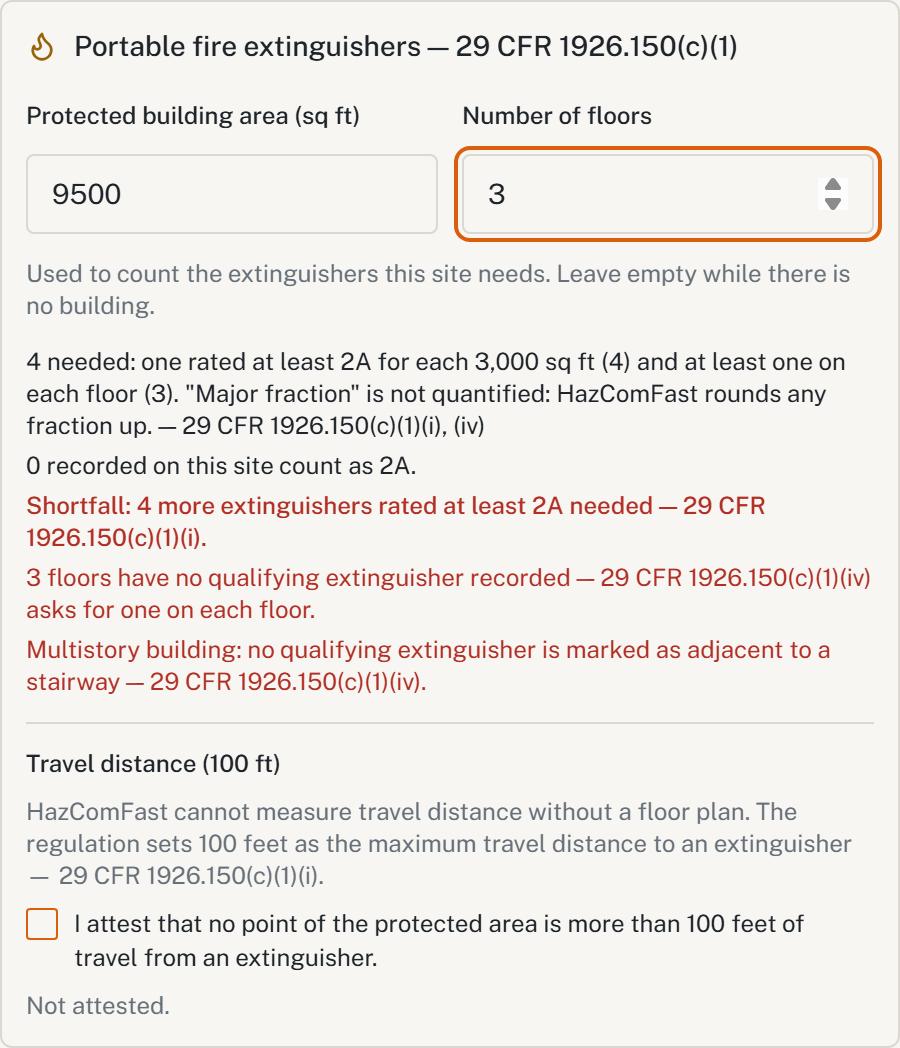
Each extinguisher is recorded as equipment, with its kind, its UL rating, its floor, whether it sits next to a stairway, and its location on site. A unit rated below 2A isn't counted toward the 2A total. A water drum or a garden hose counts only once you attest that it meets the conditions of (c)(1)(ii) or (c)(1)(iii). The site then lists what's missing: the shortfall, each floor with no qualifying unit, and a multistory building with none marked at a stair.
The 100-foot travel distance is an attestation you sign for the site. Change the area or the number of floors and the attestation asks to be signed again. Inspections follow the regime of the site: a monthly default on a construction site, with the screen stating that 1926.150(a)(4) sets no federal frequency, and the monthly and annual checks of 1910.157(e)(2) and (e)(3) on a general industry site.
The same block checks flammable liquid storage against the federal minimums of 1926.152, and against your local fire code limit when you enter one. And a construction site can't be activated without a fire protection program under 1926.24; a draft is enough to start.
Count the extinguishers for each site
Walk the site with a free weekly inspection checklist, or let HazComFast count what each jobsite needs under 1926.150 and show what's missing.
Related: OSHA fire safety requirements · Hot work permits and the fire watch · Which OSHA standards require an emergency action plan? · OSHA chemical storage requirements
Sources & verification (read on the eCFR, edition of 2026-10-01): 29 CFR 1926.150(a)(2) to (a)(4), (c)(1)(i) to (ix), (c)(2)(i); 1926.151(c)(6); 1926.152(b)(1), (c)(1), (d)(1), (d)(2), (d)(4) and (g)(11); 1926.153(l); 1926.352(d); 1910.157(e)(2) and (e)(3); 1926.24. General guidance, not legal advice.*
Frequently Asked Questions
How many fire extinguishers does OSHA require on a construction site?
Under 29 CFR 1926.150(c)(1)(i), one extinguisher rated at least 2A for each 3,000 square feet of protected building area, or major fraction thereof, with no point more than 100 feet of travel from the nearest one. Under 1926.150(c)(1)(iv), at least one 2A extinguisher on each floor, and in multistory buildings at least one next to a stairway. The larger count wins, and the travel distance can push it higher.
What extinguisher is required near fuel and flammable liquids?
A 10B extinguisher within 50 feet wherever more than 5 gallons of flammable or combustible liquids or 5 pounds of flammable gas are being used, under 29 CFR 1926.150(c)(1)(vi). A 20-B extinguisher within 10 feet outside the door of a room storing more than 60 gallons of flammable liquids (1926.152(d)(1)), and 25 to 75 feet from an outdoor flammable liquid storage area (1926.152(d)(2)).
Can a water drum or hose replace an extinguisher?
Yes, for a 2A unit. 29 CFR 1926.150(c)(1)(ii) allows one 55-gallon open drum of water with two fire pails, and (c)(1)(iii) allows a 1/2-inch garden-type hose line, no longer than 100 feet, with a nozzle, at least 5 gallons per minute and a 30-foot horizontal stream, mounted on a rack or reel.
How often must jobsite extinguishers be inspected?
29 CFR 1926.150(a)(4) requires firefighting equipment to be periodically inspected and maintained in operating condition, and 1926.150(c)(1)(viii) refers to NFPA No. 10A-1970. The construction standard sets no fixed frequency; many contractors use monthly, which is the general industry rule at 29 CFR 1910.157(e)(2).
Does hot work need its own extinguisher?
29 CFR 1926.352(d) requires suitable fire extinguishing equipment to be immediately available in the work area and kept ready for instant use wherever welding or cutting is done. That's in addition to the 1926.150 count for the building.
Site-wide regulatory figures such as compliance dates and penalty amounts come from our regulatory source-of-truth modules, last checked against the eCFR, OSHA.gov, and the Federal Register on October 5, 2026. Last reviewed October 14, 2026.
About This Article
Published by: HazComFast
Published: October 13, 2026
Last Updated: October 14, 2026
- https://www.ecfr.gov/current/title-29/subtitle-B/chapter-XVII/part-1926/subpart-F/section-1926.150
- https://www.ecfr.gov/current/title-29/subtitle-B/chapter-XVII/part-1926/subpart-F/section-1926.152
- https://www.ecfr.gov/current/title-29/subtitle-B/chapter-XVII/part-1926/subpart-F/section-1926.153
- https://www.ecfr.gov/current/title-29/subtitle-B/chapter-XVII/part-1926/subpart-J/section-1926.352
This content is for informational purposes only and does not constitute legal advice.