
Tuesday, 2:10 in the afternoon. An extension ladder kicks out on wet decking, and the drywall finisher on it catches the guardrail with his left hand. Nobody falls. His foreman fills out a near-miss report from his phone: ladder, wet deck, no injury. On Thursday the finisher mentions that his wrist has been swelling, and that evening an urgent care clinic gives him a prescription anti-inflammatory and a rigid splint.
The near-miss report is still true. It is also no longer the whole story. Somewhere between Tuesday and Thursday, a report that belonged in your safety program became a case that belongs on the OSHA 300 Log, with a 301 and a deadline.
A near miss becomes an OSHA recordable case when someone was hurt and the injury meets the general recording criteria of 29 CFR 1904.7, such as medical treatment beyond first aid; it must then be entered on the 300 Log and 301 within seven calendar days of receiving that information, under 29 CFR 1904.29(b)(3).
At a glance: A near miss with nobody hurt is not recordable. A near miss where someone got first aid only is not recordable either (29 CFR 1904.7(b)(5)(ii)). It becomes recordable when the injury meets 1904.7: medical treatment beyond first aid, days away, restricted work, loss of consciousness, a significant diagnosed injury. Then the 7 calendar days of 1904.29(b)(3) run from when you receive the information, not from the incident. A hospitalization within 24 hours of the incident is also a 24-hour report to OSHA (1904.39(a)(2)).
A near miss with nobody hurt stays off the Log
The OSHA 300 Log records work-related injuries and illnesses. 29 CFR 1904.4 sets the conditions, and 29 CFR 1904.7 lists the outcomes that make a case recordable: death, days away from work, restricted work or transfer, medical treatment beyond first aid, loss of consciousness, or a significant injury or illness diagnosed by a physician or other licensed health care professional.
A ladder that kicks out with nobody hurt meets none of that. It belongs in your near-miss program, your corrective actions and maybe your next toolbox talk, which is where the near-miss article explains the difference between the Log and the report. Nothing in Part 1904 asks you to log it.
The case changes when the first word of the report stops being true. A worker who "caught himself" can have a strained wrist, a cut hand or a back that hurts the next morning. Whether that changes the recordkeeping depends on what happens next.
First aid keeps it off the Log
29 CFR 1904.7(b)(5)(ii) gives the complete list of first aid treatments. Among them: a nonprescription medication at nonprescription strength, cleaning or soaking a wound, a bandage or Steri-Strips, hot or cold therapy, an elastic wrap or other non-rigid support, removing a splinter by simple means, drinking fluids for heat stress. If the finisher's wrist had gotten an ice pack and an elastic bandage on Tuesday, the near miss would have stayed a near miss with first aid, and the Log would stay clean.
The list is exhaustive. A treatment that is not on it, given to treat the injury, is medical treatment. That is where the Thursday clinic visit changes everything: a prescription medication is medical treatment, and so is a rigid splint used to immobilize the wrist rather than to transport the worker. Either one makes the case recordable under 29 CFR 1904.7(b)(5). The recordability guide walks the full first-aid list item by item.
The 7 days start when you learn about the injury
29 CFR 1904.29(b)(3) requires you to enter each recordable injury or illness on the OSHA 300 Log and the 301 within seven calendar days of receiving information that a recordable injury or illness has occurred. Read the trigger closely. It is the information, not the incident.
In the ladder case, the company knew about the ladder on Tuesday, but it did not know about a recordable injury until the clinic visit on Thursday. Thursday is day zero. The case is due on the Log and the 301 by the following Thursday.
Two consequences follow.
- Ask the question again a few days later. A near miss with a "maybe sore" worker deserves a follow-up call. The day you learn about the prescription starts the count, and an employer who never asks does not get extra time by not knowing.
- Keep the near-miss report and the 301 linked. The 301 asks how the injury occurred and what the employee was doing just before. The near-miss report written on Tuesday, with its photos, answers that better than anybody's memory a week later.
When the near miss ends in a hospital
If the injury is severe, a second clock applies. An in-patient hospitalization, an amputation or the loss of an eye is reported to OSHA within 24 hours under 29 CFR 1904.39(a)(2), but only when it happens within 24 hours of the work-related incident, under 29 CFR 1904.39(b)(6). A worker admitted on day three after an infection is not a 24-hour report, though the case is very likely recordable. The 8-hour clock article has the full timing table, and California employers report every serious injury within 8 hours under Title 8 CCR §342(a).
Don't let the near miss become a reason not to report
A worker who reported a near miss and then comes back two days later with a hurt wrist is doing exactly what the rule wants. 29 CFR 1904.35(b)(1)(iv) says you must not discharge or in any manner discriminate against any employee for reporting a work-related injury or illness. And 29 CFR 1904.35(b)(1)(i) says a reporting procedure is not reasonable if it would deter or discourage a reasonable employee from accurately reporting.
Watch for two quiet ways a program breaks that rule. A safety bonus that disappears when an injury is recorded tells the crew not to come back with the swollen wrist. And a culture where "it was only a near miss" ends the conversation tells the foreman not to ask on Thursday. The rules on safety incentive programs cover what you can reward instead.
What the 301 has to say for a near miss that turned
The 301 for the ladder case is an ordinary 301, with one thing worth getting right: the timeline. Record the date of the incident as Tuesday, when the ladder kicked out, because that is when the injury occurred. Describe what happened in the worker's words where you can. And keep the date you learned about the recordable injury in your own records, because that date is what shows the case was entered on time under 29 CFR 1904.29(b)(3).
If you decide the case is not recordable, for example because the clinic gave only first aid after all, keep the reason. A one-line note that says "ice and elastic wrap only, first aid under 1904.7(b)(5)(ii)" is the answer to the question an inspector will ask when the near-miss report and the clinic note turn up in the same file.
How HazComFast connects the near miss and the 301
A near-miss report in HazComFast starts with one question: was anyone hurt, or did anyone get first aid or medical care? Answer yes, and the form says plainly that this may be an injury case and not a near miss. After you submit, the OSHA 301 opens, filled in from the report and linked to it, so the description written on the day comes with the case.
The 301's own questions then decide whether the case goes on the Log: work-relatedness and its exceptions, a new case or a continuation, and the 14 first aid treatments of 1904.7(b)(5)(ii). A person makes the call, and when a case stays off the Log, the reason, the date and the person who decided stay on file. The seven-day deadline is counted from the date you learned about the case, which the form asks for, and the case shows its due date with a red badge two days before it runs out, plus a notification in the app.
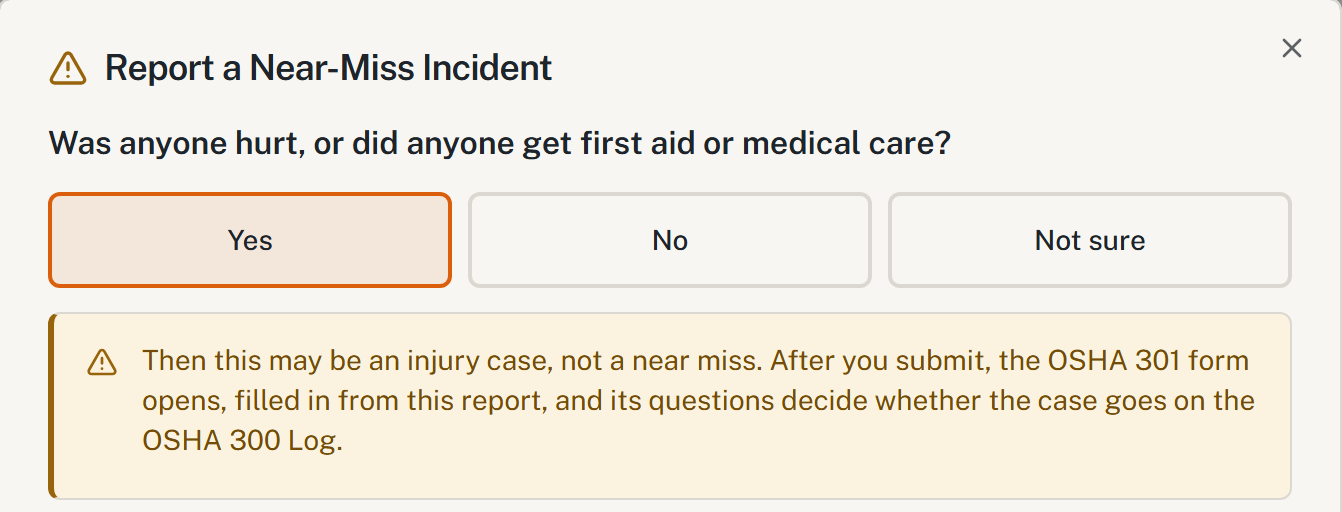
From the near miss to the 301, without retyping
HazComFast asks the injury question on every near-miss report, opens the 301 from it when the answer is yes, and counts the 7 days from the day you learned. Check a case's recordability free, or run your near misses and injury records in the app.
Related: Is a near miss OSHA recordable? · When is an injury recordable? · Work-relatedness exceptions · Root cause analysis: 5 Whys and fishbone
Sources & verification (read 2026-10-13 on osha.gov): 29 CFR 1904.4, 1904.7(a), (b)(5) and the first aid list of (b)(5)(ii); 1904.29(b)(3); 1904.35(b)(1)(i) and (iv); 1904.39(a)(2) and (b)(6). General guidance, not legal advice.*
Frequently Asked Questions
Is a near miss recordable on the OSHA 300 Log?
Not by itself. The Log records work-related injuries and illnesses that meet the general recording criteria of 29 CFR 1904.7. A near miss with nobody hurt has no injury to record. It becomes a recordable case when someone was hurt and the injury meets 1904.7, for example medical treatment beyond first aid or days away from work.
When does the 7-day recording deadline start if the injury shows up later?
From when you receive the information. 29 CFR 1904.29(b)(3) requires each recordable injury or illness on the OSHA 300 Log and 301 within seven calendar days of receiving information that a recordable case has occurred, so a near miss that turns into a clinic visit two days later is counted from the day you learn about the treatment.
If the worker only got first aid, is it recordable?
No. Treatments on the first aid list of 29 CFR 1904.7(b)(5)(ii), such as cleaning a wound, a bandage, a cold pack or a nonprescription drug at nonprescription strength, do not make a case recordable on their own. A prescription, sutures or days away from work under 1904.7(b) do.
Can I discipline a worker who reported a near miss and then an injury?
Not for reporting it. 29 CFR 1904.35(b)(1)(iv) says you must not discharge or in any manner discriminate against any employee for reporting a work-related injury or illness, and 1904.35(b)(1)(i) says a reporting procedure is not reasonable if it would deter a reasonable employee from reporting.
Does a near miss that ends in a hospitalization need to be reported to OSHA?
Yes, if the in-patient hospitalization happens within 24 hours of the incident. 29 CFR 1904.39(a)(2) requires the report within 24 hours of the hospitalization, and 1904.39(b)(6) limits that duty to hospitalizations within 24 hours of the work-related incident.
Site-wide regulatory figures such as compliance dates and penalty amounts come from our regulatory source-of-truth modules, last checked against the eCFR, OSHA.gov, and the Federal Register on October 5, 2026. Last reviewed October 13, 2026.
About This Article
Published by: HazComFast
Published: October 13, 2026
Last Updated: October 13, 2026
This content is for informational purposes only and does not constitute legal advice.