
The 301 for the roofer's sprained ankle says what happened: uneven decking at the landing zone, grade II sprain, right ankle. It is a good 301. It also answers none of the questions the superintendent will be asked on Monday. Why was the decking uneven where loads were landed? Who knew? What changes so the next ankle doesn't follow? That is the investigation report's job, and it is a different document.
An incident investigation report records the facts, the root causes and the corrective actions of a workplace incident; OSHA's 2015 investigation guide organizes it in four steps, and for process safety management incidents 29 CFR 1910.119(m)(4) requires at minimum the incident date, the date the investigation began, a description, the contributing factors and the recommendations.
At a glance: Mandatory content exists only for PSM incidents: date of incident, date investigation began, description, contributing factors, recommendations (29 CFR 1910.119(m)(4)), with corrective actions documented (m)(5), reviewed with affected personnel (m)(6), kept 5 years (m)(7). Everyone else follows OSHA's 2015 guide, which is advisory: preserve and document the scene, collect information, determine root causes, implement corrective actions. The report is not done when it names a cause; it is done when the corrective actions are in place.
What the law requires, and where it stops
For most employers, no OSHA standard says "write an investigation report." What the law requires is the recordkeeping: a 301 within seven calendar days under 29 CFR 1904.29(b)(3), and the 8- or 24-hour report to OSHA for the most severe events under 29 CFR 1904.39.
The exception is process safety management. 29 CFR 1910.119(m) requires an investigation of each incident that resulted in, or could reasonably have resulted in, a catastrophic release of a highly hazardous chemical, started no later than 48 hours after the incident, by a team that includes someone knowledgeable in the process. Its report has a minimum content, listed below, and construction work under 29 CFR 1926.64 follows the same 1910.119 requirements.
Everything else rests on OSHA's Incident [Accident] Investigations: A Guide for Employers, published in December 2015. The guide is clear that it is advisory and creates no new legal obligation. It is still the best template available, because it is what an OSHA compliance officer expects a serious employer to be doing.
The PSM minimum, a good floor for everyone
29 CFR 1910.119(m)(4) lists what the report includes at a minimum:
- Date of incident
- Date the investigation began
- A description of the incident
- The factors that contributed to the incident
- Any recommendations resulting from the investigation
Two more paragraphs complete it. Under 29 CFR 1910.119(m)(5), the employer establishes a system to promptly address and resolve the findings, and resolutions and corrective actions are documented. Under 29 CFR 1910.119(m)(6), the report is reviewed with all affected personnel whose job tasks are relevant to the findings, including contract employees. And 29 CFR 1910.119(m)(7) keeps the report five years.
Even if you never touch a highly hazardous chemical, that list is a sound floor. Item 2 is the one most reports skip, and it is the one that shows the investigation started while memories were fresh.
The report, section by section, following OSHA's guide
The guide's Appendix A is an investigation form in five sections, mapped to its four steps. A complete report covers each of them.
Section A: the investigation itself. Company, date, and the investigator or team with names and titles. The guide recommends a team in which managers and employees work together, because each brings different knowledge and perspective, and because people who build the conclusions own them.
Section B: the incident and the injury. The injured employee's name and age, first language, job title, the job at the time of injury, type of employment (full-time, part-time, temporary, seasonal), time with the company and in the position, and the description and severity of the injury. Then the date, time and location, and a detailed description of what happened before, during and after, preferably in the injured employee's own words. Then the eyewitness accounts and those of other employees with knowledge, each with the person's name, title and the date and time of the interview.
Section C: root causes. What caused or allowed the incident to happen. The guide defines root causes as the underlying reasons why unsafe conditions exist or why a procedure or safety rule was not followed, and says they generally reflect management, design, planning, organizational or operational failings. It points to the areas where contributing factors usually sit: equipment and machinery, tools, procedures, training, and the work environment. And it adds the question that turns a list of factors into root causes: why weren't these factors addressed before the incident?
Section D: recommended corrective actions. What will prevent the next incident.
Section E: corrective actions taken. What was actually done, and which root causes it addressed. The guide is direct about it: the investigation is not complete until corrective actions that address the root causes are implemented.
Evidence that belongs with the report
Step 1 of the guide is to preserve and document the scene: cones or tape to keep material evidence from being moved, then photographs, video and sketches. Step 2 collects information through interviews and documents, and the guide lists the documents worth pulling: equipment manuals, industry guidance, company policies and records, maintenance schedules and logs, training records, audit reports, enforcement records and previous corrective action recommendations.
For a jobsite incident, that usually means the site's daily log and pre-task plan, the training record of everyone involved, the inspection record for the equipment, the JHA for the task, and photos taken before anything was cleaned up. Attach them, or reference where they live. A report that says "decking was uneven" with a photo of the landing zone and the morning's inspection record is evidence. Without them it is an opinion.
The parts most reports leave out
- The date the investigation began. It shows promptness, and for PSM it is mandatory.
- The why behind the why. "Worker did not follow procedure" is where the guide says the analysis starts, not where it ends: why wasn't it followed, was the procedure out of date, did production pressure play a role?
- Corrective actions that change the system. The guide calls "employees must remember to wear PPE" a weak corrective action. Strong ones change equipment, procedures, staffing or supervision.
- Owners and dates. A recommendation without a name and a due date rarely gets done.
- The close-out. Section E: what was done, by whom, when, and how you checked it worked.
- Blame. The guide says an investigation focused on fault will always stop short of the root causes. Keep names in the facts and out of the conclusions.
How HazComFast handles the investigation
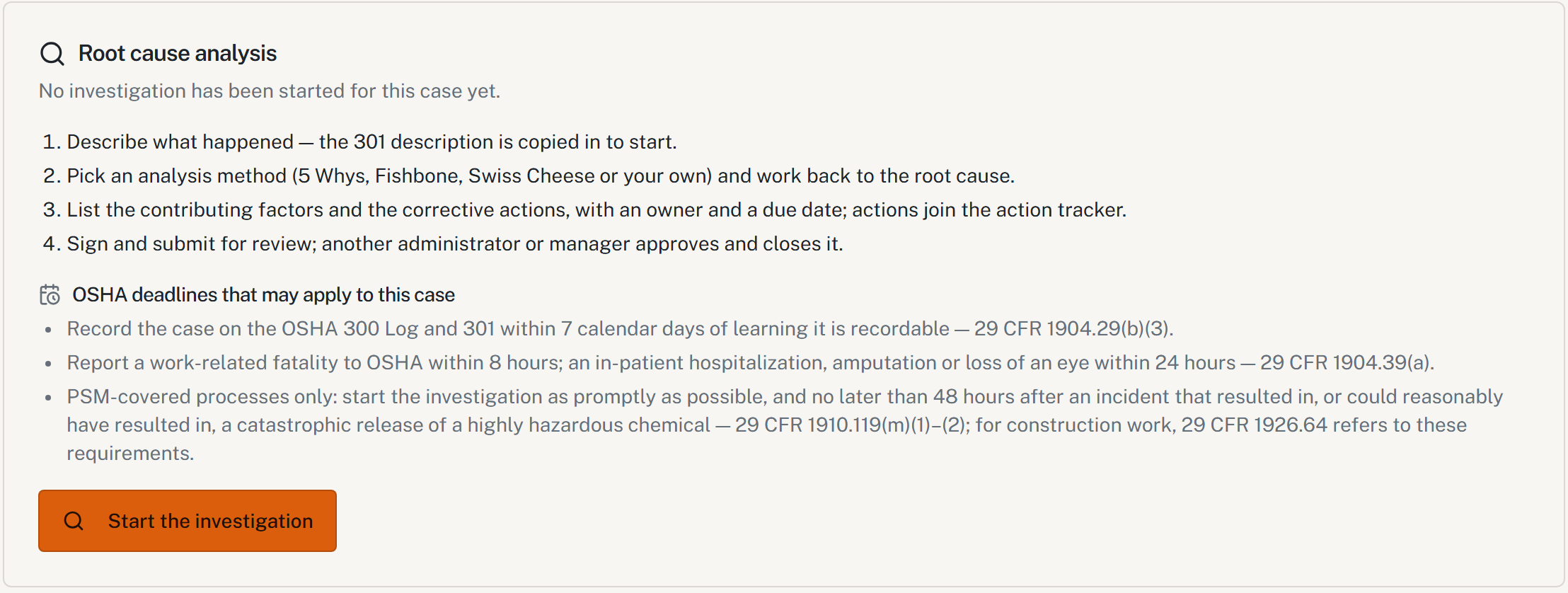
In HazComFast, the investigation lives on the 301 case it explains, in its own Investigation and root cause analysis tab, so the injury record and its follow-up stay together. You choose a root cause method, the 5 Whys, the fishbone or the Swiss cheese model, and an empty analysis is refused. Photos go in by category, each with its caption, and a draft is offered back with its time if you leave before saving.
When the investigator is done, the investigation goes to review. The reviewer is notified and can approve it or send it back with a comment, and the person who submitted it can't approve their own work: another admin or manager has to. A completed investigation is signed and becomes read-only, and reopening it is recorded. Corrective actions are tracked with an owner and a due date. The PDF prints the long fields in full, the analysis, the captioned photos and the signatures.
From the 301 to the corrective action, in one file
Track a near miss and its corrective action free, or run your investigations in HazComFast with a second reviewer, a signature and a PDF that carries the whole story.
Related: Root cause analysis: 5 Whys and fishbone · OSHA Form 301, item by item · The near miss that turned into an injury · Near miss, JHA and LOTO
Sources & verification (read 2026-10-13): OSHA, Incident [Accident] Investigations: A Guide for Employers (December 2015), including its disclaimer, the four steps and the Appendix A form; 29 CFR 1910.119(m)(1) to (m)(7); 29 CFR 1926.64; 29 CFR 1904.29(b)(3), 1904.33(a) and 1904.39, on osha.gov. General guidance, not legal advice.*
Frequently Asked Questions
Does OSHA require an incident investigation report?
For most workplaces, no single OSHA standard requires one. The process safety management standard does: 29 CFR 1910.119(m)(4) requires a report at the end of each investigation of an incident that resulted in, or could reasonably have resulted in, a catastrophic release of a highly hazardous chemical, and construction work covered by 29 CFR 1926.64 follows 1910.119. OSHA's 2015 guide recommends investigating every incident, close calls included.
What must a PSM incident investigation report contain?
At a minimum, under 29 CFR 1910.119(m)(4): the date of the incident, the date the investigation began, a description of the incident, the factors that contributed to the incident, and any recommendations resulting from the investigation. Resolutions and corrective actions must be documented under 1910.119(m)(5).
Is the OSHA 301 the same as an investigation report?
No. The 301 under 29 CFR 1904.29 records what happened to the employee and how. An investigation report goes further: why it happened, which root causes allowed it, and what will change. Many employers attach the investigation to the 301, which keeps the case and its follow-up together.
How long do I keep an incident investigation report?
Five years for a PSM investigation, under 29 CFR 1910.119(m)(7). For other investigations, keep it at least as long as the 301 it explains, which 29 CFR 1904.33(a) keeps for five years after the end of the calendar year.
Who should sign off on the report?
OSHA's guide recommends a team in which managers and employees work together. Under 29 CFR 1910.119(m)(6), a PSM report is reviewed with all affected personnel whose job tasks are relevant to the findings, contract employees included. A second reviewer before closing is good practice everywhere.
Site-wide regulatory figures such as compliance dates and penalty amounts come from our regulatory source-of-truth modules, last checked against the eCFR, OSHA.gov, and the Federal Register on October 5, 2026. Last reviewed October 13, 2026.
About This Article
Published by: HazComFast
Published: October 13, 2026
Last Updated: October 13, 2026
This content is for informational purposes only and does not constitute legal advice.