A roofer slips on a low-slope roof in San Diego at 10:30 in the morning. By noon the hospital has admitted him. If your safety manager learned the habit on federal OSHA's rule, the reflex is to report by tomorrow morning: 29 CFR 1904.39(a)(2) gives 24 hours for an in-patient hospitalization. In California, that reflex makes you late. Title 8 CCR 342(a) wants the report within 8 hours of the moment you knew, and it counts a broader set of injuries than the federal list.
California employers must report any serious injury or illness, or a death, to Cal/OSHA immediately, and 8 CCR 342(a) sets the outer limit at 8 hours after the employer knows or with diligent inquiry would have known; federal OSHA's 24-hour window for hospitalizations, amputations and eye losses does not apply.
At a glance: One clock for every serious event in California: 8 hours from when you knew or should have known (8 CCR 342(a)). Up to 24 hours only when you can demonstrate exigent circumstances. "Serious" follows 8 CCR 330(h): inpatient hospitalization of any length (other than observation or diagnostic testing), amputation, loss of an eye, serious permanent disfigurement, plus deaths. Report by phone to the nearest district office; email is the fallback until Cal/OSHA's online mechanism exists. Failing to report carries a $5,000 minimum (Labor Code 6409.1(b)).
What 8 CCR 342(a) says
Every employer reports to the Division of Occupational Safety and Health any serious injury or illness, or death, of an employee in a place of employment or in connection with any employment. The report is made immediately. And "immediately" has a number attached: as soon as practically possible, but not longer than 8 hours after the employer knows or with diligent inquiry would have known of the death or serious injury or illness.
If the employer can demonstrate that exigent circumstances exist, the report may be made no longer than 24 hours after the incident. Read the wording carefully. The burden sits on you, the 24 hours run from the incident and not from when you learned of it, and "we were busy" is not an exigent circumstance. Plan on 8.
What counts as a serious injury or illness in California?
California's definition lives in 8 CCR 330(h), and it follows Labor Code section 6302 as amended by AB 1805, in force since January 1, 2020. A serious injury or illness is any injury or illness occurring in a place of employment or in connection with any employment that:
- requires inpatient hospitalization for other than medical observation or diagnostic testing, whatever its length;
- involves an amputation;
- involves the loss of an eye;
- involves any serious degree of permanent disfigurement.
Deaths are reported under the same paragraph. The definition excludes an injury, illness or death caused by an accident on a public street or highway, unless the accident occurred in a construction zone. For a road crew or a utility contractor working a lane closure, that exception does not help: the construction zone is exactly where the work happens.
The length of the hospital stay no longer matters, so a one-night formal admission counts. Permanent disfigurement has no federal counterpart in 29 CFR 1904.39: a severe burn scar or a crush injury that leaves a visible deformity can be reportable in California when nothing on the federal list applies.
Federal and California side by side
| Event | Federal OSHA (29 CFR 1904.39) | California (8 CCR 342(a) and 330(h)) |
|---|---|---|
| Death | 8 hours, 29 CFR 1904.39(a)(1) | 8 hours |
| In-patient hospitalization | 24 hours, 29 CFR 1904.39(a)(2); a formal admission for care or treatment, 29 CFR 1904.39(b)(9) | 8 hours, any length, other than observation or diagnostic testing |
| Amputation | 24 hours, 29 CFR 1904.39(a)(2) | 8 hours |
| Loss of an eye | 24 hours, 29 CFR 1904.39(a)(2) | 8 hours |
| Serious permanent disfigurement | not on the list | 8 hours |
| Public street or highway accident | not reported unless in a construction work zone, 29 CFR 1904.39(b)(3) | excluded unless in a construction zone |
| Clock starts | when the event is reported to you or your agents, if you learn later, 29 CFR 1904.39(b)(7) | when you know, or with diligent inquiry would have known |
| How to report | Area Office by phone, 1-800-321-OSHA or online, 29 CFR 1904.39(a)(3); no email, fax or voicemail, 29 CFR 1904.39(b)(1) | phone to the district office, or email until the online mechanism exists |
The last row matters more than it looks. Federal OSHA starts the clock late when the employer learns late, under 29 CFR 1904.39(b)(7). California asks what you would have known with diligent inquiry. A foreman who drives the injured worker to the hospital, then waits until the next morning to tell the office, does not buy the company extra time: the company knew through him.
How to report
Section 342(a) allows a report by telephone or through an online mechanism the Division establishes for the purpose, and until that mechanism is available, by telephone or email. Cal/OSHA's own instructions put the phone first: call the district office nearest the site. Email is the fallback, at caloshaaccidentreport@tel-us.com. That is one place where California is more forgiving than federal OSHA: under 29 CFR 1904.39(b)(1), an email, a fax or a voicemail to the Area Office does not count as a report, and the federal options are a call to the Area Office, the 1-800-321-OSHA line or the online form in 29 CFR 1904.39(a)(3). The Cal/OSHA email instructions page lists what the message has to carry.
Section 342(c) asks for the same facts, if available, whichever channel you use:
- Time and date of the accident or event
- Employer's name, address and telephone number
- Name and job title of the person reporting
- Address of the accident site
- Name of the person to contact at the site
- Name and address of each injured employee
- Nature of the injuries
- Where each injured employee was taken for treatment
- Other law enforcement agencies present at the site
- A description of the accident and whether the scene or the equipment has been altered
Item 10 deserves a note to the crew. Don't move the equipment or clean up beyond what safety requires before somebody writes down what the scene looked like, because the question will be asked.
The fire department and the police have their own duty under 342(b): when they respond to an accident involving a serious injury, illness or death of a covered employee, they notify the nearest Cal/OSHA office. Their call does not replace yours. A district office that hears about your accident from a fire captain before it hears from you already has questions.
The penalty for a late or missing report
California Labor Code section 6409.1(b) sets a civil penalty of not less than $5,000 for an employer who fails to make the immediate report. That floor applies before anyone looks at what caused the injury. An employer that handles the medical side well and still reports at hour 20 can face the minimum for the report alone.
Mistakes that turn into a late report
- Using the federal 24 hours. For a hospitalization in California, that habit is three times too long.
- Waiting for the hospital to decide. The clock runs from knowledge of the admission, so call the hospital or the family for a status rather than waiting for a discharge summary. "Admitted" is the word that starts the count.
- Counting from the injury instead of the knowledge, or the reverse. The 8 hours run from when the employer knew or should have known. The exigent 24 hours run from the incident.
- Leaving the call to whoever is free. Name the person who reports, a backup, and the district office number in the site's emergency information, so the call happens on a Saturday too.
- Forgetting disfigurement. A burn or a crush injury that leaves a serious, permanent disfigurement is reportable in California even when nobody was admitted.
- Treating a heart attack as personal. A heart attack at work is reported like any other event. Federal 29 CFR 1904.39(b)(5) says so for OSHA, and California's definition in §330(h) has no exclusion for it.
How HazComFast handles a California case
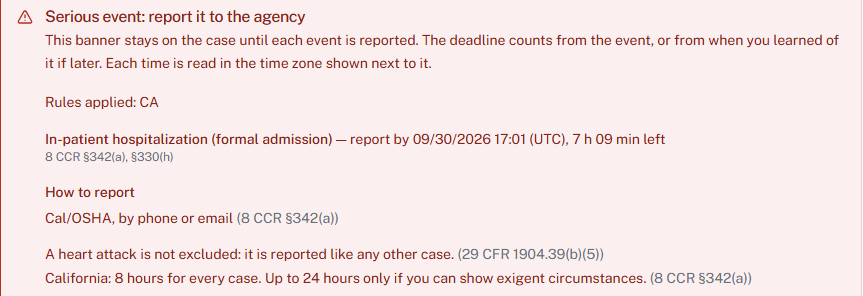
When a 301 case in HazComFast records an inpatient hospitalization, an amputation or the loss of an eye, the case shows a red banner that stays until each event is reported. For an establishment in California, the deadline is 8 hours, shown as a date and time with the time left, and the banner cites 8 CCR 342(a) and 330(h). It names the channel, Cal/OSHA by phone or email, and states the exigent-circumstances limit in the rule's own terms. The facts to give are listed and ready to copy into the call notes or the email, and admins hear about the case right away.
Once you have called, you record the report on the case, and it stays listed under the case's reports. That is the proof you will want when somebody asks whether the call was made on time.
Know the deadline before the hospital calls back
HazComFast puts the reporting deadline on the case the moment a serious event is recorded, with California's 8 hours for a California establishment. Check a case's recordability free, or run your injury records in the app.
Related: When does OSHA's 8-hour reporting clock start? · Cal/OSHA first aid and CPR on construction sites · 19,690 amputations and hospitalizations: what OSHA's severe injury data reveals · OSHA 300 Log requirements · Forms 300, 300A and 301
Sources & verification (read 2026-10-13): 8 CCR 342(a), (b) and (c) and 8 CCR 330(h) on dir.ca.gov; Cal/OSHA's FAQ on the AB 1805 and AB 1804 changes in force since January 1, 2020; Cal/OSHA's email reporting instructions; California Labor Code section 6409.1(b); federal 29 CFR 1904.39(a), (b)(3), (b)(7) and (b)(9) on osha.gov. General guidance, not legal advice.*
Frequently Asked Questions
How long do California employers have to report a serious injury to Cal/OSHA?
Eight hours. Title 8 CCR §342(a) requires the report immediately, defined as as soon as practically possible and no longer than 8 hours after the employer knows, or with diligent inquiry would have known, of the death or serious injury or illness. Only if the employer can demonstrate exigent circumstances may the report come up to 24 hours after the incident.
What counts as a serious injury or illness in California?
Under Title 8 CCR §330(h), any injury or illness at work or in connection with employment that requires inpatient hospitalization for other than medical observation or diagnostic testing, or in which an employee suffers an amputation, the loss of an eye, or any serious degree of permanent disfigurement. A death is reported under §342(a) as well. Accidents on a public street or highway are excluded unless they happened in a construction zone.
Can I report a serious injury to Cal/OSHA by email?
Title 8 CCR §342(a) allows a report by telephone or through an online mechanism the Division establishes, and until that mechanism exists, by telephone or email. Cal/OSHA asks employers to phone the nearest district office first and publishes caloshaaccidentreport@tel-us.com for email reports, with the information listed in §342(c). Federal OSHA is stricter on the channel: 29 CFR 1904.39(b)(1) rules out email, fax and answering machines.
What is the penalty for not reporting a serious injury in California?
California Labor Code §6409.1(b) sets a civil penalty of not less than $5,000 for an employer who fails to make the immediate report. The reporting duty itself sits in Title 8 CCR §342(a), and the definition of a serious injury or illness in §330(h).
Does the federal 24-hour rule apply to a California employer?
Federal 29 CFR 1904.39(a)(2) gives 24 hours for an in-patient hospitalization, amputation or loss of an eye, but a California employer under Cal/OSHA's jurisdiction reports under 8 CCR 342(a), which allows 8 hours for every serious injury or illness and for a death. Planning around 24 hours is how California employers end up late.
Site-wide regulatory figures such as compliance dates and penalty amounts come from our regulatory source-of-truth modules, last checked against the eCFR, OSHA.gov, and the Federal Register on October 5, 2026. Last reviewed October 14, 2026.
About This Article
Published by: HazComFast
Published: October 13, 2026
Last Updated: October 14, 2026
This content is for informational purposes only and does not constitute legal advice.