The question usually comes from the superintendent, three days after an injury: "Are we done with the investigation?" The honest answer depends on what "done" means. The OSHA report, if one was due, had to go out within hours. The 301 is due within a week. The investigation itself has no federal deadline at all, unless the incident was a process safety event. What it has is a standard of reasonableness that an inspector, an insurer and a jury will apply later, by looking at the dates in your file.
OSHA sets no general deadline for completing an incident investigation; it sets deadlines around it: 8 or 24 hours to report a severe event under 29 CFR 1904.39, 7 calendar days for the 301 under 1904.29(b)(3), and, for process safety incidents, a start within 48 hours under 1910.119(m)(2). OSHA's 2015 guide asks employers to set their own written timetable.
At a glance: Report a fatality within 8 hours, a hospitalization, amputation or eye loss within 24 hours (29 CFR 1904.39). Record the case on the 300 Log and 301 within 7 calendar days (1904.29(b)(3)). Start a PSM investigation within 48 hours (1910.119(m)(2)). Finish: no federal deadline; OSHA's guide wants a written timetable and says the investigation is not complete until corrective actions are implemented. Keep a PSM report 5 years (1910.119(m)(7)).
Which clocks does OSHA actually set?
Three deadlines run around an incident, and none of them is "finish the investigation".
| Deadline | What | Rule |
|---|---|---|
| 8 hours | Report a work-related fatality to OSHA | 29 CFR 1904.39(a)(1) |
| 24 hours | Report an in-patient hospitalization, amputation or loss of an eye | 29 CFR 1904.39(a)(2) |
| 7 calendar days | Enter a recordable case on the 300 Log and the 301 | 29 CFR 1904.29(b)(3) |
| 48 hours | Start the investigation of a process safety incident | 29 CFR 1910.119(m)(2) |
| 5 years | Keep a PSM investigation report | 29 CFR 1910.119(m)(7) |
California shortens the first two to 8 hours for every serious injury or illness under Title 8 CCR §342(a); the Cal/OSHA article has the details. The 8-hour clock article covers when each federal clock starts.
What OSHA's guide asks instead of a deadline
OSHA's Incident [Accident] Investigations: A Guide for Employers, from December 2015, is advisory, and it says so. It still answers the timing question in two ways.
First, it asks for a written program prepared before anything happens, including timetables for completing the investigation and for developing and implementing recommendations. The timetable is yours to set. The guide's point is that it should exist on paper before the incident, not be improvised after.
Second, it is specific about the start. Interviews must be conducted as promptly as possible, as soon as things have settled down and the site is secure and safe, because memories fade and the sooner a witness is interviewed, the more accurate and candid the statement. And it is specific about the end: the investigation is not complete until corrective actions that address the root causes are implemented.
For process safety incidents, 29 CFR 1910.119(m)(2) turns "promptly" into a number: as promptly as possible, but not later than 48 hours following the incident. That 48 hours is a useful benchmark for any serious incident, PSM or not.
A timetable you can defend
The timetable below is a recommendation, not a rule. It follows the guide's four steps and the deadlines above, and it is the kind of timetable that holds up when someone reads your file a year later.
- First hour: make safe, then preserve. Emergency response first, as the guide insists. Then tape or cone off the scene and photograph it before anything moves.
- Same shift: notify and open the file. Management notified, the investigation opened with today's date as its start, witnesses identified. If the event is reportable, the 8- or 24-hour report is made now.
- Within 24 hours: the interviews. The injured worker when medically possible, the witnesses, the foreman. In each person's language, as fact-finding, not fault-finding.
- Within 48 hours: the investigation under way. Documents pulled: daily log, pre-task plan, JHA, training and inspection records, maintenance logs.
- Within 7 days: the 301 complete. It records the case; the investigation explains it.
- Within about two weeks: root causes and recommended corrective actions. With an owner and a due date for each action.
- Close when the corrective actions are in place, and checked to work. Then review the findings with the crews whose work they touch.
Some investigations will run past two weeks, and that's fine when the file says why: a lab result, a manufacturer's teardown of a failed component, an injured worker who can't be interviewed yet. What doesn't hold up is a file with no dates, or one where the analysis sat untouched for a month.
What slows investigations down, and what to do about it
- Waiting for the medical outcome. Start anyway. The classification on the Log can change later; the scene and the memories won't wait.
- Waiting for one person. Interview everyone else, note the missing interview and its expected date.
- Disagreement about cause. Write down both versions and the evidence for each. The guide's method, asking why until you reach the program failure, usually settles it.
- No owner. An investigation assigned to "safety" belongs to nobody. Name the investigator and the reviewer on day one.
- Corrective actions that never close. Track them like the work they are: owner, due date, status, proof.
How HazComFast keeps the dates
In HazComFast, the investigation opens from the 301 case it explains, so its start date and the incident date sit side by side. A draft is kept with the time it was saved. The investigations list shows what is waiting for review, what is in progress and what is completed, for each person who reviews.
Each step leaves a dated line in the investigation's history: who edited the analysis or the interviews and when, when it was submitted for review, when changes were requested and with what comment, and when it was approved and signed. Corrective actions carry an owner, a due date and a status, so the question "is it done?" has an answer with dates. The person who submitted an investigation can't approve it; another admin or manager does.
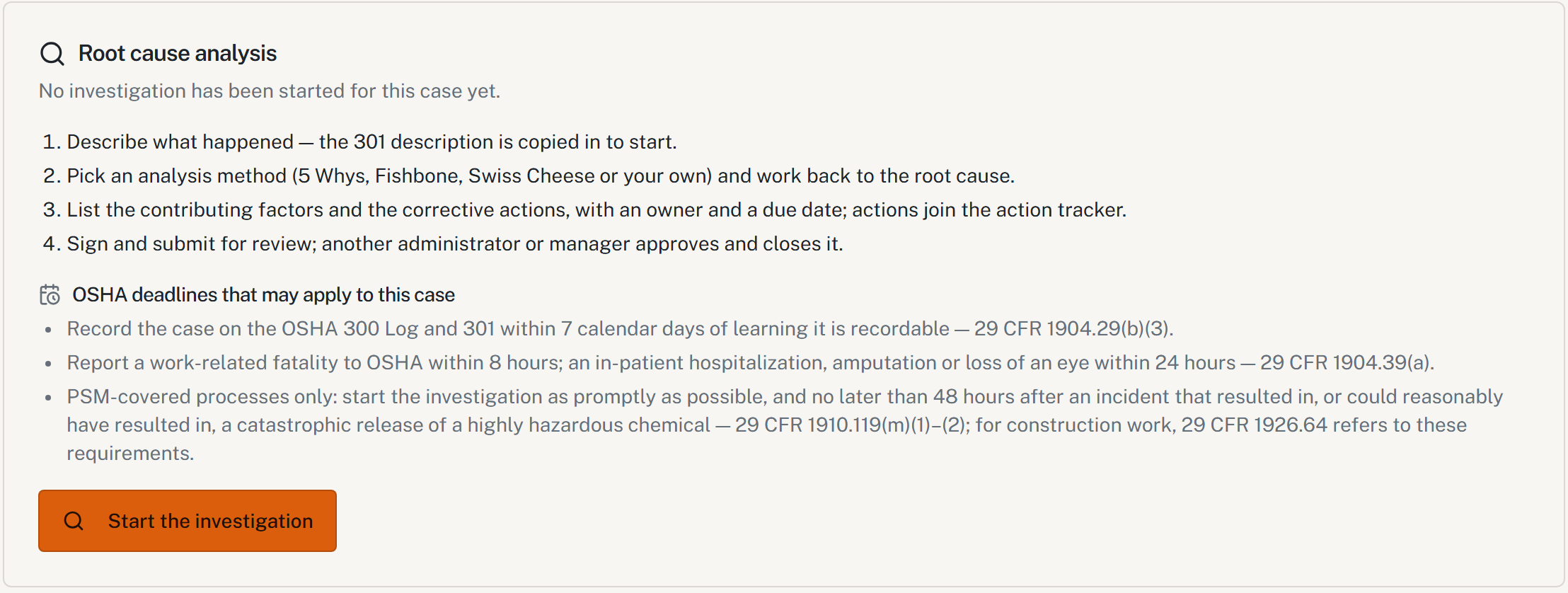
An investigation file with its dates
Track near misses and corrective actions free, or run your investigations in HazComFast, where every step is dated and a second person approves.
Related: What goes in an incident investigation report · Root cause analysis: 5 Whys and fishbone · When does OSHA's 8-hour clock start? · OSHA Form 301, item by item
Sources & verification (read 2026-10-13): OSHA, Incident [Accident] Investigations: A Guide for Employers (December 2015); 29 CFR 1910.119(m)(2), (m)(5) and (m)(7); 29 CFR 1904.29(b)(3), 1904.33(a), 1904.39(a)(1) and (a)(2); Title 8 CCR §342(a). General guidance, not legal advice.*
Frequently Asked Questions
Is there an OSHA deadline to complete an incident investigation?
Not in general. OSHA sets deadlines around the incident: 8 hours for a fatality and 24 hours for a hospitalization, amputation or loss of an eye under 29 CFR 1904.39, and 7 calendar days for the 300 Log and 301 under 1904.29(b)(3). For process safety management incidents, 29 CFR 1910.119(m)(2) requires the investigation to start no later than 48 hours after the incident, without setting a date to finish.
When should an investigation start?
As soon as the site is safe. OSHA's 2015 investigation guide says interviews must be conducted as promptly as possible because memories fade, and for PSM incidents 29 CFR 1910.119(m)(2) sets the outer limit at 48 hours after the incident.
How long should root cause analysis and corrective actions take?
Long enough to reach the root causes, and no longer than your written timetable allows. OSHA's guide asks employers to set timetables for completing the investigation and implementing recommendations, and for PSM, 29 CFR 1910.119(m)(5) requires a system to promptly address and resolve the findings.
Can I close the investigation before the corrective actions are done?
OSHA's guide says the investigation is not complete until corrective actions that address the root causes are implemented. For PSM incidents, 29 CFR 1910.119(m)(5) requires resolutions and corrective actions to be documented.
How long do I keep the investigation file?
Five years for a PSM investigation report under 29 CFR 1910.119(m)(7). For other incidents, keep it with the 301 it explains, which 29 CFR 1904.33(a) keeps for five years after the end of the calendar year.
Site-wide regulatory figures such as compliance dates and penalty amounts come from our regulatory source-of-truth modules, last checked against the eCFR, OSHA.gov, and the Federal Register on October 5, 2026. Last reviewed October 14, 2026.
About This Article
Published by: HazComFast
Published: October 13, 2026
Last Updated: October 14, 2026
This content is for informational purposes only and does not constitute legal advice.