
A carpenter falls from a scaffold on a Thursday afternoon. He is admitted to the hospital, and he dies there eleven days later, on a Monday morning at 6:40. The site superintendent hears about it from the family at 9:15. Somebody in the office asks the question this article answers: did OSHA's 8 hours start at the fall, at 6:40, or at 9:15? Under 29 CFR 1904.39, the answer is 9:15, and the company has until 5:15 that afternoon. It also had a 24-hour report to make eleven days earlier, for the hospitalization.
OSHA's 8-hour clock for reporting a work-related death starts at the death, or later when the death is first reported to the employer or any of its agents, under 29 CFR 1904.39(a)(1) and (b)(7); a death is reportable only if it occurs within 30 days of the incident, and a hospitalization, amputation or loss of an eye only if it occurs within 24 hours of the incident.
At a glance: 8 hours for a fatality, 24 hours for an in-patient hospitalization, an amputation or the loss of an eye (29 CFR 1904.39(a)). Each clock starts at the event, or when the event is reported to you or any of your agents if you learn later (1904.39(b)(7)). A death counts only if it comes within 30 days of the incident; a hospitalization, amputation or eye loss only if it comes within 24 hours (1904.39(b)(6)). Report by phone to the Area Office, 1-800-321-OSHA, or online; not by email or voicemail (1904.39(a)(3), (b)(1)).
The two clocks, in the rule's words
29 CFR 1904.39(a)(1) says that within eight hours after the death of any employee as a result of a work-related incident, you must report the fatality to OSHA. 29 CFR 1904.39(a)(2) sets twenty-four hours after the in-patient hospitalization of one or more employees, or an employee's amputation, or an employee's loss of an eye, as a result of a work-related incident.
Notice what each clock is attached to. The 8 hours run from the death, not from the accident. The 24 hours run from the hospitalization, the amputation or the loss of the eye. In most cases those happen on the same day as the accident. In the scaffold case above, they happen eleven days apart, and the company owes two reports.
When you learn late: 1904.39(b)(7)
The rule expects that you won't always know at once. 29 CFR 1904.39(b)(7) says that if you do not learn about a reportable event at the time it takes place, you must report it within eight hours for a fatality, and twenty-four hours for an in-patient hospitalization, amputation or loss of an eye, after it is reported to you or to any of your agents.
"Any of your agents" carries the weight of that paragraph. A foreman, a superintendent, a site safety lead: when one of them learns that a worker was admitted, the company has learned. The clock does not wait for the information to travel to the office, and a supervisor who sits on a phone call until Monday has spent the company's time.
Two practical habits follow. Tell every supervisor that a hospital admission or an amputation is a phone call to the office within the hour, whatever the day. And write down when each person learned what, because the report's timing will be measured from the first of those moments.
The windows that decide whether to report at all
29 CFR 1904.39(b)(6) puts an outer limit on both clocks. You report a fatality only if it occurs within thirty days of the work-related incident. You report an in-patient hospitalization, an amputation or a loss of an eye only if it occurs within twenty-four hours of the incident.
| Situation | Report? | Clock |
|---|---|---|
| Worker dies at the scene | Yes, 29 CFR 1904.39(a)(1) | 8 hours from the death |
| Worker admitted the same day, dies on day 11 | Yes, twice | 24 hours from the admission, then 8 hours from the death, 29 CFR 1904.39(a) |
| Worker dies on day 40 | No fatality report, 29 CFR 1904.39(b)(6) | the earlier hospitalization report still applies if it came within 24 hours |
| Worker admitted on day 3 after a slow infection | No hospitalization report, 29 CFR 1904.39(b)(6) | the case still goes on the 300 Log if recordable |
| You learn of an admission two days later | Yes | 24 hours from when you or an agent learned, 29 CFR 1904.39(b)(7) |
| Heart attack at work | Yes, 29 CFR 1904.39(b)(5) | same clocks as any other event |
| Car crash on a public highway outside a work zone | No, 29 CFR 1904.39(b)(3) | the case may still be recordable |
The table's last column carries a point people miss: the reporting rule and the recording rule are separate. An event OSHA does not want reported within 8 or 24 hours can still belong on the OSHA 300 Log under 29 CFR 1904.4 to 1904.7, entered within seven calendar days under 29 CFR 1904.29(b)(3).
What counts as an in-patient hospitalization
29 CFR 1904.39(b)(9) defines it as a formal admission to the in-patient service of a hospital or clinic for care or treatment. OSHA's reporting page says it plainly: treatment in an emergency room only is not reportable. A hospitalization that involves only observation or diagnostic testing is not reportable either, under 29 CFR 1904.39(b)(10). When the hospital keeps the worker, ask whether it is a formal admission, and start counting from the answer.
How to report, and what to say
29 CFR 1904.39(a)(3) gives three methods: by phone or in person to the OSHA Area Office nearest the site, by phone to 1-800-321-OSHA (1-800-321-6742), or through the reporting application on osha.gov. 29 CFR 1904.39(b)(1) closes the shortcuts: a message on the Area Office answering machine, a fax or an email does not count when the office is closed. Use the toll-free line or the online form.
Have these ready before you call, the list in 29 CFR 1904.39(b)(2):
- The establishment name
- The location of the work-related incident
- The time of the work-related incident
- The type of reportable event: fatality, in-patient hospitalization, amputation or loss of an eye
- The number of employees who suffered it
- The names of those employees
- Your contact person and phone number
- A brief description of the incident
Write down the time of the call, the name of the person you spoke to, and any confirmation number from the online form. That note is the proof that the clock was met.
California runs one clock, and it is shorter
A California employer reports to Cal/OSHA under Title 8 CCR §342(a): 8 hours for every serious injury or illness and for a death, counted from when the employer knows or with diligent inquiry would have known, and a definition in §330(h) that adds serious permanent disfigurement. The details are in California serious injury reporting: 8 hours, not 24.
How HazComFast keeps the clock
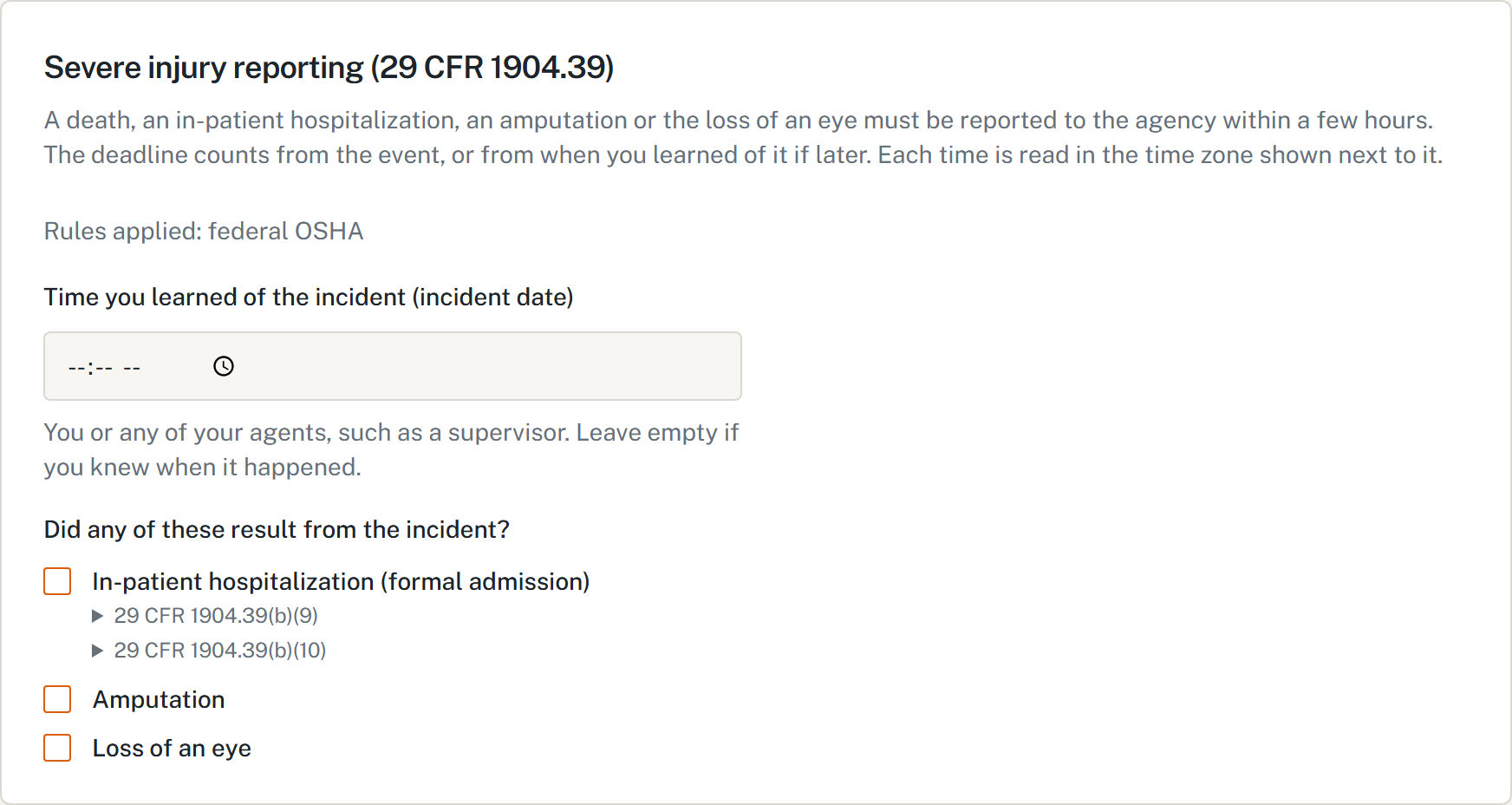
When a case in HazComFast records a death, an in-patient hospitalization, an amputation or the loss of an eye, a red banner appears on the case and stays until each event is reported. The banner says it in plain terms: the deadline counts from the event, or from when you learned of it if later, and each time is read in the time zone shown next to it. It lists each event with its deadline as a date and time, the time left, and the rule it comes from, 24 hours or 8, or California's 8 hours for a California establishment.
The facts OSHA asks for are listed under the deadline and ready to copy into the call notes, and admins hear about the case right away. After the call, you record the report on the case, and it stays listed there for the day somebody asks when OSHA was told.
Know the deadline from the first call
HazComFast puts the 8- or 24-hour deadline on the case as soon as a serious event is recorded, with the facts OSHA will ask for. Check whether a case is recordable free, or run your injury records in the app.
Related: California serious injury reporting · 19,690 amputations and hospitalizations: what OSHA's severe injury data reveals · When is an injury recordable? · Forms 300, 300A and 301
Sources & verification (read 2026-10-13 on osha.gov): 29 CFR 1904.39(a)(1), (a)(2), (a)(3), (b)(1), (b)(2), (b)(3), (b)(5), (b)(6), (b)(7) and (b)(9); 29 CFR 1904.29(b)(3); Title 8 CCR §342(a) on dir.ca.gov. General guidance, not legal advice.*
Frequently Asked Questions
When does the 8-hour clock for reporting a work-related death start?
At the death, if you know about it then. 29 CFR 1904.39(a)(1) requires the report within eight hours after the death of an employee as a result of a work-related incident. If you learn of it later, 1904.39(b)(7) starts the eight hours when the fatality is reported to you or to any of your agents.
Does a death weeks after the accident still have to be reported?
Only within limits. Under 29 CFR 1904.39(b)(6), you report a fatality only if it occurs within thirty days of the work-related incident. A death on day 20 is reported within eight hours of the death, or of when you learn of it.
Who counts as knowing about the event for the clock?
You and your agents. 29 CFR 1904.39(b)(7) counts the time from when the event is reported to you or to any of your agents, so a foreman or site supervisor who learns of the hospitalization starts the clock for the company.
Can I report a fatality to OSHA by email or voicemail?
No. 29 CFR 1904.39(a)(3) lists the methods: by phone or in person to the nearest Area Office, by phone to 1-800-321-OSHA, or through the reporting application on osha.gov. Under 1904.39(b)(1), a voicemail, a fax or an email to a closed Area Office does not count.
Is the clock different in California?
Yes. California employers report to Cal/OSHA under Title 8 CCR §342(a), which allows 8 hours for every serious injury or illness and for a death, counted from when the employer knows or with diligent inquiry would have known. Federal 29 CFR 1904.39(a)(2) allows 24 hours for a hospitalization, an amputation or the loss of an eye.
Site-wide regulatory figures such as compliance dates and penalty amounts come from our regulatory source-of-truth modules, last checked against the eCFR, OSHA.gov, and the Federal Register on October 5, 2026. Last reviewed October 13, 2026.
About This Article
Published by: HazComFast
Published: October 13, 2026
Last Updated: October 13, 2026
This content is for informational purposes only and does not constitute legal advice.