
Safety incentive programs are legal under OSHA. So is post-incident drug testing, in most forms. The rule that worries employers, 29 CFR 1904.35(b)(1)(iv), prohibits exactly one thing: "You must not discharge or in any manner discriminate against any employee for reporting a work-related injury or illness." A bonus is not a violation. A safety bingo card is not a violation. Punishing the worker who reported is the violation, and OSHA's October 11, 2018 memorandum spells out where that line sits. This guide walks through the rule, the three memos that shaped it, the program designs OSHA calls always permissible, and the precautions that keep a rate-based bonus on the right side of a citation.
OSHA's October 11, 2018 memorandum draws the line inside 1904.35(b)(1)(iv): rewarding workers for reporting near misses or hazards is always permissible, a rate-based bonus withheld after a reported injury is permissible where the employer has adequate precautions so workers still feel free to report, and post-incident drug testing is permissible when it is random, legally required, or used to investigate an incident by testing everyone whose conduct could have contributed.
The question a superintendent actually asks
A drywall contractor runs a quarterly bonus: every crew that finishes the quarter without a recordable injury splits a pool. In week eleven, a taper reports a shoulder injury from an overhead lift. The crew loses the bonus. Two things are now true at once. The company rewarded safe quarters in good faith, and eleven other tapers just learned that the next report costs their crew money.
That second effect is what 1904.35(b)(1)(iv) is aimed at. Not the bonus. The rule cares whether your program, as implemented, makes a reasonable worker think twice before reporting. The distinction matters because underreporting is not a paperwork problem: an injury that never gets reported never appears on the OSHA 300 Log, never feeds your TRIR and DART rates, and never triggers the fix that prevents the next one.
What the rule says, word for word
Two provisions of 1904.35(b) do the work. Both are quoted here from the regulation itself:
| Provision | Verbatim text |
|---|---|
| 1904.35(b)(1)(i) | Your reporting procedure must be reasonable, and "a procedure is not reasonable if it would deter or discourage a reasonable employee from accurately reporting a workplace injury or illness" |
| 1904.35(b)(1)(iv) | "You must not discharge or in any manner discriminate against any employee for reporting a work-related injury or illness" |
Note what is absent. There is no sentence about incentive programs, no sentence about drug testing, no sentence about bonuses. Those words appeared in the preamble commentary when OSHA published the rule in 2016, and that commentary caused two years of confusion that the agency itself later walked back.
Three memos, one direction of travel
The doctrine on incentive programs was built in three steps, each one softer on employers than the last.
March 12, 2012. The Fairfax memo warned that some incentive practices could discourage reporting and could violate Section 11(c) of the OSH Act, the whistleblower provision. At that point, retaliation cases required an employee complaint filed within 30 days.
October 19, 2016. After 1904.35(b)(1)(iv) took effect, OSHA issued an interpretation memo applying §1904.35(b)(1)(i) and §1904.35(b)(1)(iv) to disciplinary programs, incentive programs and post-incident drug testing. The new mechanism had teeth the old one lacked: a compliance officer can cite a 1904.35(b)(1)(iv) violation during an inspection, no employee complaint needed.
October 11, 2018. The current memorandum clarified the agency's position and states that it supersedes prior interpretive documents to the extent they are inconsistent. Its core holding: action taken under a safety incentive program or post-incident drug testing policy violates 1904.35(b)(1)(iv) only if the employer took the action to penalize an employee for reporting, rather than for the legitimate purpose of promoting workplace safety and health.
If your safety consultant is still telling you that zero-injury bonuses became illegal in 2016, they are two memos behind.
What OSHA calls always permissible
The 2018 memo singles out one category of program and puts it beyond argument, in its own words:
"One type of incentive program rewards workers for reporting near-misses or hazards, and encourages involvement in a safety and health management system. Positive action taken under this type of program is always permissible under § 1904.35(b)(1)(iv)."
Rewarding the report itself cannot discourage reporting; it does the opposite.
In practice, on a construction site, that looks like:
- A gift card or recognition for every documented near-miss report, because a near miss is a free preview of a recordable injury and is never itself recordable under 1904.7
- Rewards for hazard identifications that lead to a fix, tracked through your corrective-action process
- Credit for attendance and participation in toolbox talks, safety walks and JHA reviews, the backbone of a proactive safety program
These are called leading-indicator programs, and they reward behavior a worker controls. A crew member can choose to report the swinging load that missed. They cannot choose whether the quarter ends injury-free.
Rate-based bonuses: legal, with precautions
Rate-based programs, the classic zero-injury bonus, remain permissible under §1904.35(b)(1)(iv) as the 2018 memo reads it, as long as they are not implemented in a manner that discourages reporting. The memo is specific about the mechanics: if an employer withholds a prize or bonus because of a reported injury, OSHA would not cite under 1904.35(b)(1)(iv) as long as the employer has implemented adequate precautions to ensure employees feel free to report.
The memo gives examples of what counts as an adequate precaution:
| Precaution | What it looks like on a jobsite |
|---|---|
| An incentive program that also rewards identifying unsafe conditions | The crew that lost the quarterly bonus still earned hazard-report awards the same quarter |
| Training that reinforces the right to report | New-hire orientation and refreshers state, in plain words, that reporting an injury or illness never costs anyone their job and is required, citing your own policy |
| A mechanism for evaluating willingness to report | Anonymous pulse surveys, stand-down conversations, or comparing near-miss volume against injury volume by crew |
Run the drywall scenario again with those precautions in place. The taper reports the shoulder. The crew loses the quarterly pool, but the same crew collected hazard-identification awards all quarter, every one of them was trained that reporting is protected, and the safety director can show OSHA a survey confirming workers feel free to report. Under the 2018 memo, that employer is not cited. Take the precautions away and leave only the pool, and the identical bonus structure becomes evidence that the program exists to keep injuries off the books.
Post-incident drug testing
The same logic governs drug testing. The 2018 memo lists testing that is permissible under 1904.35(b)(1)(iv):
- Random drug testing
- Testing unrelated to the reporting of a work-related injury or illness
- Testing required by state workers' compensation law
- Testing required by federal law or regulation, such as DOT rules for drivers under 49 CFR Part 40
- Testing to evaluate the root cause of a workplace incident that harmed or could have harmed employees
The condition on that last category is the one to write into your policy: if you test to investigate an incident, you test all employees whose conduct could have contributed to the incident, not only the employee who reported an injury. Testing the forklift operator who struck the rack and the spotter who waved him on is an investigation. Testing only the laborer who reported his crushed foot looks like a penalty for reporting, and that is the fact pattern that draws the citation.
Where employers actually get cited
The violation is never the program on paper. It is the action taken against a specific worker, in circumstances that show the action punished the report. The patterns that recur:
- Discipline dressed as a rule violation. Firing a worker for "violating the safety policy" the same day he reported a laceration, when the underlying rule is vague or never enforced against anyone who didn't report. OSHA's memos allow discipline for violating a legitimate work rule; the rule has to be real, and enforced evenly.
- Rigid reporting deadlines. "Report all injuries within 15 minutes or face discipline" fails the 1904.35(b)(1)(i) reasonableness test for injuries a worker could not immediately recognize, like a strain that stiffens overnight.
- The naked rate bonus. A meaningful crew bonus destroyed by any report, with no hazard-reporting reward, no training and no pulse-check, in a workplace where recordables mysteriously run far below the industry average.
- Selective drug testing. Post-incident tests administered only to injured workers who report, never to others involved.
Remember the enforcement mechanics: a compliance officer reviewing your 300 Log during any OSHA inspection can cite 1904.35(b)(1)(iv) directly, and separately, a worker who believes they were retaliated against can still file an 11(c) complaint within 30 days. Penalty amounts follow the standard schedule for other-than-serious and willful violations; the 2026 penalty figures are here.
Those two routes matter differently to a small employer. 1904.35 lives inside the recordkeeping rule, which a company of ten or fewer employees is partially exempt from under 1904.1(a)(1). Section 11(c) has no headcount at all: it protects the employees of every employer covered by the OSH Act, and it is the provision that has always made firing someone for reporting an injury unlawful. Being too small to keep a 300 Log has never meant being free to punish a report.
Designing the program you actually want
A safety incentive exists to change behavior. Since 1904.35(b)(1)(iv) polices what an employer does to a worker who reports, the safest program is one that never has to punish a report in the first place: the behavior you can buy with a bonus is the behavior the worker controls, and what a worker controls is reporting, identifying and participating, not the injury rate. The most defensible program under 1904.35(b)(1)(iv) is also the one that produces the most safety data: reward the near-miss report, the hazard identification, the toolbox-talk attendance, and let the injury rate be the outcome you measure rather than the outcome you pay for.
Rewarding the report only works if reporting is effortless
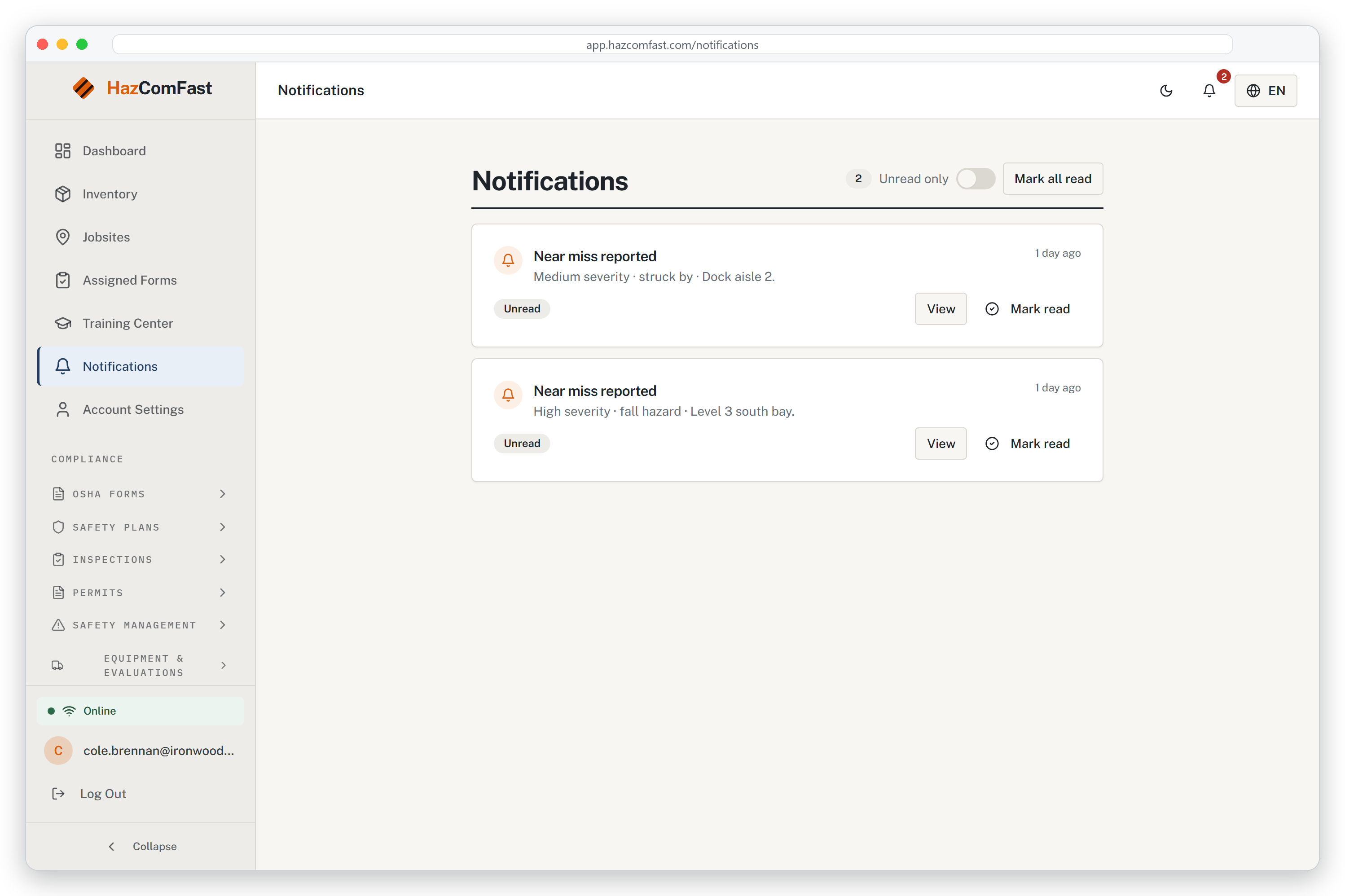
The second half of a lawful incentive program is the reporting channel itself, because a reward for near-miss reports means nothing if filing one takes a paper form and a walk to the trailer. In HazComFast, a crew member files a near-miss report from their phone: category, severity, what happened, which jobsite. Nothing about that report ever touches the 300 Log, because a near miss meets no criterion in 1904.7. The moment it is saved, the site's manager and the company's admins find it in their notification inbox, with the severity, category and location up front. The reporter is not notified of their own report, a report filed without a jobsite still reaches the admins, and a manager whose profile is set to Spanish reads the alert in Spanish. This is an in-app inbox rather than a push alert to a phone: the recipient sees it when they open the app.
Reward the report, and make the report take ten seconds
The incentive OSHA calls always permissible is the one that pays for near-miss and hazard reports. HazComFast is where those reports land: filed from a phone in the field, routed to the site manager and the admins by the system of record itself, in the recipient’s language. Start with the free tools, or run the reporting loop on trial.
What 1904.35 allows, question by question
| Question | Answer |
|---|---|
| Are safety incentive programs legal? | Yes — 1904.35(b)(1)(iv) prohibits retaliation for reporting, not incentives |
| Are zero-injury bonuses legal? | Yes, with adequate precautions so workers feel free to report (2018 memo) |
| Which programs are always permissible? | Rewards for reporting near misses and hazards and for safety participation |
| Is post-incident drug testing legal? | Yes, in the five forms the 2018 memo lists; test everyone whose conduct could have contributed, not just the reporter |
| What gets cited? | Action taken to penalize a worker for reporting, including a rate bonus with no precautions |
Related reading
- The recordkeeping side: Is a near miss OSHA recordable? · When is an injury recordable? · OSHA recordkeeping hub
- The program side: Near-miss reporting, JHA and LOTO · Toolbox Talk Generator
- If an inspection comes: What to expect in an OSHA inspection · Producing your 300 Logs in four business hours
Sources and verification (verified 2026-08-26): 29 CFR 1904.35(b)(1)(i), (b)(1)(iv) quoted from the regulation; OSHA memorandum of October 11, 2018, "Clarification of OSHA's Position on Workplace Safety Incentive Programs and Post-Incident Drug Testing Under 29 C.F.R. §1904.35(b)(1)(iv)"; OSHA memorandum of October 19, 2016; OSHA memorandum of March 12, 2012. General guidance, not legal advice; State-Plan states may impose additional requirements.
Frequently Asked Questions
Are safety incentive programs illegal under OSHA?
No. OSHA has never prohibited safety incentive programs. 29 CFR 1904.35(b)(1)(iv) prohibits one thing: discharging or discriminating against an employee for reporting a work-related injury or illness. OSHA's October 11, 2018 memorandum states that rate-based programs, including bonuses tied to injury numbers, are permissible as long as they are not implemented in a way that discourages reporting, and that programs rewarding workers for reporting near misses or hazards are always permissible.
Can we still pay a bonus for an injury-free quarter?
Yes, with precautions. Under the 2018 memo, withholding a prize or bonus because of a reported injury does not by itself violate 1904.35(b)(1)(iv), provided the employer has adequate precautions in place so employees feel free to report. OSHA's examples include rewarding workers for identifying unsafe conditions, training that reinforces the right to report without fear of retaliation, and a mechanism for checking whether employees actually feel free to report.
Is post-incident drug testing allowed?
In most cases, yes. The 2018 memo lists permissible testing: random testing, testing unrelated to the reporting of an injury, testing required by state workers' compensation law, testing required by federal law such as DOT rules, and testing to evaluate the root cause of an incident that harmed or could have harmed employees. If you test to investigate an incident, test every employee whose conduct could have contributed, not only the one who reported. The line it draws is the one in 29 CFR 1904.35(b)(1)(iv); DOT-required testing follows 49 CFR Part 40.
Can we discipline an employee who reports an injury late?
You can require timely reporting, but the procedure must be reasonable. 1904.35(b)(1)(i) says a procedure is not reasonable if it would deter or discourage a reasonable employee from accurately reporting. OSHA's memos distinguish discipline for violating a legitimate safety rule, which is allowed, from discipline that in practice punishes the act of reporting, which is not. A rigid deadline applied to an injury the worker could not immediately recognize is where employers get into trouble.
Does an employee have to file a complaint before OSHA can act?
No, and that is what makes 1904.35(b)(1)(iv) different from Section 11(c) whistleblower cases. An 11(c) retaliation complaint must come from the worker within 30 days. A 1904.35(b)(1)(iv) violation can be cited by a compliance officer during an inspection like any other recordkeeping violation, with no employee complaint required.
Do near-miss reports fall under the anti-retaliation rule?
The rule's text covers reporting a work-related injury or illness. But OSHA's 2018 memo goes out of its way to say that incentive programs rewarding workers for reporting near misses or hazards are always permissible, and a near-miss program only works when reporting is free of punishment. A near miss itself is never recordable, since it meets none of the general recording criteria in 29 CFR 1904.7, so it never belongs on the 300 Log either.
OSHA figures and citations here come from our regulatory source-of-truth modules, last checked against the eCFR, OSHA.gov, and the Federal Register on October 5, 2026. Last reviewed October 5, 2026.
About This Article
Published by: HazComFast
Published: August 26, 2026
Last Updated: October 5, 2026
This content is for informational purposes only and does not constitute legal advice.