
A near miss is not OSHA recordable, and it is not reportable to OSHA. Under 29 CFR 1904.7, a case only goes on the 300 Log if it results in an actual outcome — death, days away, restricted work, medical treatment beyond first aid, loss of consciousness, or a significant diagnosis. A near miss, by definition, produces none of those, because nobody was hurt. So it never touches the log, and it never triggers the severe-event reporting rule either. The one place OSHA does require action is narrow and specific — and every serious safety program tracks near misses anyway, for a reason that has nothing to do with the log.
At a glance: no injury means no 1904.7 criterion, so a near miss never reaches the 300 Log; 1904.39 reporting needs an actual fatality, in-patient hospitalization, amputation or eye loss, so there is no call to make either. The single OSHA duty a near miss triggers is refresher training for a forklift operator — 1910.178(l)(4)(ii)(B), "involved in an accident or near-miss incident." Track them anyway: they show you the hazard before it produces the entry. A near miss is not OSHA recordable and not reportable, because 29 CFR 1904.7 records only injuries and illnesses that actually occurred; the one OSHA duty a near miss triggers is refresher training for a forklift operator under 1910.178(l)(4)(ii)(B).
What a near miss actually is
A near miss (OSHA and NIOSH also call it a "close call" or "near hit") is an unplanned event that could have caused injury, illness, or damage — but didn't. A load swings past a worker's head and misses. A scaffold plank shifts but no one is standing on it. A worker catches themselves at the edge of an unguarded hole. The hazard was real; the harm didn't happen.
That last part is the whole answer to the recordkeeping question. OSHA's injury and illness recordkeeping system, 29 CFR Part 1904, records outcomes — actual harm to actual people. No harm, no record.
Why the 300 Log never gets the entry
The recordability test is a gate, and a near miss fails it at the first question. To be recordable under 1904.4, a case must be work-related, a new case, and meet one of the general recording criteria in 1904.7(a):
- Death
- Days away from work
- Restricted work or transfer to another job
- Medical treatment beyond first aid
- Loss of consciousness
- A significant injury or illness diagnosed by a physician or other licensed health care professional
The gate a near miss can't pass
Every criterion above describes something that happened to a person — days lost, treatment given, consciousness lost, a diagnosis made. A near miss produces none of them because no one was injured. There is no "close call" column on the OSHA 300, and there is no box for "almost." No injury → no 1904.7 trigger → no entry.
This is also why you cannot "record a near miss to be safe." Putting a no-injury event on the 300 Log overstates your injury counts, distorts your DART and total-recordable rates, and misrepresents your establishment's data to OSHA and the BLS — which pulls the national injury estimate directly from employer logs. The log is for injuries and illnesses that met the criteria. Nothing else belongs on it.
Recordable vs. reportable vs. near miss — three different things
Employers routinely collapse three separate ideas into one. They are not the same, and only the third is optional.
| Term | What triggers it | The rule |
|---|---|---|
| Recordable | An injury/illness meeting a 1904.7 criterion | Goes on the 300 Log within 7 days |
| Reportable | An actual fatality, in-patient hospitalization, amputation, or eye loss | Phone OSHA: 8 hours (fatality) / 24 hours (the rest) — 1904.39 |
| Near miss | An event that could have hurt someone but didn't | No OSHA recording or reporting duty (one training exception) |
A near miss is neither recordable nor reportable. If a near miss had actually injured someone, it would stop being a near miss — it would be an injury, and then the recordability test in 1904.7 decides whether it lands on the log.
The one exception: a forklift near miss
There is exactly one place in the standards where a near miss compels an OSHA-required action. Under 29 CFR 1910.178(l)(4)(ii)(B), if a powered-industrial-truck (forklift) operator is involved in an accident or a near-miss incident, the employer must give that operator refresher training and re-evaluate their performance — regardless of the three-year evaluation cycle, and regardless of whether anyone was hurt.
Note what this is and isn't. It is a training duty, triggered by the near miss. It is not a recording duty (nothing goes on the 300 Log) and not a reporting duty (no call to OSHA). Outside this specific forklift provision, OSHA imposes no mandatory response to a near miss at all. (See the full picture on OSHA training requirements and the forklift certification guide.)
Why you should track every near miss anyway
Here is the part that matters more than the recordkeeping answer. The fact that OSHA doesn't require you to log near misses is not a reason to ignore them — it is the reason they are so valuable.
A near miss is a leading indicator: it exposes exactly the hazard that produces a recordable injury, but before the injury happens. The swinging load that missed today is the struck-by fatality next month if nothing changes. Every near miss is a free preview of a future 300-Log entry — and a chance to prevent it.
- They reveal cause without cost. You get the diagnostic value of an incident without a hurt worker, a workers'-comp claim, or a citation.
- They are far more frequent than injuries. For every recordable injury, there are many near misses and unsafe conditions beneath it. Acting on the wide base of the pyramid is how you shrink the top.
- A documented program is evidence of good faith. If a citation ever does land, a real near-miss reporting-and-correction system helps show OSHA an effective safety program — which can support a good-faith penalty reduction under the Field Operations Manual.
The catch is culture: workers only report near misses when reporting is easy and blame-free. A one-tap report, a visible "we fixed it" response, and no punishment for honesty are what keep the reports coming. Rewarding the reports is expressly allowed, and OSHA's 2018 guidance calls that kind of incentive always permissible; the full rules for safety incentive programs and post-incident drug testing are worth knowing before you design the program. Build the habit with a toolbox talk, and route the hazards a near miss reveals into your job hazard analysis and corrective-action process.
The report that nobody reads is the one that didn't count
The second half of a near-miss program is what happens after the worker hits Submit. In HazComFast, a crew member files the report from their phone — category, severity, what happened, which jobsite — and the moment it is saved, the site's manager and the company's admins find it in their notification inbox: severity, category and location, never the raw narrative. The alert is produced by the system of record itself, not by the reporting screen, so it fires no matter how the report arrived — filed in the app, or written on a jobsite with no signal and synced later. A report filed without a jobsite still reaches the admins, so no near miss lands in an empty room; the reporter is not notified of their own report; and a manager whose profile is set to Spanish reads "Cuasi accidente reportado" in their own language. This is an in-app inbox, not a push alert to the manager's phone — the recipient sees it when they open the app.
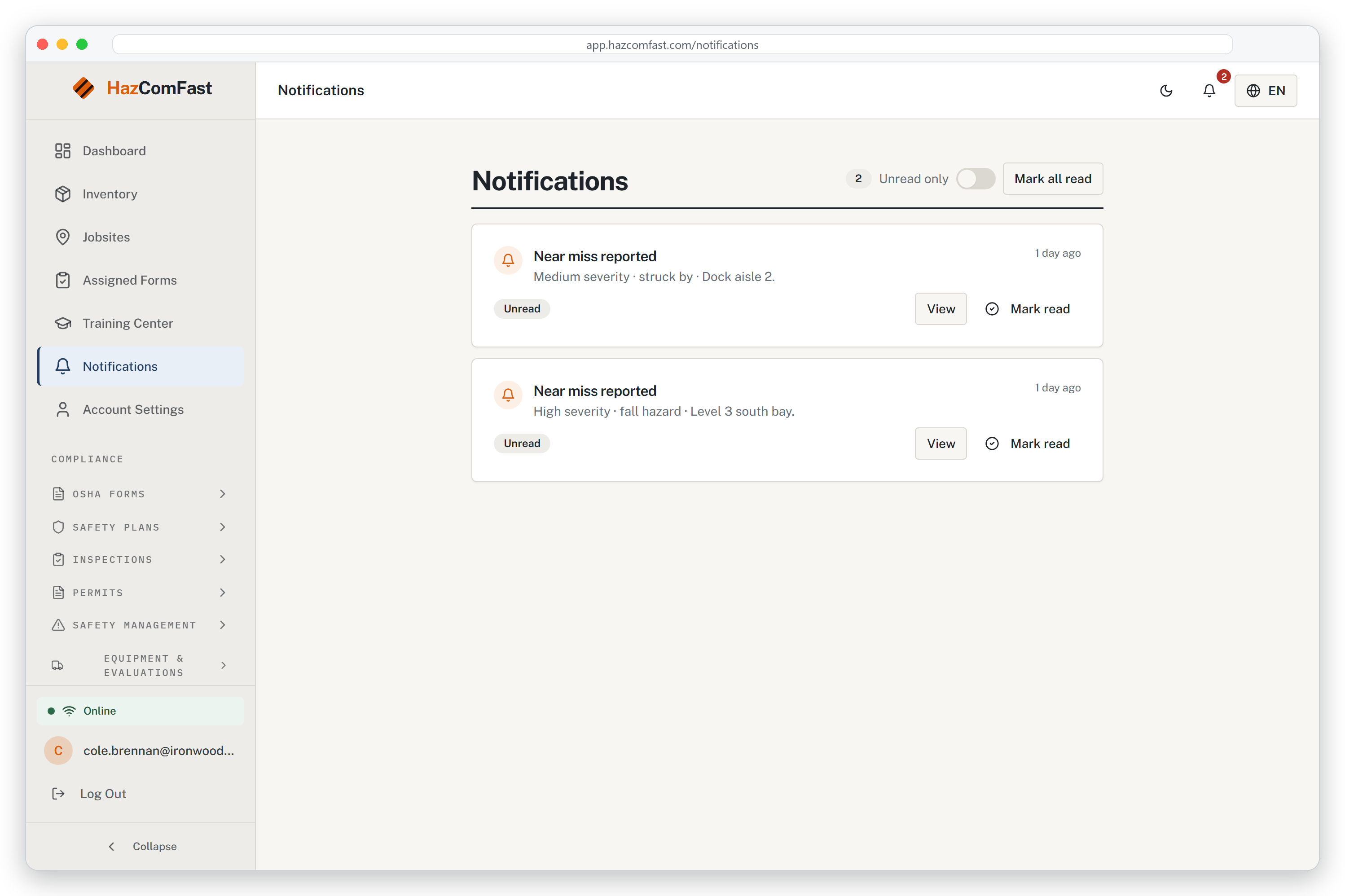
Near misses that reach someone who can act
One tap from the field, and the site manager and admins have it in their inbox with severity, category and location — including reports filed with no signal and synced later. The reporter stays out of their own notification, and a manager set to Spanish reads it in Spanish.
Near misses: what to log, what to report, what to track
| Question | Answer |
|---|---|
| Does a near miss go on the OSHA 300 Log? | No — no injury, no 1904.7 trigger |
| Do I report a near miss to OSHA? | No — 1904.39 needs an actual fatality/hospitalization/amputation/eye loss |
| Does a near miss ever require OSHA action? | Once — forklift operator refresher training (1910.178(l)(4)(ii)(B)) |
| Should I track near misses? | Yes — leading indicators that prevent the next recordable injury |
A near miss is a warning, not a record. OSHA doesn't want it on your log — it wants the hazard behind it gone before it becomes the injury that does belong there.
Related reading
- The hub: OSHA recordkeeping — 300, 300A & 301 · When is an injury recordable?
- Decide a real case: OSHA Recordability Decision Tree
- Glossary: near miss · recordable injury
- Proactive safety: Near-Miss Reporting, JHA & LOTO
- 2026 OSHA penalty schedule · penalties by state
Sources & verification (verified 2026-07-17): recordability criteria per 29 CFR 1904.7(a); severe-event reporting per 29 CFR 1904.39(a); forklift near-miss refresher per 29 CFR 1910.178(l)(4)(ii)(B). General guidance, not legal advice; OSHA State-Plan states may impose additional requirements.
Frequently Asked Questions
Is a near miss OSHA recordable?
No. Under 29 CFR 1904.7, a case is recordable only if it results in death, days away from work, restricted work or transfer, medical treatment beyond first aid, loss of consciousness, or a significant diagnosis. A near miss by definition produces no injury or illness, so it meets none of those criteria and never goes on the OSHA 300 Log.
Do I have to report a near miss to OSHA?
No. The severe-event reporting rule, 29 CFR 1904.39, is triggered only by an actual work-related fatality (report within 8 hours) or an in-patient hospitalization, amputation, or loss of an eye (within 24 hours). A near miss caused none of those, so there is nothing to report by phone or online.
Is there any OSHA requirement that a near miss triggers?
One. If a powered-industrial-truck (forklift) operator is involved in a near miss, 29 CFR 1910.178(l)(4)(ii)(B) requires the employer to provide refresher training and re-evaluate the operator — even though no injury occurred. That is a training duty, not a recording or reporting duty. Outside that specific case, OSHA does not mandate any action on a near miss.
What is the difference between a near miss and a first-aid case?
A near miss produces no injury at all. A first-aid case produces a minor injury that was treated with only the measures on OSHA's exclusive first-aid list (1904.7(b)(5)(ii)) — a Band-Aid, a tetanus shot, non-prescription medication at non-prescription strength. Neither is recordable, but they are different events: nobody was hurt in a near miss, and someone was slightly hurt in a first-aid case.
Should I track near misses even though OSHA doesn't require it?
Yes. OSHA strongly encourages employers to investigate close calls as well as injuries (osha.gov/incident-investigation), and near misses never go on the 300 Log, since they meet none of the recording criteria of 29 CFR 1904.7. Near misses are leading indicators: they reveal the same hazards that produce recordable injuries, but before anyone is hurt. A crew that reports and fixes near misses is removing the causes of future 300-Log entries. OSHA encourages near-miss reporting programs, and a documented one is also evidence of good faith if a citation ever lands.
OSHA figures and citations here come from our regulatory source-of-truth modules, last checked against the eCFR, OSHA.gov, and the Federal Register on October 5, 2026. Last reviewed October 5, 2026.
About This Article
Published by: HazComFast
Published: July 17, 2026
Last Updated: October 5, 2026
This content is for informational purposes only and does not constitute legal advice.