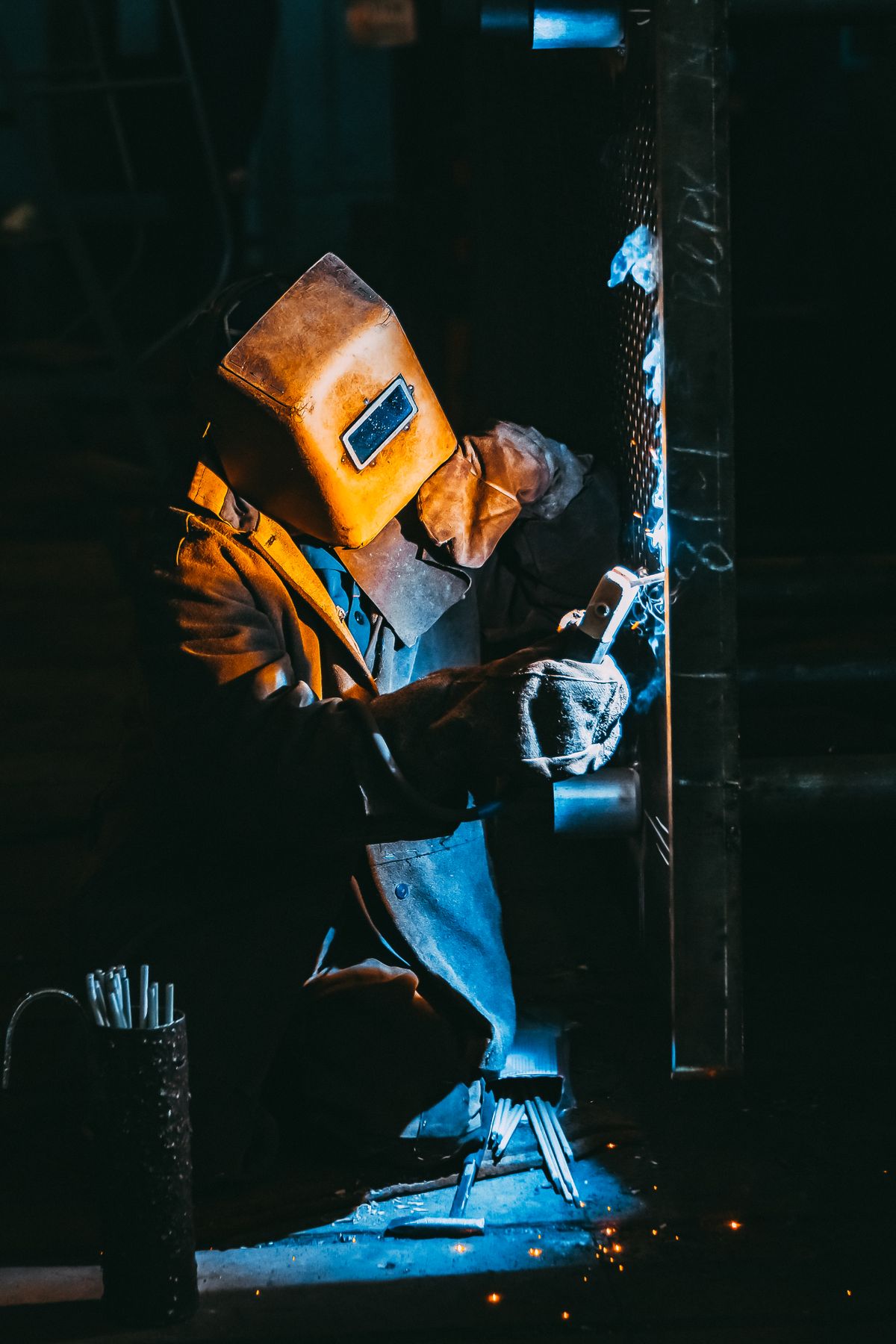
OSHA's hot-work rule for construction is short, and it's widely mis-quoted. Welding, cutting, grinding, brazing, and torch work start fires through sparks, slag, and conducted heat — so 29 CFR 1926.352 requires fire-prevention controls and, where the risk warrants it, a fire watch. But the numbers everyone recites — "keep combustibles 35 feet away," "watch the area for 30 minutes after" — are not in the construction rule. The 35 feet comes from NFPA 51B, the industry consensus standard OSHA references; the 30 minutes comes from OSHA general industry at 1910.252(a)(2)(iii)(B), which does not reach construction work. NFPA 51B itself has called for 60 minutes since its 2019 edition. Knowing which is the law and which is the recognized practice is the difference between a defensible program and a citation you can't explain.
At a glance: 29 CFR 1926.352 governs construction hot work — fire-extinguishing equipment ready (d), combustibles moved or protected (a)/(b), and a fire watch where normal precautions aren't enough (e), maintained after the work until no fire is possible. The 35-ft clearance and the 60-minute watch are NFPA 51B recognized practice, not CFR text; the 30-minute figure people quote is OSHA general industry (1910.252(a)(2)(iii)(B)), not construction. Hot work in a confined space needs both the entry permit and the hot-work controls. OSHA's construction hot-work standard, 29 CFR 1926.352, requires a fire watch when normal fire-prevention precautions are not sufficient, but the 35-foot combustible clearance and the 60-minute post-work fire watch come from NFPA 51B, not from the OSHA construction regulation itself.
What 1926.352 actually requires
The standard is a list of fire-prevention duties, not a permit form. Grouped by what they protect against:
- Move or protect the combustibles first (a), (b). Move the work to a safe location, or — when the object can't be moved — move the fire hazards away, and where neither is possible, confine the heat, sparks, and slag and protect the immovable combustibles.
- Don't work in a flammable atmosphere (c). No welding, cutting, or heating where flammable paints, compounds, or heavy dust concentrations create a hazard.
- Keep extinguishing equipment ready (d). Suitable fire-extinguishing equipment must be immediately available and ready for instant use.
- Post a fire watch (e). Assigned personnel when normal precautions aren't sufficient — the heart of the rule, below.
- Protect the far side (f). Apply the same precautions on the opposite side of walls, floors, and ceilings as on the working side — sparks and conducted heat travel through the structure.
- Control the fuel gas and containers (g)–(j). Shut off the gas supply outside enclosed spaces when a torch is unattended and remove torches/hoses at shift changes (g); keep flammable-liquid containers closed and remove empties (h); fill or thoroughly clean and ventilate any container before applying heat (i); and provide a vent opening on drums before heating them (j).
Note the standard number: construction hot work is 1926.352, not the general-industry welding standard 1910.252. Citing 1910.252 to a construction crew applies the wrong rule.
The fire watch — the part that gets cited
Paragraph (e) is where most hot-work citations land. The trigger is written broadly:
A fire watch is required "when the welding, cutting, or heating operation is such that normal fire prevention precautions are not sufficient," and it must be maintained "for a sufficient period of time after completion of the work to ensure that no possibility of fire exists." — 29 CFR 1926.352(e)
OSHA deliberately did not put a number in the CFR. NFPA 51B fills that gap with the operational figures inspectors expect you to meet:
The law vs. the numbers — don't confuse the two
- Fire watch when normal precautions aren't enough (e)
- Extinguishing equipment ready for instant use (d)
- Combustibles moved or protected (a)/(b)
- Watch continued until no fire is possible (e)
- 35 ft combustible-clearance radius
- 60 min minimum post-work fire watch (2019 ed. onward)
- Written hot-work permit as the documentation
- Openings within 35 ft covered/protected
Cite 1926.352(e) for the fire-watch duty; cite NFPA 51B for the 35-ft clearance and the 60-minute watch; cite 1910.252(a)(2)(iii)(B) if you mean the 30-minute general-industry floor. Presenting the numbers as "OSHA rules" is a common and avoidable error. Whether 51B itself is an OSHA requirement is its own question, with a precise answer: no — 29 CFR 1926.6 incorporates six NFPA standards into construction, and 51B is not among them.
What a hot-work permit should capture
The permit is the artifact that proves the 1926.352 controls were in place before the torch was lit. A defensible hot-work permit captures:
- Location, date, and an authorized time window (with an end time — the permit should expire, not float).
- Combustibles within ~35 ft removed or protected (NFPA 51B), and any floor/wall openings within reach covered.
- A fire watch assigned, with the start time and the post-work monitoring end time (≥ 60 minutes, per NFPA 51B).
- Fire-extinguishing equipment present and verified, with type.
- Atmospheric testing where the hot work is in or adjacent to a confined space (continuous LEL monitoring).
- The issuing supervisor's signature and a post-work close-out confirming no fire developed.
Build one in seconds with the free Hot Work Permit Generator.
A hot-work permit, filled in end to end
The example below is illustrative, not a real job: a steel crew torch-cutting an abandoned embed plate from a concrete column on the second floor of a building under renovation, with bundles of roof insulation stored on the floor below. Each line shows what goes on the permit and the rule or practice behind it.
| Permit line | Example entry | Why it is there |
|---|---|---|
| Location and task | Level 2, column C-4: torch-cut an abandoned embed plate | The area the issuer walks and authorizes |
| Time window | Tuesday, 9:00 to 11:00; the permit expires at 11:00 | A permit with an end time cannot be reused for tomorrow's work |
| Combustibles | Pallets and cardboard moved 40 ft away; insulation bundles below covered with a fire-retardant blanket | 1926.352(a) and (b); the 35-ft radius is NFPA 51B |
| Atmosphere | No flammable paint, compound or heavy dust at C-4 | 1926.352(c) |
| Floor and far side | Penetration at C-4 sealed; Level 1 below checked and watched | 1926.352(f): same precautions on the opposite side |
| Extinguishing equipment | Two charged extinguishers at the work point | 1926.352(d): immediately available, ready for instant use |
| Fire watch | Watch 1 on Level 2, watch 2 on Level 1; both briefed on the insulation hazard and on the extinguishers | 1926.352(e): watchers instructed on the anticipated hazards and the equipment |
| Close-out | Torch off 10:40; watch until 11:40; area rechecked, no smoldering; permit closed 11:45 | 1926.352(e) "sufficient period"; NFPA 51B 60-minute minimum |
| Signatures | Issued at 8:50 after the walk; closed and signed at 11:45 | The record that the controls came before the torch |
The fire watch, by the clock
The same job, minute by minute. The federal construction rule sets no number of minutes; it sets an outcome, and NFPA 51B sets the minimum most permits use.
| Time | What happens | Rule or practice |
|---|---|---|
| 8:45 | Issuer walks the area and the floor below; combustibles within 35 ft moved or covered | 1926.352(a), (b), (f); NFPA 51B radius |
| 8:50 | Permit issued; both watchers briefed on the hazards and the extinguishers | 1926.352(e) |
| 9:00 to 10:40 | Cutting, with both watchers in place on Level 2 and Level 1 | 1926.352(e) |
| 10:40 | Torch off; the post-work watch starts | 1926.352(e) |
| 11:40 | Earliest end of the watch under NFPA 51B | NFPA 51B, 60 minutes |
| 11:45 | Area rechecked, no heat or smoldering found; permit closed | 1926.352(e): until no possibility of fire exists |
If the recheck at 11:40 finds a warm spot in the insulation, the watch does not end at 60 minutes. Under 1926.352(e) the test is the outcome, not the clock.
What 1926.352 asks you to show, paragraph by paragraph
| Paragraph | What must be in place | The proof on site |
|---|---|---|
| (a) and (b) | Combustibles moved, or the heat, sparks and slag confined and the fire hazards protected | The combustibles line of the permit; blankets and guards in place |
| (c) | No welding, cutting or heating where flammable paints, compounds or heavy dust create a hazard | The area check on the permit |
| (d) | Suitable extinguishing equipment in the work area, ready for instant use | The extinguisher at the work point, charged |
| (e) | A fire watch when normal precautions are not enough, during the work and after it, instructed on the hazards and the equipment | The watchers, and the start and end times on the permit |
| (f) | The same precautions on the far side of walls, floors and ceilings | The second watcher, or the check of the adjacent area |
| (g) | In enclosed spaces, gas shut off outside the space when the torch is unattended; torch and hose removed overnight | Valve position; hoses out of the space |
| (h) to (j) | Flammable-liquid containers closed and empties removed; containers filled with water, or cleaned, ventilated and tested, before heat; a vent before heating a drum or hollow structure | The containers themselves |
Hot work inside a confined space takes both permits
The riskiest hot work happens inside tanks and vessels — a confined space and an ignition source at once. That takes both documents: the confined-space entry permit under 29 CFR 1926.1205 and the hot-work controls of 1926.352. Sequence matters — authorize the entry on acceptable atmospheric readings first, then layer the hot-work permit, monitor the LEL continuously because welding changes the atmosphere, and keep a fire watch in addition to the confined-space attendant. The Safety Permits hub walks the confined-space side, and the confined space entry guide covers the entry permit in full.
What a hot-work gap costs
Hot-work and fire-watch failures are cited under 1926.352 like any serious construction violation. The 2026 OSHA civil-penalty maximums (29 CFR 1903.15(d)) are $16,550 per serious violation and $165,514 per willful or repeated violation — unchanged from 2025 (no inflation increase was made, per OMB Memo M-26-11), so 2026 is not a higher-penalty year. A hot-work fire that ignites after the crew leaves — the classic "no fire watch after the torch stopped" case — is exactly the willful/repeat exposure the standard exists to prevent.
Prove the controls were in place before the torch
A hot-work citation is rarely the welding — it's the missing proof: the fire watch posted, the combustibles cleared, the extinguisher staged, and the close-out signed. HazComFast builds the hot-work permit (and the confined-space permit when the work is inside a vessel), keeps the fire-watch and atmospheric records, and stores the signed permit for the file. Plan it with the free tools, then keep the record on trial.
The standard, tools & related reading
- The hub: Safety Permits — confined space & hot work
- The standard: Fire prevention, welding & cutting — 29 CFR 1926.352
- Tools: Hot Work Permit Generator · Confined Space Permit Generator · Toolbox Talk Generator
- The data behind the rule: Why hot work keeps killing — 15 CSB investigations & the OSHA rules
- Related reading: OSHA Welding Safety Requirements · Digital Permits for Construction · Confined Space Entry Permit Guide
- Glossary: Competent person · Confined space · 2026 OSHA penalties
Sources & verification (verified 2026-08-13 against osha.gov; 1926.352 re-read on the eCFR, title 29 current as of September 25, 2026, on October 2, 2026, for the filled permit, the timeline and the paragraph table): construction hot-work fire-prevention duties per 29 CFR 1926.352(a) to (j), with the fire-watch requirement and its "sufficient period after completion" duration at 1926.352(e); the 35-ft combustible clearance and the 60-minute post-work watch are NFPA 51B recognized practice (60 minutes since the 2019 edition), not CFR text, and the widely-quoted 30 minutes is OSHA general industry at 1910.252(a)(2)(iii)(B), which does not apply to construction; the confined-space entry permit at 29 CFR 1926.1205; 2026 civil-penalty maximums ($16,550 serious / $165,514 willful, unchanged from 2025) per 29 CFR 1903.15(d). General guidance, not legal advice; OSHA-approved State Plans may impose additional requirements.*
Frequently Asked Questions
Does OSHA require a hot work permit?
OSHA's construction fire-prevention rule, 29 CFR 1926.352, requires fire-prevention controls and a fire watch for welding, cutting, and other hot work — but it does not use the word 'permit.' A written hot-work permit is the recognized way to document those controls (NFPA 51B consensus practice, which OSHA references and inspectors expect). So the permit itself isn't a literal CFR mandate, but the controls it captures — the fire watch, combustible clearance, and extinguishing equipment — are enforceable under 1926.352.
When is a fire watch required for hot work?
Under 29 CFR 1926.352(e), a fire watch is required 'when the welding, cutting, or heating operation is such that normal fire prevention precautions are not sufficient.' In practice (NFPA 51B), that means whenever appreciable combustibles are within about 35 feet of the work and can't be removed or protected, or when sparks could reach combustibles through floor or wall openings. The fire watch must be maintained for a sufficient period after the work to ensure no fire can start.
Is the 35-foot rule an OSHA regulation?
No. 29 CFR 1926.352 does not state a numeric clearance distance or a fire-watch duration. The familiar 35-foot combustible clearance comes from NFPA 51B, the industry consensus standard OSHA references; NFPA 51B sets the post-work fire watch at a minimum of 60 minutes, and has since its 2019 edition. The 30 minutes commonly quoted is OSHA general industry, 1910.252(a)(2)(iii), which does not reach construction work. Treat them as the recognized standard of care and cite NFPA 51B — not 1926.352 — for those specific numbers.
How long must a fire watch continue after welding stops?
29 CFR 1926.352(e) requires the watch to continue 'for a sufficient period of time after completion of the work to ensure that no possibility of fire exists.' NFPA 51B sets a minimum of 60 minutes — a figure that has been 60 since the 2019 edition, having previously been half an hour — and allows fire monitoring to continue for up to three further hours at the permit authorizing individual's discretion. OSHA general industry keeps its own floor of half an hour at 1910.252(a)(2)(iii)(B), which is where the familiar 30-minute figure actually comes from; it does not apply to construction. Smoldering slag and conducted heat can ignite combustibles well after the torch is off.
What does a completed hot work permit need to show?
That each 1926.352 control was in place before the torch was lit: combustibles moved or protected (29 CFR 1926.352(a) and (b)), no flammable paint, compound or heavy dust in the area ((c)), suitable extinguishing equipment at hand and ready ((d)), the far side of any wall, floor or ceiling protected ((f)), and a fire watch assigned and instructed on the specific hazards and the firefighting equipment ((e)). It should also record when the work ended and when the watch ended, because (e) requires the watch to continue until no possibility of fire exists. The 35-foot radius and the 60-minute minimum on the form come from NFPA 51B.
Do I need a separate permit for hot work inside a confined space?
Yes — you need both. Hot work inside a permit-required confined space requires the confined-space entry permit (29 CFR 1926.1205) and the hot-work controls of 1926.352, because welding adds an ignition source to a space that must already be atmospherically controlled. The LEL (flammable-gas) reading must be monitored continuously during the hot work, and a fire watch is posted in addition to the confined-space attendant.
OSHA figures and citations here come from our regulatory source-of-truth modules, last checked against the eCFR, OSHA.gov, and the Federal Register on October 5, 2026. Last reviewed October 2, 2026.
About This Article
Published by: HazComFast
Published: July 21, 2026
Last Updated: October 2, 2026
This content is for informational purposes only and does not constitute legal advice.