Skip to content

Urgent: Nov 20, 2026 — HCS 2024 Deadline. Get ready →

Safety data sheet

Goof Off Professional Strength Remover SDS

W. M. Barr and Company, Inc.'s sheet for Goof Off Professional Strength Remover lists seven hazard classes, among them flammable liquids, Category 2, so it is a hazardous chemical as 29 CFR 1910.1200(c) defines it. The HazCom program, label, sheet and training paragraphs follow ((e)(1), (f)(6), (g)(8) and (h)(1)), unless a scope paragraph of (b) takes the product out.

Product as the sheet names it
Goof Off Professional Strength
Maker
W. M. Barr and Company, Inc.
Product code
FG612, FG631, FG653, FG654, FG654LWS, FG656AM, FG657, FG661, FG661CAN
Revision date as read on Oct 21, 2026
Sep 24, 2024 (the sheet calls it "Revision")

Goof Off Professional Strength, the general purpose adhesive remover in the product codes listed (a liquid, not the aerosol).

What this SDS tells an employer

Read in the maker's sheet on October 21, 2026: Product code FG612, FG631, FG653, FG654, FG654LWS, FG656AM, FG657, FG661, FG661CAN, Revision Sep 24, 2024, 8 pages. The maker's version is the one that counts.

Goof Off Professional Strength: facts read in the safety data sheet, by section
Section 2, hazards

Section 2 calls the material classified as hazardous under OSHA regulations.

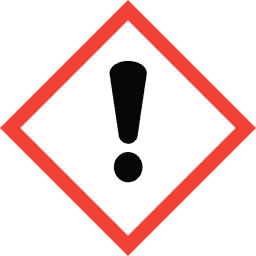
Signal word: Danger. Pictograms: Flame (GHS02), Exclamation Mark (GHS07), Health Hazard (GHS08).

Hazard statements: H225, H315, H319, H332, H351, H370, H373. Their text, in English and Spanish, is on the label below.

Section 3, ingredients
  • Acetone (CAS 67-64-1) at 60 to 80 %, xylene, mixed isomers (CAS 1330-20-7) at 7 to 13 %, and Stoddard solvent (CAS 8052-41-3) at 5 to 10 %.
  • Ethylbenzene (CAS 100-41-4) and methanol (CAS 67-56-1) at 1 to 5 % each.
  • The sheet withholds the specific percentage of composition as a trade secret.
Section 4, first aid
  • Skin: rinse clothing and skin at once with plenty of water before removing the clothes.
  • Eyes: flush with plenty of water for at least 15 minutes.
  • Inhaled: move to fresh air. Give artificial respiration if not breathing and oxygen if breathing is difficult. Get medical attention at once.
  • Swallowed: do not induce vomiting unless medical personnel direct it. Get medical attention at once.
Section 5, fire fighting
  • Use water spray, dry chemical, carbon dioxide or an appropriate foam.
  • The sheet gives NFPA class IB and says vapor may travel a considerable distance to a source of ignition and flash back.
  • Firefighters wear self-contained breathing apparatus if necessary.
Section 7, handling and storage
  • Keep the container tightly closed when not in use, in a cool, dry place, away from flames and high temperatures.
  • Do not use near any source of heat or open flame, furnace areas, pilot lights or stoves.
  • Do not spread the product over large surface areas, because fire and health risks increase.
Section 8, exposure limits
  • OSHA PEL for acetone: 1000 ppm (TWA)
  • OSHA PEL for xylene (mixed isomers): 100 ppm (TWA)
  • OSHA PEL for Stoddard solvent: 500 ppm (TWA)
  • OSHA PEL for ethylbenzene: 100 ppm (TWA)
  • OSHA PEL for methanol: 200 ppm (TWA)
Section 8, protection

Respiratory protection: Use respirators tested and approved under government standards such as NIOSH; use only with adequate ventilation to prevent buildup of vapors.

  • Eye protection tested and approved under a government standard such as NIOSH or EN 166.
  • Gloves and protective clothing to prevent skin exposure.

The sheet does not name eyewash equipment.

Section 9, flash point1.00 °F (-17.2 °C), Setaflash closed cup
Section 9, other properties
  • Liquid with a solvent odor. Boiling point 37.7 °C (99.90 °F). Evaporation rate above 1.
  • Specific gravity 0.8200 to 0.8248 (6.84 to 6.88 lb/gal). Viscosity under 5 cps. Only partly soluble in water.
  • VOC 163.25 g/L at most.
Section 10, what to avoid
  • Incompatible with strong oxidizing agents. Decomposition gives carbon monoxide and carbon dioxide.
Section 14, transportUN1263, Paint related material, hazard class 3, packing group II.

What this product triggers under OSHA

The sheet says the product is regulated by the United States Consumer Product Safety Commission. The standard does not apply to a consumer product the employer shows is used as its maker intended, at no more than consumer exposure. (29 CFR 1910.1200(b)(6)(ix), (b)(5)(v))

Section 2 lists a Category 2 flammable liquid: the electrical connection of nozzle and container applies when you dispense it in general industry; the construction paragraph names Category 1, 2 and 3. (29 CFR 1910.106(e)(6)(ii); 1926.152(e)(2))

Section 8 mentions a respirator: the employer provides one when necessary to protect health and keeps a respiratory protection program. (29 CFR 1910.134(a)(2); 1926.103)

Section 8 lists OSHA PELs for acetone, xylene (mixed isomers), Stoddard solvent and ethylbenzene and 1 more; the tables are 1910.1000 and, in construction, Table 1 of 1926.55. (29 CFR 1910.1000; 1926.55)

A classified product brings a written program with its chemical list, training, an accessible sheet and workplace labels. (29 CFR 1910.1200(c), (e)(1), (f)(6), (g)(8), (h)(1); 1926.59)

Container label from this SDS

For a container of Goof Off Professional Strength Remover you fill at work (29 CFR 1910.1200(f)(6)).

Goof Off Professional Strength

Danger / Peligro
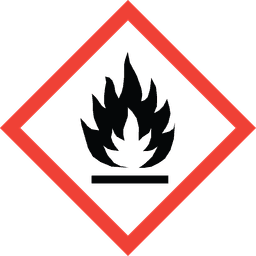
  • Flame pictogram (GHS02)Flame / Llama
  • Exclamation Mark pictogram (GHS07)Exclamation Mark / Signo de exclamación
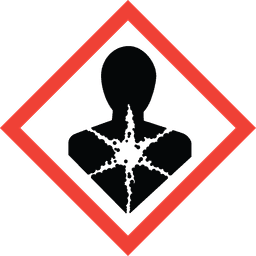
  • Health Hazard pictogram (GHS08)Health Hazard / Peligro para la salud
Hazard statements in English and Spanish
CodeEnglish (as the sheet prints it)Español (official European text)
H225Highly flammable liquid and vapor.Líquido y vapores muy inflamables.
H315Causes skin irritation.Provoca irritación cutánea.
H319Causes serious eye irritation.Provoca irritación ocular grave.
H332Harmful if inhaled.Nocivo en caso de inhalación.
H351Suspected of causing cancer.Se sospecha que provoca cáncer.
H370Causes damage to organs.Provoca daños en los órganos.
H373May cause damage to organs through prolonged or repeated exposure.Puede provocar daños en los órganos tras exposiciones prolongadas o repetidas.

The label carries 29 precautionary statements (P201, P202, P210, P233, P240, P241, P242, P243, P260, P264, P270, P271, P280, P302, P352, P303, P361, P353, P304, P340, P305, P351, P338, P308, P311, P313, P312, P314, P321, P332, P337, P362, P364, P370, P378, P403, P235, P405, P501), and the PDF prints their full text. 28 of its 36 lines have official Spanish; a line marked English only has none that says the same.

Next

Section 3 lists acetone, xylene, mineral spirits, methanol, which have a chemical page. Trades: Painting contractors, Building maintenance, Janitorial and facilities. Similar products: Goo Gone Goo & Adhesive Remover. Another product: SDS Lookup.

Finding the Goof Off Professional Strength Remover sheet is the easy part

Keeping every sheet read, current and ready for an inspector is the work that never ends. HazComFast does it with your crew: the AI extracts each sheet, and every reading leaves a proof.

Extraction: the AI reads every sheet

Scanned, long or in Spanish, it reads

Drop in the Goof Off Professional Strength Remover sheet, scanned or not, in English or Spanish. HazComFast reads every page, with progress shown page by page, so a 32-page sheet gets read to the last page.

Every section a foreman needs

Composition, spill response, storage, physical properties, stability and toxicology land on the product page with their source, so the sections a foreman actually needs aren't buried in a PDF.

The AI proposes, a person signs off

Each hazard shows where it came from: extracted from the sheet, or confirmed by a named person on a date. Confidence is measured against the text of the sheet, and below a floor every field is checked by hand before it saves.

A pictogram is never guessed

A pictogram only goes on your label if it's actually on the sheet or follows from its H-codes. H225 on the sheet means GHS02 and DANGER on the label, derived from OSHA's Appendix C.

Checked against 200 real sheets

Every change to the AI is checked against a reference set of 200 real SDSs before it ships. A field it isn't sure about is highlighted for you to check, and the inventory flags products whose extraction hasn't been validated yet.

Proof of reading, without the chasing

Nobody has to remember to ask

Add a hazardous product to a site and every worker there gets one notice with a 7-day due date. A reminder follows at day 3 and an escalation at day 7.

“I read it” can't be a reflex tap

The confirm button stays grey until the worker has scrolled through first aid or to the last page of the PDF and has spent 15 seconds there. The record keeps how long and how far.

A proof of reading the worker keeps

The worker ticks an attestation, and the record keeps which SDS version they read, the server time and the device. They can download their own PDF of it.

A new sheet means a new reading

When a manufacturer updates a sheet and the hazards change, everyone who confirmed the old one is asked to read the new one. Each confirmation keeps which version they read, for which jobsite.

Who read what, in one console

See who hasn't read what, nudge everyone overdue in one click, and export last month's confirmations for one jobsite, each with the SDS version they read.

The reading joins the training file

Each confirmed reading also lands in the worker's training file as a HazCom reading record, so your training records and your SDS records tell the same story.

From the sheet to the label

A label that can't go out empty

A label with five pictograms keeps all five, because the format switches. A label with no hazard information won't print. When the sheet changes, you get a relabeling task with its six-month deadline.

English and Spanish, side by side

Hazard and precautionary statements show in English and Spanish on every product page. A Spanish sheet that says PELIGRO is recorded as DANGER, and the original file stays attached as you received it.

Every print on record

Every print run is logged with exactly what went on the labels. When a hazard changes, the relabel task can only be closed by a print made after the change.

In the field, on the phone

Scan the drum

Scan the QR code on a drum and the page shows the maker and the CAS number under the title, so you know you hold the right one. A drum taken out of inventory still opens its SDS, marked as removed.

Search inside the sheet

Type “eye contact” and you land on first aid. Pinch to zoom on the small print.

Still there with no signal

Offline, the worker opens the sheet itself, with first aid and what to do in a spill. “Available offline” only shows when the PDF is on the phone.

When the inspector asks

The binder, in one click

One click gives you the jobsite's SDS binder, with Goof Off Professional Strength Remover in it, as a ZIP with a CSV index, and a dated CSV or PDF of who confirmed reading what. That is what you hand an inspector or a GC.

No expired-sheet myth

HazComFast never tells you a sheet has expired, because OSHA doesn't set an expiration date. You choose your own review interval, and the app labels it as your internal policy.

The chemical list behind it

Bring your spreadsheet

Imported products get the same pictograms as ones entered by hand, and importing the same file twice doesn't duplicate anything.

Each product, at every site

Each product page shows every site it's stored at with quantities, and warns you if something incompatible is stored at the same site.

A program that stays true

The chemical list in your HazCom program is built from each jobsite's inventory. Remove a product and the program tells you the list is out of date, with a button to rebuild it.

Start with the free SDS Binder Kit. It works with nothing but a printer.

Free to use as well: the chemical inventory template and the SDS QR code generator. The software side: the chemical inventory in HazComFast.

Questions about Goof Off Professional Strength Remover

Where do I get the SDS for Goof Off Professional Strength Remover?

From W. M. Barr and Company, Inc.. The button at the top of this page opens its own copy (many product codes, Revision Sep 24, 2024). It covers Goof Off Professional Strength, the general purpose adhesive remover in the product codes listed (a liquid, not the aerosol).

Is Goof Off Professional Strength Remover a hazardous chemical under OSHA?

Yes: Section 2 lists seven hazard classes, among them flammable liquids, Category 2 (29 CFR 1910.1200(c)). Its consumer wording matters (1910.1200(b)(6)(ix)).

Sources and notes