
A carpenter cuts his hand on a Wednesday. The clinic closes it with four sutures and he comes back the next day. On Friday his supervisor keeps him off the table saw for two weeks, sweeping and carrying. The recordkeeper had checked column J, other recordable cases, on Thursday. By Friday the right answer is column I, job transfer or restriction, with 14 in column L. Nothing was wrong on Thursday. The case changed.
On the OSHA 300 Log, each recordable case gets exactly one classification column, chosen by its most serious outcome: G for death, H for days away from work, I for job transfer or restriction, J for other recordable cases; days away and days of restriction are counted in calendar days in columns K and L, starting the day after the injury, under 29 CFR 1904.7(b)(3).
At a glance: One box per case, the most serious outcome (Form 300 instructions). G death, 1904.7(b)(2). H days away, 1904.7(b)(3). I job transfer or restriction, 1904.7(b)(4). J everything else recordable: medical treatment beyond first aid, loss of consciousness, a significant diagnosed injury, 1904.7(b)(5) to (b)(7). K and L: calendar days, starting the day after, cap at 180. M: injury, or one of five illness types. When the outcome changes, change the box.
One box, the most serious outcome
The Form 300 instructions are short on this point and worth reading in full: choose only one of these categories; classify the case by recording the most serious outcome of the case, with column G (death) being the most serious and column J (other recordable cases) being the least serious. The order runs G, H, I, J, from most serious to least.
So the question is never "which boxes apply". It is "what is the worst thing that happened in this case". A case with sutures, two days away and a week of restricted work is a column H case, with numbers in both K and L.
The four columns, with the rule behind each
| Column | Outcome | Rule |
|---|---|---|
| (G) Death | The employee died as a result of the work-related injury or illness | 29 CFR 1904.7(b)(2) |
| (H) Days away from work | At least one calendar day away, after the day of injury | 29 CFR 1904.7(b)(3) |
| (I) Job transfer or restriction | Kept from one or more routine functions, or from a full workday, or moved to another job | 29 CFR 1904.7(b)(4) |
| (J) Other recordable cases | Medical treatment beyond first aid, loss of consciousness, or a significant diagnosed injury or illness, with none of the above | 29 CFR 1904.7(b)(5), (b)(6), (b)(7) |
Column J is where the cases with sutures, a prescription, a rigid splint or a fracture with no lost time go. 29 CFR 1904.7(b)(7) lists the significant diagnoses that are always recorded at diagnosis: cancer, a chronic irreversible disease, a fractured or cracked bone, a punctured eardrum. 29 CFR 1904.7(b)(6) records any loss of consciousness, however short.
Column I: what counts as restricted work
29 CFR 1904.7(b)(4) defines restricted work as the employer keeping the employee from performing one or more of the routine functions of the job, or from working the full workday the employee would otherwise have worked, or a physician recommending it. Routine functions are the work activities the employee regularly performs at least once per week.
The once-a-week test settles most arguments. A roofer who normally climbs ladders daily and is told "no ladders for ten days" is restricted. An office manager told not to climb ladders, which she never does, is not. A worker sent home two hours early on a later day because of the injury is restricted too, because the full workday was cut. A restriction that applies only to the day of the injury is not recorded under 29 CFR 1904.7(b)(4).
Columns K and L: counting the days
29 CFR 1904.7(b)(3) sets the counting rules for days away, and 29 CFR 1904.7(b)(4) applies the same rules to days of job transfer or restriction.
- Start the day after. Under 29 CFR 1904.7(b)(3)(i), you do not count the day on which the injury occurred or the illness began.
- Count calendar days. Under 29 CFR 1904.7(b)(3)(iv), weekends, holidays and other days the employee would not have worked count, if the employee could not have worked them because of the injury. A Friday injury with a return on Tuesday is four days away, not one.
- Stop at 180. Under 29 CFR 1904.7(b)(3)(vii), when the case passes 180 calendar days away and or days of job transfer or restriction, entering 180 is adequate.
- Estimate at year end. Under 29 CFR 1904.7(b)(3)(ix), a case that occurs in one year is recorded only in that year. If the employee is still away when you prepare the annual summary, enter an estimate and update the Log when the actual count is known or reaches the cap.
Column M: injury or which illness
Each case also goes in exactly one column of M. The Form 300 instructions define them:
- (M)(1) Injury: any wound or damage to the body resulting from an event in the work environment, such as a cut, fracture, burn or amputation. A sprain or strain from a slip, trip, fall or similar accident is an injury.
- (M)(2) Skin disorder: contact dermatitis, eczema, a rash from irritants or sensitizers, chrome ulcers.
- (M)(3) Respiratory condition: silicosis, asbestosis, occupational asthma, metal fume fever and the like.
- (M)(4) Poisoning: abnormal concentrations of toxic substances in blood or breath, such as lead, carbon monoxide or solvents.
- (M)(5) Hearing loss: a standard threshold shift averaging 10 dB or more at 2000, 3000 and 4000 hertz, with a total hearing level of 25 dB or more in the same ear.
- (M)(6) All other illnesses: heatstroke, frostbite, the effects of radiation, bloodborne diseases such as hepatitis or HIV.
A contaminated needlestick is recorded as an injury under 29 CFR 1904.8, and 29 CFR 1904.29(b)(7) makes it a privacy case. If the worker is later diagnosed with an infectious bloodborne disease, 29 CFR 1904.8(b)(3) moves the case from an injury to an illness.
When the outcome changes, the box changes
The carpenter's case shows why the classification is not a one-time decision. The Form 300 instructions say what to do when the outcome or extent of a case changes after you have recorded it: draw a line through the original entry, or delete it, and write the new entry where it belongs, remembering that you record the most serious outcome. 29 CFR 1904.33(b)(1) requires you to update the stored Logs to show changes in the classification of a recorded case for the five years you keep them.
That has a practical consequence for the 300A. A case still open at year end, or one that turns from J to H in January, changes the totals you certify. The 300A executive review guide covers what the signer should check, and how to correct the OSHA 300 Log covers the mechanics of a correction.
Mistakes that show up in an inspection
- Two boxes for one case. The totals of G to J then add up to more cases than the Log has.
- J with days in column K. A case with days away is an H case, whatever the first entry said.
- Counting the injury day, or only workdays. Both undercount or overcount against 1904.7(b)(3)(i) and (iv).
- A blank where a zero belongs. In K and L, an H case still needs its count, even when it is an estimate.
- Never revisiting an open case. A worker on restricted duty since November is still accruing days in January.
How HazComFast classifies a case
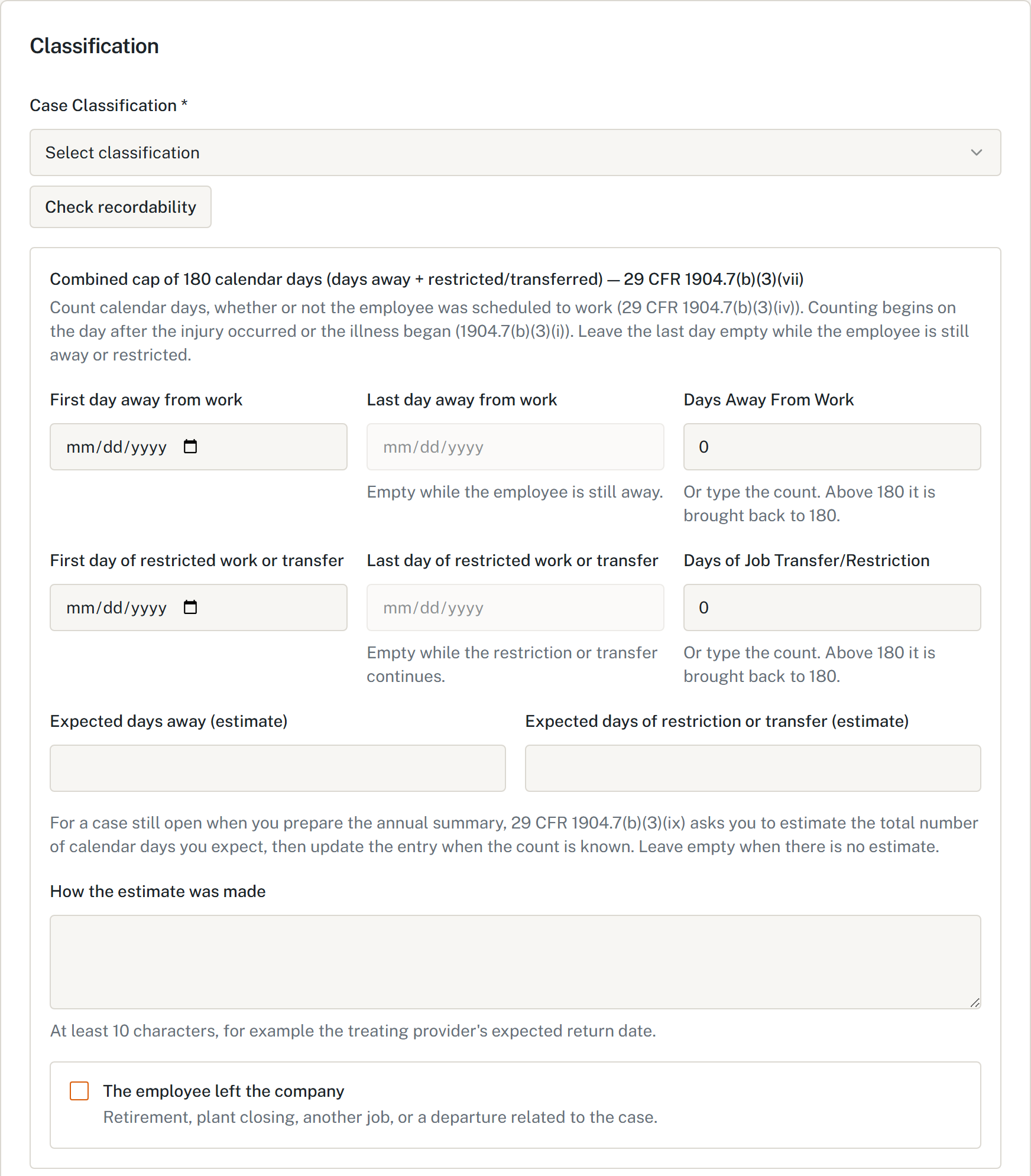
In HazComFast the classification of a 301 case is a required field, and the "Check recordability" assistant walks the questions of 1904.4 to 1904.7 before you pick it: work-relatedness and its exceptions, new case or continuation, the 14 first aid treatments. A person makes the call, and a case kept off the Log keeps its reason, its date and who decided.
The day counts come from dates. Enter the first and last day away, or of restriction, and the count starts the day after the injury and runs in calendar days, as the screen explains with 1904.7(b)(3)(i) and (b)(3)(iv). Leave the last day empty while the employee is still out. A typed count above 180 is brought back to 180. For a case still open when you prepare the annual summary, the case asks for the expected days and how the estimate was made, citing 1904.7(b)(3)(ix), and open cases get a monthly "is it closed yet?" reminder. The injury or illness category is required too, so no case reaches the Log without its column M.
One box per case, and the right one
Walk a case through OSHA's recordability questions free, or keep your Log in HazComFast, where the classification is required and the day counts follow 1904.7.
Related: When is an injury recordable? · OSHA Form 301, item by item · The OSHA 300 Log in Excel · Before you sign the OSHA 300A
Sources & verification (read 2026-10-13 on osha.gov): 29 CFR 1904.7(a), (b)(2), (b)(3)(i), (iv), (vii) and (ix), (b)(4), (b)(5), (b)(6), (b)(7); 1904.8 and 1904.8(b)(3); 1904.29(b)(7); 1904.33(b)(1); Form 300 instructions and the injury and illness definitions in OSHA's recordkeeping forms package. General guidance, not legal advice.*
Frequently Asked Questions
Can I check more than one classification column for a case on the OSHA 300 Log?
No. The Form 300 instructions say to choose only one of the four categories and to classify the case by its most serious outcome, with column G (death) the most serious and column J (other recordable cases) the least. The outcomes themselves come from 29 CFR 1904.7(b)(2) through (b)(7).
A case had days away and then restricted work. Which column do I check?
Column H, days away from work, because it is the more serious outcome. Enter both counts: the days away in column K and the days of job transfer or restriction in column L, counted the same way under 29 CFR 1904.7(b)(4).
Do I count the day of the injury or weekends in the days away?
Not the day of the injury: under 29 CFR 1904.7(b)(3)(i), counting begins on the day after. Weekends and holidays count: 29 CFR 1904.7(b)(3)(iv) says to count calendar days the employee was unable to work, whether or not the employee would have worked them.
What if the case gets worse after I recorded it?
Change the entry. The Form 300 instructions say to line out the original entry and write the new one where it belongs, and 29 CFR 1904.33(b)(1) requires you to update the stored Logs to show changes in the classification of a recorded case.
Is there a maximum number of days I must count?
Yes. 29 CFR 1904.7(b)(3)(vii) lets you cap the total at 180 calendar days: when the case exceeds 180 days away and or days of job transfer or restriction, entering 180 is adequate.
Site-wide regulatory figures such as compliance dates and penalty amounts come from our regulatory source-of-truth modules, last checked against the eCFR, OSHA.gov, and the Federal Register on October 5, 2026. Last reviewed October 13, 2026.
About This Article
Published by: HazComFast
Published: October 13, 2026
Last Updated: October 13, 2026
This content is for informational purposes only and does not constitute legal advice.