
Before you sign the 300A, ask for the Log. Then ask what changed. A summary can have correct arithmetic and still omit a case that was removed without a supported OSHA determination. 29 CFR 1904.32(b)(3) requires the executive to examine the Log and reasonably believe the summary is correct and complete, based on knowledge of the recording process. The signature belongs at the end of that review.
The executive signing OSHA 300A must examine the OSHA 300 Log and reasonably believe the summary is correct and complete based on knowledge of the recording process. Check the establishment, case totals, and required employment figures first. The signer must qualify under one of the four categories in 1904.32(b)(4).
The federal rule applies to employers required to keep these records. Check exemptions separately before treating an empty reporting year as an exemption. For a covered employer, no recordable cases means zero case-column totals under 1904.32(b)(2)(i), not permission to skip the annual summary.
HazComFast is built around that sequence. A 300A can be certified only after the Log has been reviewed since its last change, and only under one of the four titles 1904.32(b)(4) names, so a "Safety Manager" title isn't offered. The certified figures are then frozen, the PDF prints that certified snapshot, and if the Log changes later, the summary names the columns that no longer match.
Who qualifies as the company executive?
Read the four categories in 1904.32(b)(4). An owner qualifies under (i) only when the company is a sole proprietorship or partnership. Paragraph (ii) names an officer of the corporation. Paragraph (iii) names the highest-ranking company official working at the establishment, and (iv) names that official's immediate supervisor.
An EHS manager can prepare the summary and do much of the review work. The job title by itself doesn't put that person in one of these categories. Check the person's actual role and the establishment covered by the Log before routing the signature.
For a corporation, don't use the owner category merely because someone owns shares. Determine whether that person qualifies as an officer or under another listed category. Under 1904.32(b)(4), the role is what matters. Preparing the figures does not by itself qualify someone to make the executive certification.
What must the signer know about the recording process?
Paragraph 1904.32(b)(3) connects reasonable belief in the summary with knowledge of the process by which information was recorded. It doesn't prescribe a fixed meeting length or an executive examination of every medical document. It does require examination of the Log and a supported belief that the summary is correct and complete.
Give the signer a workable view of how cases reached the Log. Explain who evaluates reports, how information from jobsites reaches the recordkeeper, and how changed outcomes are reflected. If a case was corrected or excluded after review, have the factual reason available. Those explanations help the executive assess the process described in (b)(3).
The employer's review duty under 1904.32(b)(1) is as extensive as necessary to make the entries complete and correct. A totals page cannot show whether a recordable case was never entered. The recordkeeping guide explains the underlying recording duties; the executive review should start from the resulting Log and come to the summary last.
Check that the year and establishment match the Log
Under 1904.32(b)(2)(ii), the summary carries the covered calendar year, company name, establishment name, and establishment address. Compare those fields with the Log you reviewed. A company-wide employment figure can be wrong for a summary covering only one establishment.
For employers with multiple establishments, 1904.30(a) requires a separate Log for each establishment expected to operate one year or longer. Paragraph (b)(1) permits a consolidated Log for short-term establishments, including permitted division or regional groupings. Confirm which arrangement the company actually uses before deciding what belongs in this summary.
Central storage is a different question. Under 1904.30(b)(2), records can be kept centrally when the transmission and production conditions are met. Keeping all files at headquarters doesn't turn separate establishment Logs into a single company Log. The executive needs to know which establishment or permitted short-term grouping the figures represent.
Reconcile the cases before adding the columns
1904.32(a)(1) requires review of Log entries for completeness and accuracy and correction of deficiencies. Compare reports awaiting a recording determination with the completed Log. A case waiting in an inbox can be absent from the summary even when the arithmetic on that summary is flawless.
For cases already entered, check the recorded outcomes against the latest information you have. Under 1904.7, days away, restricted work, medical treatment, and other qualifying outcomes affect the entry. Use the relevant implementation paragraph instead of assuming the initial classification stays correct through year end.
An employee still away at year end is not automatically deferred into next year's case count. Paragraph 1904.7(b)(3)(ix) says to record the case once in the year it occurred, estimate expected days for the annual summary when needed, and update the Log later when the actual count is known or reaches the cap. Make those unresolved day-count assumptions visible to the reviewer.
If a claim was denied, keep that insurance disposition separate from the OSHA criteria. The note to 1904.0 makes that distinction. The recordability guide explains the OSHA determination; the executive should be able to see why any material change affected the numbers being certified.
Compare every summary total with the Log
Paragraph 1904.32(b)(2)(i) requires totaling the Log columns. Work from the reviewed Log and compare the result with the 300A. Don't substitute a dashboard number unless you've checked that it covers the same year, establishment, and cases.
Check zero totals deliberately. If there are no recordable cases, the rule directs zeros for each column total. A blank cell may mean nobody entered the number. It doesn't establish that the correct total is zero. For a Log containing cases, compare the classifications and day counts with the corresponding summary columns.
| Before signing | What to compare | Federal reference |
|---|---|---|
| Year and establishment | Summary identifiers against the reviewed Log | 1904.32(b)(2)(ii) |
| Case and day totals | Each summary column against the Log total | 1904.32(b)(2)(i) |
| Ongoing cases | Estimates and year allocation against current information | 1904.7(b)(3)(ix) |
| Corrections | Reason for changed classification or outcome | 1904.33(b)(1) |
| Signer | Actual role against the four executive categories | 1904.32(b)(4) |
Use the table as the review aid. If you use your own summary form instead of OSHA's, 1904.29(b)(4) asks it to contain the same information and follow the same instructions, and 1904.32(b)(2)(iii) adds the employee-access and employer-penalty statements.
Check the employee average and hours separately
1904.32(b)(2)(ii) requires annual average employees and total hours worked for the employees covered by the Log. Ask which source records produced those figures and whether their coverage matches this establishment or permitted short-term grouping. A payroll report for the whole company may include employees outside this Log.
Don't fill a missing hours total with zero to finish the form. Zero is a value, not an explanation of unavailable information. Resolve the figure using the company's applicable records and the form instructions. The same applies to annual average employment: the figure needs to represent the year and employees covered.
The executive's knowledge of the recording process under 1904.32(b)(3) should include understanding what the figures represent. That doesn't make payroll reconciliation a separately named OSHA checklist item. It makes it possible to assess whether the required summary information is correct and complete.
Certify, then post the annual summary
1904.32(a) puts review, summary creation, certification, and posting in the annual process. Under (b)(5), post the summary conspicuously at each establishment where notices are customarily posted, and protect it from alteration, defacement, or being covered. The annual posting is the 300A summary, not the employee-name Log.
For the 2026 year, the posting period under 1904.32(b)(6) is February 1 through April 30, 2027. Electronic submission has separate coverage and requirements. Don't treat an electronic filing confirmation as evidence that the physical posting duty was carried out. The posting-versus-submission guide covers that distinction.
Store the records under 1904.33(a). Later Log updates remain required under (b)(1), while stored-summary updates are optional under (b)(2). That optional-update provision doesn't excuse a deficient summary at the time you prepare and certify it under 1904.32.
Explain the cases removed from the Log before asking for a signature
Put a short review note beside the Log and summary before sending them for signature. Identify unresolved cases, estimated day counts, and the source of the employee and hours figures. Where a correction changed a total, include the case number and the reason. That note gives the executive the context the certification under 1904.32(b)(3) depends on.
One question deserves a direct answer: which cases disappeared from the Log, and why? Bring that answer with the reviewed records. A duplicate entered twice and a case reclassified after new medical information need different explanations. Neither should be reduced to a lower number on the summary.
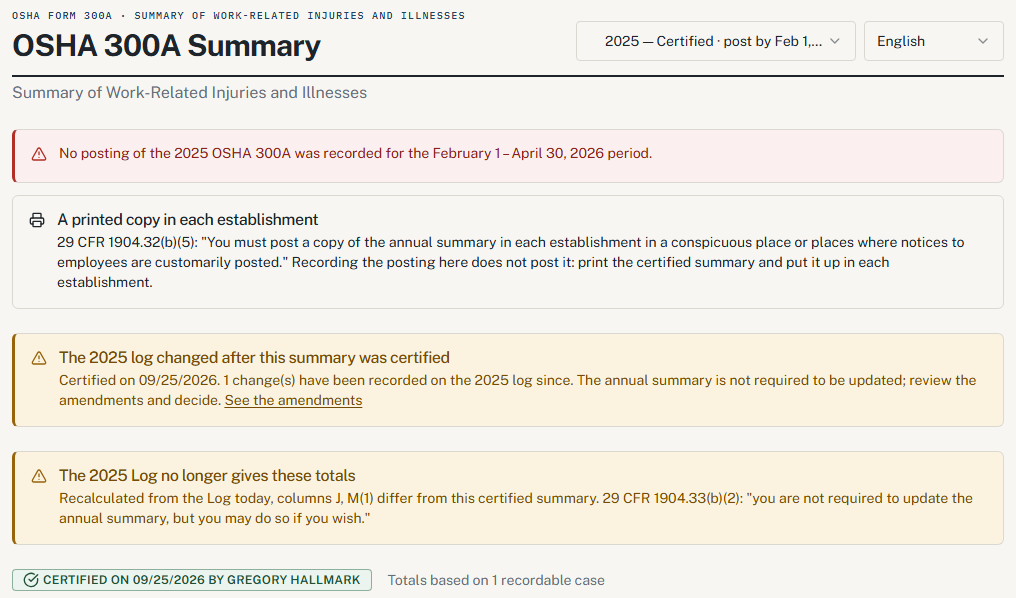
In HazComFast, the Amendments tab on the OSHA 300 Log records removals, restorations, and changes to case fields. Each entry identifies the case, the author, the date, and the reason; field changes retain the original and new values. Review those entries with the Log before sending the annual summary for certification.
For example, a summary with one fewer case than the previous draft needs an explanation. Was the missing entry a duplicate? Was it a case that remains recordable but was removed after an insurance denial? The first may explain a supported correction; the second needs the recordkeeper to revisit the OSHA determination. How to correct the OSHA 300 Log covers that decision. The executive's question is what happened to the case, not whether the new total looks better.
HazComFast restricts case removal to an administrator and requires a reason with written detail. Linked records are named before confirmation, and a case-specific legal hold blocks removal. An immediate undo appears as a restoration. These controls keep the explanation available when a reviewer asks why this year's Log changed.
Bring the reviewed Log, its amendment history and the 300A to the same review, and resolve unexplained differences before routing the signature.
Certify a 300A you can defend
HazComFast keeps the Log, its amendments and the 300A for each establishment together, offers only the four certifying titles of 1904.32(b)(4), freezes what was certified, and tells you when the Log moves afterward. Start with the free 300A filler, or run the year-end review in the app.
Related: OSHA 300A posting vs electronic submission · Who must submit to the ITA · When is an injury recordable? · How long to keep OSHA records
Sources & verification (read 2026-10-13): 29 CFR 1904.32(a), (b)(1) to (b)(6) (review, summary, certification, posting); 1904.29(b)(4) (equivalent forms); 1904.30(a) and (b) (establishments, central storage); 1904.33(a) and (b) (retention and updates); 1904.7(b)(3)(ix) (cases still open at year end); note to 1904.0 (workers' compensation is a separate question). Not legal advice.*
Frequently Asked Questions
Who can sign the OSHA 300A annual summary?
1904.32(b)(4) lists an owner of a sole proprietorship or partnership, a corporate officer, the highest-ranking company official working at the establishment, or that official's immediate supervisor. A safety manager's title alone does not establish eligibility under one of those categories.
What does the executive certify?
Under 1904.32(b)(3), the executive certifies examination of the OSHA 300 Log and reasonable belief, based on knowledge of the recording process, that the annual summary is correct and complete. Signing a page without that examination does not perform the stated certification.
Does a zero-case year still need a summary?
For an employer required to keep these records, 1904.32(b)(2)(i) directs entry of zeros for each column total when there are no recordable cases. The annual summary still has the required establishment and employment information and must be certified and posted under 1904.32(a).
What employment information belongs on OSHA 300A?
1904.32(b)(2)(ii) requires the annual average number of employees covered by the Log and total hours worked by all employees covered by it, alongside the year and company and establishment identifiers. A blank figure is not interchangeable with a verified zero.
When is the 2026 OSHA 300A posted?
1904.32(b)(6) requires posting no later than February 1 of the following year through April 30. For the 2026 summary, those dates are February 1 through April 30, 2027. Paragraph (b)(5) governs the location and protection of the posted copy.
Must a stored annual summary change every time an old Log changes?
No. 1904.33(b)(2) makes stored annual-summary updates optional. That differs from the review and accurate summary preparation required at year end by 1904.32(a)-(b). Keep the duty for the current summary separate from later stored-record updates.
Site-wide regulatory figures such as compliance dates and penalty amounts come from our regulatory source-of-truth modules, last checked against the eCFR, OSHA.gov, and the Federal Register on October 5, 2026. Last reviewed October 13, 2026.
About This Article
Published by: HazComFast
Published: October 13, 2026
Last Updated: October 13, 2026
- https://www.osha.gov/laws-regs/regulations/standardnumber/1904/1904.32
- https://www.osha.gov/laws-regs/regulations/standardnumber/1904/1904.29
- https://www.osha.gov/laws-regs/regulations/standardnumber/1904/1904.30
- https://www.osha.gov/laws-regs/regulations/standardnumber/1904/1904.33
- https://www.osha.gov/laws-regs/regulations/standardnumber/1904/1904.7
- https://www.osha.gov/laws-regs/regulations/standardnumber/1904/1904.0
This content is for informational purposes only and does not constitute legal advice.