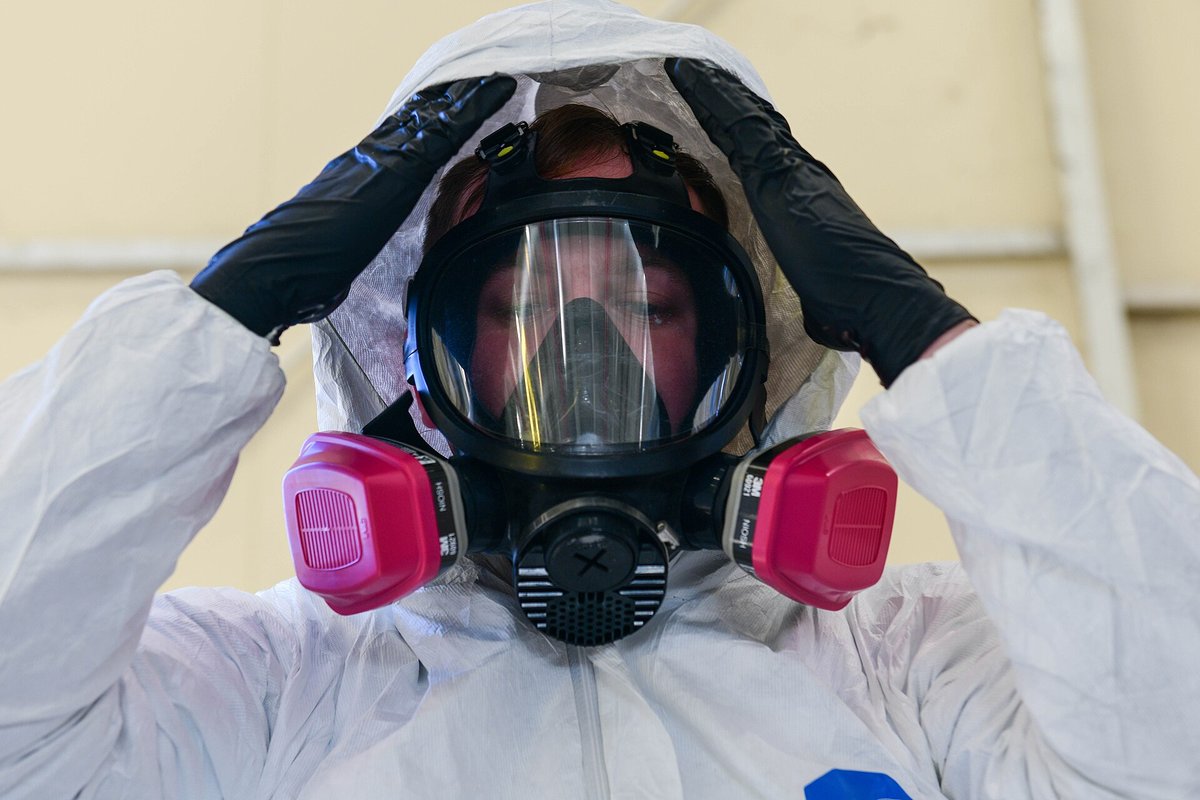
An SDS can recommend ventilation, gloves, and respiratory protection without telling an employer whether a particular job can proceed. Section 8 describes exposure limits and protective measures for the product. The employer still has to establish what workers will handle, what can reach them, and whether the selected controls work under those conditions.
That assessment should end with a usable instruction: which operation is covered, which controls need to be operating, which protective equipment has been selected, and what changes call for another review. “Follow the SDS” leaves those decisions unresolved.
Download the task exposure-control worksheet (Word). It records the evidence behind the decision, missing information, and conditions for starting or stopping the task.
Establish which rules govern the operation
Under 1910.1200 Appendix D, Section 8 includes available OSHA PELs, ACGIH TLVs, and other exposure limits used or recommended by the SDS preparer, together with appropriate engineering controls and individual protection measures. Those entries are inputs to an assessment. They do not constitute an employer's completed PPE selection or a measurement of employee exposure.
For general industry, start with the applicable air-contaminant or substance-specific standard, 1910.132 for PPE, 1910.138 for hand protection, and 1910.134 when respirators are involved. A substance-specific rule may add assessment methods, action levels, regulated areas, or medical-surveillance duties that a generic Section 8 summary does not resolve.
Construction uses its applicable provisions, including 1926.55 and 1926.95. Construction adopts the respiratory standard through 1926.103 and HazCom through 1926.59. Do not automatically carry every general-industry documentation provision into construction. Confirm the OSHA-approved State Plan requirements for the location as well.
Laboratory operations also need an applicability decision under 1910.1450. Where that standard applies, use its laboratory-specific framework and Chemical Hygiene Plan; its scope preserves applicable PELs and specifies how other health-standard provisions interact with the laboratory requirements. Work does not qualify merely because it takes place in a room called a laboratory.
Match the sheet to the product and its use
Check the container's product identifier against Section 1. Confirm the supplier, grade, concentration, and any component designation. A two-part adhesive needs the relevant information for both components and for mixing, application, and curing. A sheet for a diluted cleaner does not necessarily describe the concentrate used to make it.
Keep the reviewed revision with the assessment. Read the recommended use and restrictions, then compare them with the proposed operation. Heating, spraying, grinding, reacting, or using a chemical inside equipment can create conditions very different from handling a closed package. Sections 2, 3, 7, 9, 10, and 11 help establish what Section 8 needs to address.
An SDS does not expire, and its revision date is not an expiration date. The useful question is whether the employer has the correct sheet and whether new information changes the controls. The SDS management guide covers access and library administration; the task review needs to address the actual exposure.
Read an exposure limit with its identity and averaging period
A limit is incomplete without the chemical identity, units, averaging period, and source. An eight-hour TWA addresses an average exposure. A ceiling or short-term limit addresses different exposure conditions. Passing an average does not demonstrate that a separate ceiling has been met.
An applicable OSHA PEL is enforceable under its governing provision. NIOSH RELs and ACGIH TLVs are recommendations unless another applicable rule adopts a value. They can still inform the employer's assessment and choice of a more protective operating target. OSHA's annotated PEL tables explain why the federal PEL should not be assumed to represent the latest health-based recommendation. HazComFast's exposure-limits guide provides the broader comparison.
Check whether a listed value is marked vacated. A vacated value is not the current federal limit, even when it appears in an OSHA column on an SDS. Also separate U.S. values from limits listed for other countries. If the assessment uses a company target below the legal limit, identify it as the company's target and preserve the reason for selecting it.
An airborne limit does not settle skin absorption, chemical burns, eye injury, sensitization, oxygen deficiency, or ignition hazards. A worker can have a serious splash exposure while the measured airborne concentration remains below a PEL.
A real Section 8 example: Fisher Chemical acetone
The U.S. Fisher Scientific acetone SDS for the A18 product family, revised December 18, 2025, illustrates several review problems. Section 8 lists the federal acetone TWA of 1,000 ppm, the NIOSH REL of 250 ppm, advisory TLVs, and separate vacated entries. The NIOSH acetone entry independently confirms the federal PEL and REL.
| Information on this sheet | Employer's next decision |
|---|---|
| Current and vacated exposure-limit entries | Identify the applicable current limit; retain advisory targets separately |
| General ventilation and protective-clothing recommendations | Establish the task's release conditions and selected controls |
| Respiratory references that include a European AX designation | Select a suitable NIOSH-approved configuration for U.S. workplace use |
The TLVs here are the values that SDS revision reports; the current ACGIH edition may differ. The sheet does not provide a measured exposure for the employer's job, a glove-model selection, or an approved cartridge change schedule.
Describe the task before evaluating its controls
Consider an illustrative laboratory task: a technician wipes adhesive residue from a metal fixture with the identified acetone product. This is a proposed assessment, not a report of measured conditions or a declaration that the operation is safe.
The reviewer first establishes the amount dispensed, container arrangement, wetted surface, time spent wiping, frequency, worker position, and location of used wipes. The description distinguishes open pouring from dispensing, application from drying, and routine work from cleanup. It also identifies nearby workers who could be exposed.
Next, evaluate each route. Evaporation can create inhalation exposure; wet handling creates skin and eye-contact opportunities; contaminated gloves can transfer material to other surfaces. Ignition control needs a separate review of the actual process and applicable flammable-liquid and electrical provisions. No assumed air concentration or ventilation rate is needed to identify these questions, but those questions need answers before the assessment can support routine work.
Choose controls that address the release
Review whether the residue-removal step can be eliminated or performed with a suitably evaluated alternative. If acetone remains necessary, consider how dispensing, enclosure, local exhaust, and waste-wipe handling could reduce releases. Evaluate an alternative on its actual hazards and performance, rather than treating “water-based” as a complete safety finding.
For work within 1910.1000, paragraph (e) has feasible administrative or engineering controls determined and implemented first to achieve its limits. Equipment and technical measures used for that purpose need approval for the particular use by a competent industrial hygienist or other technically qualified person. That provision is more specific than a supervisor deciding that the room feels ventilated.
“Adequate ventilation” does not specify a design. The reviewer needs a basis for source capture or dilution under the identified conditions, including where contaminated air goes and how failure will be recognized. An open door or the sound of a fan does not establish contaminant control.
Establish whether the exposure evidence is sufficient
Look for representative personal sampling, relevant objective data, or a technically supported exposure estimate, where the applicable standard permits that approach. Explain why the evidence represents this product, task, duration, controls, and employee group. A measurement from another operation is useful only if the comparison is supported.
Monitoring is necessary when an applicable standard calls for it or when the available evidence cannot adequately establish exposure for the decision being made. The HazCom rule does not impose one universal sampling schedule for every chemical task. Where sampling is selected, the plan should distinguish full-shift exposure from shorter releases and use an appropriate validated method.
An area reading is not automatically a worker's breathing-zone exposure. A general-purpose instrument may not measure the chemical selectively or respond adequately to the concentration range. Record the method's suitability, sampling conditions, and interpretation rather than preserving only a number.
Select gloves and eye protection from the contact conditions
For the wiping task, identify credible splash and wet-contact conditions. Obtain chemical-resistance information for the specific glove model, including material, thickness, test conditions, degradation, and permeation information relevant to the product. A material name such as “nitrile” is not a complete selection. Laboratory breakthrough information is not an automatic safe wearing time under flexing, heat, abrasion, or mixed-chemical exposure.
Under 1910.138(b), selection considers performance relative to the tasks, conditions, duration, and identified hazards. Decide how gloves will be inspected, changed, removed, and disposed of without contaminating the worker. Eye and face protection need their own selection; a face shield is not automatically a substitute for suitable primary eye protection.
Resolve respiratory protection before relying on it
If the operation requires a respirator, the decision must fit 1910.134(c)(1) and (d)(1)(iii): identified hazards, a reasonable exposure estimate, suitable NIOSH-approved equipment, and the applicable program, medical evaluation, fit testing, training, use, maintenance, and cartridge provisions. A filter color or an SDS's generic respirator recommendation does not establish that complete arrangement.
Gas and vapor cartridges require an appropriate NIOSH-certified ESLI or a supported change schedule under 1910.134(d)(3)(iii)(B). Do not invent a replacement interval from the SDS. If respiratory exposure cannot be identified or reasonably estimated, paragraph (d)(1)(iii) requires the atmosphere to be considered IDLH; choosing a stronger air-purifying cartridge does not resolve that condition.
For this proposed task, keep the review pending until the exposure assessment and control selection are complete. Record the outstanding evidence, the responsible reviewer, and the conditions to meet before routine work begins.
Turn the assessment into instructions workers can use
The final record should identify the covered task and its boundaries, the engineering controls and checks, selected PPE, safe handling and cleanup, emergency arrangements, training, and the evidence supporting release. Name the person responsible for each outstanding issue and the person authorized by the employer to accept the completed review.
For general-industry PPE assessments, 1910.132(d)(2) requires a written certification identifying the workplace, certifying person, assessment date or dates, and the document as a certification of hazard assessment. The downloadable worksheet can support the assessment; it is not automatically that certification and does not replace separately required records.
Keep exposure measurements under their applicable retention and access rules, including 1910.1020 where it applies. Assign retention periods by record type and applicable requirement.
Reopen the review when the formulation, application method, quantities, temperature, work duration, ventilation, worker position, or other material conditions change. A new SDS hazard, symptoms, a control failure, or evidence that the assumptions were wrong also warrants review. Reassessment should connect to the employer's purchasing and change-management processes.
Supervisor checks before starting
Hold the affected operation for further evaluation when the product and SDS do not match, important exposure routes remain unassessed, selected controls are unavailable, the selected glove has no relevant performance basis, or the respirator arrangement is incomplete. Escalate unresolved incompatibilities and unidentified reaction products as well.
During work, workers need clear instructions for control failure, unexpected releases, damaged PPE, or symptoms. Use the site's protective and emergency procedures; do not wait for a scheduled assessment review. An employer's completed record should reflect evidence that actually exists, with unresolved conditions visible.
Frequently Asked Questions
Does Section 8 tell me exactly which gloves to buy?
Usually it does not establish a complete glove selection. Match the specific glove's performance to the product, contact conditions, task, and duration. Under 1910.138, the employer evaluates that performance; a generic material name on an SDS is only an input.
Are NIOSH RELs and ACGIH TLVs federal OSHA limits?
They are recommendations rather than automatically enforceable federal PELs such as those in 29 CFR 1910.1000. Check the governing standard and State Plan before deciding which legal limit applies. An employer may use a more protective target, but should identify its source and status accurately.
Does every chemical task need air sampling?
No single OSHA rule sets the same sampling program for every chemical task. Substance-specific assessment requirements, such as those in 1910.1053 or 1926.1153, may apply, and monitoring may be needed when other available evidence cannot support the exposure decision. Document the basis for whichever permitted method is used.
What if the SDS recommends a respirator approved outside the United States?
For U.S. workplace use under 1910.134, select a suitable NIOSH-certified respirator and approved configuration. A foreign filter designation alone does not demonstrate that selection. The employer must also satisfy the applicable respiratory-program requirements of 1910.134(c)(1).
Does a result below the PEL settle the entire assessment?
No. Consider the averaging period, short-term or ceiling requirements under standards such as 1910.1000, the represented conditions, other applicable duties, and exposure routes. A low airborne result does not resolve skin contact, eye injury, ignition, or an unassessed task.
When should a supplier be contacted?
Seek clarification when the product identity, revision, ingredient information, recommended use, exposure-limit entry, or protective recommendation is insufficient for the task review. Ask a specific question and retain the response. Supplier clarification supports the employer's assessment; it does not transfer the employer's workplace-control duties under standards such as 1910.132 and 1910.1000.
Site-wide regulatory figures such as compliance dates and penalty amounts come from our regulatory source-of-truth modules, last checked against the eCFR, OSHA.gov, and the Federal Register on October 19, 2026. Last reviewed November 14, 2026.
About This Article
Published by: HazComFast
Published: November 14, 2026
Last Updated: November 14, 2026
- https://www.cdc.gov/niosh/npg/npgd0004.html
- https://www.fishersci.com/store/msds?countryCode=US&language=en&partNumber=A184&productDescription=ACETONE+CERTIFIED+ACS+4L&vendorId=VN00033897
- https://www.osha.gov/annotated-pels
- https://www.osha.gov/laws-regs/regulations/standardnumber/1910/1910.1000
- https://www.osha.gov/laws-regs/regulations/standardnumber/1910/1910.1020
- https://www.osha.gov/laws-regs/regulations/standardnumber/1910/1910.1200AppD
- https://www.osha.gov/laws-regs/regulations/standardnumber/1910/1910.132
- https://www.osha.gov/laws-regs/regulations/standardnumber/1910/1910.134
- https://www.osha.gov/laws-regs/regulations/standardnumber/1910/1910.138
- https://www.osha.gov/laws-regs/regulations/standardnumber/1910/1910.1450
- https://www.osha.gov/laws-regs/regulations/standardnumber/1926/1926.103
- https://www.osha.gov/laws-regs/regulations/standardnumber/1926/1926.55
- https://www.osha.gov/laws-regs/regulations/standardnumber/1926/1926.59
- https://www.osha.gov/laws-regs/regulations/standardnumber/1926/1926.95
This content is for informational purposes only and does not constitute legal advice.