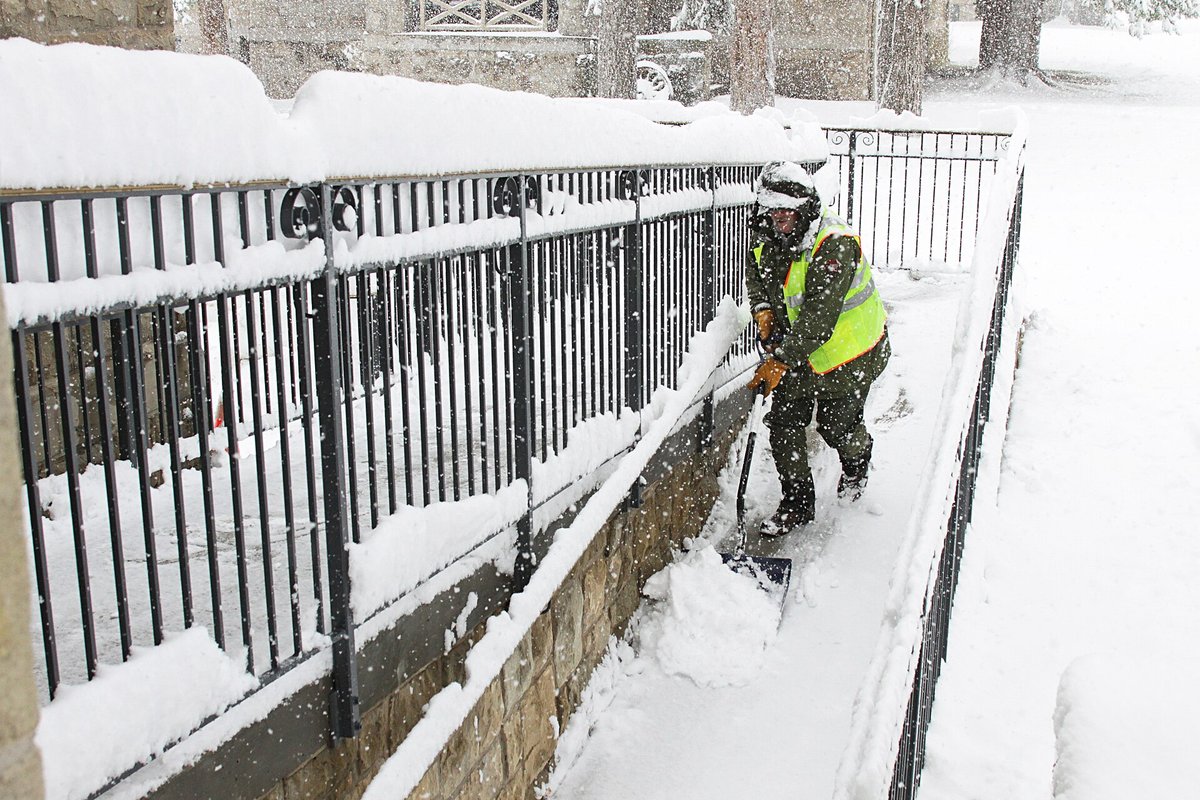
A construction crew can begin a winter shift in dry conditions and finish it in freezing rain. A worker carrying materials may sweat through an insulating layer, while a flagger standing nearby produces little body heat. Both can become dangerously cold, but not necessarily for the same reasons.
Cold stress occurs when the body loses heat faster than it can maintain a safe internal temperature. It can lead to hypothermia, frostbite, and other injuries. Before a medical emergency develops, cold may also interfere with grip, dexterity, balance, and judgment, abilities that matter when workers handle power tools, climb ladders, work on scaffolds, or perform tasks near water.
A winter work plan needs to address the actual exposure: weather, wind, moisture, workload, protective clothing, access to warming facilities, opportunities to recover, worker observation, and emergency response.
Federal OSHA has no specific cold-stress standard establishing a universal outdoor stop-work temperature, a binding warm-up break interval, or a maximum cold-exposure duration for all construction work. That does not excuse failure to address serious recognized hazards. The Occupational Safety and Health Act's General Duty Clause may apply where its legal elements are established, and relevant construction standards remain enforceable. OSHA and NIOSH also recommend controls that help employers manage the risk. See OSHA's cold-stress guidance, the OSH Act, section 5(a)(1), and CDC/NIOSH's Cold and Work guidance.
How cold stress develops
The body generates heat through normal metabolism and physical activity, while losing heat to its surroundings. During winter work, several processes accelerate heat loss:
- Convection: Moving cold air removes heat from exposed skin; wind increases the effect.
- Conduction: Direct contact with cold metal, ground, concrete, or water transfers heat from the body.
- Evaporation: Sweat or water on the skin and in clothing removes heat as it evaporates.
- Radiation: Heat transfers from the body toward colder surroundings.
The body reduces blood flow near the skin to conserve core heat, leaving fingers, toes, ears, and the face vulnerable. Shivering helps generate heat but also signals significant cold exposure. As cooling progresses, coordination, thinking, and judgment may deteriorate.
Cold stress does not need freezing weather. Hypothermia can occur above 40°F when a person becomes chilled by rain, sweat, or immersion in cold water. Trench foot can develop in continuously wet feet at temperatures as high as 60°F. These are medical facts, not OSHA thresholds requiring automatic shutdown. Sources: CDC, Preventing Hypothermia and NIOSH, Cold-related Illnesses.
Recognize cold-related illnesses early
| Condition | Signs workers may notice | Recommended immediate response |
|---|---|---|
| Hypothermia | Shivering, unusual fatigue, clumsiness, confusion; later slurred speech, severe loss of coordination, abnormally slow breathing, reduced responsiveness | Stop exposure and request medical assistance. Activate emergency medical services immediately for serious symptoms. |
| Frostbite | Numbness, tingling or aching; pale, bluish or waxy skin; unusually firm skin or blisters | Protect the affected tissue from further cold and obtain prompt medical assessment. Do not rub, massage, or use direct high heat. |
| Trench foot (immersion foot) | Prolonged wet feet followed by numbness, pain, swelling, redness, or blisters | Remove wet footwear, dry and protect the feet, limit walking, and obtain medical evaluation. |
| Chilblains | Itchy, red, swollen, or painful skin after repeated exposure to cold; possible blisters | End exposure, warm the skin gradually, and seek assessment if persistent, recurrent, or severe. |
This is a recognition and response guide, not a diagnostic tool. Workers do not need to confirm an exact core body temperature before seeking medical assistance. Hypothermia is defined clinically by core body temperature below 95°F, but jobsite responders should act on concerning symptoms. CDC/NIOSH symptoms and first aid.
Immediate emergency warning signs: Confusion, slurred speech, inability to stand or walk normally, collapse, reduced responsiveness, or absent/abnormal breathing after cold exposure. A severely affected worker may not appreciate their own condition. Do not leave the worker alone or let the worker operate equipment.
Evaluate the exposure at the work location
Review both the forecast and the conditions where employees will actually work. Record the observation time and identify when the assessment needs to be repeated.
Air temperature and wind. Check temperature, wind speed or gusts, and exposure to open building levels, raised platforms, bridge decks, and unprotected work fronts. The National Weather Service wind-chill guidance helps describe the cooling effect on exposed skin. Wind chill is not the actual air temperature, a measurement of the temperature of tools or materials, or an OSHA work/rest schedule.
Moisture. Identify rain, sleet, standing water, wet boots, snow entering clothing, and sweating during heavy labor. A worker who sweats during material handling can cool rapidly when the assignment changes to stationary observation or equipment operation.
Duration and workload. Identify stationary, moderate, and high-exertion assignments, travel time to warmth, repeated cold exposures, and opportunities to change wet clothing. A single shift-wide approach may be inadequate because different workers experience different heat production and exposure.
Individual factors. OSHA identifies exhaustion, inadequate clothing, poor physical conditioning, and some health conditions as risk factors. Encourage workers to report limitations through appropriate confidential channels; do not demand disclosure of private diagnoses during a crew briefing. Provide added observation for workers unfamiliar with cold-weather operations. OSHA Cold Stress Guide.
Apply controls before relying on clothing alone
Start by changing the work where feasible: move preparation indoors, prefabricate parts, reduce unnecessary trips outside, postpone a particularly exposed activity, or schedule it for the warmer part of the day.
Where possible, provide physical wind protection, dry staging areas, and safe access to sheltered work. Use mechanical handling to reduce excessive exertion where suitable. Avoid designing a task so that workers need to repeatedly soak their boots or work in wet clothing without a way to change.
Then organize the job: use relief personnel, rotate workers from exposed work to genuinely sheltered tasks, and maintain effective supervision and communication. A rotation from one windy outdoor task to another is not necessarily recovery.
These measures reflect CDC/NIOSH employer recommendations and NIOSH Publication 2019-113, Preventing Cold-related Illness, Injury & Death among Workers. They are recommended prevention measures, not a federally mandated numerical break formula.
Make warming facilities usable
Identify an accessible, warm, dry space (a suitable heated trailer, building, or properly arranged vehicle) where workers can recover and change wet layers. Check its capacity, location, access, and availability throughout the affected operations. A locked shelter or one that takes too long to reach may not function as the intended control.
Temporary heating introduces fire and exhaust risks. 29 CFR 1926.154 addresses fresh air and ventilation, clearance and mounting, stability, and particular heater types. Fuel-burning equipment can produce carbon monoxide; do not improvise combustion heating in enclosed areas. The regulation needs to be followed where applicable. 29 CFR 1926.154.
Select clothing and PPE for the task
Use adjustable layers that preserve insulation while managing sweat and precipitation:
- Base layer: Wool or suitable synthetic fabric to help manage moisture.
- Insulating layer: Fleece, wool, or another suitable insulating material.
- Outer layer: Appropriate wind and precipitation protection with ventilation that helps prevent overheating.
Carry spare gloves, socks, and other dry clothing. Use insulated, suitable boots for the conditions; check fit and traction. Tight clothing can restrict circulation, while bulky garments can interfere with movement. OSHA Cold Stress Guide.
Winter clothing should not defeat task-specific protection. Confirm that insulated gloves permit control of tools and connectors, headwear does not interfere with hard-hat fit, hoods do not obstruct vision, outer layers preserve high visibility, and harnesses fit correctly over the intended clothing arrangement. Workers should be able to inspect and operate protective equipment without removing necessary protection.
PPE payment distinction: Under 29 CFR 1926.95(d)(4)(ii), employers generally do not have to pay for ordinary clothing used solely for weather protection, such as ordinary winter coats, hats, gloves, and raincoats. That exception does not extend automatically to specialized PPE required by Part 1926. The general employer-payment rule and its exceptions must be evaluated for the particular item. PPE must also be selected to properly fit each affected employee under 1926.95(c)(2). Official rule; HazComFast PPE for Construction.
Build a risk-based work/warming plan
There is no universal federal OSHA cold-weather work/rest table. The employer should set a workable site-specific exposure and recovery plan, then change it if the controls are not effective.
Step 1: Classify the work. Identify prolonged stationary positions, strenuous work that can cause sweating, tasks requiring fine motor control, work at height, and wet or isolated locations. These are planning categories, not legal exposure classes.
Step 2: Select effective recovery. Determine where a worker can warm up, whether wet layers can be replaced, and whether a relief worker or sheltered alternative task is available. Plan a method for workers to request unscheduled warming or help.
Fluids and food. During recovery periods, provide access to appropriate drinks and food. OSHA recommends warm, sweet, nonalcoholic beverages and high-carbohydrate snacks for cold-weather work. These are prevention recommendations, not a universal federal requirement to provide a specific beverage or snack. OSHA cold-stress prevention guidance.
Step 3: Assign responsibility. Identify who confirms the warming area, who monitors worker condition, who manages rotations, and who can modify or suspend the task.
Step 4: Observe effectiveness. Look for persistent shivering, wet clothing, diminished hand function, slowed work, unusual behavior, and difficulty with normally familiar tasks. Check whether workers can actually reach and use the warming area.
Step 5: Reassess and adjust. Increase protection or recovery opportunities, change assignments, or hold work when conditions deteriorate. Never make a symptomatic worker wait for a scheduled break.
Document the selected arrangement. For every exposed crew or distinct task, complete the work/warming plan in the downloadable field record, including the employer-selected work segments, recovery arrangements, observer, and early-reassessment triggers. The plan needs to allow immediate unscheduled warming and needs to never delay medical help.
A numerical schedule chosen voluntarily by an employer needs to reflect conditions and be reassessed; an example interval is not an OSHA minimum or maximum. Sources: OSHA cold-stress prevention recommendations; NIOSH Publication 2019-113.
Know when to proceed, modify, hold, or activate emergency response
| Decision | Trigger | Supervisor action |
|---|---|---|
| Proceed with controls | Exposure and task hazards are adequately controlled; equipment, warming, observation, and communication arrangements work | Authorize the task and continue observation |
| Modify before proceeding | Wet clothing, increasing wind, poor glove dexterity, inadequate rotation, or ineffective shelter can be corrected | Stop the affected exposure, implement and verify controls, brief the crew |
| Hold or suspend affected work | Needed task-specific safeguards are missing; access is unsafe; hand function or coordination is impaired; essential rescue/communication arrangements are unavailable without a safe alternative | Keep the task on hold until the hazard is controlled and restart is authorized |
| Medical emergency | Confusion, slurred speech, collapse, inability to walk normally, unresponsiveness, or absent/abnormal breathing | Activate emergency medical services immediately and begin the site's emergency procedure |
The table is a recommended company decision model, not an OSHA-prescribed classification. Particular task restrictions, such as snow- or ice-covered scaffolds, are independently enforceable under the applicable standards.
Restart check: Identify what changed, verify the corrective measure and equipment or access conditions, communicate new controls, respect any medical restrictions, and document the responsible supervisor's authorization. Do not treat a completed form as proof that the actual hazards have been eliminated.
Address construction tasks with compounded cold hazards
Tools, controls, and metal components
Numb hands can impair grip and precise tool control. Test gloves with the actual control arrangement before work. Keep handles and contact surfaces free of ice where feasible. Avoid bare-skin contact with cold metal. If a worker cannot safely operate a tool with needed protection, change the tool or method rather than removing the protection.
Ladders, scaffolds, and work at height
Inspect access routes, ladder rungs, work platforms, and anchor or attachment areas for ice or snow; confirm that winter clothing and fall-protection equipment remain compatible. Under 29 CFR 1926.451(f)(8), employees may not work on scaffolds covered with snow, ice, or other slippery material except as necessary to remove it. 1926.451(f)(12) restricts scaffold work during storms or high winds unless the specified competent-person determination and protections are provided. Ladder requirements in 1926.1053 continue to apply. OSHA scaffold rule; OSHA ladder rule.
Work over or near water
Cold-water immersion can rapidly compromise movement and survival. Assess drowning hazards, rescue access, the risk to rescuers, and medical follow-up. 29 CFR 1926.106(a) requires U.S. Coast Guard-approved life jackets or buoyant work vests for employees working over or near water where the danger of drowning exists; (b) requires inspection of those devices before and after use. Separately, 1926.106(c) requires readily available ring buoys with at least 90 feet of line, spaced no more than 200 feet apart, and (d) requires at least one immediately available lifesaving skiff where employees work over or adjacent to water. OSHA has explained that the ring-buoy and skiff requirements apply even when continuous fall protection is in place. Do not condition all four provisions on the drowning-hazard language in paragraph (a). 29 CFR 1926.106; OSHA interpretation on ring buoys and skiffs; NIOSH cold-water immersion information.
Wet excavation and concrete work
Standing water, saturated boots, and kneeling or standing on cold, wet surfaces can increase cold-related risks. Provide drainage or water controls where feasible, appropriate footwear, and dry replacement supplies. Continue complying with applicable excavation, electrical, and concrete-work requirements.
Snow removal and strenuous material handling
Evaluate overexertion, slick surfaces, visibility, and subsequent sweating. Where practical, use suitable mechanical handling, control walking routes, organize the work to avoid unnecessary exertion, and provide opportunities to recover.
Isolated work fronts and poor communication coverage
Do not assume that mobile coverage is reliable at every site. Confirm a workable means of contacting supervision and emergency services, a location description responders can use, and a risk-based check-in arrangement for physically separated workers. GPS tracking alone does not create a rescue capability.
Train the crew and observe workers throughout the shift
Provide site-specific instruction on symptoms, clothing, wetness, warm-up arrangements, reporting, the work-modification process, and emergency contacts. 29 CFR 1926.21(b)(2) requires employers to instruct employees in recognizing and avoiding unsafe conditions and applicable regulations; OSHA and NIOSH also recommend cold-stress-specific training. 29 CFR 1926.21; CDC/NIOSH worker training recommendations.
Supervisors should watch for shivering, fatigue, fumbling, reduced hand function, unsteady movement, confusion, slurred speech, and wet clothing. Pairing workers can support observation but does not replace supervisor oversight. Ask workers to demonstrate that they know where to warm up and how to summon help. A signed briefing sheet documents participation, not necessarily understanding.
Coordinate winter controls with subcontractor crews and site management. Make sure new crews know where warming facilities are located and how site emergency communication works.
Emergency arrangements: what 29 CFR 1926.50 actually requires
Before the project begins, the construction employer must establish provisions for prompt medical attention in serious-injury cases under 1926.50(b). The following related requirements apply according to their terms:
| Provision | Requirement relevant to emergency readiness |
|---|---|
| 1926.50(a) | Medical personnel must be available for advice and consultation on occupational health matters. |
| 1926.50(c) | If no suitable infirmary, clinic, hospital, or physician is reasonably accessible and available for treatment, a person holding valid, recognized or equivalent documented first-aid training must be available at the worksite. |
| 1926.50(d)(1)–(2) | Required first-aid supplies must be easily accessible; first-aid-kit contents must be in a weatherproof container with individually sealed packages, checked before each job and at least weekly on each job. |
| 1926.50(e) | Suitable equipment for prompt transport to medical care or a communication system to contact necessary ambulance service must be provided. |
| 1926.50(f)(1) | Where 911 dispatch is unavailable, telephone numbers for physicians, hospitals, or ambulances must be conspicuously posted. |
| 1926.50(f)(2) | Where 911 is available and the employer uses a communication system for EMS contact, the system must effectively reach EMS; certain sites must conspicuously post coordinates or other effective site-location information if the system does not automatically transmit latitude/longitude, subject to the regulation's qualifying landline exception. |
These are general construction medical-services duties, not a special cold-stress break standard. Read the exact 29 CFR 1926.50 before implementing the plan.
Use this site-specific instruction consistently: Activate emergency medical services immediately when serious symptoms occur. Call 911 where available; otherwise use the worksite's established emergency medical contact and communication arrangements.
Before remote or water-exposed work, verify who makes the call, how responders receive the site location, which gate or route is accessible, who meets responders, and how the worker can be reached without endangering rescuers.
First aid: suspected hypothermia
Activate emergency medical services immediately for confusion, slurred speech, severe loss of coordination, collapse, reduced responsiveness, or abnormal breathing following cold exposure. Call 911 where available; otherwise use the verified emergency contact method for the worksite. Do not wait to obtain a core-temperature reading.
- Make the scene safe. Control traffic, machinery, fall hazards, electrical hazards, or water exposure before approaching. Do not create a second victim.
- Move to shelter if safe. Handle a severely hypothermic person gently; do not force an impaired person to walk.
- Stop further heat loss. In shelter, replace wet clothing with dry layers when feasible. Use dry blankets or insulation under and around the person, including the head and neck without covering the face.
- Rewarm cautiously. Focus on conserving heat and gentle central-body warming under current first-aid training and medical or dispatcher direction. Avoid burns from uncontrolled heat sources.
- Give drinks only when appropriate. Warm, nonalcoholic drinks may be appropriate only if the person is fully alert and can swallow normally; never give oral fluids to someone confused, drowsy, unconscious, or unable to swallow safely.
- Monitor until EMS arrives. Do not leave the person unattended. Keep rescuers informed of exposure, changes in responsiveness, breathing, and any actions taken.
CPR instruction for nonprofessional responders: If an adult is unresponsive and is not breathing normally (including only gasping), activate emergency medical services, start CPR according to current basic-life-support training and dispatcher instructions, and use an AED as soon as available. Lay rescuers should not delay CPR to search for a pulse. Severe hypothermia can make circulation and breathing difficult to assess; professional rescuers should follow applicable hypothermia-specific resuscitation guidelines. AHA 2025 Adult Basic Life Support; AHA Special Circumstances, Hypothermia; OSHA first-aid guidance.
Do not assume that the absence of shivering means recovery, and do not return a person with suspected cold-related illness to hazardous duty merely because they feel warmer.
First aid: frostbite, trench foot, and chilblains
Suspected frostbite
Remove the worker from cold exposure and obtain prompt medical assistance. Protect the affected area with a loose, dry covering; avoid rubbing, massaging, breaking blisters, direct heating devices, and unnecessary walking on frostbitten feet.
Rewarming calls for particular care: CDC/NIOSH describes gentle rewarming with warm, not hot, water or body heat. OSHA cautions against field rewarming before medical help, especially when refreezing is possible, because refreezing after thawing can increase damage. On construction sites, prevent further exposure and seek medical or EMS direction rather than improvise rewarming if conditions or access to care are uncertain. Do not attempt to thaw tissue if it may freeze again. CDC/NIOSH frostbite first aid; OSHA frostbite first aid.
Suspected trench foot
Remove wet footwear and socks, dry and protect the feet, avoid unnecessary walking, and obtain medical evaluation. Pain, swelling, numbness, blisters, or skin breakdown warrant prompt attention. NIOSH trench-foot guidance.
Chilblains
End exposure; warm the area gradually; avoid scratching and protect damaged skin. Seek medical advice for persistent, recurring, blistered, or ulcerated areas. NIOSH chilblains guidance.
Federal OSHA, selected state rules, and professional recommendations
| Measure | Status | What to understand |
|---|---|---|
| Universal federal outdoor stop-work temperature or fixed cold break schedule | No universal numerical federal rule | Do not treat a temperature or interval as a universal OSHA limit. |
| General Duty Clause | Federal statutory duty, subject to its enforcement elements | Recognized hazards likely to cause death or serious physical harm may implicate the clause. |
| Construction hazard-recognition instruction | Enforceable: 1926.21(b)(2) | Employees must be instructed on recognition and avoidance of unsafe conditions. |
| Construction inspections and accident prevention | Enforceable: 1926.20(b), as applicable | Site inspections and accident-prevention responsibilities still apply. |
| PPE fit and applicable payment rules | Enforceable: 1926.95 | Ordinary weather clothing and specialized required PPE are not automatically treated alike. |
| Medical services and first aid | Enforceable: 1926.50 | Prepare for prompt treatment and effective emergency communication. |
| Frequent warm-up opportunities, relief workers, buddy observation, and work/rest planning | OSHA/NIOSH recommendations | Strong prevention measures, but no single universally mandated federal schedule. |
Selected state-law illustrations, not a 50-state survey:
-
Minnesota: Minn. R. 5205.0110, subp. 3 establishes 60°F for heavy work and 65°F for light-to-moderate work in covered indoor places of employment, with process-related exceptions. It is not a general outdoor construction stop-work temperature.
-
California: 8 CCR 1509 requires applicable construction Injury and Illness Prevention Program measures and crew toolbox/tailgate safety meetings at least every 10 working days. It does not itself establish a fixed cold-exposure break interval.
-
Washington: WAC 296-155-110 contains construction accident-prevention and crew-meeting requirements, including meetings at the beginning of each job and at least weekly thereafter. It is not a universal cold-temperature cutoff.
A separate Washington fire-service cold/heat rehabilitation rule applies to covered fire departments, not automatically to ordinary construction contractors. Check the jurisdiction, activity, and worker coverage rather than borrowing another industry's rule. See the OSHA State Plans directory.
Hypothetical winter-work decisions
Example 1: exposed fastening work at height. At a hypothetical 22°F, wind begins increasing on an open steel structure. The contractor has a warming area, accessible relief arrangements, winter PPE compatible with fall protection, and a supervisor checking hand function. A worker reports numb fingers and starts fumbling fasteners. The supervisor stops the affected task, removes the worker from exposure, evaluates the need for medical attention, and verifies improved controls before any restart. The supervisor acts on impaired hand function and the raised task. The example's 22°F temperature is not a federal OSHA stop-work threshold.
Example 2: wet utility work above freezing. At a hypothetical 44°F in persistent rain, several workers stand in muddy ground while installing a utility line. One develops painful, numb, swollen feet. The supervisor removes the worker from wet conditions, arranges appropriate assistance, and evaluates whether water-control, footwear, and drying arrangements are sufficient for the remaining crew. The risk persists despite the air temperature being above freezing.
Use a winter assessment and shift plan
Download the winter work assessment and shift plan (Word). It includes a pre-task assessment, a crew-specific work and warming record, supervisor observations, corrective actions and restart authorization.
The pre-task assessment checks weather, wetness, access, clothing, warming facilities, heaters, emergency communication and any work at height or water-exposed work. The shift record identifies the actual work segments, recovery arrangements, observer and triggers for earlier reassessment. Complete separate records where crews or tasks have materially different exposures.
A scheduled break does not determine when an unwell worker receives assistance. If symptoms develop or a control fails, stop the affected exposure, assess the worker and apply the emergency arrangements when needed.
Related HazComFast resources
- Cold Stress Toolbox Talk: a short crew safety briefing covering cold-related illness recognition, prevention, and first-aid fundamentals.
- PPE for Construction: selection, fit, and payment requirements.
- Daily Pre-Task Plan Generator: a general-purpose field card where the crew enters its winter-specific controls.
- Ladder Safety Toolbox Talk: safe climbing and access.
- Slips, Trips and Falls Toolbox Talk: wet and icy walking surfaces.
- First Aid Toolbox Talk: first-aid and emergency preparations.
- Construction Safety Hub: additional construction regulations and tools.
Sources
Federal regulations: OSH Act § 5(a)(1); 29 CFR 1926.20; 1926.21; 1926.50; 1926.95; 1926.106; OSHA interpretation of 1926.106(c)–(d); 1926.154; 1926.451; 1926.1053.
Cold and emergency medicine: OSHA Cold Stress; OSHA Cold Stress Guide; CDC/NIOSH Cold and Work (July 14, 2026); CDC/NIOSH Cold-related Illnesses (March 3, 2026); NIOSH Publication 2019-113; CDC Preventing Hypothermia (August 25, 2026); NWS Wind Chill; AHA Adult BLS; AHA Special Circumstances, Hypothermia.
Selected state rules: Minnesota 5205.0110; California 8 CCR 1509; Washington 296-155-110; OSHA State Plans.
Sources checked November 13, 2026. This article is general compliance and safety information, not a medical diagnosis, a substitute for site-specific assessment, or an exhaustive state-law survey.
Frequently Asked Questions
Does OSHA set a minimum outdoor temperature for construction work?
No. Federal OSHA has no universal minimum outdoor work temperature or general cold-stress stop-work cutoff. Employers need to assess serious recognized hazards under the general duty clause, 29 U.S.C. 654(a)(1), and comply with applicable task-specific construction requirements.
Does OSHA mandate a 10-, 15-, or 30-minute warm-up break?
No universal federal cold-weather break interval in 29 CFR Part 1926 applies to all construction work. OSHA and NIOSH recommend frequent warming opportunities and risk-based exposure control. Employers should adapt their plan to temperature, wind, moisture, workload, clothing, and worker condition.
Can hypothermia occur above freezing?
Yes. According to CDC and OSHA, hypothermia can occur above 40°F when a person becomes chilled by rain, sweat, or cold-water exposure. Temperature alone is not a reliable all-clear signal, and the construction rules in 29 CFR Part 1926 set no cold temperature cutoff.
Who pays for winter coats and insulated gloves?
Under 29 CFR 1926.95(d)(4)(ii), employers generally need not pay for ordinary clothing used solely for weather protection. Specialized protective equipment required by Part 1926 is governed by the applicable PPE payment provisions and exceptions. Assess the actual item and task.
What should a supervisor do if a cold-exposed worker becomes confused or slurs speech?
Treat it as a possible serious hypothermia emergency. Stop the exposure and activate emergency medical services immediately: call 911 where available or use the worksite's established EMS contacts. Move the person to shelter only when safe, minimize further heat loss, and follow appropriate first-aid and dispatcher instructions. The first-aid and EMS arrangements come from 29 CFR 1926.50.
Is wind chill an OSHA cold-exposure limit?
No. Wind chill describes increased cooling of exposed skin in windy conditions. It is useful context, but it is not a federal OSHA cold-exposure limit under 29 CFR Part 1926, universal stop-work rule, or work/rest schedule.
Site-wide regulatory figures such as compliance dates and penalty amounts come from our regulatory source-of-truth modules, last checked against the eCFR, OSHA.gov, and the Federal Register on October 19, 2026. Last reviewed November 14, 2026.
About This Article
Published by: HazComFast
Published: November 14, 2026
Last Updated: November 14, 2026
- https://app.leg.wa.gov/wac/default.aspx?cite=296-155-110
- https://app.leg.wa.gov/wac/default.aspx?cite=296-305-05004
- https://cpr.heart.org/en/resuscitation-science/cpr-and-ecc-guidelines/adult-and-pediatric-special-circumstances-of-resuscitation/
- https://cpr.heart.org/en/resuscitation-science/cpr-and-ecc-guidelines/adult-basic-life-support
- https://www.cdc.gov/niosh/cold-stress/about/
- https://www.cdc.gov/niosh/cold-stress/about/related-illness.html
- https://www.cdc.gov/niosh/publications/numbered/2019-113.html
- https://www.cdc.gov/winter-weather/prevention/
- https://www.dir.ca.gov/title8/1509.html
- https://www.osha.gov/emergency-preparedness/guides/cold-stress
- https://www.osha.gov/laws-regs/oshact/section5-duties
- https://www.osha.gov/laws-regs/regulations/standardnumber/1926/1926.1053
- https://www.osha.gov/laws-regs/regulations/standardnumber/1926/1926.106
- https://www.osha.gov/laws-regs/regulations/standardnumber/1926/1926.154
- https://www.osha.gov/laws-regs/regulations/standardnumber/1926/1926.20
- https://www.osha.gov/laws-regs/regulations/standardnumber/1926/1926.21
- https://www.osha.gov/laws-regs/regulations/standardnumber/1926/1926.451
- https://www.osha.gov/laws-regs/regulations/standardnumber/1926/1926.50
- https://www.osha.gov/laws-regs/regulations/standardnumber/1926/1926.95
- https://www.osha.gov/laws-regs/standardinterpretations/1998-12-10-0
- https://www.osha.gov/stateplans
- https://www.osha.gov/winter-weather/cold-stress
- https://www.revisor.mn.gov/rules/5205.0110/
- https://www.weather.gov/safety/cold-wind-chill-chart
This content is for informational purposes only and does not constitute legal advice.