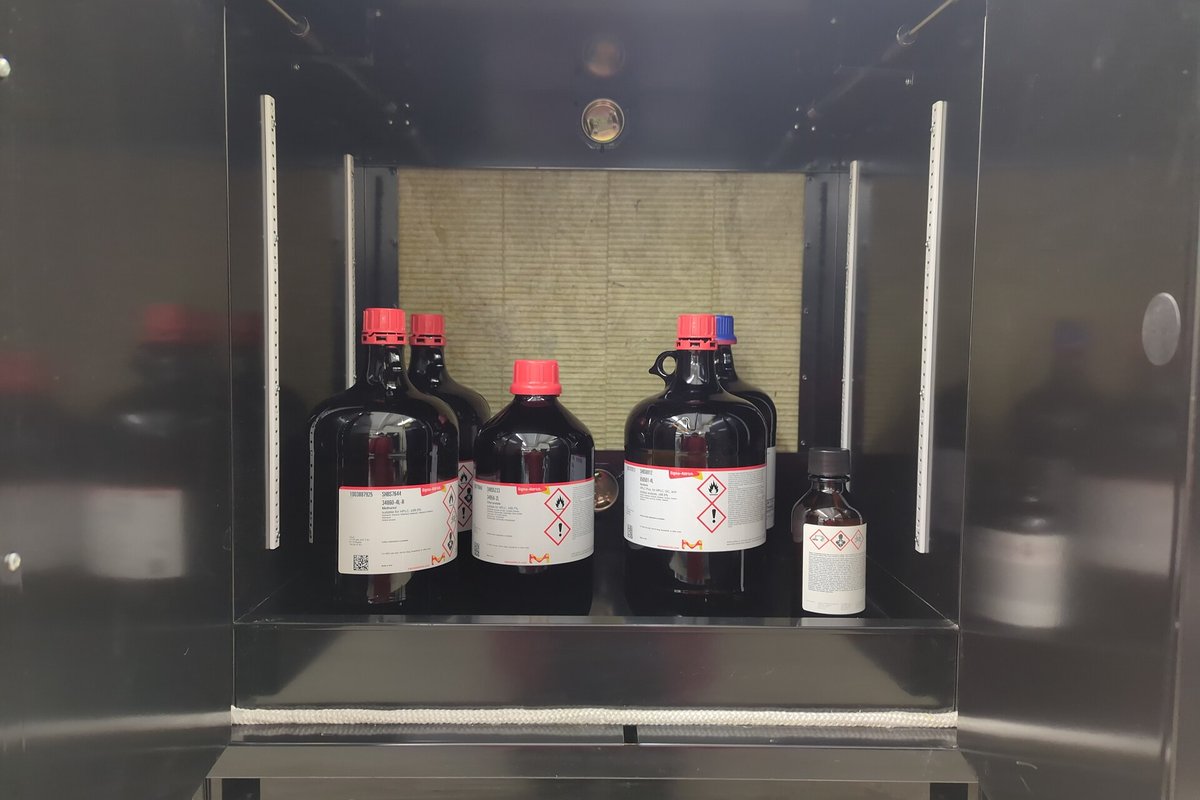
A purchasing approval can put a chemical on the loading dock before anyone has determined where it can be stored or how it can be used. The supplier's SDS may be available, yet the first employee to open the container still faces an unresolved exposure, incompatible equipment, or an inadequate cleanup arrangement.
A chemical approval procedure connects the purchasing decision to those operating conditions. It establishes what needs review, who resolves missing information, and what needs verification before the product is released for the proposed use.
Download the chemical approval procedure and assessment forms (Word). The package includes a product comparison, responsibility record, approval conditions, and a separate pre-use release.
Separate the company procedure from the governing requirements
OSHA does not prescribe one universal pre-purchase chemical approval form for every employer. A company can adopt this procedure to organize the decisions needed to meet its actual duties. The form's name, internal job titles, review levels, and purchasing thresholds are employer choices unless a separate applicable requirement says otherwise.
The underlying obligations remain specific. 1910.1200 addresses covered hazardous chemicals through the written program, chemical list, labels, SDSs, and effective information and training. 1910.132 and 1910.138 govern applicable PPE decisions. 1910.134(a)(2) governs required respiratory protection. Exposure, fire, process, environmental, and industry-specific requirements may add other conditions.
For a covered PSM process, changes to process chemicals and other specified process elements require the applicable 1910.119(l) management-of-change procedure, except replacement in kind. The purchasing form does not replace that procedure or any required pre-startup safety review. EPA RMP-covered processes need their separate applicability review as well.
Construction adopts HazCom through 1926.59 and uses its applicable task standards. Laboratories meeting 1910.1450 need their Chemical Hygiene Plan and laboratory-specific review. Confirm relevant State Plan requirements rather than assuming the federal rules are the only requirements at the location.
Define what triggers review
Cover a new product, new supplier formulation or grade, a substitute, and a material change in use. Also address samples, contractor-supplied chemicals, customer-provided products, and maintenance purchases that can bypass the normal procurement system. The procedure should identify who can place a product on hold and how an urgent request receives competent review.
Do not rely only on the product's trade name. The same name can be associated with different concentrations, components, or formulations. Conversely, a supplier's administrative name change does not necessarily create a new chemical hazard. Determine whether the change affects the product's identity, hazards, or approved use.
An existing approval should have boundaries: product identity, permitted use, location, operating conditions, and any quantity or storage limits selected for that review. “Approved chemical” should not mean approved for every operation at every facility.
Obtain a complete request before selecting controls
The requesting department should describe the work that makes the chemical necessary. Obtain the exact SDS and technical instructions, intended application, quantities used and stored, package sizes, operating temperature, frequency, application equipment, workers affected, and expected waste streams. Include cleanup, maintenance, and foreseeable abnormal conditions.
Identify the people outside the requesting department who could be affected. Ventilation discharge, shared drains, adjacent work, contractor exposure, or common storage can make the review a site decision rather than a single supervisor's choice. HazCom's multi-employer provisions in 1910.1200(e)(2) address specified SDS-access, precaution, and labeling-system coordination duties where they apply.
The request should distinguish facts from unknowns. “Ventilation available” is incomplete when no one has established whether the proposed release is controlled. “Waste handled by contractor” does not establish an acceptable waste determination or shipping arrangement.
Screen the actual operation in a consistent order
Product identity and hazards
Match the container identifier to Section 1, preserve the SDS revision, and review Sections 2 and 3. Resolve mismatched grades, missing components, and important composition uncertainty. Read the SDS as a product-specific source, not a certificate that the workplace's intended use is compliant.
Exposure and protective measures
Evaluate inhalation, skin, eye, and other relevant routes for dispensing, use, drying or curing, cleaning, and maintenance. Identify the applicable exposure standards and evidence needed to support the controls. Assess elimination, substitution, enclosure, ventilation, and work practices before treating PPE as the entire solution.
For general-industry work within 1910.1000(e), feasible administrative or engineering controls and the specified technical approval requirements apply. If respirators are necessary, establish their complete applicable program arrangements before use. A purchase approval cannot make an unsupported cartridge selection acceptable.
Storage, compatibility, and emergency arrangements
Review Sections 7, 9, and 10 against actual containers, cabinets, equipment materials, neighboring chemicals, ignition sources, and expected operating conditions. Verify applicable 1910.106 flammable-liquid requirements. Storage limits depend on the liquid and the actual arrangement.
Determine what a credible release would require. Consider emergency washing under 1910.151(c), containment, communications, evacuation, and the site's response arrangements as applicable. The purchasing review should not assign untrained employees to handle an uncontrolled release merely because a spill kit is nearby.
Environmental restrictions and waste
Check chemical-specific restrictions that affect the proposed use. EPA's TSCA risk-management information identifies chemical-specific actions; the governing rule, use category, dates, and any workplace protection arrangements it sets need review where relevant. General supplier availability does not establish that every commercial use remains permitted.
Determine expected waste streams and the applicable waste-management route before relying on a disposal price or recycler's offer. Under 40 CFR 262.11, generators make an accurate hazardous-waste determination. An SDS disposal statement is not that determination. Evaluate wastewater, air-permit, spill-prevention, and EPCRA implications where the actual product and use make them relevant; do not assume every purchase triggers all those programs.
Compare alternatives on the same task
Review the current and proposed products against the same work description. A lower price or less severe hazard classification for one endpoint may be offset by increased quantity, spray application, higher temperature, incompatible materials, longer contact, or a different waste stream.
| Comparison item | Existing arrangement | Proposed alternative | Evidence needed |
|---|---|---|---|
| Cleaning or process function | Verified performance and limitations | Proposed performance and conditions | Technical information or a controlled trial plan |
| Health and physical hazards | Identified product and task hazards | Identified changes, including new hazards | Exact SDSs and technical review |
| Exposure and controls | Current assessment and control evidence | Suitability of existing controls; needed changes | Representative evidence and control verification |
| Equipment and storage | Known materials and arrangement | Compatibility and storage implications | Manufacturer information and applicable requirements |
| Waste and other program effects | Existing determinations and arrangements | New or changed streams and restrictions | Program-specific review |
Unknown entries should remain visible. A ranking that converts missing data into a favorable score creates a false comparison. Where one issue is essential to safe use or legal applicability, do not allow an overall score to override it.
Assign responsibilities with decision authority
The employer decides how to assign these functions; the table is a practical arrangement, not a legally prescribed organization chart.
| Function | Work to complete | Evidence to retain |
|---|---|---|
| Requesting department | Define task, need, location, quantity, and affected people | Complete request and actual-use description |
| Purchasing | Obtain the exact documents; enforce the selected buying restrictions | Supplier information and approved product identity |
| EHS or designated technical reviewer | Determine applicable requirements and assessment needs; resolve material uncertainties | Review basis, specialist findings, and conditions |
| Maintenance or engineering | Evaluate equipment, ventilation, utilities, materials, and installation needs | Design information and verification records |
| Supervisor | Confirm the work instructions and worker preparation | Pre-use checks and communication evidence |
| Employer-designated release authority | Confirm the approval conditions are satisfied before the approved operation starts | Scope, restrictions, unresolved items, and release decision |
A purchasing manager should know whether approval permits ordering, receiving, a controlled trial, or routine use. Those permissions need not be the same.
Use decision statuses that cannot hide unfinished work
Hold for information when the review cannot support a material conclusion. State the missing evidence, owner, and restriction. Do not mark an incomplete review as approved simply because the supplier response is expected.
Approve for a defined trial only when a separate trial plan establishes the applicable protections, trained personnel, operating limits, monitoring or observation method, and stop conditions. Trial work should not expose workers merely to discover whether necessary controls were missing.
Approve with conditions when the conditions and scope are explicit. Distinguish conditions that need to be completed before use from legitimate later administrative work. A legal requirement or safeguard needed for safe operation cannot be postponed by renaming it a post-approval action.
Reject the proposed use when it is prohibited, cannot be adequately controlled within the reviewed arrangement, or cannot be supported with necessary evidence. Explain whether a different product, process, or engineered arrangement could be reviewed as a new proposal.
Worked decision: replacing a solvent cleaner
In this hypothetical decision record, a maintenance department proposes replacing its current solvent with a supplier-described water-based cleaner for use on existing parts and seals.
The initial disposition is hold. The purchasing description does not establish the proposed formulation, dilution, application method, material compatibility, exposure controls, or waste route. The reviewer requests the exact SDS and technical instructions, defines the actual parts-cleaning task, and identifies the needed compatibility and exposure evidence.
The review may authorize purchase of a sample without authorizing production use. If a trial is appropriate, its safe-work plan should address the trial's own chemical handling, equipment, disposal, worker preparation, and stop conditions. The employer does not assume the current solvent's gloves, ventilation, or cleanup instructions also suit the alternative.
An acceptable release record would identify the evaluated product and revision, permitted application and location, verified equipment compatibility, installed controls, selected PPE, operating instructions, waste arrangements, and completed training or other applicable requirements. If compatibility evidence is adverse or an essential control remains unresolved, the product remains held or the proposed use is rejected.
Receiving and pre-use verification
At receipt, confirm that the delivered product matches the approved identity and formulation. Inspect the container and labeling, obtain any required missing SDS, and apply the employer's hold arrangements if the delivery differs from the review. Add the covered hazardous chemical to the appropriate HazCom list and make its SDS readily accessible as required by 1910.1200(e) and (g).
Before use, verify the location and storage arrangement, selected controls, equipment readiness, protective equipment, work instructions, emergency provisions, and required employee information and training. New-hazard training under 1910.1200(h)(1) is triggered by a chemical hazard not previously covered in the employee's training; a different product name alone is not the legal test.
Document the actual release, not a prediction that someone will finish the checks. Preserve the review and supporting evidence under the applicable retention and access requirements. Specify company retention requirements separately from periods imposed by an applicable standard.
Keep approvals connected to later changes
Reopen the assessment after a relevant formulation, supplier, task, quantity, temperature, equipment, or location change. Evaluate new hazard information, exposure findings, worker concerns, and control failures. Maintain a usable relationship between the approval record and the product's current inventory and work instructions.
For an already operating hazardous condition, a review status does not replace immediate protective action. Stop or restrict the affected exposure as needed under the site's arrangements and applicable requirements, then resolve the technical issue before releasing the affected work.
Frequently Asked Questions
Does OSHA mandate a chemical approval form before every purchase?
No universal federal OSHA form applies to every chemical purchase. A company procedure can organize compliance decisions, while applicable HazCom (1910.1200), exposure, PPE, respiratory, process, and other requirements still govern the operation. Covered PSM changes have their own management-of-change requirements under 1910.119(l).
Is an SDS enough to approve a chemical?
No. The SDS required by 1910.1200(g) describes the identified product, but does not establish the employer's actual exposure, equipment compatibility, control performance, waste determination, or completed worker preparation. Approval needs to address the defined use and supporting evidence.
Can purchasing approve a sample before the full review is complete?
The company may distinguish permission to obtain a sample from permission to use it. Any handling or trial still needs its own applicable protections under standards such as 1910.1200 and 1910.132. A small package does not automatically remove the relevant chemical hazards or requirements.
Is a water-based substitute automatically safer?
No. Compare the actual formulation and task, including health hazards, contact conditions, application, temperature, compatibility, quantity, and waste, starting from the SDS under 1910.1200(g). The description water-based does not establish the suitability of existing controls.
When is additional HazCom training needed?
Covered employees need effective training at initial assignment and when a new chemical hazard they have not previously been trained about enters their work area. Evaluate the hazards and existing training; 1910.1200(h)(1) does not require annual retraining or a fresh course solely because a product name changes.
Should every chemical change go through PSM management of change?
No. Determine whether the process and change fall within 1910.119. A voluntary review outside PSM can still be useful. It isn't a PSM legal obligation, and where PSM applies it doesn't replace the full governing procedure.
Site-wide regulatory figures such as compliance dates and penalty amounts come from our regulatory source-of-truth modules, last checked against the eCFR, OSHA.gov, and the Federal Register on October 19, 2026. Last reviewed November 14, 2026.
About This Article
Published by: HazComFast
Published: November 14, 2026
Last Updated: November 14, 2026
- https://www.ecfr.gov/current/title-40/chapter-I/subchapter-I/part-262/subpart-A/section-262.11
- https://www.epa.gov/assessing-and-managing-chemicals-under-tsca/risk-management-existing-chemicals-under-tsca
- https://www.osha.gov/laws-regs/regulations/standardnumber/1910/1910.1000
- https://www.osha.gov/laws-regs/regulations/standardnumber/1910/1910.106
- https://www.osha.gov/laws-regs/regulations/standardnumber/1910/1910.119
- https://www.osha.gov/laws-regs/regulations/standardnumber/1910/1910.1200
- https://www.osha.gov/laws-regs/regulations/standardnumber/1910/1910.132
- https://www.osha.gov/laws-regs/regulations/standardnumber/1910/1910.134
- https://www.osha.gov/laws-regs/regulations/standardnumber/1910/1910.138
- https://www.osha.gov/laws-regs/regulations/standardnumber/1910/1910.1450
- https://www.osha.gov/laws-regs/regulations/standardnumber/1910/1910.151
- https://www.osha.gov/laws-regs/regulations/standardnumber/1926/1926.59
This content is for informational purposes only and does not constitute legal advice.