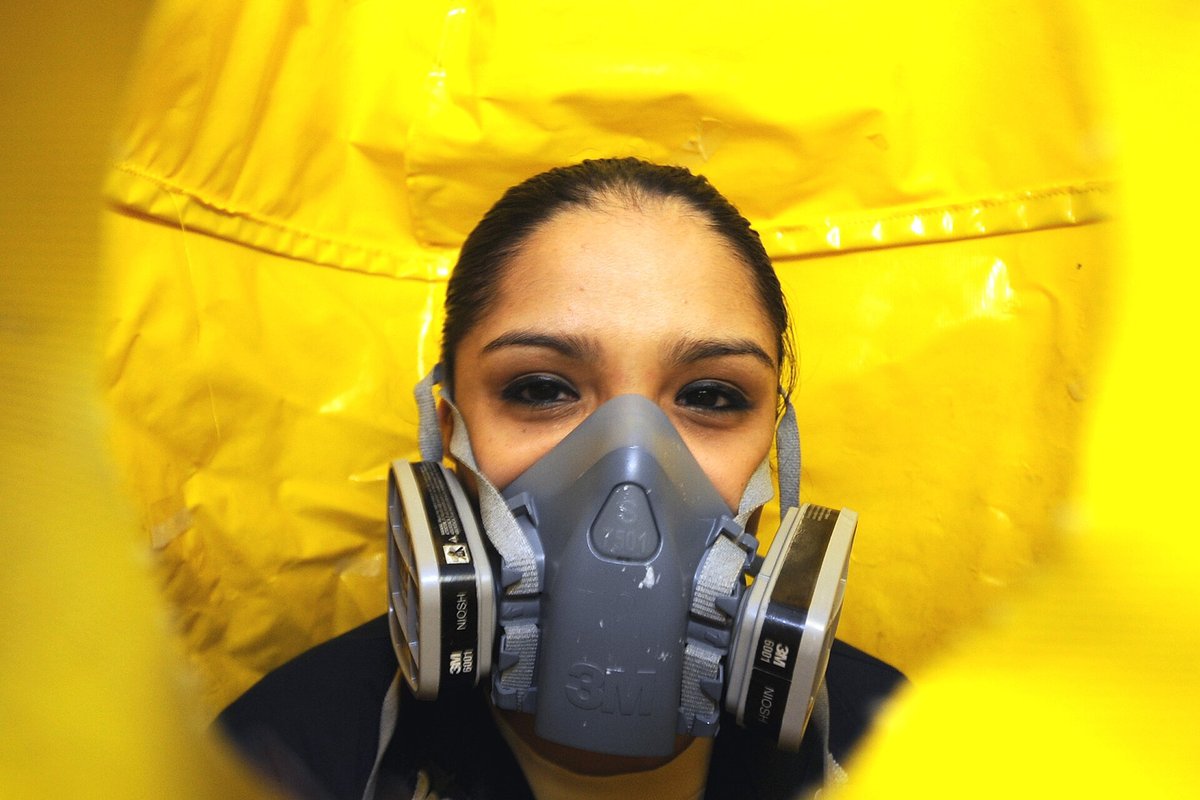
“Replace cartridges weekly” is not a defensible change schedule unless the employer can explain why that interval protects workers in the conditions where the cartridges are used. The explanation needs the contaminants, exposure assessment, exact equipment, relevant service-life information, assumptions, and limits of the conclusion.
A service-life model cannot supply missing workplace facts. Before calculating an interval, establish whether an air-purifying respirator is appropriate and whether the available method represents the actual application. If essential inputs are absent, the result should remain unresolved rather than becoming a plausible-looking number.
Download the objective-data checklist and written change-schedule template (Word). It includes configuration checks, data and assumptions, a worker briefing, and reassessment triggers.
What OSHA actually requires
For protection against gases and vapors, 1910.134(d)(3)(iii) permits an atmosphere-supplying respirator or an air-purifying respirator meeting the specified conditions. For the air-purifying route, use a NIOSH-certified end-of-service-life indicator for the contaminant, or, when no ESLI is appropriate for the workplace conditions, implement a change schedule based on objective information or data that ensures replacement before the end of service life.
Paragraph (d)(3)(iii)(B)(2) also calls for the respirator program to describe the information and data relied on, the basis for the schedule, and the basis for relying on those data. A calendar entry with no supporting assessment does not provide that explanation.
Construction adopts the same respiratory-protection requirements through 1926.103. Confirm applicable State Plan and substance-specific provisions. HazComFast's respiratory protection hub covers the wider program; the process here focuses on the cartridge's supported replacement decision.
Distinguish cartridges, filters, and the complete respirator
A gas or vapor cartridge contains material selected to remove particular contaminants. A particulate filter removes particles; its filtration classification does not establish gas or vapor protection. A combination assembly has to remain suitable for both functions.
The gas/vapor change-schedule provision is not a universal replacement interval for particulate filters. Follow applicable requirements and manufacturer instructions for particulate-filter replacement, including relevant condition and use limits. For a combination assembly, replacement may be needed because the gas/vapor schedule is reached or because another applicable replacement condition occurs first.
Record the complete approved configuration: manufacturer, facepiece, cartridge or canister, filters and retainers where applicable, and the relevant NIOSH approval information and instructions. A cartridge that fits a connector is not automatically approved in that assembly or suitable for every substance.
The respirator's assigned protection factor and maximum use concentration address different questions from cartridge service life. An acceptable concentration relative to the selected APF does not establish how long the sorbent remains effective. Likewise, a long modeled service life does not establish that the respirator class provides adequate protection.
Rule out conditions a cartridge cannot solve
Identify the contaminant, chemical state, physical form, and reasonably estimated employee exposure under 1910.134(d)(1). If exposure cannot be identified or reasonably estimated, paragraph (d)(1)(iii) requires the atmosphere to be considered IDLH. The standard's IDLH selection provisions then govern; choosing a stronger organic-vapor cartridge does not resolve the missing assessment.
An air-purifying respirator does not supply oxygen and cannot be used as a substitute for the needed atmosphere-supplying protection in IDLH conditions. Evaluate oxygen and foreseeable conditions as applicable. Maximum use concentrations cannot be applied to justify IDLH use, and a lower cartridge performance limit can constrain the permitted application.
Substance-specific requirements or manufacturer limitations can also rule out a proposed cartridge. Confirm that an adequate service-life method exists for the chemical and exact product. The absence of a software entry is not permission to use the nearest chemical name.
Build the input record before running a model
| Input | What the record should establish | Why an unsupported assumption matters |
|---|---|---|
| Contaminants | Identity, relevant mixture components, physical form, and applicable limits | An unmodeled component may affect suitability or breakthrough |
| Exposure | Representative concentration and variability for the covered tasks and groups | An unrelated average may not represent the conditions being protected |
| Respirator configuration | Exact approved cartridge/canister and assembly | Capacity and performance cannot be transferred between products by color or appearance |
| Work demands | Breathing or work-rate basis compatible with the method | Airflow through the sorbent affects contaminant loading |
| Environment | Relevant temperature and humidity range | Conditions outside the method's basis can change the estimate |
| Use pattern | Continuous and intermittent use, task duration, and breaks | A continuous-use estimate may not validate later reuse |
| Storage | Manufacturer-specified storage conditions and elapsed time between uses | Storage in a bag does not reset the cartridge's prior exposure history |
| Method | Manufacturer advice, relevant testing, or a suitable model with its limitations | A numerical output can be invalid when the application lies outside its scope |
Use representative exposure evidence rather than silently copying the SDS's ingredient concentration or a PEL into the model's airborne-concentration field. A PEL is a limit, not a measurement of the task. Record the units and whether the chosen value represents expected or conservatively bounded conditions within the supported assessment.
OSHA's change-schedule eTool discusses experimental testing, manufacturer recommendations, and mathematical models, with the effects of workplace and user variables. It is guidance supporting the assessment; its examples and older rules of thumb are not universal replacement schedules.
Select a method that fits the application
Manufacturer recommendations are useful when they identify the actual cartridge and sufficiently represent the contaminant, concentration, environment, and use pattern. Retain the recommendation and its conditions, not merely a note saying “manufacturer approved.” Ask the manufacturer to resolve important differences between its data and the workplace.
Relevant experimental evidence can be appropriate, particularly when mixtures or unusual conditions are poorly represented by available models. Establish the competence and methods needed for the testing. Do not conduct an unprotected workplace trial to discover when a worker first notices breakthrough.
A model is useful only within its documented applicability. Retain the software or model identity, version or calculation date, inputs, relevant limitations, output, and reviewer interpretation. Do not borrow one manufacturer's cartridge result for another product without adequate supporting evidence.
For a real manufacturer resource, 3M Select and Service Life Software provides a location-based entry point, including the United States. It can support assessment of relevant 3M configurations, subject to its instructions and limitations. The existence of the software does not establish a result for a cartridge or exposure that has not been evaluated.
Resolve mixtures and uncertain conditions explicitly
Several vapors can interact with the cartridge's sorbent. The component that controls a result may not be the largest ingredient percentage in the liquid product or the chemical with the lowest exposure limit. Do not estimate mixed-vapor service life by averaging individual service-life predictions or choosing the most favorable single-solvent result.
Evaluate the manufacturer's mixture method and applicability. If necessary components or relevant conditions cannot be represented, obtain technical assistance, appropriate testing, or another suitable protection arrangement. An arbitrary safety factor does not make an unsuitable model suitable.
Temperature, humidity, concentration variability, and work rate also need their own supported treatment. A dry-room estimate should not be treated as validated for hot, humid work simply because the average concentration is similar. Do not apply a universal humidity correction or assume every cartridge's service life changes in the same proportion.
Record how uncertainty was addressed. OSHA's guidance recommends a conservative approach and discusses safety factors. It does not prescribe one numerical factor for every chemical and workplace. The selected margin should have a defensible relationship to method limitations and actual variability.
Treat intermittent use as an assessment question
Distinguish service time while worn from elapsed time after opening or first use. Record how cartridges are stored, whether they are assigned or shared, how exposure time is tracked, and what the manufacturer permits for reuse. Check any calendar-life or storage limitation as well as the modeled use time.
A cartridge used briefly on several days cannot automatically be assigned the unused portion of a continuous-use prediction. That conclusion needs supporting manufacturer information or another valid assessment basis for the actual pattern. Nor does a tightly closed container restore consumed capacity or erase earlier use.
The worker's replacement instruction should be simple enough to follow without doing calculations at the worksite. If the technical basis produces conditions that cannot be reliably tracked, revise the operating arrangement or choose a sufficiently supported, more manageable schedule. Administrative convenience is a constraint to solve, not evidence that a chosen interval protects workers.
Do not use odor as the normal replacement clock
OSHA's change-schedule guidance does not permit odor thresholds or other warning properties as the primary basis for gas/vapor cartridge service life. Warning properties differ between chemicals and people and do not establish a reliable advance warning before an unacceptable exposure.
Unexpected odor, taste, irritation, increased breathing resistance, or another relevant problem still needs an immediate response under the program. Under 1910.134(g)(2), the employer needs to provide for leaving the respirator-use area for the specified problems and corrective actions. Workers should follow the trained exit and emergency procedures; do not have them remove or change the respirator while remaining in the hazardous atmosphere.
Investigate the cause before return under an unsupported arrangement. The problem could involve cartridge exhaustion, an unsuitable configuration, leakage, maintenance, a different contaminant, or changed conditions. Replacing the cartridge with another identical one does not resolve every possible cause.
Needed use below a PEL still needs the applicable program
The need for a cartridge schedule is not decided solely by whether a measured concentration exceeds a PEL. If the employer requires respirator use, the applicable required-use program provisions apply. Separate that situation from genuinely voluntary use under 1910.134(c)(2), which has its own conditions.
3M's Technical Bulletin #244, published September 2016, discusses low-exposure environments and the distinction between needed and voluntary use. It does not permit omitting a contaminant from a workplace assessment simply because one measurement is below its limit. Any such technical treatment needs the complete supported assessment, relevant mixture effects, manufacturer limitations, and applicable regulatory requirements.
Do not convert the bulletin's illustrative calendar intervals into a general schedule. For needed gas/vapor cartridge use, document a suitable objective basis or the appropriate ESLI arrangement under the governing rule.
A decision flow for the program administrator
| Question | If yes | If no or unresolved |
|---|---|---|
| Are the hazards and exposure reasonably established? | Evaluate respirator suitability | Address the assessment; apply the standard's IDLH presumption where needed |
| Is the proposed air-purifying configuration appropriate for all relevant conditions? | Evaluate its service-life basis | Select another suitable arrangement; do not calculate around an unsuitable respirator |
| Is there a NIOSH-certified ESLI appropriate for the contaminant and workplace conditions? | Follow its approved instructions and program provisions | Establish a supported change schedule for the cartridge route |
| Does the selected method represent the actual cartridge, contaminants, and use conditions? | Evaluate its result and uncertainty | Obtain adequate data, assistance, testing, or another protection arrangement |
| Can replacement and limits be implemented reliably? | Document, train, and verify implementation | Revise the arrangement before relying on it |
| Have conditions or evidence changed? | Reassess the basis and necessary protective action | Continue the supported schedule and needed program evaluation |
Example: correcting an unsupported weekly schedule
Consider a hypothetical program record that says to replace organic-vapor cartridges every Friday. It contains no exposure assessment reference, exact cartridge identification, manufacturer data, environmental inputs, use-history method, or explanation of intermittent storage.
The review cannot validate that schedule from the information provided. It records the missing inputs and determines the protective arrangement needed while they are resolved. The administrator obtains representative hazard and exposure information, verifies the approved equipment, evaluates a suitable method, and documents the resulting basis and limitations.
The revised instruction needs to identify the replacement interval, the tasks and conditions it covers, and how workers will track use and storage. Until the assessment supports that instruction, the administrator needs to maintain the suitable protective arrangement selected for the unresolved task. Moving replacement from Friday to an earlier day would not, by itself, establish a valid service-life basis.
Document the schedule workers will actually follow
The written record should identify the covered tasks and employee groups, exact equipment, contaminants, assessment references, data source, assumptions, method limitations, selected replacement instruction, storage and reuse conditions, and triggers for earlier replacement or reassessment. Include the responsible program administrator and the date and scope of the decision.
Workers need the practical instruction: which cartridge, which tasks, when to replace it, how use is tracked, where and how it is stored, what problems call for exit, and who resolves a discrepancy. A worker briefing form supports that communication; it does not substitute for the applicable training, medical evaluation, fit testing, or other needed-use program elements.
Evaluate the schedule after a formulation or process change, new exposure information, different work rate or environment, equipment substitution, unexplained symptoms, apparent breakthrough, or evidence that the instructions are not being followed. 1910.134(l) calls for program evaluation and consultation with employees, with correction of identified problems. Retain the current written program as needed by paragraph (m); apply any separately applicable record-retention rules to supporting exposure information.
Frequently Asked Questions
Does OSHA mandate replacing organic-vapor cartridges every eight hours?
No universal fixed replacement interval applies to every cartridge and task. For the relevant air-purifying gas/vapor route, use an appropriate NIOSH-certified ESLI or a supported objective-data change schedule under 1910.134(d)(3)(iii)(B). Manufacturer and substance-specific restrictions also matter.
Can I wait until I smell the contaminant?
No. Odor or other warning properties cannot be the primary basis for service life under 1910.134(d)(3)(iii)(B). Unexpected odor, taste, irritation, or another problem still calls for the trained exit and corrective response under the program, followed by evaluation of the cause.
Can an SDS supply the cartridge's service life?
An SDS can inform hazard identification and selection questions, but a generic respirator recommendation is not a documented service-life result for the employer's conditions. The assessment of 1910.134(d)(1)(iii) needs the actual equipment, exposure, environment, use pattern, and valid objective basis.
Can I add together unused hours across several days?
Only where the method and manufacturer information support the actual intermittent-use and storage pattern. A continuous-use estimate does not automatically establish later reuse or a calendar-life allowance. Preserve the use history and applicable limitations in the change-schedule basis described under 1910.134(d)(3)(iii)(B).
Do particulate filters use the same schedule rule?
The gas/vapor cartridge provision, 1910.134(d)(3)(iii)(B), is distinct from particulate-filter selection and replacement. Follow the applicable filter requirements and manufacturer limits. A combination assembly may need replacement when either its supported gas/vapor schedule or another applicable replacement condition is reached.
What if essential model inputs are missing?
Do not fabricate them or select a convenient replacement interval. Resolve the hazard and exposure assessment of 1910.134(d)(1)(iii) and method applicability, and establish a suitable protective arrangement while the issue is unresolved. A model output is useful only when its inputs and scope support the decision.
Site-wide regulatory figures such as compliance dates and penalty amounts come from our regulatory source-of-truth modules, last checked against the eCFR, OSHA.gov, and the Federal Register on October 19, 2026. Last reviewed November 14, 2026.
About This Article
Published by: HazComFast
Published: November 14, 2026
Last Updated: November 14, 2026
This content is for informational purposes only and does not constitute legal advice.