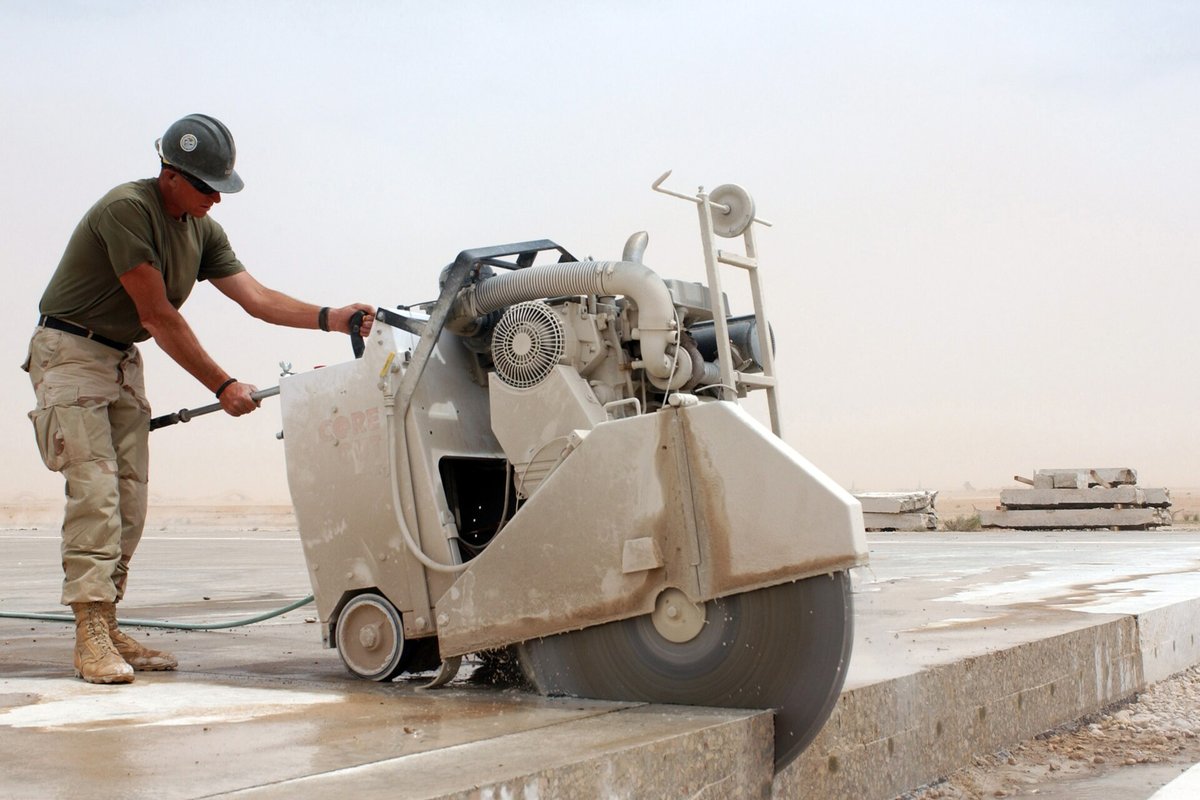
A worker wears a respirator while cleaning metal parts with solvent. A contractor uses a water-fed saw to cut concrete. Employees near a stamping press wear earplugs. All three workplaces have introduced protection. But none of those precautions, by itself, proves that the hazard is adequately controlled. A respirator does not prevent solvent vapor from entering the workroom. A concrete saw may release respirable silica when its water system fails. Earplugs reduce sound reaching the wearer but do not make machinery quieter.
The hierarchy of controls helps employers address hazards closer to their source rather than relying primarily on individual protective equipment. The National Institute for Occupational Safety and Health (NIOSH) identifies five levels, generally ranked from more effective to less effective:
- Elimination: Remove the hazardous operation or source.
- Substitution: Replace it with a less hazardous material, process, or equipment.
- Engineering controls: Isolate, capture, contain, or reduce the hazard through physical design.
- Administrative controls: Change procedures, access, scheduling, or exposure duration.
- Personal protective equipment (PPE): Protect individuals against remaining exposure.
This hierarchy is a prevention framework. No single OSHA regulation makes employers document five unsuccessful attempts before selecting PPE. Specific Occupational Safety and Health Administration (OSHA) standards may prescribe controls, call for feasible engineering measures, establish permissible exposure limits (PELs), or mandate respiratory and hearing protection. The objective is to select controls that meet the applicable legal requirements, reduce exposure, and remain effective under actual working conditions. Three hypothetical workplace scenarios show how to select, verify and maintain controls while meeting the distinct requirements for chemical exposure, silica and noise.
How the five levels apply to different hazards
| Control | Solvent handling | Concrete cutting | Workplace noise |
|---|---|---|---|
| Elimination | Obtain parts that need no solvent cleaning | Specify precut components | Remove an unnecessary noisy operation |
| Substitution | Evaluate a lower-hazard cleaning method | Use an approved process that avoids silica-generating cuts | Replace equipment with a quieter alternative |
| Engineering | Closed dispensing and local exhaust ventilation | Integrated wet cutting or prescribed dust collection | Acoustic enclosure, damping, isolation |
| Administrative | Control open-container handling and train employees | Inspect water delivery, manage access, control housekeeping | Maintain equipment and manage access and work duration |
| PPE | Compatible gloves, splash protection, respirators where needed | Respirators specified by the applicable silica provisions | Appropriate hearing protectors |
The hierarchy does not mean every employer has to implement these levels one at a time. A process may need several simultaneously. A solvent-cleaning workstation might use a lower-hazard chemical, closed dispensing, local exhaust, and protective gloves. The selected measures address different risks. A substitute can reduce inhalation exposure while creating a new skin hazard. An effective dust-control method can still leave electrical or slip hazards. A quieter machine may need different guarding or maintenance arrangements.
Control selection should address the entire task. A single exposure number won't cover it.
Six questions to ask before choosing a control
A supervisor should establish:
1. What generates the hazard? Identify the material, equipment, or activity.
2. How does exposure occur? Consider normal operation, setup, maintenance, cleaning, and foreseeable failures.
3. Who is exposed? Include operators, helpers, maintenance employees, nearby workers, and contractors.
4. Which requirements apply? Confirm whether the work is governed by general-industry, construction, or other OSHA standards and whether an approved State Plan applies.
5. Which controls are feasible and necessary? Evaluate elimination and substitution before deciding how to engineer, administer, or protect against the remaining hazard.
6. What proves the control works? Identify a regulatory compliance criterion or technically defensible performance requirement.
A fan operating is not proof of effective vapor capture. A saw being wet is not proof that its controls meet OSHA Table 1. A manufacturer's noise rating does not establish every employee's full-shift exposure.
Scenario 1: Solvent cleaning in a metal fabrication shop
Solvent cleaning: Workplace conditions
A hypothetical metal fabrication facility cleans small components using a commercial solvent mixture. Employees dispense solvent onto cloths, wipe parts, and place the components on racks to dry. Containers are repeatedly opened during production. General room ventilation is present, but the employer has not established whether vapor is adequately captured near the workstations. The formulation, airborne concentrations, and employee exposures have not been determined. The supervisor needs to evaluate more than inhalation exposure.
Identify the exposure routes and physical hazards
The current safety data sheet (SDS) is a starting point for identifying ingredients, classified hazards, physical properties, and handling precautions. Potential exposure pathways include:
- Inhalation: Vapors released during dispensing, wiping, and drying.
- Skin contact: Solvent transferred to hands, clothing, tools, and contaminated surfaces.
- Eye contact: Splashes during dispensing or handling.
- Fire and ignition: Flammable vapor-air mixtures, depending on the product and conditions.
- Nonroutine exposure: Spills, waste handling, equipment cleaning, and maintenance.
Odor is not a reliable indicator of regulatory compliance. A chemical may present a hazard even when employees do not notice a smell.
Elimination: Can the cleaning operation be removed?
Before purchasing additional PPE, examine why the cleaning operation exists. Could the supplier deliver clean components? Could an upstream process be modified to prevent residue formation? Could a product specification be changed without compromising quality? Production engineering and quality personnel should establish whether the operation can be eliminated.
Verification: Confirm that the hazardous step is absent from routine production, rework, and foreseeable maintenance.
Sending identical cleaning work to a subcontractor transfers the process rather than necessarily eliminating the underlying hazard.
Substitution: Compare the complete hazard profile
If cleaning remains necessary, evaluate alternative products or cleaning methods. A lower-hazard formulation, aqueous cleaning process, or appropriate mechanical method may reduce some risks. However, a substitute should be evaluated under its actual conditions of use. A heated aqueous cleaner may produce chemical mist. A lower-odor solvent may still contain hazardous ingredients. Mechanical cleaning could introduce dust or equipment hazards. The evaluation should consider the chemical composition, SDS, exposure routes, physical hazards, operating temperature, application method, cleaning performance, and waste handling.
Acceptance criterion: The replacement reduces the relevant risks without introducing unacceptable new hazards.
Marketing terms such as green, water-based, or low odor are not sufficient evidence.
Engineering: Contain or capture the vapor
Where the task still releases hazardous vapor, consider closed dispensing, enclosed cleaning equipment, or properly designed local exhaust ventilation. The system should address the actual emission sources and work conditions. Hood position, cross-drafts, operator movement, process temperature, and container openings can affect capture. A portable fan blowing across the workstation may move contaminants through the worker's breathing zone rather than capture them. Appropriate verification may include equipment inspection, airflow measurements, pressure readings, capture visualization, and personal exposure assessment. These methods answer different questions. A ventilation system can operate while employee exposure remains excessive.
OSHA's technical approval requirement
Under 29 CFR 1910.1000(e), administrative or engineering controls are first determined and implemented whenever feasible to achieve compliance with the air-contaminant limits addressed by the section. Under the same paragraph, equipment or technical measures used for that purpose are approved for their particular application by a competent industrial hygienist or another technically qualified person. That doesn't mean every ventilation fan has to be approved by an industrial hygienist. It applies in the context established by 1910.1000(e).
For a system used to achieve compliance with this provision, the employer should document the appropriate technical approval and establish performance checks.
Administrative controls and PPE
Work practices should define safe dispensing, container closure, handling of contaminated cloths, spill response, and procedures for ventilation failure. Employees need applicable chemical hazard information and training. Protective gloves must be selected based on chemical compatibility, resistance, anticipated contact, and duration. Eye and face protection should match the task. Respirators, when required, must be selected according to the actual respiratory hazards. Under 29 CFR 1910.134(c)(1), required respiratory protection involves hazard evaluation, appropriate selection, medical evaluation, fit testing where applicable, training, maintenance, and a written program.
If the employer cannot identify or reasonably estimate the exposure, 1910.134(d)(1)(iii) requires the atmosphere to be considered immediately dangerous to life or health (IDLH) for respirator-selection purposes. For gas- and vapor-removing air-purifying respirators, 1910.134(d)(3)(iii)(B) requires an appropriate end-of-service-life indicator or an objectively supported cartridge replacement schedule. Odor breakthrough is not an adequate substitute for that schedule.
Which OSHA standards govern solvent exposure?
The governing requirements depend on the substance and industry.
29 CFR 1910.1200, Hazard Communication. Covered employers must comply with applicable written-program, labeling, SDS, and employee training requirements (1910.1200(e), (f), (g) and (h)).
29 CFR 1910.1000, Air Contaminants. Employers must identify the relevant limits and apply the section's exposure and control provisions (1910.1000(a) through (e)).
29 CFR 1910.134, Respiratory Protection. Required respirator use must satisfy applicable program and equipment requirements (1910.134(c) and (d)).
29 CFR 1910.106, Flammable Liquids. Covered operations must meet applicable storage, handling, transfer, and ignition-control provisions (1910.106(d) and (e)).
Construction has corresponding requirements under 1926.59, 1926.55, and 1926.103, where applicable. Hazard communication identifies and communicates chemical hazards. It does not establish one universal PEL for every solvent mixture.
Worked calculation: OSHA's official air-contaminant mixture example
29 CFR 1910.1000(d)(2) provides an equivalent-exposure formula for a mixture of air contaminants.
Em = (C1/L1) + (C2/L2) + ... + (Cn/Ln)
Where:
- C is the airborne concentration of an individual contaminant.
- L is its applicable exposure limit.
- Em is the equivalent exposure for the mixture.
Under 1910.1000(d)(2)(i), Em must not exceed 1. OSHA's published example uses:
| Substance | Eight-hour concentration | Eight-hour TWA PEL | Ratio |
|---|---|---|---|
| B | 500 ppm | 1,000 ppm | 0.500 |
| C | 45 ppm | 200 ppm | 0.225 |
| D | 40 ppm | 200 ppm | 0.200 |
| Combined | 0.925 |
Em = 500/1,000 + 45/200 + 40/200 = 0.925
Because the result is below 1, the example illustrates a combination within the limits addressed by the calculation.
Source: 29 CFR 1910.1000(d)(2)(ii).
The calculation does not replace separate evaluation of applicable ceiling limits, substance-specific standards, skin contact, or physical hazards. A total-VOC reading should not be treated as individual contaminant concentrations without a defensible analytical basis.
Flammable solvents: Separate health and fire controls
A solvent-cleaning operation can meet an airborne exposure limit and still present an ignition hazard. Where 1910.106 applies, employers should evaluate the specific requirements for the product category and operating method. For industrial facilities where flammable-liquid use is incidental to the principal business, 1910.106(e)(2) includes potentially relevant requirements:
| Activity | Relevant paragraph | Control question |
|---|---|---|
| Storage | 1910.106(e)(2)(ii) | Are storage quantities and containers permitted? |
| Transfer area | 1910.106(e)(2)(iii) | Are spill control, separation, and ventilation adequate? |
| Point-of-use containers | 1910.106(e)(2)(iv)(a) | Are covered containers used when required? |
| Leakage and spills | 1910.106(e)(2)(iv)(b) | Is prompt, safe disposal provided? |
| Indoor transfers | 1910.106(e)(2)(iv)(d) | Is the transfer method permitted? |
| Ignition control | 1910.106(e)(2)(iv)(c) and (e)(6) | Are ignition sources controlled? |
| Electrical interconnection | 1910.106(e)(6)(ii) | Does the liquid category and dispensing operation trigger this requirement? |
For example, 1910.106(e)(2)(iv)(a) requires covered containers when not actually in use for Category 1 and 2 flammable liquids and Category 3 liquids with flashpoints below 100°F (37.8°C). Section 1910.106(e)(2)(iv)(d) identifies permitted indoor transfer methods and prohibits transfer using air pressure applied to a container or portable tank. Section 1910.106(e)(6)(ii) addresses nozzle-container electrical interconnection when dispensing specified categories of flammable liquids. Match these requirements to the actual liquid category and operation; they don't apply to every chemical transfer.
Supervisor decision: Resolve the relevant health-exposure and ignition-control requirements independently before approving the cleaning process.
HCS 2024: Do not confuse the employer deadlines
OSHA's 2024 Hazard Communication revisions include phased deadlines, extended in January 2026. Under 1910.1200(j), the transition dates are:
| Chemical category | Manufacturer, importer, distributor | Employer updates, as necessary |
|---|---|---|
| Substances | May 19, 2026 | November 20, 2026 |
| Mixtures | November 19, 2027 | May 19, 2028 |
The employer transition duties concern necessary changes to alternative workplace labels, the Hazard Communication program, and additional training related to newly identified hazards. This example involves a solvent mixture. The November 2026 employer deadline for substances isn't the deadline for mixtures. Existing Hazard Communication requirements remain applicable during the transition.
Primary authority: 1910.1200(j) and OSHA's compliance-date extension notice.
Solvent scenario: Release decision
Before approving routine work, the supervisor should have an adequate basis to establish that:
- Chemical ingredients and important hazards have been identified.
- Elimination or substitution has been evaluated.
- Applicable exposure limits and other chemical-specific requirements are addressed.
- Engineering measures are suitable and verified.
- Technical approval is documented when 1910.1000(e) calls for it.
- PPE and respiratory protection are properly selected.
- Applicable flammable-liquid requirements are met.
Recommended response: Hold the affected operation when a necessary control fails or essential hazard and exposure information is insufficient to establish a compliant method.
Scenario 2: Concrete cutting and respirable crystalline silica
Concrete cutting: Workplace conditions
A hypothetical contractor uses a handheld power saw to cut silica-containing concrete. Work may occur outdoors or inside an enclosed area. The operation can release respirable crystalline silica. Exposure may affect the operator, helpers, and nearby workers. The supervisor needs to determine whether the construction silica standard applies and which compliance route will be used.
First: Does the construction silica standard apply?
Under 29 CFR 1926.1153(a), the standard applies to construction silica exposure except where employee exposure will remain below 25 µg/m³ as an eight-hour TWA under any foreseeable conditions. OSHA's construction silica FAQs, Scope and Question 5, explain that this exclusion requires exposures to remain below that level without implementing engineering or other controls. Do not use the exposure reduction achieved by wet cutting, dust extraction or a respirator to claim that a silica-generating task falls outside the standard. A short task, outdoor location, or absence of visible dust does not automatically establish the exclusion either. Consider foreseeable exposure from nearby contractors as well. When the standard applies, use a compliant control method.
Elimination and substitution for concrete cutting
Can the contractor specify precut concrete components or change installation sequencing to eliminate field cutting? If the cut remains necessary, can another approved process or material avoid the silica-generating operation? These choices need to meet construction and structural requirements. A substitute that reduces silica exposure may create other dust, chemical, or mechanical risks.
Table 1: The handheld power saw requirement
For handheld power saws of any blade diameter, Table 1 under 1926.1153(c) specifies:
- A saw equipped with integrated water delivery that continuously feeds water to the blade.
- Operation and maintenance according to the manufacturer's instructions to minimize dust emissions.
A water hose near the saw is not automatically equivalent to this specified system. Paragraph 1926.1153(c)(2) adds applicable requirements, including adequate water flow to minimize visible dust release. For indoor or enclosed-area work, the paragraph calls for exhaust as needed to minimize accumulation of visible airborne dust.
Respirators for the handheld saw
| Work environment | Four hours or less per shift | More than four hours per shift |
|---|---|---|
| Outdoors | None specified | Minimum APF 10 |
| Indoors or enclosed | Minimum APF 10 | Minimum APF 10 |
These are the Table 1 requirements when the specified controls are fully and properly implemented. The assigned protection factor (APF) is a respirator classification used in selection. It is not a measured individual exposure reduction.
Three straightforward decisions
Outdoor cutting for three hours
An employee performs only this Table 1 task outdoors for three hours. If the specified controls are fully and properly implemented, the entry lists no respirator for the task.
Outdoor cutting for five hours
The same task lasts five hours. The entry lists minimum APF 10.
Indoor cutting for three hours
The task occurs in an enclosed area. The entry lists APF 10, together with applicable indoor-control measures.
One easily missed rule: Combine Table 1 task durations
Under 1926.1153(c)(3), the employer must account for all Table 1 tasks performed by the employee during the shift.
Suppose a worker performs two hours of outdoor handheld-saw cutting and three hours of another Table 1 operation. The combined Table 1 duration exceeds four hours. The more-than-four-hours column applies to each task, with the particular respirator requirement determined from each task's own Table 1 entry. Evaluating only the duration of one operation could produce the wrong respiratory protection decision.
Two different construction silica compliance routes
Route 1: Fully implement Table 1
The employer fully and properly implements the specified engineering controls, work practices, and any required respiratory protection (1926.1153(c)(1)). For a task covered and properly controlled through Table 1, a separate exposure assessment is not required to use that specified-control route. Other applicable provisions remain relevant, including the written exposure control plan, housekeeping, training, and medical surveillance when triggered.
Table 1 and respirator selection: What 1926.1153(e)(3) actually means
Paragraph 1926.1153(e)(3) provides a limited recognition of compliance with particular respirator-selection requirements. When an employer fully and properly implements the specified Table 1 controls, including respiratory protection, the employer is considered compliant with:
- 1926.1153(e)(1); and
- The respirator-selection requirements of 1910.134(d)(1)(iii) and (d)(3), with regard to exposure to respirable crystalline silica.
This does not waive the whole respiratory protection standard. Under 1926.1153(e)(2), when respirators are required by the silica standard, the employer must implement a respiratory protection program in accordance with 1910.134. Medical evaluation, fit testing where applicable, training, maintenance, and other relevant program duties remain (1910.134(c)(1)). The Table 1 provision also does not excuse failure to assess unrelated contaminants that may be present during the work.
Route 2: Alternative exposure controls
For tasks not listed in Table 1 or when its controls are not fully and properly implemented, 1926.1153(d) governs.
| Parameter | Eight-hour TWA |
|---|---|
| Action level | 25 µg/m³ |
| Permissible exposure limit | 50 µg/m³ |
Under 1926.1153(d)(2)(i), when employees are or may reasonably be expected to be exposed at or above the action level, the employer must assess exposure using one of two approaches.
Performance option, 1926.1153(d)(2)(ii): Use sufficient air-monitoring data, objective data, or both to accurately characterize employee exposure.
Scheduled monitoring option, 1926.1153(d)(2)(iii): Use representative personal breathing-zone samples for relevant shifts, job classifications, and work areas, selecting employees expected to have the highest exposure among those represented.
Under 1926.1153(d)(3)(i), use engineering and work-practice controls to keep exposure at or below the PEL unless those controls are demonstrably infeasible. If feasible controls are insufficient, implement them to the lowest feasible exposure level and supplement them with required respiratory protection. A generic assumed task concentration does not automatically qualify as objective data. Under the standard, objective data must adequately reflect conditions resembling the employer's operation or presenting greater exposure potential.
Exactly when can silica monitoring stop?
The scheduled-monitoring provisions distinguish initial monitoring from later monitoring.
| Monitoring result | OSHA requirement | Regulatory reference |
|---|---|---|
| Initial result below 25 µg/m³ | Monitoring may be discontinued for employees represented by the result | 1926.1153(d)(2)(iii)(B) |
| Result at or above 25, but at or below 50 µg/m³ | Repeat within six months | 1926.1153(d)(2)(iii)(C) |
| Result above 50 µg/m³ | Repeat within three months | 1926.1153(d)(2)(iii)(D) |
| Non-initial result below 25 µg/m³ | Repeat within six months until two consecutive measurements, taken at least seven days apart, are below the action level; then monitoring may be discontinued for represented employees | 1926.1153(d)(2)(iii)(E) |
If the initial assessment is below the action level, paragraph (B) permits discontinuation for represented employees. If monitoring has already continued and a non-initial result is below the action level, the employer must follow paragraph (E), including the two-consecutive-measurement condition. Discontinuation is also subject to the reassessment requirement in 1926.1153(d)(2)(iv). Changes in production, processes, equipment, personnel, or work practices, or other evidence of new exposure, may require renewed assessment. This table addresses the scheduled-monitoring option. Employers that properly use the performance option don't follow this sequence.
Laboratory analysis, notification, and observation
The alternative exposure-control route includes additional obligations.
Laboratory, 1926.1153(d)(2)(v). Samples taken to satisfy the monitoring requirements must be evaluated by a laboratory following the procedures in Appendix A.
Notification, 1926.1153(d)(2)(vi). Affected employees must receive individual written notification or an appropriate accessible posting of assessment results within five working days after the assessment is completed.
Under 1926.1153(d)(2)(vi)(B), when results exceed the PEL, the notification must describe corrective actions.
Observation, 1926.1153(d)(2)(vii). Affected employees or designated representatives must have the opportunity to observe monitoring performed to comply with the standard. Required protective clothing or equipment for observation must be provided at no cost, and the employer must ensure its use.
What if the water system fails?
If the saw's integrated water delivery stops during cutting, the employer cannot continue claiming full and proper Table 1 implementation.
Recommended response: Stop the affected cutting operation, correct the failure, and verify the control before resuming under Table 1.
If another approach is used, the employer must meet the alternative exposure-control provisions of 1926.1153(d). Providing a respirator does not, by itself, establish compliance with a Table 1 engineering method that is not being implemented.
Written plan, competent person, and housekeeping
Under 1926.1153(g), the written exposure control plan must address:
- Tasks involving respirable crystalline silica.
- Engineering controls, work practices, and respiratory protection.
- Housekeeping measures.
- Access restrictions when necessary, including consideration of exposure generated by other employers or sole proprietors.
The employer must review and evaluate the plan at least annually and update it when necessary. A competent person must conduct frequent and regular inspections to implement the plan. Under 1926.1153(f), dry sweeping or brushing is restricted when it could contribute to exposure unless acceptable alternatives are not feasible. Compressed-air cleaning is separately restricted, subject to stated exceptions. Wet slurry can become another source of exposure after drying.
Medical surveillance and records
Under 1926.1153(h), construction employers must make medical surveillance available under the specified conditions for employees required by the silica standard to wear a respirator for 30 or more days per year. Paragraph (j) establishes applicable recordkeeping duties. The general-industry silica standard, 1910.1053, has different provisions.
General industry is not automatically covered by Table 1
Under 1910.1053(a)(3), the general-industry silica standard provides a limited exception when the task is indistinguishable from a construction Table 1 task, the task is not performed regularly in the same environment and conditions, and the employer complies with 1926.1153. Routine manufacturing cutting operations should not automatically be classified as construction tasks simply because similar tools are used.
Silica scenario: Release decision
Before starting the cut, verify:
- The applicable silica standard and compliance route.
- The Table 1 task and tool configuration, if that route is used.
- Water delivery, indoor exhaust where needed, and work practices.
- Combined Table 1 task duration.
- Respirators and respiratory program elements.
- The written plan, competent-person, and housekeeping provisions.
- Any alternative-route assessment, laboratory, notification, and observation duties.
Decision: Hold the affected task when necessary controls fail or the chosen compliance route cannot be established.
Primary authority: OSHA 1926.1153.
Scenario 3: Manufacturing noise from a stamping press
Stamping press: Workplace conditions
A hypothetical manufacturing facility operates a stamping press beside conveyors and material-handling equipment. Employees report difficulty communicating during production. The plant has short area measurements but does not have representative personal exposure information for all affected employees. The press also produces sharp impacts. The employer needs to evaluate two questions: cumulative exposure over the shift and potentially hazardous impact-noise peaks.
Elimination and substitution for press noise
Review whether unnecessary impact, compressed-air blowoff, or material-handling operations can be removed. Where the operation remains necessary, evaluate quieter machines, tooling, or process alternatives. Manufacturer noise ratings should be assessed under actual production conditions. A replacement should also be reviewed for new mechanical and maintenance hazards.
Engineering controls
Potential measures include acoustic enclosures, isolation, damping, barriers, and machine modifications. The control should address the actual noise source and worker locations. An enclosure may be effective with doors closed but less effective during setup or maintenance.
Verification: Evaluate representative employee exposure after installation and confirm the control works under foreseeable operating conditions.
Administrative controls and hearing protection
Administrative measures may reduce unnecessary access, improve maintenance, or limit time near high-noise sources. Rotation should be evaluated across the complete work shift. Moving an employee between noisy tasks may not adequately reduce exposure. Hearing protectors should be suitable for the noise environment and fitted correctly. A package noise reduction rating does not establish the attenuation achieved by every employee.
General industry: The 85 dBA and 90 dBA distinction
Under 29 CFR 1910.95, two thresholds serve different purposes.
85 dBA: Hearing conservation
Under 1910.95(c), a continuing, effective hearing conservation program is required when exposure equals or exceeds an eight-hour TWA of 85 dBA, or the equivalent dose defined by the standard. Exposure is calculated without credit for hearing protector attenuation. Applicable requirements include exposure monitoring, audiometric testing, hearing protection, training, and records. Under 1910.95(d), monitoring must be conducted when information indicates that employee exposure may equal or exceed the action level. Personal sampling may be necessary when worker mobility, significant variation, or impulsive noise makes area monitoring generally inappropriate, unless equivalent results can be demonstrated.
90 dBA for eight hours: Table G-16
Under 1910.95(b)(1), the regulation's text calls for feasible administrative or engineering controls when exposure exceeds the permissible values of Table G-16. The table lists 90 dBA for eight hours. Additional provisions address hearing protection when controls do not reduce exposure sufficiently. The 85 dBA hearing-conservation action level (1910.95(c)(1)) and the 90 dBA eight-hour permissible value are not interchangeable.
OSHA's noise enforcement policy: What it actually allows
OSHA's Field Operations Manual, Chapter 4, Section XI.B, Violations of the Noise Standard, explains a significant distinction between regulatory text and enforcement policy. The regulation in 1910.95(b)(1) states the requirement for feasible administrative or engineering controls. OSHA's current enforcement policy may nevertheless allow an employer to rely on effective hearing protection and a hearing conservation program, rather than engineering or administrative controls, when the hearing protectors reliably reduce exposure to acceptable levels. This is not an unconditional exemption.
The Field Operations Manual identifies circumstances in which OSHA may cite an employer for failing to implement technologically and economically feasible controls, including when:
- Hearing protectors alone cannot reliably reduce exposure to the applicable limits; or
- The cost of feasible engineering or administrative controls is less than the cost of an effective hearing conservation program.
OSHA also evaluates whether a hearing conservation program is effective, including relevant audiometric evidence. Where the program is inadequate or employees remain insufficiently protected, additional or improved controls may be necessary.
Do not read this enforcement policy as permission to skip an exposure assessment, omit a hearing conservation program, provide ineffective protectors, or ignore feasible controls under every circumstance.
The policy concerns OSHA's application of general-industry 1910.95(b)(1). It does not rewrite the regulation or automatically establish an identical exception for construction noise. Primary references:
Hearing protection at 85 dBA: Available versus worn
Under 1910.95(i), employers must make hearing protectors available at no cost to employees exposed at or above an eight-hour TWA of 85 dBA. The circumstances requiring employers to ensure protectors are worn are more specific. They include employees covered by the permissible-exposure provisions and certain employees at or above the action level who have not received the required baseline audiogram or who have experienced a standard threshold shift. An exposure of exactly 85 dBA does not create identical mandatory-wear circumstances for every employee. Hearing protector attenuation must be evaluated under 1910.95(j).
Audiometric testing and employee training are addressed by 1910.95(g) and 1910.95(k), including annual training for employees included in the hearing conservation program.
Impact noise: The 140 dB peak statement
The note following Table G-16 states that impulsive or impact noise should not exceed 140 dB peak sound pressure level. In an interpretation dated July 30, 2025, OSHA clarified that this statement is not, by itself, a mandatory action level or PEL. OSHA nevertheless considers unprotected exposure above 140 dB peak a serious hearing hazard. The letter also explains that 1910.95(d)(2)(i) requires continuous, intermittent, and impulsive sound levels from 80 through 130 dB to be integrated into monitoring performed under that provision.
For peak sound-pressure assessment, the letter discusses unweighted or Z-weighted true-peak measurements and suitable specialized instruments. An ordinary A-weighted slow-response reading is not equivalent to an unweighted true-peak measurement.
The 2025 interpretation responded to an indoor firearms testing-range situation. Its explanations of the general-industry rule are useful, but its case-specific conclusions cannot automatically be transferred to a stamping press.
Construction also contains 140 dB peak language
29 CFR 1926.52(e) also states that exposure to impulsive or impact noise should not exceed 140 dB peak sound pressure level, the same wording as the note to Table G-16 of 1910.95. The distinction between should and shall remains important. Because it says should, the wording doesn't set a separate mandatory 140 dB PEL. Nevertheless, an employer should not assume that a brief intense noise exposure is harmless because the employee's average exposure appears relatively low.
Choosing a noise measurement method
| Measurement | Purpose | Limitation |
|---|---|---|
| Sound-level survey | Identify sources and high-noise areas | Does not automatically describe individual full-shift exposure |
| Representative personal dosimetry | Characterize employee exposure where appropriate | Needs suitable regulatory settings |
| True-peak assessment | Evaluate brief, intense impacts | Needs suitable instrumentation and methods |
NIOSH recommends an eight-hour occupational noise exposure limit of 85 dBA using its prevention criteria, including a 3 dB exchange rate. OSHA's regulatory calculations use the applicable methods and conventions of 1910.95. A NIOSH-based result isn't an OSHA compliance result.
Construction noise: Different federal requirements
Construction uses 1926.52 and 1926.101. Table D-2 lists 90 dBA for eight hours, along with permissible durations at other sound levels. Section 1926.52(b) calls for feasible administrative or engineering controls where the table's levels are exceeded, with additional protection where needed. Section 1926.52(d)(1) requires a continuing, effective hearing conservation program where sound levels exceed the listed values. Section 1926.101 addresses hearing protection where noise cannot feasibly be reduced to specified limits. The federal construction rules do not establish the identical 85 dBA general-industry hearing-conservation action-level framework of 1910.95(c)(1).
Worked example: OSHA's construction noise calculation
Section 1926.52(d)(2) gives a formula for workdays involving exposure to several sound levels:
Fe = (T1/L1) + (T2/L2) + ... + (Tn/Ln)
Here, T is the actual exposure duration and L is the corresponding permissible duration. OSHA's published example uses:
| Sound level | Actual duration | Permissible duration | Ratio |
|---|---|---|---|
| 110 dBA | ¼ hour | ½ hour | 0.500 |
| 100 dBA | ½ hour | 2 hours | 0.250 |
| 90 dBA | 1½ hours | 8 hours | 0.1875 |
| Combined | 0.9375 |
Fe = 0.500 + 0.250 + 0.1875 = 0.9375
The regulation rounds the result to 0.938. The example is within the permissible exposure factor because the combined value does not exceed 1. Source: 29 CFR 1926.52(d)(2)(iii). These figures are official OSHA illustrative values. The practical lesson is that separate exposures should be considered together when the governing standard calls for it.
Noise scenario: Release decision
Before concluding that employees are adequately protected, determine:
- Which noise standard applies.
- Whether exposure data represent the employees and actual operating conditions.
- Whether impulsive noise needs additional assessment.
- Which engineering and administrative controls are necessary or appropriate.
- Whether hearing conservation and hearing protection requirements are met.
- Whether controls remain effective during production, setup, and maintenance.
Decision: Do not make a compliance determination from an incomplete area survey or equipment noise rating.
Compliance, exposure reduction, and control verification
Meeting an OSHA requirement and minimizing occupational exposure are related, but not identical. A solvent process may be within an applicable PEL while closed dispensing could further reduce exposure. A contractor may properly use silica Table 1 while also eliminating unnecessary cuts. A manufacturer may meet applicable noise requirements yet benefit from quieter equipment. A complete control program should therefore address three questions:
| Decision | Question | Evidence |
|---|---|---|
| Regulatory compliance | Are applicable OSHA duties satisfied? | Applicable controls, assessments, programs, and records |
| Exposure prevention | Can the source or residual exposure be further reduced? | Process evaluation, engineering alternatives, worker feedback |
| Continued effectiveness | Will controls remain effective when conditions change? | Maintenance, inspection, reassessment, corrective action |
Control effectiveness should be reassessed when chemical formulations, equipment, processes, work duration, ventilation, staffing, or exposure findings materially change.
Supervisor control-selection worksheet
This worksheet is a management aid. OSHA doesn't prescribe a form for it.
| Field | Record |
|---|---|
| Task, location, and date | Work steps and operating conditions |
| Exposed employees | Operators, helpers, maintenance, nearby workers |
| Hazard and exposure route | Substance, source, inhalation/contact/noise pathway |
| Applicable requirements | OSHA standard, paragraph, State Plan |
| Existing evidence | SDS, monitoring, objective data, technical information |
| Elimination | Option considered and decision |
| Substitution | Candidate, new hazards, technical approval |
| Engineering controls | Design, operating conditions, technical approval |
| Administrative controls | Procedures, access, housekeeping, maintenance |
| PPE | Selection basis and applicable protective programs |
| Acceptance criterion | Regulatory or defensible technical basis |
| Verification | Inspection, measurement, monitoring, analysis |
| Responsible person | Role accountable for checking the control |
| Residual hazards | Hazards remaining after implementation |
| Failure response | Conditions requiring correction or stopping work |
| Reassessment | Changes triggering renewed evaluation |
| Final decision | Approved / Hold pending evidence / Not approved |
Example completed record: Handheld concrete saw
Task: Outdoor cutting of silica-containing concrete.
Compliance route: 1926.1153(c), Table 1.
Elimination: Reviewed; the specified cut remains necessary.
Engineering control: Integrated water delivery continuously feeding the blade, operated and maintained according to manufacturer instructions.
Duration: Combined Table 1 task duration evaluated for the shift.
Respiratory protection: Determined from the applicable Table 1 entry.
Supporting requirements: Written exposure control plan, competent-person arrangements, housekeeping, and respiratory protection program where triggered.
Acceptance criterion: Full and proper implementation of Table 1 and applicable supporting provisions.
Verification: Inspect equipment, water delivery, work environment, duration, and supporting controls.
Failure response: Stop the affected task if a specified control fails; restore it or establish another compliant method.
Decision: Conditional authorization only after the specified measures are verified.
Pre-task checklist
- The actual hazard and exposure routes are identified.
- Employees and nearby personnel potentially exposed are considered.
- Applicable OSHA and state requirements are established.
- Elimination and substitution have been evaluated.
- New hazards from proposed alternatives are assessed.
- Specified engineering controls are functional.
- Work practices, training, and maintenance are appropriate.
- PPE and applicable programs are implemented.
- Exposure assessment or specified-control verification is supported by appropriate evidence.
- Acceptance criteria and responsible persons are identified.
- Control-failure responses are established.
- Reassessment triggers are documented.
Completing a checklist does not independently establish compliance. The underlying evidence should support the decision.
Related HazComFast tools
HazComFast provides planning and documentation tools relevant to these control decisions. The JSA and Job Hazard Analysis Builder helps organize job steps, hazards, and control measures. The Daily Pre-Task / STA Card Generator can document pre-start checks. The SDS and HazCom Gap Analyzer supports review of reported hazard communication program gaps. The Silica Table 1 Control Selector helps identify prescribed construction silica controls. The Respiratory Protection Program Builder provides a starting template for a workplace-specific written program.
Primary sources
NIOSH
OSHA: Chemical Hazards
- 29 CFR 1910.1200, Hazard Communication
- HCS 2024 Compliance-Date Extension
- 29 CFR 1910.1000, Air Contaminants
- 29 CFR 1910.106, Flammable Liquids
- 29 CFR 1910.134, Respiratory Protection
- 29 CFR 1926.55, Construction Air Contaminants
OSHA: Silica
- 29 CFR 1926.1153, Construction Respirable Crystalline Silica
- Appendix A, Methods of Sample Analysis
- 29 CFR 1910.1053, General Industry Silica
OSHA: Noise
- 29 CFR 1910.95, General Industry Occupational Noise Exposure
- 29 CFR 1926.52, Construction Occupational Noise Exposure
- 29 CFR 1926.101, Construction Hearing Protection
- OSHA Field Operations Manual, Chapter 4
- OSHA Interpretation: 140 dB Impact/Impulse Policy, July 30, 2025
Jurisdiction
Frequently Asked Questions
Is the hierarchy of controls an OSHA regulation?
NIOSH's five-level hierarchy is a prevention framework. No single OSHA regulation has employers attempt all five levels for every task. Specific OSHA standards, such as 29 CFR 1910.1000 and 1926.1153, establish enforceable requirements.
Can PPE replace engineering controls?
That depends on the applicable standard and circumstances. Some provisions, such as 29 CFR 1910.1000(e), prioritize feasible engineering or administrative controls; others, such as Table 1 of 1926.1153(c), prescribe specific combinations of controls and PPE. General-industry noise enforcement policy under 1910.95(b)(1) also has specific conditions that don't carry over to other hazards.
Is meeting an OSHA PEL enough to eliminate a hazard?
No. A PEL, such as the limits in 29 CFR 1910.1000, addresses a particular exposure under an applicable regulatory method. Other exposure routes, physical hazards, and opportunities for additional prevention may remain.
How does OSHA calculate exposure to a solvent mixture?
Under 1910.1000(d)(2), the calculation combines the ratios of individual contaminant concentrations to their applicable limits. The equivalent mixture exposure must not exceed 1 under that provision. Other requirements may apply separately.
Does wet cutting always eliminate the need for a respirator?
No. Construction silica Table 1 respiratory protection requirements, under 29 CFR 1926.1153(c), depend on the specified task, work environment, and shift duration. All prescribed controls must be fully and properly implemented.
Does Table 1 remove the requirement for a respiratory protection program?
No. Section 1926.1153(e)(3) recognizes compliance with particular respirator-selection requirements for silica when Table 1 is fully and properly implemented. Other applicable respiratory protection program duties remain.
When can silica scheduled monitoring stop?
Under 1926.1153(d)(2)(iii), an initial result below the action level can permit discontinuation for represented employees. A later non-initial result below the action level triggers the separate two-consecutive-measurement procedure, with measurements at least seven days apart, before monitoring may be discontinued under that provision.
Is 85 dBA the construction hearing-conservation action level?
Not under the same federal provision used for general industry. The 85 dBA eight-hour action level is established in 1910.95. Construction has separate requirements under 1926.52 and 1926.101.
May general-industry employers always use earplugs instead of engineering noise controls?
No. OSHA's enforcement policy allows reliance on effective hearing protection and a hearing conservation program in certain circumstances, but the policy is conditional and does not rewrite 1910.95(b)(1).
Is 140 dB peak a separate enforceable OSHA PEL?
OSHA's July 30, 2025 interpretation explains that the “should not exceed 140 dB peak” statement in the general-industry noise standard (Table G-16 of 29 CFR 1910.95) does not itself establish a mandatory PEL or action level. The construction standard, 1926.52(e), also uses “should not exceed” wording. High-level impulsive noise remains a serious hazard requiring appropriate evaluation.
Site-wide regulatory figures such as compliance dates and penalty amounts come from our regulatory source-of-truth modules, last checked against the eCFR, OSHA.gov, and the Federal Register on October 19, 2026. Last reviewed November 14, 2026.
About This Article
Published by: HazComFast
Published: November 14, 2026
Last Updated: November 14, 2026
- https://www.osha.gov/laws-regs/regulations/standardnumber/1910/1910.1000
- https://www.osha.gov/laws-regs/regulations/standardnumber/1910/1910.1200
- https://www.osha.gov/hazcom/rulemaking/extension
- https://www.osha.gov/silica-crystalline/construction-info
- https://www.osha.gov/laws-regs/regulations/standardnumber/1926/1926.1153
- https://www.osha.gov/fom/chapter-4
- https://www.osha.gov/laws-regs/standardinterpretations/2025-07-30
- https://www.cdc.gov/niosh/hierarchy-of-controls/about/
This content is for informational purposes only and does not constitute legal advice.