
Confined space entry in construction is governed by 29 CFR 1926 Subpart AA (sections 1926.1200–1926.1213) — not the general-industry standard 1910.146. A space is "permit-required" the moment it has a hazardous atmosphere, an engulfment hazard, an inwardly converging or tapering configuration, or any other recognized serious hazard. Before anyone enters a permit-required space you must complete a written permit, test the atmosphere in the order oxygen → flammables → toxics, station an attendant outside, and have rescue arranged before entry. Skipping any one of those is a citable failure, and it is how confined spaces kill workers and their would-be rescuers.
In construction, confined spaces fall under 29 CFR 1926 Subpart AA, not 1910.146: a competent person identifies every confined space and permit space before work begins, and before anyone enters a permit space the employer completes a signed entry permit, tests oxygen first, then flammables, then toxics, keeps an attendant outside, and arranges rescue, with non-entry retrieval required whenever it works.
Confined space vs. permit-required: the distinction in one table
Not every confined space requires a permit. The two-step test — is it a confined space? then does it have a hazard? — decides which rules apply. Get this wrong and you either over-permit harmless work or, far worse, send a worker into a permit space with no controls.
| Confined space | Permit-required confined space (PRCS) | |
|---|---|---|
| Definition cite | 29 CFR 1926.1202 | 29 CFR 1926.1202 |
| Test 1: large enough to enter & work? | Yes | Yes |
| Test 2: limited/restricted entry or exit? | Yes | Yes |
| Test 3: not designed for continuous occupancy? | Yes | Yes |
| Plus a serious hazard? | No recognized serious hazard | Yes — atmosphere, engulfment, converging walls/sloping floor, or other recognized serious hazard |
| What you must do | A competent person identifies and evaluates it before work begins (1926.1203(a)); watch for changes that would make it a permit space | Danger signs or equally effective notice, effective measures against unauthorized entry (1926.1203(b)-(c)), and the full permit program: written program, permit, testing, attendant, rescue (1926.1203(d)–1926.1211) |
A confined space "becomes" permit-required if any one of the four hazard triggers is present. The four triggers (1926.1202) are:
| Hazard trigger | Construction examples |
|---|---|
| Hazardous atmosphere | Oxygen deficiency/enrichment, methane or sewer gas, H₂S, CO from gas engines, welding fumes, solvent vapors |
| Engulfment | Sand, grout, slurry, water inflow, loose aggregate that can bury an entrant |
| Configuration | Inwardly converging walls; a floor that slopes and tapers to a smaller cross-section (a trap a worker can't climb out of) |
| Other recognized serious hazard | Unguarded augers/mixers, energized electrical, extreme heat, falling-object exposure |
Trenches and excavations are NOT confined spaces. 29 CFR 1926.1201(b)(1) expressly excludes excavation work from Subpart AA. Cave-in and excavation hazards are covered by Subpart P (1926.650–652). Citing the wrong subpart is a common error — see Trenching & Excavation Safety and our deeper Subpart AA vs. 1910.146 breakdown.
Two ways to avoid the full permit — legitimately
A permit-required space isn’t always a full permit-and-attendant operation. Subpart AA gives two documented ways to reduce the burden when the facts support it — and both are the correct answer, not a shortcut:
- Alternate (ventilation-only) procedures — 1926.1203(e). If the space’s only hazard is an actual or potential hazardous atmosphere — every physical hazard eliminated or isolated by engineering controls (1926.1203(e)(1)(i)) — and continuous forced-air ventilation alone keeps it safe, with entrants able to exit safely if the fan stops (1926.1203(e)(1)(ii)), you may enter without a full permit or an attendant. You still test before entry and monitor continuously with alarms (1926.1203(e)(2)), and you keep the monitoring/inspection data that proves it (1926.1203(e)(1)(iii)).
- Reclassification to non-permit — 1926.1203(g). If the space has no atmospheric hazard and all other hazards are eliminated or isolated without entry, it can be reclassified as a non-permit confined space, documented by a dated, signed certification (1926.1203(g)(3)). If entry is needed to eliminate the hazards, do that under permit first, then reclassify once testing confirms they’re gone (1926.1203(g)(2)).
The trap is treating “we ventilate, so we skip the permit” as universal. It is compliant only when the atmospheric hazard is the only hazard. One un-isolated physical hazard — an energized auger, standing water, a converging floor — and you are back to the full permit, attendant, and rescue.
Why the construction standard (Subpart AA) is its own rule
OSHA published the construction confined space standard in 2015 because construction work presents hazards the 1993 general-industry rule (1910.146) never contemplated: multiple employers on one space, continuously changing site conditions, and temporary, improvised entry points. The biggest practical difference is the multi-employer coordination architecture in 29 CFR 1926.1203(h) — host employer, controlling contractor, and entry employer each have explicit, separate duties (covered below). For the full side-by-side of the two standards, see Confined Spaces: Subpart AA vs. 1910.146.
Atmospheric testing: order matters, and so does continuous monitoring
Atmospheric testing under 29 CFR 1926.1204(e) must be done before entry and then continuously or periodically during occupancy; a single pre-entry reading is not enough. Testing follows a fixed order, set by 1926.1204(e)(3), because the sensors depend on each other.
Test in this exact sequence
- Oxygen (O₂) — acceptable range 19.5% to 23.5%
- Below 19.5% = oxygen-deficient (impairment and death; also disables some sensors)
- Above 23.5% = oxygen-enriched (materials burn violently; fire/explosion risk)
- Flammable gases and vapors — below 10% of the lower flammable limit (LFL, often called LEL; 1926.1202)
- At or above 10% LEL, entry is prohibited until ventilated and controlled
- Potential toxic air contaminants — below the applicable OSHA PEL for each substance (construction: 1926.55)
- H₂S (hydrogen sulfide), CO (carbon monoxide), solvent vapors, etc. — use the limit from the chemical's Safety Data Sheet (Section 8)
Mandatory atmospheric testing order · 1926.1204(e)(3)
Oxygen first: combustible-gas (LEL) sensors need oxygen and read falsely low in oxygen-deficient air.
Why oxygen is tested first
- Catalytic-bead combustible-gas (LEL) sensors require oxygen to function and read falsely low in oxygen-deficient air.
- Some toxic-gas sensors are also affected by abnormal oxygen levels; check the manufacturer's manual.
- Oxygen displacement is itself an early indicator that another gas (e.g., nitrogen purge, methane) is present.
Common toxic-gas thresholds you'll meet underground
| Gas | Where it shows up | Reference limit |
|---|---|---|
| Oxygen (O₂) | Purged tanks, deep manholes, rusting steel | 19.5%–23.5% acceptable |
| Hydrogen sulfide (H₂S) | Sewers, sludge, decaying organics | Construction PEL is 10 ppm as an 8-hour TWA (29 CFR 1926.55 Table 1) — NIOSH sets the same 10 ppm as a 10-minute ceiling. The 20 ppm ceiling is Table Z-2, general industry, and does not govern construction work |
| Carbon monoxide (CO) | Gas/diesel engines, hot work | Construction PEL 50 ppm, 8-hr TWA (29 CFR 1926.55 Table 1); most crews alarm at 25 ppm |
| Methane (CH₄) / flammables | Landfills, sewers, fuel residues | Keep below 10% LEL |
Use the SDS, not memory, for substance-specific limits — vapor density in SDS Section 9 tells you whether a vapor sinks and pools in the bottom of a vessel. Keep your chemical list current with the free Chemical Inventory Template.
Calibrate and bump-test the monitor
A perfect testing order is worthless on an uncalibrated instrument. The employer must provide testing and monitoring equipment and maintain it properly (1926.1204(d)(1)); the manufacturer's instructions set the schedule. Document everything.
| Requirement | Frequency |
|---|---|
| Bump test (functional check with gas) | Before each day's use |
| Full calibration | Per the manufacturer's instructions (commonly every 30–180 days) |
| Sensor replacement | Per the manufacturer's stated sensor lifespan |
| Records | Keep dates, gas used, and pass/fail for inspection |
The entry permit: every required element
The written entry permit is the document that proves the entry was authorized. Under 29 CFR 1926.1206, the permit must identify:
- Space to be entered (1926.1206(a))
- Purpose of entry (1926.1206(b))
- Date and authorized duration of the permit (1926.1206(c))
- Authorized entrants — by name, or by a roster or tracking system that tells the attendant who is inside (1926.1206(d))
- Means of detecting a rise in atmospheric hazards if the ventilation system stops (1926.1206(e)), an element the general-industry permit list of 1910.146(f) does not have
- Attendant(s) — by name (1926.1206(f))
- Entry supervisor — by name, with the signature or initials of each supervisor who authorizes entry (1926.1206(g))
- Hazards of the space to be entered (1926.1206(h))
- Isolation and hazard-control measures — lockout or tagging, purging, inerting, ventilating, flushing (1926.1206(i))
- Acceptable entry conditions — the O₂, LFL, and toxic limits that must hold (1926.1206(j))
- Test and monitoring results — with the testers' names or initials and when the tests were done (1926.1206(k))
- Rescue and emergency services and how to summon them (1926.1206(l))
- Communication procedures between entrants and attendants (1926.1206(m))
- Equipment provided — PPE, testing, communications, alarms, rescue gear (1926.1206(n))
- Any other information the space's circumstances make necessary for safety (1926.1206(o))
- Additional permits (e.g., a hot-work permit) issued for work in the space (1926.1206(p))
Permit duration and cancellation
- Valid only for the time needed to complete the task identified on the permit, often one shift (1926.1205(d)).
- The entry supervisor must terminate entry and cancel the permit when work is done or when a condition the permit doesn't allow arises (1926.1205(e)).
- The entry employer must keep each canceled permit for at least one year to support the program review required by 1926.1204(n) (1926.1205(f)).
Generating these by hand invites missing fields. The free Confined Space Permit Generator builds a Subpart-AA-formatted permit, including the ventilation-failure detection line of 1926.1206(e), and the Hot Work Permit Generator covers the companion permit when welding or cutting is involved.
Worked example: is this a permit-required space, and what do you need?
Scenario. A utility contractor sends two workers into a 6-foot-deep concrete valve vault to repair a flange. Access is a single 24-inch manhole cover. The vault is normally sealed and is downstream of a sanitary line.
Step 1 — Is it a confined space? Large enough to enter and work (yes), restricted entry through one 24-inch hole (yes), not designed for continuous occupancy (yes). It is a confined space (1926.1202).
Step 2 — Is it permit-required? It connects to a sanitary line, so it can accumulate H₂S and methane and can be oxygen-deficient from organic decay and rusting rebar. Potential hazardous atmosphere = permit-required (PRCS).
Step 3 — What's required before entry?
- A completed entry permit (1926.1206) signed by the entry supervisor.
- Atmospheric test in order — O₂, then LEL, then H₂S/CO — before entry, then continuous monitoring (1926.1204(e)).
- Forced-air ventilation to control the atmosphere; no entry until readings are in the acceptable range.
- An attendant stationed at the manhole the entire time, outside the space until relieved (1926.1209(d)).
- Non-entry rescue set up: each entrant in a full-body harness on a retrieval line rigged to a tripod and winch at the manhole (1926.1211(c)), since a vertical space more than 5 feet deep needs a mechanical retrieval device (1926.1211(c)(2)), unless that gear would increase the overall risk.
- Communication between entrants and attendant maintained throughout.
Result. Two workers, one vault, a permit, a calibrated 4-gas meter, a blower, a tripod and harnesses, and an attendant who stays topside. Skip the attendant or the rescue rigging and you have both a fatality risk and a textbook OSHA citation.
The three rescue options (1926.1211)
Rescue must be arranged before entry, not figured out during the emergency. Subpart AA recognizes three approaches, and non-entry retrieval is required whenever it works (1926.1211(c)).
| Option | What it is | Key requirement |
|---|---|---|
| 1. Non-entry (retrieval) — preferred | Entrant wears a full-body harness on a retrieval line; attendant winches them out from outside | Required unless the equipment would increase the overall risk or wouldn't help (1926.1211(c)) |
| 2. On-site entry rescue team | Trained team standing by during entry | Practices rescues from actual or representative spaces at least once every 12 months (1926.1211(b)(4)); at least one member with current first aid and CPR certification available (1926.1211(b)(3)); PPE and training at no cost (1926.1211(b)) |
| 3. Third-party / off-site service | Pre-arranged fire department or rescue contractor | Evaluate its timeliness and proficiency, select one that is equipped and agrees to report if it becomes unavailable, inform it of the hazards, and give it access to the spaces (1926.1211(a)) |
The rescuer rule. Untrained, unequipped entry to pull out a collapsed coworker is how one fatality becomes two. Every employee not authorized for entry rescue must be trained to understand the dangers of attempting it (1926.1207(a)), and OSHA explained in the 2015 final rule that it prohibits such entry because it is likely to increase the risks of further injury to both the would-be rescuer and the employee requiring rescue (80 FR 25366). "We'll just pull them out" is not a rescue plan. Only trained, equipped personnel may enter a PRCS to perform rescue.
Who does what: the three on-site roles
| Role | CFR | Core duties |
|---|---|---|
| Entry supervisor | 1926.1210 | Verifies the permit and acceptable conditions before authorizing entry; signs the permit; ensures rescue is available; terminates entry and cancels the permit when conditions change |
| Authorized entrant | 1926.1208 | Knows the hazards; uses PPE/monitors properly; maintains communication; self-evacuates on any warning sign or attendant order |
| Attendant | 1926.1209 | Stays outside the space until relieved by another attendant; keeps an accurate count of who is inside; monitors conditions; keeps unauthorized persons out; summons rescue; orders evacuation |
The hard line: the attendant stays outside. If a down entrant needs help, the attendant summons the rescue service and performs non-entry retrieval (1926.1209(g), (i)). Only after being relieved by another attendant, and only if the program allows it and the attendant is trained and equipped for rescue, may an attendant enter to attempt a rescue (note to 1926.1209(d)). An untrained attendant who goes in is the next casualty.
Multi-employer coordination — the construction-specific layer (1926.1203(h))
This is what 1910.146 doesn't have. On a multi-employer site, Subpart AA assigns three distinct roles:
Host employer
Before entry operations begin, gives the controlling contractor the information it has: the location of each known permit space, its hazards or the reason it is a permit space, and the precautions the host or earlier contractors used there (1926.1203(h)(1)).
Controlling contractor (the coordination hub)
- Receives the host's information and passes it to each entry employer and to any other employer whose work could create a hazard in the space (1926.1203(h)(2)).
- Coordinates entry operations when more than one entity enters at the same time, or when an activity outside the space could create a hazard inside it (1926.1203(h)(4)).
- After entry, debriefs the entry employers and passes new hazard information back to the host employer (1926.1203(h)(5)).
Entry employer
- Obtains the controlling contractor's information, informs it of the permit program it will follow before entry (1926.1203(h)(3)), and reports the hazards it confronted or created after entry (1926.1203(h)(5)(ii)).
On controlling-employer liability, OSHA's multi-employer policy holds the controlling employer to a reasonable-care standard — not the same degree of care as the employer that created or is exposed to the hazard (CPL 02-00-124; Acosta v. Hensel Phelps, 5th Cir. 2018). Coordinate diligently; document the handoffs on the permit.
What it costs to get this wrong
Confined-space violations are routinely cited as serious or willful, and a fatality investigation can produce multiple items across testing, attendant, rescue, and program failures. The 2026 OSHA civil-penalty maximums (29 CFR 1903.15(d)) are:
| Violation type | 2026 maximum penalty |
|---|---|
| Serious | $16,550 |
| Other-than-serious | $16,550 |
| Willful or Repeated | $165,514 |
| Failure to abate | $16,550 per day |
These figures are unchanged from 2025 — there was no 2026 inflation increase (OMB Memo M-26-11), so do not present 2026 as a higher year. Estimate your exposure with the OSHA Fine Calculator.
Common citation traps (and how to clear them)
- No written confined space program — even if your crew "always does it right," 1926.1203(d) requires a written program that complies with 1926.1204.
- Failure to identify the spaces — pits, vaults, crawl spaces, and tanks get overlooked. Evaluate the whole site (1926.1203(a)).
- One-and-done testing — a single pre-entry reading; no continuous/periodic monitoring during occupancy (1926.1204(e)).
- "Call 911" as the rescue plan — no evaluation of the responder's ability/willingness/timeliness (1926.1211(a)).
- Attendant leaving the post — even briefly, even to grab a tool (1926.1209).
- Citing the wrong standard — using 1910.146 for construction work instead of 1926 Subpart AA.
- No multi-employer coordination — host/controlling/entry handoffs not done or not documented (1926.1203(h)).
- Missing or expired permits — not completed, not signed by the entry supervisor, or not made available at the entry portal (1926.1205(a)-(c)).
- Uncalibrated monitors — testing equipment not properly maintained (1926.1204(d)(1)); no documented bump test or calibration.
- No annual rescue practice — on-site entry-rescue teams must practice from actual or representative spaces at least once every 12 months (1926.1211(b)(4)).
Training (1926.1207)
Train each affected employee, at no cost, before first assignment, before a change in assigned duties, when a change in entry operations presents a hazard the employee was not trained on, and whenever there is evidence of deviations from the entry procedures or gaps in the employee's knowledge (1926.1207(a)-(b)). Training must cover hazard recognition, the role they'll perform (entrant, attendant, or supervisor), atmospheric testing and interpretation, permit procedures, and rescue/emergency response — and it must be in a language and vocabulary the worker understands (1926.1207(b)(1)). Keep records with each employee's name, the trainers' names, and the dates, available for as long as the employee works for you (1926.1207(d)). A quick Toolbox Talk reinforces the basics between formal sessions.
The HazCom connection
Confined spaces are where your chemical program and your entry program meet:
- SDS Section 9 (physical/chemical properties) gives vapor density — heavier-than-air vapors sink and pool at the bottom of a vessel, exactly where the entrant works.
- SDS Section 8 lists the PELs you monitor against.
- Your chemical inventory tells you what may be in process vessels, tanks, and lines before you ever open them.
- GHS pictograms on nearby containers preview the atmospheric hazards to expect.
Keep the inventory current with the free Chemical Inventory Template, and confirm your overall program with the HazCom Compliance Scorer.
What to do next
- Inventory every space on the site and classify each as confined / permit-required / not a confined space (1926.1203(a)).
- Write the program if you don't have one (1926.1204) — or generate compliant permits with the Confined Space Permit Generator.
- Calibrate and bump-test your 4-gas monitor today; start a calibration log.
- Pin down rescue before any entry — retrieval gear rigged, or a service you've actually evaluated and confirmed (1926.1211).
- Document the multi-employer handoffs on the permit if subs are involved (1926.1203(h)).
- Train and re-train entrants, attendants, and supervisors; keep LOTO procedures ready where stored energy is part of the hazard.
Note: This is general guidance, not legal advice. State Plans may have confined-space requirements at least as effective as the federal standard — verify your state's rules before you build your program.
The question paper can't answer at 2 p.m.: who is inside, right now?
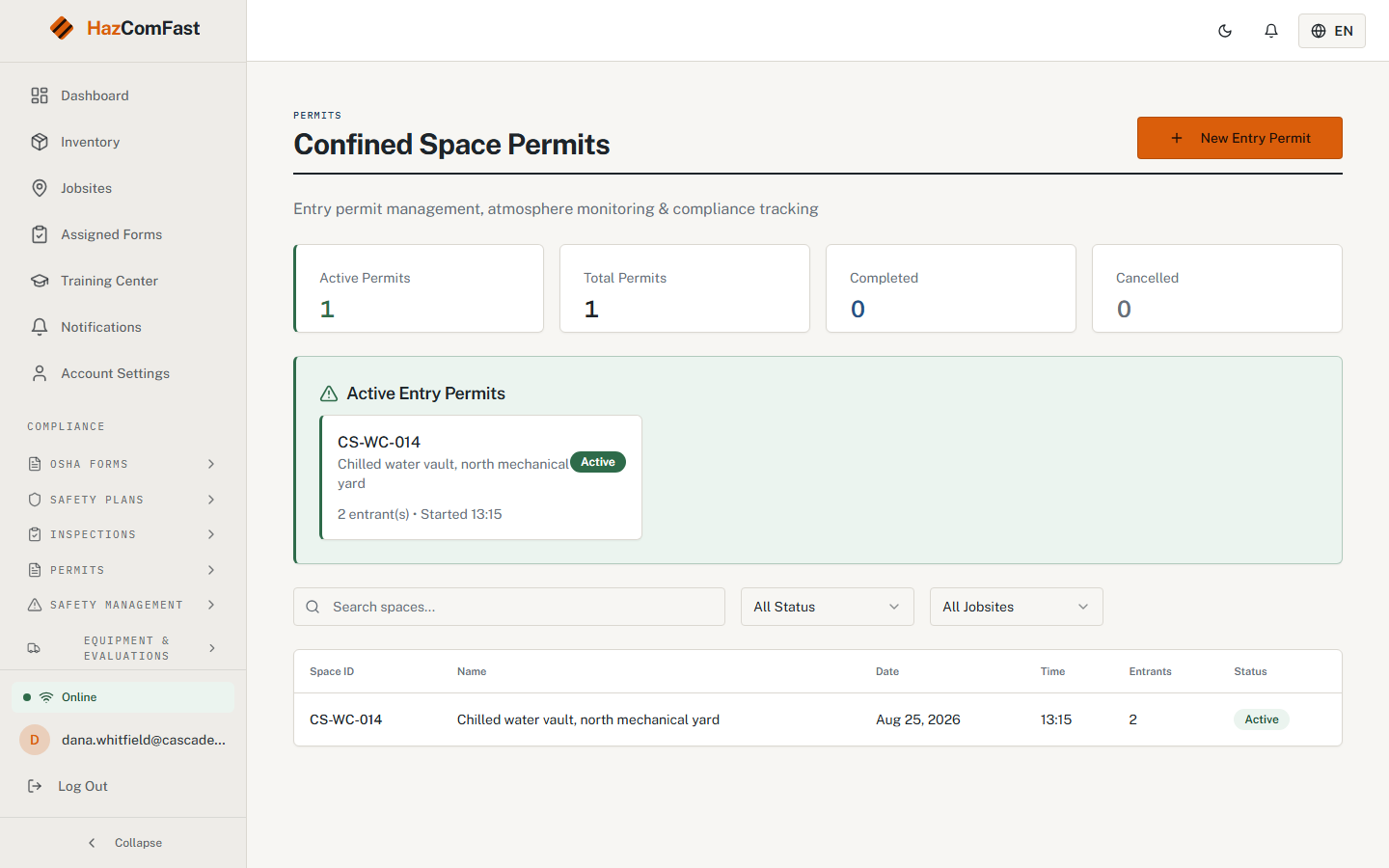
A signed permit proves the entry was authorized. It does not tell the superintendent walking the site whether anyone is inside a space at this moment, and since when — that answer usually lives on a clipboard next to the hatch. In HazComFast, the entry permit is a live record attached to the jobsite: the moment an entry starts, the site's permit screen shows the space, the number of entrants, and the start time, and keeps showing them until the entry is closed. Running counts — active, completed, canceled — sit above the list, filterable by jobsite; when the entry ends, the permit moves to Completed and stays on the record, which is the file 1926.1205(f) asks you to keep and review.
Build a compliant permit in minutes
Don't reconstruct a 16-element permit from memory at the manhole. Generate a Subpart-AA-formatted entry permit with the free Confined Space Permit Generator. Related reading: Safety Permits hub — confined space & hot work · Subpart AA vs. 1910.146 · Digital Permits for Construction · Trenching & Excavation Safety. For your trade: HVAC contractors · Plumbing contractors.
Sources & verification: 29 CFR 1926 Subpart AA — Confined Spaces in Construction (1926.1200–1926.1213), with definitions at 1926.1202, program at 1926.1204, permit elements at 1926.1206, duties at 1926.1208–1926.1210, and rescue at 1926.1211; excavation exclusion at 1926.1201(b)(1) (Subpart P, 1926.650–652); multi-employer policy CPL 02-00-124; penalty maximums per 29 CFR 1903.15(d) (2026, unchanged from 2025); the 2015 final rule, 80 FR 25366. Regulatory text read on the eCFR and govinfo, October 6, 2026. Not legal advice.
Frequently Asked Questions
What is a confined space under OSHA?
Under 29 CFR 1926.1202, a confined space is (1) large enough to enter and perform work, (2) has limited or restricted means of entry or exit, and (3) is not designed for continuous human occupancy. All three must be true. Examples include tanks, vaults, manholes, tunnels, pits, and sewers. Trenches and excavations are NOT confined spaces — 1926.1201(b)(1) expressly excludes excavation work, which is regulated by Subpart P (1926.650–652).
What makes a confined space permit-required?
Per 29 CFR 1926.1202, a confined space becomes a permit-required confined space (PRCS) if it contains or has the potential to contain a hazardous atmosphere, contains a material that could engulf an entrant, has walls that converge inward or a floor that slopes and tapers to a smaller cross-section, or contains any other recognized serious safety or health hazard. Any ONE of these makes it permit-required.
What atmospheric testing is required before confined space entry?
29 CFR 1926.1204(e) requires testing before entry and continuous or periodic monitoring during occupancy. 1926.1204(e)(3) sets the order: (1) oxygen, acceptable from 19.5% to 23.5%; (2) flammable gases and vapors, below 10% of the lower flammable limit (LFL, often called LEL); (3) toxic gases and vapors. Oxygen comes first because most combustible gas meters depend on oxygen and read unreliably in oxygen-deficient air.
Is a rescue plan required for confined space entry?
Yes. For permit-required spaces, 29 CFR 1926.1211 requires the employer to arrange rescue and emergency services before entry. Non-entry rescue (a chest or full-body harness on a retrieval line) is required unless the equipment would increase the overall risk or not contribute to the rescue (1926.1211(c)). 'Call 911' alone is not a compliant plan: you must evaluate the responder's timeliness and proficiency, select one that is equipped and agrees to tell you if it becomes unavailable, and give it access to your spaces (1926.1211(a)).
What construction standard covers confined spaces?
29 CFR 1926 Subpart AA (sections 1926.1200 through 1926.1213) covers confined spaces in construction. It is separate from the general industry standard 1910.146 and adds construction-specific provisions — most notably the host employer / controlling contractor / entry employer coordination duties in 1926.1203(h).
How long is a confined space entry permit valid?
Under 29 CFR 1926.1205(d), the duration of an entry permit may not exceed the time required to complete the assigned task or job identified on the permit, often a single shift or entry operation. Under 1926.1205(e), the entry supervisor must terminate entry and cancel the permit when the work is complete or when a condition not allowed by the permit arises. Under 1926.1205(f), the entry employer must keep each canceled entry permit for at least one year to support the program review required by 1926.1204(n).
OSHA figures and citations here come from our regulatory source-of-truth modules, last checked against the eCFR, OSHA.gov, and the Federal Register on October 5, 2026. Last reviewed October 6, 2026.
About This Article
Published by: HazComFast
Published: March 9, 2026
Last Updated: October 6, 2026
This content is for informational purposes only and does not constitute legal advice.