No. NFPA 51B is not incorporated by reference into OSHA's construction standards. 29 CFR 1926.6 — the section that lists every outside standard OSHA construction adopts as law — names six NFPA documents, and 51B is not one of them. On a federal construction site, the rule that binds your hot work is 29 CFR 1926.352, and its fire-watch clause fixes no duration at all.
That answer matters because of how the question usually arrives. A general contractor's safety manager, an insurance auditor, or an 8-hour course instructor tells you "NFPA 51B is the OSHA hot work standard — you need the 60-minute fire watch." Half of that sentence is useful and half of it is wrong, and if you write the wrong half on a permit, it is the permit an inspector reads.
At a glance: 29 CFR 1926.6 incorporates six NFPA standards into construction — 10A, 13, 30, 80, 251, 385 — and NFPA 51B is not among them. For welding and cutting, what construction incorporates is ANSI Z49.1-1967, via 1926.350(j). The binding fire-watch rule is 1926.352(e): a watch maintained "for a sufficient period of time after completion of the work to ensure that no possibility of fire exists" — an obligation of result with no number. NFPA 51B is not required by OSHA in construction: 29 CFR 1926.6 incorporates six NFPA standards by reference and 51B is not among them, so the binding rule for a construction fire watch is 29 CFR 1926.352(e), which sets no numeric duration.
What 29 CFR 1926.6 actually incorporates
Incorporation by reference is the mechanism that turns a private standard into enforceable law: the CFR names the document and the edition, and from that moment the named text is a rule. The complete NFPA list for construction, read on the eCFR on October 6, 2026:
| Standard | Edition | Where it becomes binding |
|---|---|---|
| NFPA 10A — Maintenance and Use of Portable Fire Extinguishers | 1970 | 1926.150(c) |
| NFPA 13 — Installation of Sprinkler Systems | 1969 | 1926.152(d) |
| NFPA 30 — Flammable and Combustible Liquids Code | 1969 | 1926.152(c) |
| NFPA 80 — Fire Doors and Windows | 1970 | 1926.152(b) |
| NFPA 251 — Fire Tests of Building Construction | 1969 | 1926.152(b), 1926.155(f) |
| NFPA 385 — Tank Vehicles for Flammable and Combustible Liquids | 1966 | 1926.152(g) |
| NFPA 51B | — | absent |
And for welding and cutting specifically, the incorporated standard is not an NFPA document at all:
"ANSI Z49.1-1967, Safety in Welding and Cutting, IBR approved for § 1926.350(j)."
Notice the edition years: 55 to 60 years old. That is not sloppiness; it is what static incorporation means. OSHA froze those texts at a date, and moving them requires rulemaking. NFPA 51B, by contrast, has kept revising on its own calendar (its fire-watch minimum went from 30 to 60 minutes at the 2019 edition, and the 2024 edition keeps that baseline), which is exactly the kind of moving target incorporation by reference is designed to avoid.
What actually binds your hot work: 1926.352(e)
The construction fire-watch duty, verbatim:
"…additional personnel shall be assigned to guard against fire while the actual welding, cutting, or heating operation is being performed, and for a sufficient period of time after completion of the work to ensure that no possibility of fire exists. Such personnel shall be instructed as to the specific anticipated fire hazards and how the firefighting equipment provided is to be used."
No numeric duration appears anywhere in 1926.352: not in paragraph (e), not elsewhere in the section. And understand what that means before celebrating: an obligation of result is more demanding than a number, not less. A number is a finish line — you cross it, you pack up. Under (e), a 60-minute watch that walks away from a smoldering joist is a violation, and a 20-minute watch over work with no combustibles in reach is not. The clock the standard cares about is the one on the smoldering fire, not the one on the wall.
Where the 30 and the 60 everyone recites actually come from
| Number | Real source | Reach |
|---|---|---|
| 30 minutes | 29 CFR 1910.252(a)(2)(iii)(B) | General industry only — it does not apply to construction work. And it reads "at least a half hour": a floor, never a finish line |
| 60 minutes | NFPA 51B, since the 2019 edition; the current 2024 edition keeps it, and lets the permit authorizing individual reduce it to no less than 30 minutes where fire hazards are absent | Consensus standard, not incorporated into Part 1926 |
| Up to 3 more hours | NFPA 51B, 2019 edition onward (unchanged in 2024) | Additional fire monitoring at the discretion of the permit authorizing individual |
A common mistake in the field is attributing the 30 minutes to NFPA. That is wrong twice: 30 is OSHA general industry, and 51B has said 60 since 2019. Our companion article on what 1926.352 really requires walks through the full permit — clearances, extinguishers, the watch itself; this one settles only the question of which of it is law.
So NFPA 51B doesn't matter? It matters — through three other doors
Being outside 1926.6 does not make 51B decorative. It binds most jobsites anyway, by routes that have nothing to do with OSHA incorporation:
- Your local fire code adopts it. The International Fire Code points to NFPA 51B for hot work, and the fire code is law in the jurisdictions that adopt it.
- Your contract imposes it. Owners, general contractors, and insurers often write 51B compliance into contract documents. Breach of contract needs no CFR citation.
- The General Duty Clause reaches for it. Under Section 5(a)(1), a recognized consensus standard is evidence of what a diligent employer should have known. Ignoring 51B entirely is a bad position even where no rule names it.
What the distinction changes is what you write and what you cite. Citing 1926.352(e) for a duration it does not contain is an error. Citing NFPA 51B as "the OSHA standard" is another. The inspector cites the CFR; your permit should too — and should name 51B for what it is where you follow it.
Three lines that fix most hot-work permits
- Don't pre-print a duration as if it were federal. If your company sets one, label it: company minimum, not required by OSHA.
- Write the obligation of result in full, with what the watch is looking for — a smoldering fire, not a clock.
- Put the right source next to each requirement: 1926.352(e) for the duty to keep watch · NFPA 51B for the 35-foot clearance and the 60 minutes, named as recognized practice · 1910.252(a)(2)(iii)(B) only if you are actually in general industry.
What the permit screen should say
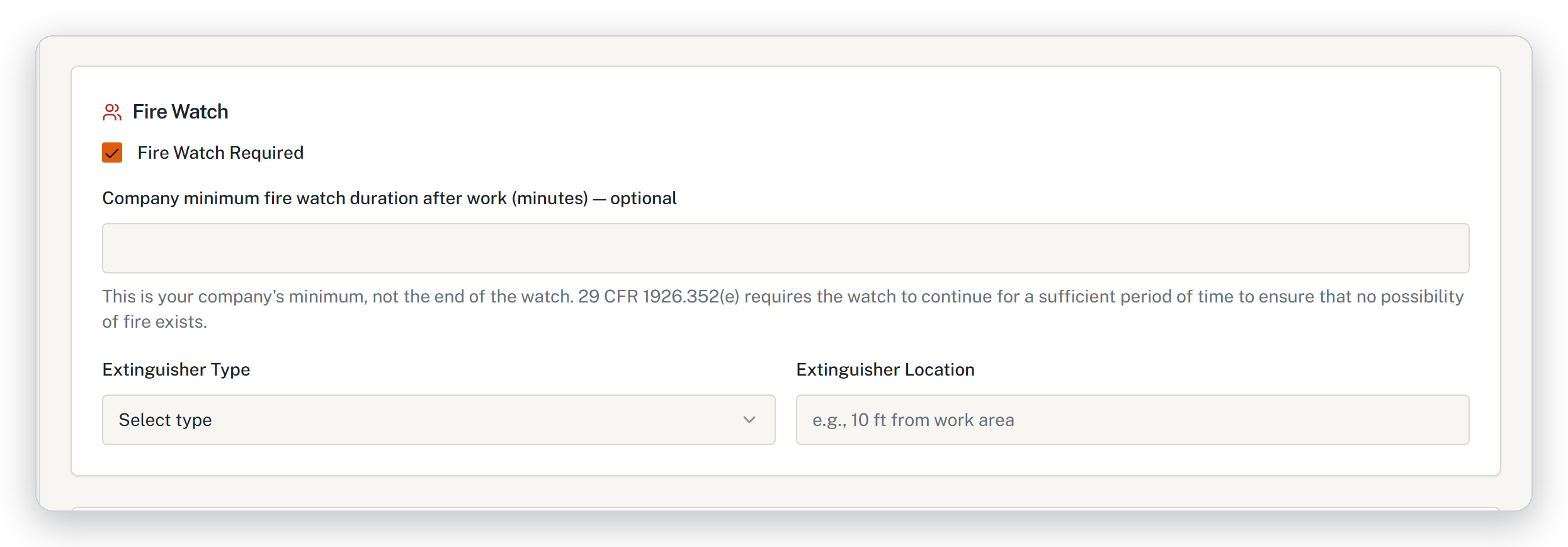
A permit form that pre-prints a number teaches every crew that reads it the wrong rule, and the number then travels: into the exported fire prevention plan, into the toolbox talk, into the answer a foreman gives an inspector. The fire watch section of a HazComFast hot work permit states the 1926.352(e) duty in the standard's own words and treats any duration as what it is: a company minimum, entered by the employer and labeled that way on the permit. Leave the field blank and the permit still carries the obligation of result. Fill it in and the number prints as your company's minimum, never as OSHA's.
Print a permit that cites its sources — free, no login
Our hot work permit generator puts the citation next to each control: the 1926.352 duties as CFR text, and the 35-foot clearance and 60-minute watch labeled as NFPA 51B recognized practice — never as OSHA law. The post-work monitoring field defaults to the NFPA figure and says so.
The hub & related: Digital safety permits · OSHA Hot Work Permit & Fire Watch: What 1926.352 Really Requires · OSHA Welding Safety Requirements · Digital Permits for Construction
Sources & verification: the incorporation-by-reference list per 29 CFR 1926.6, read on the eCFR on October 6, 2026; the fire-watch duty and its "sufficient period of time" language per 29 CFR 1926.352(e), verified 2026-08-14 against osha.gov — no numeric duration appears anywhere in the section; the general-industry half hour per 29 CFR 1910.252(a)(2)(iii)(B); the welding incorporation (ANSI Z49.1-1967) per 29 CFR 1926.350(j). NFPA 51B figures (60-minute watch, section 5.6.1.1; fire monitoring for up to 3 additional hours at the permit authorizing individual's determination) checked on August 27, 2026 against three independent descriptions of the current 2024 edition, which also added the option to shorten the watch to no less than 30 minutes; the 60-minute minimum entered at the 2019 edition. NFPA revises on its own calendar. General guidance, not legal advice.
Frequently Asked Questions
Is NFPA 51B required by OSHA?
No. 29 CFR 1926.6, the list of standards OSHA's construction rules incorporate by reference, names six NFPA documents (10A, 13, 30, 80, 251 and 385), and NFPA 51B is not among them. On a federal construction site the binding hot-work rule is 29 CFR 1926.352, whose fire-watch clause (e) fixes no duration at all. NFPA 51B remains recognized industry practice, which can still reach you through your local fire code, your contract, or the General Duty Clause, but it is not an OSHA construction requirement.
Which NFPA standards does OSHA construction actually incorporate?
Per 29 CFR 1926.6: NFPA 10A-1970 (portable fire extinguishers, for 1926.150(c)), NFPA 13-1969 (sprinkler systems, for 1926.152(d)), NFPA 30-1969 (flammable and combustible liquids, for 1926.152(c)), NFPA 80-1970 (fire doors and windows, for 1926.152(b)), NFPA 251-1969 (fire tests of building construction, for 1926.152(b) and 1926.155(f)), and NFPA 385-1966 (tank vehicles, for 1926.152(g)). For welding and cutting, the incorporated standard is not an NFPA document at all: ANSI Z49.1-1967, via 1926.350(j).
Does OSHA require a 30-minute or 60-minute fire watch in construction?
Neither. 29 CFR 1926.352(e) requires the fire watch to continue 'for a sufficient period of time after completion of the work to ensure that no possibility of fire exists'; no number appears anywhere in the section. The 30 minutes people quote is OSHA general industry, 1910.252(a)(2)(iii)(B), which does not reach construction work, and even there it is a floor, not a finish line. The 60 minutes is NFPA 51B: it entered at the 2019 edition, and the current 2024 edition keeps it as the baseline while letting the permit authorizing individual shorten it, to no less than 30 minutes, where fire hazards are absent.
If NFPA 51B isn't OSHA law, can I ignore it?
No — it just binds you through different doors. Local fire codes adopt it (the International Fire Code points to it), and the fire code is law. Owners, general contractors and insurers write it into contracts. And under the General Duty Clause, Section 5(a)(1) of the OSH Act (29 U.S.C. 654(a)(1)), a consensus standard documents what a diligent employer should have recognized. The distinction changes what you cite on your permit, not whether you take fire watch seriously.
OSHA figures and citations here come from our regulatory source-of-truth modules, last checked against the eCFR, OSHA.gov, and the Federal Register on October 5, 2026. Last reviewed October 6, 2026.
About This Article
Published by: HazComFast
Published: August 26, 2026
Last Updated: October 6, 2026
This content is for informational purposes only and does not constitute legal advice.