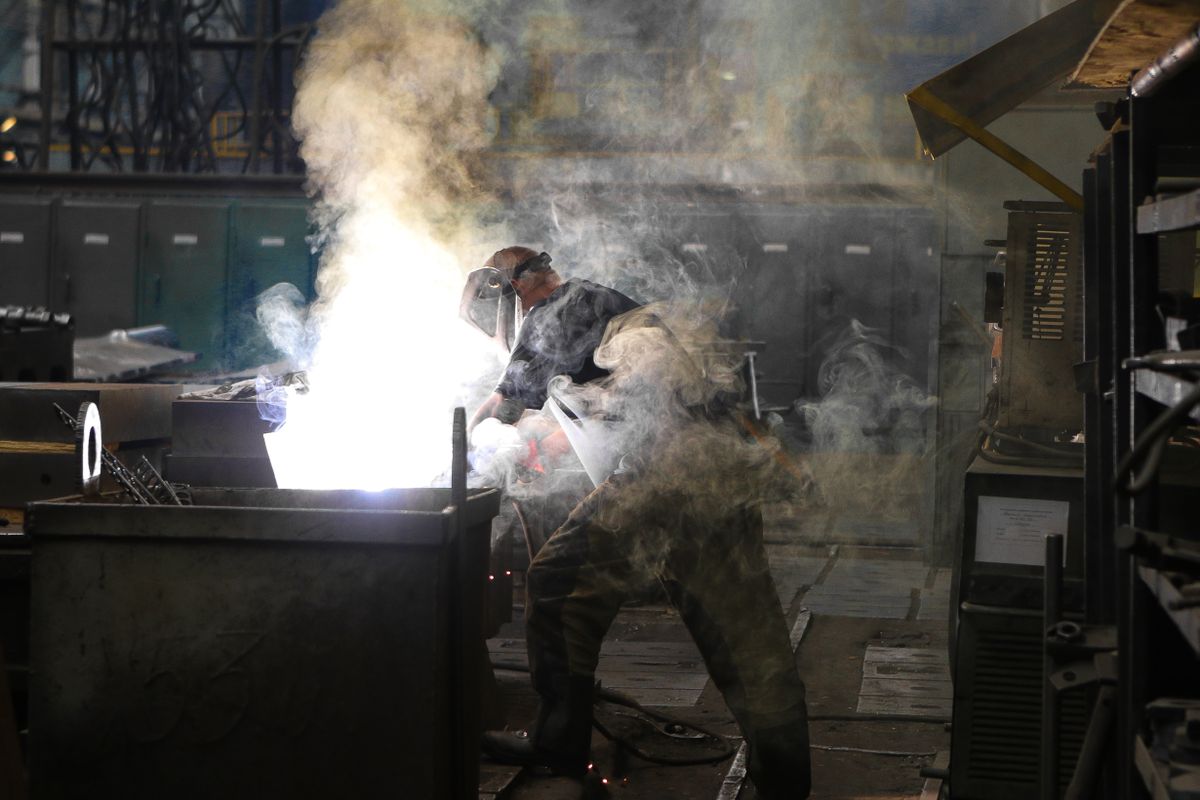
Introduction to Welding Safety in Construction
Welding, cutting, and brazing operations are essential to construction — from structural steel erection to mechanical piping, HVAC installation, and bridge repair. But these operations create some of the most concentrated hazards on any jobsite: intense heat, ultraviolet radiation, toxic fumes, molten metal, fire, explosion, and electrical shock.
In construction, these hazards are governed by 29 CFR 1926 Subpart J (1926.350 to 1926.354), with eye protection under 1926.102 and respirators under 1926.103. This guide covers OSHA welding safety compliance for construction in 2026, and it flags each number that comes from general industry or a consensus standard rather than from Subpart J.
In construction, welding and cutting fall under 29 CFR 1926 Subpart J: fire hazards are moved or protected and extinguishers kept at hand under 1926.352, a fire watch stays as long as needed with no fixed number of minutes, and ventilation or respirators control fumes under 1926.353.
Fire-prevention geometry · 1926 Subpart J
OSHA Standards That Apply
Construction Standards (29 CFR 1926 Subpart J)
The primary construction welding standards include:
- 1926.350 — Gas welding and cutting (equipment, storage, use of fuel gas)
- 1926.351 — Arc welding and cutting (equipment installation, operation)
- 1926.352 — Fire prevention measures
- 1926.353 — Ventilation and protection in welding, cutting, and heating
- 1926.354 — Welding, cutting, and heating in way of preservative coatings
Cross-Referenced Standards
Several other standards also apply to welding operations:
- 1910.251-257 — General industry welding standards (not binding on construction work, but a common reference)
- 1926.62 — Lead in construction (when welding lead-coated materials)
- 1926.1153 — Crystalline silica (grinding welds on stone/concrete)
- 1910.134 — Respiratory protection (welding fume exposure)
- 1926 Subpart AA — Confined spaces (welding in confined spaces)
Hot Work Permits
When Required
Subpart J does not require a written permit; general industry's rule asks for an inspection and authorization "preferably in the form of a written permit" (1910.252(a)(2)(iv)). A hot work permit system is still the best way to manage welding, cutting, and brazing outside designated shops. The permit system ensures:
- The area has been inspected for fire hazards before work begins
- Combustible materials have been removed or protected
- Fire protection equipment is available
- A fire watch has been assigned when required
- Supervisory approval has been obtained
Permit Contents
An effective hot work permit documents:
- Date, time, and location of hot work
- Description of work to be performed
- Name of person performing the work
- Fire prevention measures in place
- Type and location of fire extinguishing equipment
- Atmospheric testing results (for confined spaces)
- Names of fire watch personnel
- Supervisor authorization signature
- Duration of permit validity (typically one shift maximum)
Designated Welding Areas
Permanent welding areas may be established where:
- Floors are non-combustible or concrete
- Combustible materials are kept at least 35 feet away
- Combustible walls are protected with fire-resistant shields
- Fire extinguishers are readily available
In designated areas, individual hot work permits may not be required for each operation, but the area must maintain these conditions continuously.
Fire Prevention: The 35-Foot Rule and Beyond
Fire prevention is where welding safety starts. OSHA's fire prevention requirements for construction welding sit in 1926.352.
Move It or Protect It (1926.352(a)-(c), (f))
In construction the rule is a sequence, not a distance:
- Move the object to a designated safe location when practical; otherwise take the movable fire hazards away or protect them (1926.352(a)).
- If neither the object nor the hazards can be moved, confine the heat, sparks, and slag and protect the immovable hazards (1926.352(b)).
- Take the same precautions on the opposite side of walls, floors, and ceilings (1926.352(f)), and do not weld where flammable paints, other flammable compounds, or heavy dust create a hazard (1926.352(c)).
The 35-foot figure comes from NFPA 51B and general industry's fire-watch triggers (1910.252(a)(2)(iii)(A)(1)); many contractors use it as their working radius, and it belongs on the hot work permit with the specific combustibles identified.
Fire Extinguisher Requirements
Suitable fire extinguishing equipment must be immediately available in the work area and ready for instant use (1926.352(d)). In practice:
- A fire extinguisher rated at least 10B within 50 feet wherever more than 5 pounds of flammable gas is in use, as with oxy-fuel work (1926.150(c)(1)(vi)), on top of the building's 2A coverage (1926.150(c)(1)(i))
- Fire watch personnel instructed in the anticipated fire hazards and in using the equipment provided (1926.352(e))
- For operations on sprinklered buildings, ensure sprinkler system is operational
Fire Watch Requirements
Under 1926.352(e), the fire watch is instructed in the specific anticipated fire hazards and in using the firefighting equipment provided. General industry's version (1910.252(a)(2)(iii)(B)) adds duties many contractors adopt. A good fire watch:
- Be trained in fire extinguisher use and emergency procedures
- Have suitable fire extinguishing equipment readily available
- Be familiar with the facility's fire alarm system
- Watch for fires in all exposed areas and attempt to extinguish them only within the capability of available equipment
- Remain on duty after welding operations cease — 1926.352(e) requires a sufficient period to ensure no fire is possible, and sets no number; NFPA 51B calls for at least 60 minutes, though it is not incorporated by reference into the construction standards
- Be authorized to stop welding if conditions become hazardous
Common Fire Prevention Violations
- Welding on or near combustible materials without protection
- No fire extinguisher at the welding site
- No fire watch assigned when required
- Fire watch person leaves before the area is cold — NFPA 51B puts that at 60 minutes minimum
- Failure to inspect the area before welding begins
- Welding above combustible materials without spark containment
Gas Welding and Cutting Equipment (1926.350)
Cylinder Storage and Handling
Gas cylinders present significant hazards if improperly stored or handled:
Storage Requirements:
- Store cylinders upright and secured to prevent falling (1926.350(a)(9))
- Keep valve protection caps in place and secured (1926.350(a)(1))
- Separate oxygen from fuel gas cylinders by at least 20 feet or a 5-foot noncombustible barrier with minimum ½-hour fire resistance (1926.350(a)(10))
- Inside buildings, store cylinders in a well-protected, well-ventilated, dry place at least 20 feet from highly combustible materials, away from elevators, stairs, and gangways (1926.350(a)(11)), and never where they can become part of an electrical circuit (1926.350(b)(2))
- Never store cylinders near readily ignitable materials
Handling Requirements:
- Never lift cylinders by the valve protection cap (1926.350(a)(5))
- Never use cylinders as rollers or supports (1926.350(c)(1))
- Close valves when work is finished, when cylinders are empty, and whenever they are moved (1926.350(a)(8))
- Never use damaged or defective cylinders (1926.350(c)(3)); tag and remove a cylinder whose valve keeps leaking (1926.350(d)(5))
- Mark empty cylinders "MT" or "EMPTY" and store separately (common practice)
Hose and Regulator Safety
- Inspect hoses at the beginning of each working shift and remove defective hose from service (1926.350(f)(3))
- Use only proper ferrules or clamps — never wire, tape, or improvised connections
- Purge hoses before lighting and after extended breaks
- Keep hoses away from hot surfaces, sharp edges, and traffic
- Use proper flashback arrestors on both oxygen and fuel gas lines (ANSI Z49.1 practice, which 1926.350(j) brings in for details Subpart J does not cover)
Acetylene Safety
Acetylene requires special attention:
- Never exceed 15 psig working pressure for acetylene (general industry 1910.253(a)(2); ANSI Z49.1)
- Never use acetylene from a cylinder in a horizontal position (acetone solvent can enter the regulator)
- Never use copper fittings with acetylene (explosive copper acetylide formation)
- If a cylinder has been stored on its side, stand upright and wait at least 30 minutes before use (manufacturer and industry practice, like the two rules above)
Arc Welding Safety (1926.351)
Electrical Safety
Arc welding equipment operates at potentially lethal voltage levels:
- Open circuit voltage (OCV): 60-100V AC or 60-100V DC — sufficient to cause fatal shock
- All welding equipment must be properly grounded (1926.351(c))
- Electrode holders must be fully insulated against the maximum voltage to ground (1926.351(a)(2)); remove electrodes from unattended holders and never dip hot holders in water (1926.351(d)(1)-(2))
- Cables must be inspected before use for damaged insulation
- Work leads (ground clamps) must have firm connection to the workpiece
- Never coil or loop electrode cable around the body
- Never change electrodes with bare hands, wet gloves, or while standing on wet surfaces
Equipment Requirements
- Open the machine's power supply switch when leaving the work or moving the machine (1926.351(d)(3))
- Voltage reduction devices (VRDs) are recommended for SMAW (stick) in confined or cramped areas
- All cables must be of adequate capacity and properly insulated
- Electrode stubs (hot ends) must not be left on the floor — use a metal container
Ventilation Requirements (1926.353)
General Ventilation
In construction, 1926.353 sets performance rules rather than airflow numbers. Mechanical ventilation is either general mechanical ventilation, with enough air changes to keep fumes and smoke within the Subpart D limits, or local exhaust through freely movable hoods placed as close as practicable to the work (1926.353(a)(1)-(3)). It is required whenever welding, cutting, or heating is done in a confined space (1926.353(b)(1)); exhaust air is discharged clear of the intake (1926.353(a)(4)), and oxygen is never used for ventilation (1926.353(a)(6)). The numbers often quoted, 2,000 cubic feet per minute per welder and 100 feet per minute at a local hood, are general industry's (1910.252(c)(2)(ii) and (c)(3)(i)); they make a reasonable design reference.
Toxic Materials — Special Ventilation
In enclosed spaces, 1926.353(c) adds rules by metal: zinc, lead base metals, cadmium-bearing filler, and chromium require general mechanical or local exhaust ventilation ((c)(1)); lead-bearing or lead-coated metals, cadmium base metals, mercury-coated metals, and beryllium require local exhaust or airline respirators, and beryllium both ((c)(2)). In the open air these operations call for filter-type respirators, or airline respirators for beryllium ((c)(3)), and anyone else in the same atmosphere gets the same protection ((c)(4)). The exposure limits set the target:
| Material | Fume Hazard | OSHA PEL | Required Controls |
|---|---|---|---|
| Zinc (galvanized steel) | Metal fume fever | 5 mg/m³ zinc oxide fume (1926.55) | Mechanical ventilation in enclosed spaces (1926.353(c)(1)) |
| Lead | Neurological damage, kidney disease | 50 µg/m³ (1926.62(c)(1)) | Local exhaust or airline respirator in enclosed spaces (1926.353(c)(2)) |
| Cadmium | Lung cancer, kidney damage | 5 µg/m³ (1926.1127(c)) | Local exhaust or airline respirator in enclosed spaces (1926.353(c)(2)) |
| Chromium (Cr VI) | Lung cancer | 5 µg/m³ (1926.1126(c)) | Mechanical ventilation in enclosed spaces (1926.353(c)(1)) |
| Mercury | Neurological damage | 0.1 mg/m³ (1926.55) | Local exhaust or airline respirator in enclosed spaces (1926.353(c)(2)) |
| Beryllium | Chronic beryllium disease | 0.2 µg/m³ (1926.1124(c)(1)) | Local exhaust and airline respirator in enclosed spaces (1926.353(c)(2)) |
Beryllium is the one metal where the rule demands both local exhaust and airline respirators in enclosed spaces, and airline respirators even in the open air (1926.353(c)(2)-(3)).
Fluorine Compounds
Fluxes and electrode coverings that contain fluorine compounds produce fluoride fumes. Subpart J has no fluorine-specific rule; the construction exposure limit for fluorides is 2.5 mg/m³ as F (1926.55, Appendix A), and general industry applies its confined-space ventilation rules to fluorine-bearing fluxes (1910.252(c)(5)), a sensible reference on a jobsite.
When Respirators Are Required
Respiratory protection for welding fumes (1910.134, adopted for construction by 1926.103):
- Minimum: Half-face APR with P100 (HEPA) filters for most welding fumes
- Toxic metals: Full-face APR or PAPR depending on concentration
- IDLH conditions: SCBA required
- Confined spaces: Supplied-air respirator may be needed to address both fumes and oxygen displacement
Personal Protective Equipment for Welding
Eye and Face Protection
The most critical PPE for welding — UV and infrared radiation from arc welding causes "arc eye" (photokeratitis) within seconds of unprotected exposure.
Minimum filter shades (OSHA's table, 1910.133(a)(5)). Construction eye protection must meet ANSI Z87.1 (1926.102(b)(1)), and OSHA's general-industry table is the federal reference for shade numbers:
| Operation | Minimum shade |
|---|---|
| SMAW (stick), under 60 A / 60-160 A / 160-250 A / 250-550 A | 7 / 8 / 10 / 11 |
| GMAW (MIG) and FCAW, under 60 A / 60-500 A | 7 / 10 |
| GTAW (TIG), under 150 A / 150-500 A | 8 / 10 |
| Air carbon arc cutting, light / heavy | 10 / 11 |
| Plasma arc cutting, light / medium / heavy | 8 / 9 / 10 |
| Gas welding, light / medium / heavy plate | 4 / 5 / 6 |
| Oxygen cutting, light / medium / heavy | 3 / 4 / 5 |
| Torch brazing / torch soldering / carbon arc welding | 3 / 2 / 14 |
OSHA's rule of thumb: start with a shade too dark to see the weld zone, then go lighter until the view is sufficient, never below the minimum.
Additional eye protection:
- Safety glasses with side shields under the welding helmet (ANSI Z49.1 practice); in gas metal-arc work, when two or more welders are exposed to each other's arc, filter lens goggles go under the helmets (1926.353(d)(1)(ii))
- Helpers and nearby workers are protected by noncombustible or flameproof screens wherever practicable (1926.351(e)) or by filter lenses (1926.353(d)(1)(ii))
- Helmets, auto-darkening ones included, must meet ANSI Z87.1 (1926.102(b)(1))
Body Protection
- Flame-resistant (FR) clothing or leather welding jacket
- Leather welding gloves — insulated for electrical protection
- Leather boots — high-top preferred to prevent sparks entering
- Leather apron for overhead or vertical welding
- Skull cap or leather hood for overhead welding
- Ear plugs — to prevent sparks entering the ear canal (and for noise protection)
Critical PPE Rules
- Never wear synthetic fabrics (polyester, nylon) under or around welding operations — they melt and fuse to skin
- No rolled-up sleeves or open pockets — trap sparks and molten metal
- Button shirt collars and use leather cape/bib for overhead work
- Keep clothing dry — wet clothing increases shock hazard
- No rings or jewelry — conduct electricity and trap sparks
Welding in Confined Spaces (1926.353(b) + Subpart AA)
Welding in confined spaces combines the hazards of hot work with the inherent dangers of confined spaces — creating one of the most hazardous construction operations.
Additional Requirements
Beyond standard confined space entry procedures:
-
Atmospheric testing — Before entry and continuously during welding:
- Oxygen: 19.5-23.5% (welding can deplete O₂ rapidly)
- LEL: Below 10% (acetylene, fuel gas, coating vapors); above it the atmosphere is hazardous (1926.1202)
- Toxic gases: Below applicable PELs (welding fumes, CO, NO₂)
-
Ventilation — Mechanical ventilation is required (1926.353(b)(1)); where it would block the access, airline respirators with an employee outside in contact (1926.353(b)(2)):
- Position exhaust to remove fumes from the breathing zone
- Ensure fresh air intake is not contaminated
-
Gas cylinders — Must remain outside the confined space (1926.350(b)(4))
- Only hoses and torches enter the space
- Shut off the gas supply outside whenever the torch is unattended, and remove torch and hose overnight (1926.352(g))
- Bleed hoses when not in use
-
Welding machines — Keep them outside the confined space (general industry 1910.252(b)(4); good practice)
- Only electrode holders/cables enter
- Proper grounding of welding leads to the workpiece
-
Attendant — Must be stationed outside, with a pre-planned rescue procedure, when a welder enters through a small opening (1926.353(b)(3)):
- Communication capability with entrant(s)
- Rescue equipment immediately available
- Emergency services contact information
- Authority to order evacuation
-
Rescue plan — Must be established before entry:
- Non-entry rescue preferred (retrieval system with mechanical advantage)
- Entry rescue team trained and equipped
- Practice drills conducted
Critical Safety Practices
- Never use oxygen to ventilate a confined space (1926.353(a)(6)); it creates an oxygen-enriched atmosphere and an extreme fire risk
- Remove electrodes from holders when not in use (1926.351(d)(1))
- Disconnect welding machines when leaving the space for extended periods
- Monitor atmospheric conditions continuously — welding consumes oxygen and produces CO, NO₂, and ozone
Preservative Coatings (1926.354)
When welding or cutting metals coated with preservative coatings (paint, galvanizing, cadmium plating, lead paint):
Pre-Work Requirements
- Identify the coating — Check the SDS; when a coating's flammability is not known, a competent person tests it first (1926.354(a)), and highly flammable coatings are stripped from the area to be heated (1926.354(b))
- Toxic coatings in enclosed spaces — strip them at least 4 inches from the area of heat application, or protect employees with airline respirators (1926.354(c)(1))
- Toxic coatings in the open air — protect employees with respirators (1926.354(c)(2)), and remove the coating far enough that the unstripped metal does not heat appreciably (1926.354(d))
- Notify workers about the coating hazards
Specific Coating Hazards
- Lead paint — Triggers the full lead standard (1926.62). See our lead exposure guide
- Galvanized coating (zinc) — Causes metal fume fever. Mechanical ventilation in enclosed spaces (1926.353(c)(1)(i)); filter-type respirators in the open air (1926.353(c)(3))
- Cadmium plating — Extremely toxic. Local exhaust or airline respirators in enclosed spaces (1926.353(c)(2)(ii)), and the cadmium standard (1926.1127) applies
- Chrome plating — Hexavalent chromium fumes are carcinogenic. Mechanical ventilation in enclosed spaces (1926.353(c)(1)(iv)), and the Cr(VI) standard (1926.1126) applies
Training Requirements
Required Training Topics
Several rules require instruction: the safe use of fuel gas (1926.350(d)), fire watch duties (1926.352(e)), and the recognition and avoidance of unsafe conditions (1926.21(b)(2)). A complete program covers:
- Safe operation of welding and cutting equipment
- Fire prevention and fire watch duties
- Hot work permit procedures
- Proper PPE selection and use
- Ventilation requirements
- Hazards of specific metals and coatings being welded
- Emergency procedures
- Confined space procedures (if applicable)
- Electrical safety for arc welding
Welder Qualification
OSHA does not require welder certification; it requires instruction, such as in the safe use of fuel gas (1926.350(d)). Industry best practices include:
- AWS D1.1 structural welding qualification
- ASME Section IX for pressure vessel/piping welding
- Employer-specific competency assessments
- Equipment-specific training for each welding process used
Inspection and Documentation
Pre-Work Inspection Checklist
Before starting any welding or cutting operation:
- Hot work permit completed and signed
- Area inspected for fire hazards within 35 feet
- Combustibles removed or protected
- Fire extinguisher available and charged
- Fire watch assigned (if required)
- Ventilation adequate or respiratory protection in place
- Proper PPE available and in good condition
- Equipment inspected (cables, hoses, regulators, holders)
- Gas cylinders secured and properly separated
- Welding machine properly grounded
- Atmospheric testing completed (confined spaces)
- Nearby workers notified and protected (flash screens)
Documentation Requirements
Maintain records of:
- Hot work permits (Subpart J sets no retention period; follow your company policy)
- Fire watch logs
- Welder qualifications and training records
- Equipment inspection records
- Atmospheric monitoring results (confined space welding)
- Exposure monitoring results (toxic metal fumes)
Common OSHA Citations and Prevention
Common Welding Citation Areas
- No fire prevention measures (1926.352) — Missing fire watch, no extinguisher, combustibles not removed
- Inadequate ventilation (1926.353) — Welding toxic metals without ventilation or respiratory protection
- Cylinder storage violations (1926.350) — Oxygen and fuel gas stored together, no valve caps
- Missing PPE (1926.102) — Wrong shade lens, no safety glasses under helmet
- Confined space violations (1926 Subpart AA) — Welding in confined spaces without proper permit/precautions
Prevention Best Practices
- ✅ Implement a written hot work permit system for all non-shop welding
- ✅ Train fire watch personnel on duties and responsibilities
- ✅ Conduct pre-work inspections using a standardized checklist
- ✅ Identify coatings on all metals before welding — check SDS
- ✅ Provide proper shade filter lenses for each welding process
- ✅ Monitor air quality when welding in enclosed spaces or on toxic materials
- ✅ Maintain cylinder storage compliance — 20-foot separation or 5-foot barrier
- ✅ Document everything — permits, training, inspections, and monitoring
Conclusion
Welding safety in construction requires attention to multiple overlapping hazards — fire, fumes, radiation, electrical, and confined space risks. A comprehensive approach combining hot work permits, proper PPE, adequate ventilation, and thorough training protects workers and prevents costly OSHA citations.
The key to compliance is establishing systematic procedures — hot work permits, pre-work checklists, fire watch assignments, and atmospheric monitoring — that become standard practice on every project. Digital tools for permit management, training tracking, and SDS access for welding material hazards streamline compliance and create the audit trail needed for OSHA inspections.
The standards, tools & related reading
- Fire Prevention in Welding — 29 CFR 1926.352 · Gas Welding & Cutting — 1926.350 · Arc Welding & Cutting — 1926.351
- Define the paperwork: Hot Work Permit (glossary) · document each job with a Toolbox Talk.
- Overlapping hazards: Confined Space Entry Permits · Hexavalent Chromium in Weld Fume · Lead Exposure in Construction · Respiratory Protection Program
- 2026 OSHA penalty schedule · penalties by state
Frequently Asked Questions
What OSHA standard covers welding and cutting in construction?
Welding and cutting in construction is covered by 29 CFR 1926 Subpart J (Welding and Cutting), which includes 1926.350 (Gas Welding and Cutting), 1926.351 (Arc Welding and Cutting), 1926.352 (Fire Prevention), 1926.353 (Ventilation and Protection in Welding), and 1926.354 (Welding, Cutting, and Heating in Way of Preservative Coatings). The general industry welding rules in 29 CFR 1910 Subpart Q do not govern construction work, though they are a useful reference where Subpart J is silent.
When is a fire watch required for welding?
In construction, 29 CFR 1926.352(e) requires additional personnel to guard against fire whenever normal fire prevention precautions are not sufficient, during the work and 'for a sufficient period of time after completion of the work to ensure that no possibility of fire exists'; it fixes no distance and no number of minutes. The familiar triggers, such as combustibles closer than 35 feet, and the 30-minute watch come from general industry, 1910.252(a)(2)(iii), which does not reach construction work. NFPA 51B, the consensus standard, calls for a minimum of 60 minutes and has since its 2019 edition.
What PPE is required for welding?
Eye and face protection must meet ANSI Z87.1 in construction (29 CFR 1926.102(b)(1)), and OSHA's shade table sets minimums such as 7 to 11 for stick welding depending on current, 10 for most MIG and flux-cored work, and 3 to 5 for oxygen cutting (1910.133(a)(5)). Arc work should be shielded by noncombustible or flameproof screens that protect people nearby (1926.351(e)). Flame-resistant clothing or a leather jacket, leather gloves, boots, and hearing protection where noise requires it complete the usual kit.
What ventilation is required for welding?
In construction, 29 CFR 1926.353 requires general mechanical or local exhaust ventilation for welding in confined spaces (1926.353(b)(1)) and, in enclosed spaces, for zinc, lead base metals, cadmium-bearing filler, and chromium (1926.353(c)(1)). Lead-bearing, cadmium, mercury-coated, and beryllium metals in enclosed spaces need local exhaust or airline respirators, and beryllium needs both (1926.353(c)(2)). The ventilation must keep fumes within the Subpart D limits (1926.353(a)(2)-(3)); the 2,000 cubic feet per minute per welder figure is general industry's rule (1910.252(c)(2)(ii)), not construction's.
Can you weld in a confined space?
Yes, with precautions. Oxygen and fuel-gas cylinders stay outside the space (29 CFR 1926.350(b)(4)); the space gets mechanical ventilation (1926.353(b)(1)) or, where ventilation would block the access, airline respirators with an employee outside in contact (1926.353(b)(2)); a welder entering through a small opening needs a means of quick removal and an attendant outside (1926.353(b)(3)); and the torch gas is shut off outside whenever the torch is left unattended, with torch and hose removed overnight (1926.352(g)). A permit-required confined space also follows Subpart AA, where flammable gas above 10% of its lower flammable limit is a hazardous atmosphere (1926.1202) and the permit must cover the hot work.
OSHA figures and citations here come from our regulatory source-of-truth modules, last checked against the eCFR, OSHA.gov, and the Federal Register on October 5, 2026. Last reviewed October 6, 2026.
About This Article
Published by: HazComFast
Published: March 23, 2026
Last Updated: October 6, 2026
- https://www.osha.gov/laws-regs/regulations/standardnumber/1926/1926.352
- https://www.osha.gov/laws-regs/regulations/standardnumber/1926/1926.353
- https://content.nfpa.org/-/media/project/storefront/catalog/files/code-or-topic-fact-sheets/hotworkfactsheet2021.pdf
- https://www.osha.gov/welding-cutting-brazing
This content is for informational purposes only and does not constitute legal advice.