
Every company that runs more than one job has seen this plan. It was written for the warehouse job two years ago, then copied to each new site with the name changed on the cover. Page three still sends everyone to "the north parking lot, by the trailer". The current site has no north parking lot. The crew knows it, and so does the inspector who asks a laborer where to go when the horn sounds.
An emergency action plan only works site by site: 29 CFR 1926.35(b)(1) requires emergency escape procedures and route assignments, and 1926.35(e)(3) requires the written plan to be kept at the workplace. A company can write the procedures once, but each jobsite needs its own exits, assembly point, alarm signal, reporting method and named evacuation wardens.
At a glance: Company-wide: evacuation types (1926.35(d)), critical operations (b)(2), accounting for employees (b)(3), rescue and medical duties (b)(4), contacts (b)(6). Site by site: exits and route assignments (b)(1), assembly point, alarm and signals (1926.35(c)), how to report from that site (b)(5), wardens trained before the plan is implemented (e)(1). Written plan kept at the workplace (e)(3). Every change to a site plan means a review with the employees it covers (e)(2)(iii).
What 1926.35 leaves no room to copy
29 CFR 1926.35 never says "one plan per site". It doesn't have to. Read the six minimum elements of 1926.35(b) and three of them can only be answered standing on the site:
- (b)(1) Emergency escape procedures and emergency escape route assignments. Which way out from the third floor while the stair tower is formed? Which gate when the east side is a crane swing zone? A route assignment names an area and its exit.
- (b)(5) The preferred means of reporting fires and other emergencies. On one site it's the GC's radio channel 3, on another a cell phone and the site address, which the caller has to know.
- (c) The alarm. 1926.35(c)(1) requires an employee alarm system, and (c)(2) a distinctive signal for each purpose when it's used for more than one. Three blasts on the air horn can mean "evacuate" on your site and "crane moving" on the GC's.
Then 1926.35(e)(1) asks for a sufficient number of persons designated and trained to assist in the evacuation, before the plan is implemented. Those are people on that site, by name. And 1926.35(e)(3) keeps the written plan "at the workplace". For a contractor, the workplace is the jobsite.
When the plan is triggered by MDA work, the rule is spelled out. 29 CFR 1926.60(e)(1)(i) requires the written emergency plan to identify escape routes for employees at each construction site before the construction operation begins.
What can stay company-wide
Not everything changes with the address. These parts describe how your company handles an emergency, and they can be written once:
- The types of evacuation you use, full or partial, or shelter in place for severe weather (1926.35(d)).
- The procedure for employees who shut down critical operations before they leave: cranes, hoists, temporary power, hot work (1926.35(b)(2)).
- How you account for everyone after evacuation: who takes the head count, against which list (1926.35(b)(3)).
- Who performs rescue and medical duties, and with what training (1926.35(b)(4)).
- Who to contact for more information about the plan (1926.35(b)(6)).
Even those need a check on each site, because the names behind the roles change. The company procedure says "the foreman takes the head count". The site plan says which foreman.
What each site fills in
A site plan that starts from the company plan needs, at minimum:
| Site item | Rule | Example |
|---|---|---|
| Areas, with primary exit and alternate | 1926.35(b)(1) | "Levels 2 and 3: east stair; if blocked, west hoist" |
| Assembly point | 1926.35(b)(1), (b)(3) | "Grass strip at the 1st Ave gate, away from the crane swing" |
| Alarm and signal for each purpose | 1926.35(c) | "Air horn, three long blasts: evacuate" |
| How to report from this site | 1926.35(b)(5) | "Call 911 and read the address on the gate sign; then radio channel 3" |
| Evacuation wardens by name, trained | 1926.35(e)(1) | "Level 1: J. Ortiz. Levels 2 and 3: K. Lee" |
| Alarm code and reporting instructions posted | 1926.150(e)(2) | At the site office phone and at each employee entrance |
The last line isn't part of the emergency action plan, but every jobsite needs it. Under 29 CFR 1926.150(e), the employer establishes an alarm system that alerts employees and the local fire department, and posts the alarm code and reporting instructions at phones and employee entrances.
Keeping site plans in step with the company plan
The second failure comes later. The company updates its plan: a new medical provider, a new head-count procedure after a near miss, a new reporting number. The five site plans written from the old version don't change. Six months on, nobody can say which site runs which version.
A workable rule:
- Version the company plan. Each change gets a date, a summary and a reason.
- Compare each site plan section by section when the company plan changes, and decide for each section: take the company text, or keep the site's.
- Never let the company text overwrite site details. Exits, assembly points and wardens belong to the site.
- Go through the change with the crews it affects. Under 1926.35(e)(2)(iii), a changed plan is reviewed with each employee it covers. How often to review an emergency action plan has the three moments OSHA names.
On a multi-employer site, decide who sets the alarm, exits and assembly point, usually the general contractor, and have each subcontractor's site plan point to them. Two assembly points for one building is how head counts go wrong.
How HazComFast handles one plan per site
Write the company plan once. Each jobsite gets its own exits, assembly point and wardens, and when you update the company plan, each site sees what changed without anything being overwritten.
In HazComFast, the plan screen has a "Plan for" selector: the company plan, or one of your sites. Until a site has its own plan, the company plan is the one in effect there, and the screen says so. Creating the site plan copies the company plan's text, and the exits, assembly points, evacuation wardens and site fire hazards start blank, to be filled in for that site.

A draft can be built from what HazComFast already records for the site: its address, the employees assigned to it, the alarm systems declared for it and its flammable (GHS02) products. Only empty sections are filled, and nothing is saved until you review the plan. The chemicals assigned to the site in your HazCom inventory are printed at the end of the plan's PDF, flammable products first.
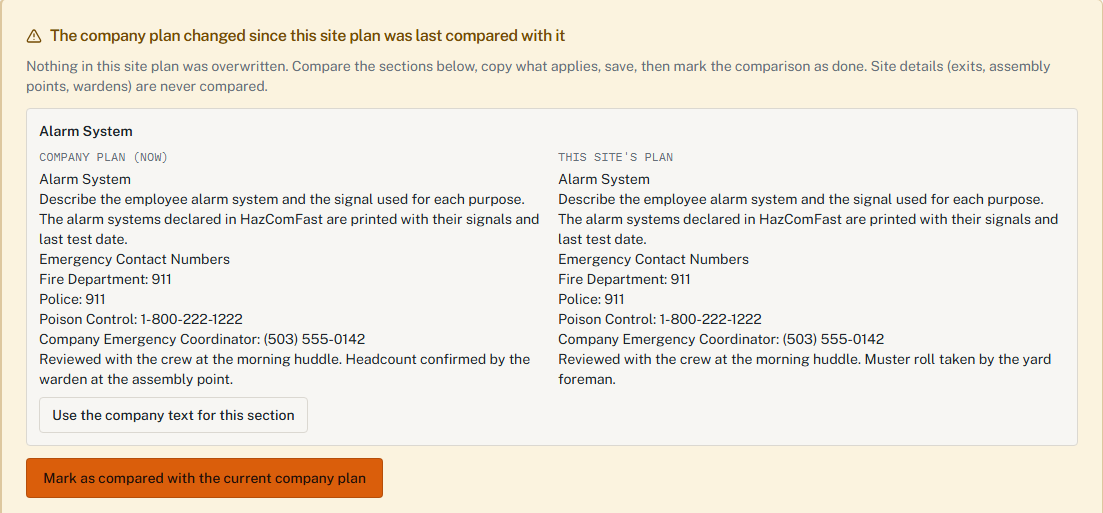
When the company plan changes, each site plan shows it: "The company plan changed since this site plan was last compared with it. Nothing in this site plan was overwritten." The two texts sit side by side, section by section. You take the company text where it applies, keep the site's where it doesn't, then mark the comparison as done. Exits, assembly points and wardens are never compared.
On the jobsite list, each site card lists the plans in effect there, says whether each one is the site's own plan or the company plan, and marks the drafts.
One company plan, one plan per site
Build a site plan free, or keep the company plan and every site plan in HazComFast, with the differences shown when the company plan changes.
Related: Emergency action plans for construction · How often must the plan be reviewed? · Which OSHA standards require an emergency action plan? · Multi-employer worksite citations
Sources & verification (read on the eCFR, edition of 2026-10-01): 29 CFR 1926.35(a) to (e); 29 CFR 1910.38(b); 29 CFR 1926.60(e)(1)(i); 29 CFR 1926.150(e)(1) and (e)(2). General guidance, not legal advice.*
Frequently Asked Questions
Does OSHA require a separate emergency action plan for each jobsite?
OSHA doesn't use the words "one per site", but the content makes it so. 29 CFR 1926.35(b)(1) requires emergency escape procedures and emergency escape route assignments, and 1926.35(e)(3) requires the written plan to be kept at the workplace and made available for employee review. Exits and route assignments only exist site by site. For MDA work, 29 CFR 1926.60(e)(1)(i) requires escape routes identified at each construction site before the operation begins.
What can stay the same across all sites?
The parts that describe how the company works: the types of evacuation under 29 CFR 1926.35(d), the procedures for critical operations and for accounting for employees under 1926.35(b)(2) and (b)(3), rescue and medical duties under (b)(4), and the contacts for more information under (b)(6). Even those need a site check, because the people change.
What must each site fill in?
Its exits and route assignments by area (29 CFR 1926.35(b)(1)), its assembly point, its alarm and the signal for each purpose (1926.35(c)), how to report an emergency from that site (1926.35(b)(5)), and the evacuation wardens designated and trained before the plan is implemented (1926.35(e)(1)).
When the company plan changes, do site plans need a new review with employees?
If the change reaches a site plan, yes. 29 CFR 1926.35(e)(2)(iii) requires the plan to be reviewed with each employee covered by it whenever the plan is changed. Update the site plan, then go through the change with the crews on that site.
Who writes the plan on a multi-employer site?
Each employer has its own duty under 29 CFR 1926.35 when a standard requires a plan. In practice the general contractor's site plan sets the alarm, the exits and the assembly point, and each subcontractor's plan should point to them rather than invent its own. Agree on it in writing at the preconstruction meeting.
Site-wide regulatory figures such as compliance dates and penalty amounts come from our regulatory source-of-truth modules, last checked against the eCFR, OSHA.gov, and the Federal Register on October 5, 2026. Last reviewed October 13, 2026.
About This Article
Published by: HazComFast
Published: October 13, 2026
Last Updated: October 13, 2026
- https://www.ecfr.gov/current/title-29/subtitle-B/chapter-XVII/part-1926/subpart-C/section-1926.35
- https://www.ecfr.gov/current/title-29/subtitle-B/chapter-XVII/part-1910/subpart-E/section-1910.38
- https://www.ecfr.gov/current/title-29/subtitle-B/chapter-XVII/part-1926/subpart-D/section-1926.60
- https://www.ecfr.gov/current/title-29/subtitle-B/chapter-XVII/part-1926/subpart-F/section-1926.150
This content is for informational purposes only and does not constitute legal advice.