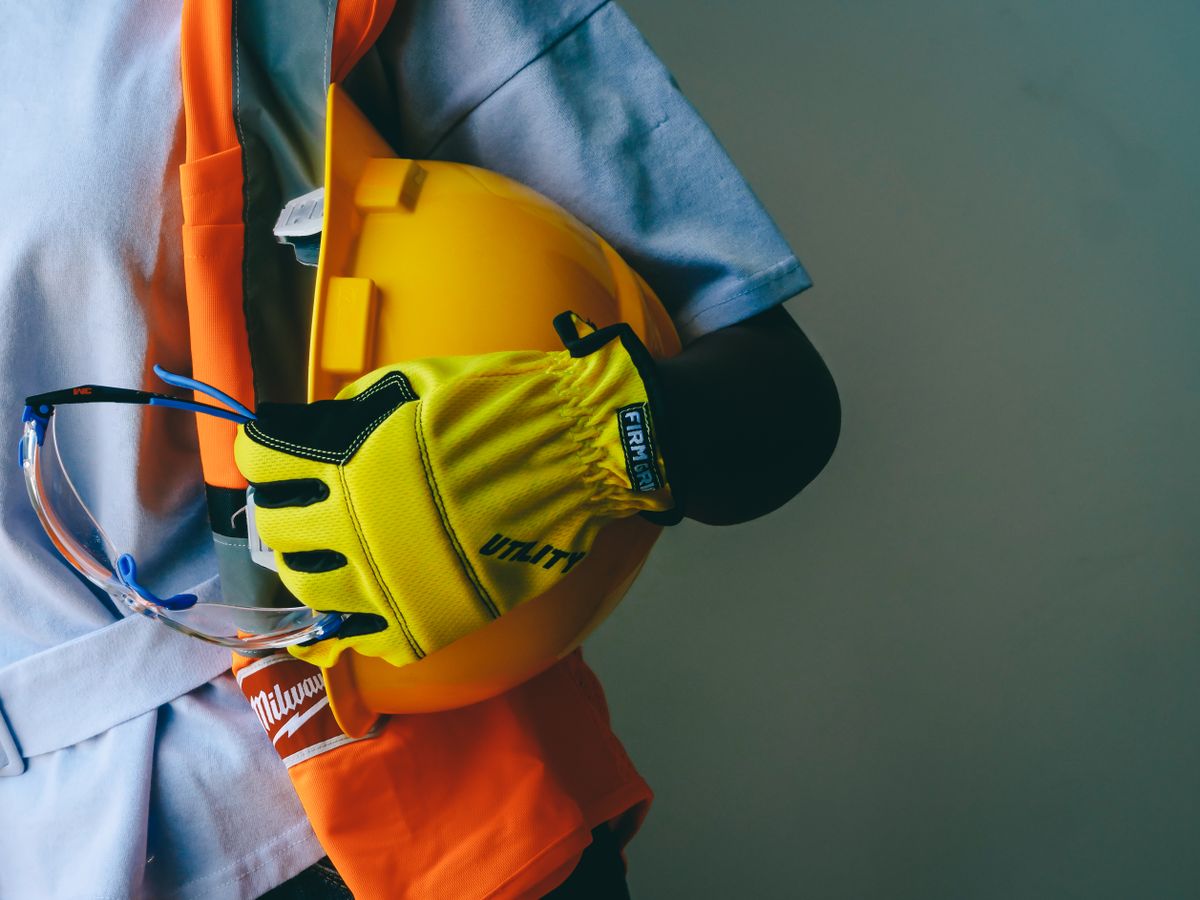
The PPE Obligation
On a construction site, the rules come from a handful of paragraphs:
- Require it. The employer is responsible for requiring appropriate PPE wherever there is exposure to hazardous conditions, or where Part 1926 calls for it (29 CFR 1926.28(a)).
- Provide and maintain it. Protective equipment is provided, used and maintained in a sanitary and reliable condition wherever the hazards call for it (1926.95(a)).
- Fit it. Since January 13, 2025, PPE must be selected to properly fit each affected employee (1926.95(c)(2)).
- Pay for it. At no cost to employees, apart from the listed exceptions (1926.95(d)).
- Train on it. Each employee is instructed in recognizing and avoiding the unsafe conditions of their work (1926.21(b)(2)).
PPE is the last line of defense in the hierarchy of controls, but on a construction site it is often the control a crew relies on most.
At a glance: the employer requires PPE where hazards exist (1926.28(a)), pays for it apart from listed exceptions (1926.95(d)), and since January 13, 2025 selects it to fit each worker (1926.95(c)(2)). On a construction site, OSHA requires the employer to require appropriate personal protective equipment wherever workers are exposed to hazards, under 29 CFR 1926.28(a), to provide it at no cost apart from listed exceptions under 1926.95(d), and since January 13, 2025 to select it so it properly fits each affected employee under 1926.95(c)(2). The full picture, including who pays for what, is on the PPE hub.
Hierarchy of controls: PPE is the last line of defense
NIOSH hierarchy of controls. PPE controls exposure only at the worker, and it fails silently if it doesn't fit, isn't worn, or breaks down.
Head Protection
Standard: 29 CFR 1926.100
Employees must wear protective helmets "working in areas where there is a possible danger of head injury from impact, or from falling or flying objects, or from electrical shock and burns" (1926.100(a)). Helmets must meet ANSI Z89.1-2009, -2003 or -1997 (1926.100(b)).
| ANSI Z89.1 type or class | Protection | Typical use |
|---|---|---|
| Type I | Top-of-head impact | General construction, falling objects |
| Type II | Top and lateral impact | Work where side impact is possible |
| Class E | Electrical, tested to 20,000 V | Work near energized parts |
| Class G | General, tested to 2,200 V | Standard construction |
| Class C | Conductive, no electrical protection | Non-electrical work |
Replace a helmet after any impact or visible damage, and follow the manufacturer's service life for the shell and suspension. Struck-by is one of OSHA's construction Focus Four hazards; the hard hat is the last layer behind toeboards, barricaded fall zones and spotters. See the struck-by safety hub for those controls.
Eye and Face Protection
Standard: 29 CFR 1926.102
The employer must ensure appropriate eye or face protection against flying particles, molten metal, liquid chemicals, acids or caustic liquids, chemical gases or vapors, and injurious light radiation (1926.102(a)(1)), with side protection where objects fly ((a)(2)). Devices meet ANSI/ISEA Z87.1-2010, ANSI Z87.1-2003 or Z87.1-1989 (R-1998), or are shown to be at least as effective (1926.102(b)).
| Hazard | Protection |
|---|---|
| Flying particles (grinding, chipping) | Safety glasses with side shields |
| Chemical splash | Chemical splash goggles |
| Welding arc | Welding helmet with the right shade lens |
| Dust and fine particles | Sealed dust goggles |
| Molten metal | Face shield over safety glasses |
| Laser | Eyewear rated for the laser's wavelength |
Prescription wearers: street glasses are not eye protection. A worker who wears prescription lenses needs eye protection that incorporates the prescription, or that fits over the glasses without moving them (1926.102(a)(3)).
Hand Protection
Standard: 29 CFR 1926.95
Part 1926 has no general glove section. Gloves fall under the requirement to protect the extremities wherever the hazard calls for it (1926.95(a)); general industry's hand protection rule is 1910.138. Rubber insulating gloves for electrical work are the exception: 1926.97 sets their design and an electrical test before first issue and every 6 months (Table E-5). No single glove protects against every hazard, so select by task:
| Hazard | Glove type | Where to check |
|---|---|---|
| Chemicals (solvents, acids) | Nitrile, neoprene or butyl rubber, by chemical | SDS section 8 |
| Cut hazards (sheet metal, glass) | Cut-resistant, rated to the task | Manufacturer's rating |
| Abrasion (concrete, rebar) | Leather or synthetic leather | |
| Electrical | Insulating rubber gloves of the right voltage class | Electrical work rules |
| Welding | Leather welding gloves | |
| Vibration | Anti-vibration gloves |
Check SDS section 8 for the glove material a chemical calls for: the wrong material can let a solvent through. The PPE Selector matches chemicals to glove types.
Foot Protection
Standard: 29 CFR 1926.96
1926.96 still names one standard: safety-toe footwear must meet ANSI Z41.1-1967. General industry's rule, 1910.136(b), names ASTM F2412-2005 and F2413-2005 or ANSI Z41-1999 and Z41-1991, the specifications most boots are labeled with today.
| Feature | ASTM F2413 marking | Where it helps |
|---|---|---|
| Safety toe (steel or composite) | I/C | Crush and impact |
| Puncture-resistant sole | PR | Nails and debris |
| Electrical hazard | EH | Near energized equipment |
| Metatarsal guard | Mt | Heavy material handling |
The employer doesn't pay for non-specialty safety-toe boots it lets workers wear off the site; metatarsal protection is a different case (1926.95(d)(2), (d)(3)).
Hearing Protection
Standards: 29 CFR 1926.52 and 1926.101
| Exposure | What the rule requires |
|---|---|
| Above Table D-2 (90 dBA over 8 hours, 95 dBA over 4, 100 dBA over 2) | Feasible administrative or engineering controls first; if they don't bring levels within the table, PPE (1926.52(b)) |
| Where noise can't feasibly be reduced | Ear protection provided and used; inserts fitted or determined individually by competent persons; plain cotton not acceptable (1926.101) |
| Any exposure above the table | A continuing, effective hearing conservation program (1926.52(d)(1)) |
Construction note: Part 1926 requires the hearing conservation program but doesn't spell out its contents. The 85 dBA action level, audiometric testing and the other program details are written in the general-industry standard, 1910.95(c) onward, and are the usual model for a construction program.
The free noise exposure calculator computes a daily dose against Table D-2.
Respiratory Protection
Standard: 29 CFR 1926.103, which adopts 1910.134
Required respirator use triggers the full program: a written program, medical evaluation, fit testing and training.
| Hazard | Respirator | Assigned protection factor (1910.134(d)(3)(i)(A)) |
|---|---|---|
| Nuisance dust | Filtering facepiece (N95) | 10 |
| Silica dust | Half-mask with P100 filters, or PAPR | 10 (half-mask) to 25 or more (PAPR) |
| Solvent vapors | Half-mask with organic vapor cartridges | 10 |
| IDLH atmospheres | Pressure-demand SCBA or supplied air with escape SCBA | Required for IDLH (1910.134(d)(2)) |
Voluntary use: where respirators aren't required, an employer that allows voluntary use of filtering facepieces must give the worker the information in Appendix D; those workers don't have to be in the written program (1910.134(c)(2)). The respiratory protection hub covers the program in full, and the silica exposure calculator covers Table 1.
Fall Protection
Standard: 29 CFR 1926.502
Fall protection is its own subpart, and 1926.501 is OSHA's most-cited standard.
| System | Use | Key requirement |
|---|---|---|
| Guardrails | Edges, platforms | Top rail 42 inches plus or minus 3 (1926.502(b)(1)); toeboards at least 3½ inches high where objects can fall ((j)(3)) |
| Safety nets | Bridge and structural work | As close as practicable under the work, never more than 30 feet below (1926.502(c)(1)) |
| Personal fall arrest | Mobile or temporary work at height | Anchorage for 5,000 pounds per worker, or designed with a safety factor of two by a qualified person (1926.502(d)(15)) |
| Positioning devices | Rebar tying, form work | Rigged so free fall can't exceed 2 feet (1926.502(e)(1)) |
| Warning lines | Low-slope roofs | At least 6 feet from the roof edge (1926.502(f)(1)(i)) |
Personal fall arrest systems are inspected before each use, and defective components come out of service (1926.502(d)(21)). Check webbing for cuts, burns and chemical damage, D-rings for distortion and cracks, buckles, stitching and labels.
Read more: fall protection in construction.
The Hazard Assessment
A written, certified PPE hazard assessment is a general-industry requirement: 1910.132(d)(2) asks for a certification naming the workplace evaluated, the person certifying, the date and the document as a certification. Part 1926 has no equivalent paragraph. On a jobsite, the duty to require PPE where hazards exist (1926.28(a)) still starts with looking, and a written assessment is how you show you looked:
- Walk the site and list hazards by category (impact, penetration, compression, chemical, heat, radiation, electrical, noise).
- Match each hazard to its Subpart E rule and to the SDS.
- Write it down: date, work area, who assessed.
- Select PPE that properly fits each worker (1926.95(c)(2)).
- Train on use, care and limitations.
- Reassess when the work or the site changes.
PPE and Chemical Hazards
For chemical-specific PPE:
- Check SDS section 8, exposure controls and personal protection.
- Identify the route: skin contact, inhalation, eye splash.
- Select by material compatibility: not every glove resists every chemical.
- Consider concentration and duration: breakthrough times vary.
The PPE Selector turns SDS data into a recommendation, and the SDS Gap Analyzer finds the products with no sheet.
The standards, tools & related reading
- The hub: PPE in construction: rules, fit and who pays
- The PPE standards: General PPE criteria: 1926.95 · Head protection: 1926.100 · Eye and face: 1926.102
- Match PPE to the job: PPE Selector · Silica Exposure Calculator · Job Hazard Analysis Builder · Toolbox Talk Generator
- Related guides: The 2024 PPE fit rule · Fall protection in construction · Respiratory protection program · New-hire safety orientation
- 2026 OSHA penalty schedule · penalties by state
Sources & verification (read September 28, 2026): 29 CFR 1926.21(b)(2), 1926.28, 1926.52, 1926.95, 1926.96, 1926.100, 1926.101, 1926.102, 1926.103, 1926.201(a), 1926.502, 1910.132, 1910.134(c)(2) and (d), 1910.136(b) on the eCFR. ANSI Z89.1 classes and ASTM F2413 markings as published in those standards. Not legal advice; state-plan states may add requirements.
Frequently Asked Questions
Is the employer required to pay for PPE?
Yes. Under 29 CFR 1926.95(d)(1), PPE used to comply with Part 1926 is provided at no cost to employees, replacements included unless the employee lost it or damaged it on purpose ((d)(5)). The employer doesn't have to pay for non-specialty safety-toe boots or prescription safety eyewear it lets workers wear off the site ((d)(2)), for everyday clothing, or for ordinary weather gear such as winter coats, rain gear and sunscreen ((d)(4)). General industry's rule is 1910.132(h).
What PPE is required on a construction site?
OSHA sets no fixed kit. The employer must require appropriate PPE wherever workers are exposed to hazardous conditions (29 CFR 1926.28(a)), and Subpart E says when each piece applies: a hard hat where there is a possible danger of head injury (1926.100(a)), eye and face protection against flying particles, chemicals or radiation (1926.102(a)), ear protection where noise can't be reduced below Table D-2 (1926.101), safety-toe footwear meeting 1926.96, and respirators under 1926.103. Section 8 of each SDS names the PPE for that chemical.
How often should PPE be inspected?
PPE must be maintained in a sanitary and reliable condition (29 CFR 1926.95(a)), and personal fall arrest systems must be inspected before each use, with defective components removed from service (1926.502(d)(21)). Check hard hats, lenses and gloves at the start of each shift, and follow the manufacturer's replacement intervals.
When must a construction hard hat be replaced?
Replace it after any impact, or if the shell shows cracks, dents, gouges or chalking, and replace the suspension when straps fray or attachment points wear. Absent damage, follow the manufacturer's service life for the shell and the suspension. OSHA requires helmets that meet ANSI Z89.1 (29 CFR 1926.100(b)) and PPE kept in a reliable condition (1926.95(a)).
Does OSHA require high-visibility clothing in construction?
For flaggers, yes: signaling by flaggers, including their warning garments, must conform to Part 6 of the MUTCD (29 CFR 1926.201(a)). Part 1926 has no general high-visibility apparel rule for other workers; where they are exposed to traffic or moving equipment, the employer's duty to require appropriate PPE under 1926.28(a) is where the answer starts.
OSHA figures and citations here come from our regulatory source-of-truth modules, last checked against the eCFR, OSHA.gov, and the Federal Register on October 5, 2026. Last reviewed September 28, 2026.
About This Article
Published by: HazComFast
Published: March 10, 2026
Last Updated: September 28, 2026
- https://www.ecfr.gov/current/title-29/section-1926.95
- https://www.ecfr.gov/current/title-29/section-1926.28
- https://www.ecfr.gov/current/title-29/section-1926.100
- https://www.ecfr.gov/current/title-29/section-1926.102
- https://www.ecfr.gov/current/title-29/section-1926.52
- https://www.ecfr.gov/current/title-29/section-1926.502
This content is for informational purposes only and does not constitute legal advice.