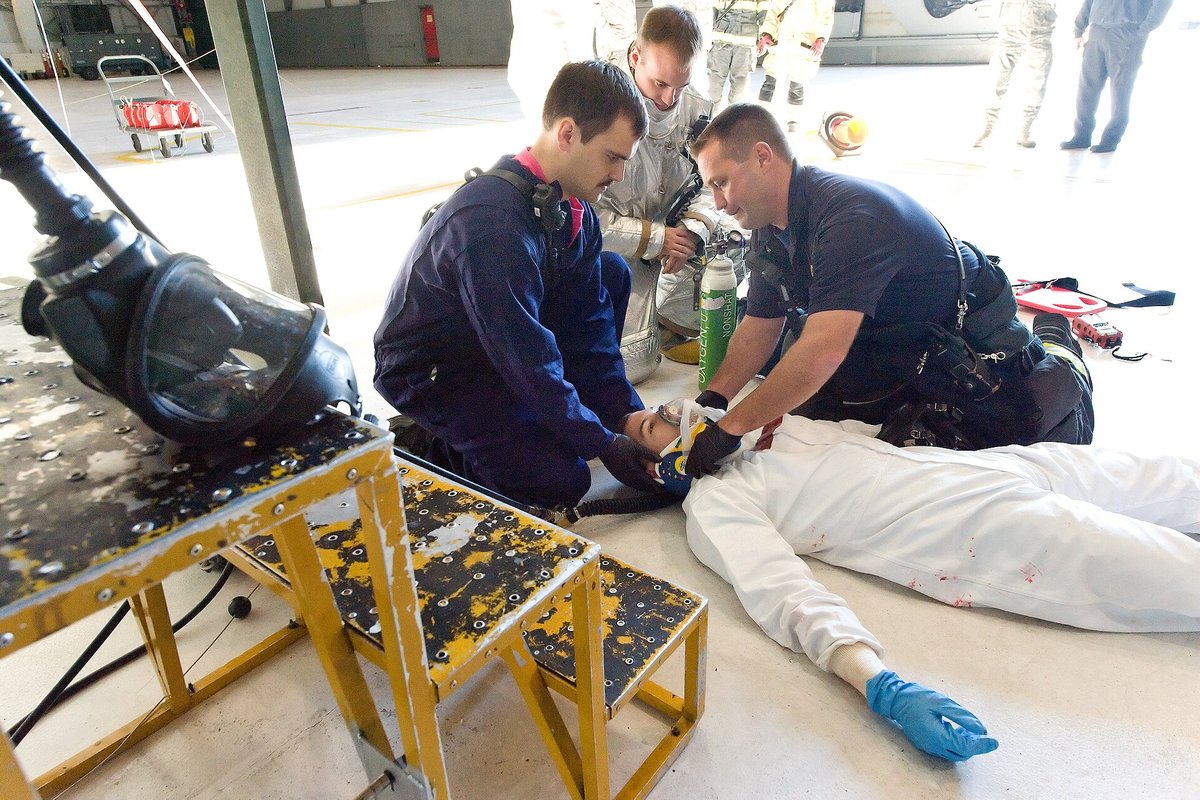
A contractor plans to inspect a valve in a permit-required space (1910.146(b)). The permit names the local fire department as the rescue service, but the contractor has not established whether the available team can pass through the entrance with the necessary breathing apparatus, reach an incapacitated entrant and complete the extraction. Before entry, the employer needs evidence of that capability and of coverage during the work.
Under 29 CFR 1910.146(k)(1) for general industry and 29 CFR 1926.1211(a) for construction, the selecting employer must evaluate the provider's timely response and proficiency with the rescue tasks and equipment required for its particular spaces. A public emergency service can be suitable, but an emergency telephone number alone does not complete the evaluation.
This guide separates those enforceable duties from the nonmandatory evaluation methods in Appendix F. It includes a restricted-access wastewater example and an editable toolkit for recording the selection decision.
Rescue arrangements need to exist before entry
Under 1910.146(d)(9), general-industry employers need to develop and implement procedures for:
- Summoning rescue and emergency services.
- Rescuing entrants from permit spaces.
- Providing necessary emergency services to rescued employees.
- Preventing unauthorized personnel from attempting rescue.
Construction 1926.1204(i) contains comparable requirements and expressly includes procedures for summoning emergency assistance if non-entry rescue fails. Entry supervisors have additional duties.
General industry, 1910.146(j)(4): Verify that rescue services are available and the means of summoning them are operable.
Construction, 1926.1210(d): Verify rescue availability, operable summons, and that the employer will be notified if the service becomes unavailable.
A service that cannot perform the needed rescue or cannot respond when needed is not made suitable by appearing on an entry permit.
Does OSHA call for a standalone rescue plan?
Neither federal standard universally calls for a separate document bearing the exact title "Confined Space Rescue Plan." The enforceable requirements concern procedures, rescue-service selection, appropriate personnel and equipment, and permit information. Written evaluations and entry-specific coordination records are useful tools for organizing evidence of compliance. They do not replace actual rescue capability.
Determine the applicable standard
General-industry permit-space work is governed by 1910.146. Construction confined-space work is generally covered by 1926 Subpart AA, subject to its scope provisions. Alternative procedures and reclassification provisions exist under 1910.146(c)(5) and (c)(7), and 1926.1203(e) and (g). Each procedure has specific conditions. Acceptable atmospheric readings alone do not automatically eliminate every physical hazard or qualify an entry for an exception. For a broader comparison, see HazComFast's Confined Spaces in Construction: Subpart AA vs. General Industry.
General industry vs. construction: Rescue-service selection
| Employer duty | General industry | Construction |
|---|---|---|
| Evaluate timely response considering identified hazards | 1910.146(k)(1)(i) | 1926.1211(a)(1) |
| Evaluate proficiency with rescue tasks and equipment | 1910.146(k)(1)(ii) | 1926.1211(a)(2) |
| Select a service capable of reaching victims within a hazard-appropriate timeframe | 1910.146(k)(1)(iii)(A) | 1926.1211(a)(3)(i) |
| Select a service equipped and proficient for needed rescue | 1910.146(k)(1)(iii)(B) | 1926.1211(a)(3)(ii) |
| Obtain agreement to report unavailability immediately | Not expressly stated in the corresponding selection provision | 1926.1211(a)(3)(iii) |
| Inform the service about relevant hazards | 1910.146(k)(1)(iv) | 1926.1211(a)(4) |
| Provide access for planning and practice | 1910.146(k)(1)(v) | 1926.1211(a)(5) |
| Apply retrieval-system provisions | 1910.146(k)(3) | 1926.1211(c) |
| Confirm emergency assistance if selected non-entry rescue fails | Addressed through general rescue requirements | Expressly required by 1926.1211(c) |
OSHA does not prescribe a universal numerical rescue-provider qualification score. Employers need to identify the rescue capabilities needed for their spaces and establish that the proposed provider possesses them.
Why calling 911 is not automatically an adequate rescue arrangement
A public fire department or emergency-response organization may be a suitable rescue provider. It is not automatically suitable. OSHA's nonmandatory Appendix F to 1910.146 explains that merely posting an emergency number or planning to call 911 when an emergency occurs does not satisfy the general-industry rescue-service evaluation requirement. OSHA's construction fact sheet, Is 911 Your Confined Space Rescue Plan?, likewise emphasizes advance evaluation and coordination. Before selecting an outside provider, determine whether it:
- Agrees to perform the needed rescue functions.
- Has personnel proficient in those functions.
- Has appropriate protective and rescue equipment.
- Can reach the actual permit-space entrance.
- Can access an incapacitated entrant.
- Can complete the necessary extraction.
- Can respond within a hazard-appropriate timeframe.
- Will be available during the entry.
- Understands the hazards and physical configuration.
- Has effective emergency activation arrangements.
An organization may provide emergency medical response without the technical rescue capability needed for a restricted vessel or underground structure. OSHA's December 20, 1994 interpretation also clarifies that 1910.146 does not itself compel a municipal fire department to accept a private employer's rescue assignment.
Identify the rescue demands before evaluating the provider
A meaningful evaluation begins with the actual space.
| Factor | What to assess |
|---|---|
| Entrance | Actual dimensions, shape, and orientation |
| Depth and elevation | Vertical distance and access conditions |
| Internal configuration | Bends, piping, platforms, machinery, and restrictions |
| Entrant position | Distance and route from the entrance |
| Atmospheric hazards | Existing and reasonably foreseeable atmospheric hazards |
| Physical hazards | Mechanical, electrical, pressure, engulfment, flooding, and other hazards |
| Isolation | Equipment and processes requiring control |
| Retrieval path | Whether an incapacitated entrant can be removed without rescuer entry |
| External access | Gates, roads, platforms, staging areas, and medical transfer routes |
Appendix F: Representative rescue spaces
OSHA's nonmandatory Appendix F provides categories for selecting representative rescue situations.
| Characteristic | Appendix F classification |
|---|---|
| Internal configuration | Open / obstructed |
| Portal elevation | 4 feet or more above grade, or less than 4 feet above grade |
| Portal size | Restricted: 24 inches or less in the smallest dimension / unrestricted: greater than 24 inches |
| Access orientation | Horizontal / vertical |
These are evaluation categories, not separate equipment mandates. They are different from the enforceable mechanical retrieval requirement for vertical-type permit spaces more than 5 feet deep. A restricted entrance can be particularly problematic when rescuers need SCBA or other atmosphere-supplying respiratory protection. Appendix F specifically identifies difficulty passing through restricted openings while wearing bulky rescue equipment.
The evaluation needs to address the complete rescuer-and-equipment configuration, not just the rescuer's ability to enter without equipment.
Rescue-capability matrix
| Rescue demand | Capability to establish | Potential evidence |
|---|---|---|
| Deep vertical access | Controlled lifting and extraction | Equipment review and demonstration |
| Restricted portal | Rescuer access and patient extraction using necessary equipment | Representative portal exercise |
| Obstructed interior | Navigation and extraction around restrictions | Representative exercise |
| Horizontal passage | Movement of an incapacitated entrant through the complete route | Extraction demonstration |
| Entrance 4 feet or more above grade | Appropriate rescue capability at that height | Performance evidence |
| Hazardous atmosphere | Appropriate assessment and protection | Procedures, equipment, and training |
| Potential IDLH atmosphere | Standby, respiratory, and emergency-rescue capability | Respiratory-program and staffing evaluation |
| Difficult site access | Reliable responder access and equipment deployment | Site familiarization |
A rescue provider needs the capabilities relevant to the actual spaces, not every specialized rescue qualification.
Non-entry rescue and retrieval limitations
Non-entry rescue removes an entrant without requiring another worker to enter the permit space. Under 1910.146(k)(3) and 1926.1211(c), retrieval systems or methods generally must be used unless the specified exception applies. Relevant provisions generally require:
- A chest or full-body harness.
- An allowable retrieval-line attachment.
- An external mechanical device or fixed point permitting prompt retrieval.
- A mechanical retrieval device available for vertical-type permit spaces more than 5 feet deep.
Limited alternatives to a harness are permitted under the standards' stated conditions. General industry permits wristlets under its exception. Construction permits wristlets or anklets. Construction also prohibits unsuitable retrieval equipment, including lines likely to become entangled or ineffective because of the internal configuration.
A tripod is not proof of successful retrieval
A worker may be located behind fixed equipment or beyond a bend. The retrieval line could snag or fail to move the entrant through the extraction route. The employer needs to evaluate whether the complete removal can work and whether retrieval would introduce additional hazards.
When entry rescue needs to be arranged
Under construction 1926.1211(c):
- An entry rescue service needs to be designated when non-entry rescue is not selected.
- When non-entry rescue is selected, the entry employer needs to confirm before entry that emergency assistance will be available if non-entry rescue fails.
These requirements do not automatically mandate two separate rescue contractors. They call for adequate capability for the foreseeable rescue situation. An attendant or coworker may not improvise unauthorized or improperly equipped entry rescue.
Evaluate rescue response capability against the hazards
OSHA does not establish one universal rescue response-time limit. The appropriate response depends on the identified hazards. Appendix F discusses notification, travel, and deployment readiness. The employer also needs to consider whether the service can actually reach and recover the victim.
| Stage | What to evaluate |
|---|---|
| Emergency recognition | Can the attendant identify the need for rescue? |
| Notification | Can the designated service be contacted promptly? |
| Dispatch | Can the needed technical rescue capability be activated? |
| Travel | Can responders reach the site reliably? |
| Site access | Can personnel and equipment reach the entrance? |
| Deployment | Can the necessary equipment be prepared? |
| Victim access | Can rescuers reach an incapacitated entrant? |
| Extraction | Can the entrant be removed through the complete route? |
| Medical handoff | Can necessary emergency care be coordinated? |
Observed exercise times can support the evaluation. They do not become universal OSHA deadlines.
Justify the response arrangement
The employer should document:
- The foreseeable emergency.
- The hazards and potential consequences.
- How quickly conditions could worsen.
- The rescue capability needed.
- Evidence supporting the service's response.
- Why that capability is appropriate.
- Unresolved limitations.
Form E provides an adaptable justification.
If essential evidence is unavailable, the capability remains unverified.
Rapidly developing IDLH conditions
Appendix F explains that rescue personnel would need to stand by at a permit space where an IDLH atmosphere exists or may rapidly develop. The enforceable respiratory-protection requirements also need to be addressed. An ordinary delayed off-site response cannot automatically be considered adequate for such conditions.
IDLH rescue: Respirator selection, outside personnel, and rescue equipment
Immediately dangerous to life or health (IDLH) atmospheres create additional duties. Three separate questions need to be evaluated:
- What respirators may employees use when entering the atmosphere?
- What outside personnel, equipment, and procedures are needed?
- Can the proposed team perform the rescue using the needed protection?
Respiratory exposure that cannot be reasonably estimated
Under 1910.134(d)(1)(iii), the employer must identify and evaluate workplace respiratory hazards, including a reasonable estimate of employee exposure and identification of the contaminant's chemical state and physical form. Where the employer cannot identify or reasonably estimate exposure, the atmosphere must be considered IDLH for the applicable respiratory-protection requirements. This does not independently authorize entry into an uncharacterized permit space. All applicable entry requirements remain in effect.
Respirators authorized for IDLH entry
Under 1910.134(d)(2)(i), the employer must provide one of the specified configurations:
| Authorized configuration | Requirement |
|---|---|
| Full-facepiece, pressure-demand SCBA | NIOSH-certified for a minimum service life of 30 minutes |
| Full-facepiece, pressure-demand supplied-air respirator | Combined with an auxiliary self-contained air supply |
The requirements apply to construction through 1926.103. Air-purifying respirators cannot replace these configurations for IDLH entry. The certified SCBA service-life rating is not a guarantee of equivalent usable rescue time. Actual air consumption depends on workload, equipment, the rescuer, and environmental conditions.
Outside personnel: the six requirements of 1910.134(g)(3)
| Paragraph | Binding requirement |
|---|---|
| (g)(3)(i) | One employee, or more when necessary, positioned outside the IDLH atmosphere |
| (g)(3)(ii) | Visual, voice, or signal-line communication maintained between inside and outside personnel |
| (g)(3)(iii) | Outside personnel trained and equipped to provide effective emergency rescue |
| (g)(3)(iv) | Employer or designee notified before outside personnel enter to perform rescue |
| (g)(3)(v) | Necessary assistance provided by the employer or authorized designee once notified |
| (g)(3)(vi) | Specific respiratory-protection and retrieval-or-equivalent-rescue equipment provided to outside personnel |
The precise equipment requirements for outside rescuers
Under 1910.134(g)(3)(vi), employees located outside IDLH atmospheres must be equipped with:
Respiratory protection, (g)(3)(vi)(A)
Either:
- A pressure-demand or other positive-pressure SCBA; or
- A pressure-demand or other positive-pressure supplied-air respirator with auxiliary SCBA.
And rescue capability, (g)(3)(vi)(B) or (C)
Either:
- Appropriate retrieval equipment for removing employees entering the hazardous atmosphere, where it would contribute to rescue without increasing the overall risk resulting from entry; or
- Equivalent means for rescue where retrieval equipment is not needed under paragraph (B).
The respiratory protection and the applicable retrieval-or-equivalent-rescue means are complementary requirements.
It would be incorrect to read the rule as permitting an employer to choose simply between supplying breathing apparatus and supplying rescue equipment. The outside personnel's needed equipment and readiness need to be appropriate to their assigned emergency-rescue duties.
Distinguish entry respirator selection from outside rescue equipment
1910.134(d)(2)(i) specifies the respirator configurations the employer must provide for employee use in IDLH entry.
1910.134(g)(3)(vi) specifies equipment for personnel stationed outside the atmosphere who may have to provide emergency rescue.
The provisions overlap but have distinct wording and purposes. Both must be evaluated where applicable. For construction, 1926.103 makes the relevant 1910.134 respiratory-protection requirements applicable. The note to 1926.1211(a)(1) also expressly explains that rescue personnel capable of immediate action may be required for employees wearing respiratory protection in IDLH atmospheres.
Staffing and role conflicts
OSHA's July 17, 2014 general-industry interpretation examines specific IDLH permit-space scenarios. It explains why rescue staffing in the circumstances examined cannot automatically be limited to an entrant, attendant, and supervisor. The personnel needed depend on the hazards, number of entrants, space configuration, and rescue demands. This is not a universal four-person rule for all confined-space entries. The employer needs to identify who will remain outside, who maintains communication, who can conduct rescue, and how other duties will continue to be met.
Verify the respiratory-protection program
The employer whose employees use respirators need to meet applicable requirements of 1910.134, including:
| Requirement | OSHA basis |
|---|---|
| Written respiratory-protection program | 1910.134(c) |
| Respiratory hazard assessment and respirator selection | 1910.134(d) |
| Medical evaluation | 1910.134(e) |
| Applicable fit testing | 1910.134(f) |
| Proper use, including IDLH procedures | 1910.134(g) |
| Cleaning, storage, maintenance, and inspections | 1910.134(h) |
| Breathing-air quality | 1910.134(i) |
| Training and program evaluation | 1910.134(k), (l) |
A selecting employer should evaluate relevant evidence of an outside provider's respiratory-program readiness when the expected rescue calls for respirators. It does not automatically become responsible for administering that independent provider's entire program.
Emergency respirator inspections
Respirators maintained for emergency use must be inspected at least monthly and checked for proper function before and after use, under the applicable provisions of 1910.134(h)(3). SCBA has additional inspection and cylinder-charge requirements. Personnel, equipment, respirator fit, air management, emergency withdrawal, and rescuer recovery must form one workable rescue arrangement.
Restricted openings and equipment compatibility
A rescuer may not be able to pass through a restricted portal while wearing necessary respiratory equipment. The evaluation should establish whether rescuers can:
- Pass through the opening without unauthorized equipment modifications.
- Maintain appropriate respiratory protection.
- Get through the interior restrictions.
- Reach and package the victim.
- Complete extraction.
- Manage breathing-air supplies.
- Withdraw safely.
- Recover a rescuer who becomes unable to exit.
A representative exercise can be performed under controlled safe conditions, provided the physical restrictions and equipment configuration realistically reflect the planned rescue.
Rescue-service training: General competence vs. site-specific instruction
The employer selecting the rescue provider and the employer whose employees perform rescues may be different organizations. The distinction matters because each has separate duties.
Training of designated rescuers
| Requirement | General industry | Construction |
|---|---|---|
| PPE and proficiency | 1910.146(k)(2)(i) | 1926.1211(b)(1) |
| Assigned rescue-duty training | 1910.146(k)(2)(ii) | 1926.1211(b)(2) |
| Authorized-entrant proficiency | 1910.146(k)(2)(ii) | 1926.1211(b)(2) |
| Basic first aid and CPR | 1910.146(k)(2)(iii) | 1926.1211(b)(3) |
| Rescue practice | 1910.146(k)(2)(iv) | 1926.1211(b)(4) |
Each affected rescuer needs to receive the needed first-aid and CPR training. The standards also call for current certification coverage among available rescue personnel. Construction expressly calls for one or more available members holding current certification in both basic first aid and CPR. OSHA's December 20, 1994 general-industry interpretation recognizes a particular arrangement involving two rescuers present at the rescue scene, one certified in first aid and the other in CPR. That interpretation should not automatically be applied to construction.
Outside-service training responsibilities in general industry
OSHA's December 20, 1994 interpretation, written under the original 1993 text, explains that where a host employer arranges outside rescue services:
The rescue-service employer is responsible for the rescue-related training of its own employees.
The host employer possesses exclusive knowledge of its particular permit spaces, hazards, work practices, and equipment.
The interpretation also put the site-specific authorized-entrant training of the responders on the host employer. Paragraph (k) was revised in 1998: today 1910.146(k)(2)(ii) places that training on the rescuers' own employer, and 1910.146(k)(1)(iv) and (k)(1)(v) have the host inform the service of the hazards and give it access to the spaces. This is more than providing a telephone number or handing the provider a generic equipment list. The site-specific information needs to address the relevant hazards and equipment that rescuers may encounter or use. Examples include:
- Unique atmospheric or physical hazards.
- Facility-specific process and isolation arrangements.
- Internal equipment that could endanger rescuers.
- Equipment rescuers may need to operate.
- Site-specific access restrictions.
- Work activities that could change conditions.
- Rescue-relevant instructions and limitations.
The information and training should be appropriate to the specific rescuer duties and covered spaces.
General-industry division of responsibilities
| Activity | Duty holder |
|---|---|
| General technical rescue training of outside employees | Rescue-service employer |
| Applicable rescue PPE and proficiency | Rescue-service employer |
| Applicable first-aid/CPR training and practice | Rescue-service employer |
| Evaluation and selection of the outside service | Employer designating the service |
| Host-specific hazard and equipment information | Host employer |
| Authorized-entrant training of the rescuers, 1910.146(k)(2)(ii) since 1998 | Rescue-service employer |
| Access to spaces for rescue planning and practice | Employer selecting the service |
| Other applicable host/contractor coordination | Relevant parties under 1910.146 |
This interpretation concerns general industry under 1910.146.
Construction has its own coordination framework
For construction, the applicable rules need to be evaluated directly.
1926.1203(h) governs specified information exchanges among host employers, controlling contractors, and entry employers.
1926.1211(a)(4) requires the employer selecting rescue services to inform them of hazards they may confront.
1926.1211(a)(5) requires access to relevant permit spaces for planning and practice.
1926.1211(b) establishes the applicable duties of an employer whose employees are designated to provide rescue services.
The 1994 general-industry interpretation is not the text of the construction rule.
What does the selecting employer need to verify?
An employer relying on outside rescuers needs to have a sufficient basis for evaluating their proficiency. It does not universally have to personally organize every training course or annual drill conducted by the outside service. Relevant evidence may include:
- Rescue training and qualifications.
- Applicable current first-aid/CPR certification coverage.
- Representative rescue exercises.
- Equipment readiness.
- Respiratory-program evidence when needed.
- Site-specific instruction and familiarization.
- Demonstrated ability to perform the necessary rescue.
General rescue credentials are not automatically proof of capability for a particular space. See HazComFast's Confined Space Training by Role.
Rescue practice and performance evaluation
Appendix F recommends two stages.
Initial evaluation: Determine whether the provider appears capable, equipped, trained, and sufficiently available.
Performance evaluation: Examine its performance during an actual or practice rescue.
Practice frequency
Designated employee rescuers generally need to practice no less than once every 12 months. Construction expressly calls for practice before an actual rescue and contains an exception for qualifying actual rescues in the same or similar space. OSHA's 1994 general-industry interpretation discusses when qualifying actual rescue performance can satisfy the practice expectation, including critique and corrective action. Representative spaces need to reflect relevant openings, configurations, and accessibility. A demonstration in an unobstructed training space may not establish proficiency in a vessel with a restricted entrance and internal piping.
Critical performance elements
For a complex entry rescue, evaluate:
- Activation and readiness.
- Hazard recognition.
- Appropriate PPE and respiratory protection.
- Passage through the portal.
- Internal access.
- Patient access and packaging.
- Extraction through the complete route.
- Breathing-air management.
- Rescuer withdrawal.
- Recovery of a rescuer in difficulty.
- Medical coordination.
An unresolved failure of an essential capability should prevent acceptance of the service for that scenario.
Provide needed chemical information to the treating facility
Under 1910.146(k)(4) and construction 1926.1211(d), if an injured entrant was exposed to a substance for which an SDS or similar written information needs to be kept at the worksite, that information needs to be made available to the medical facility treating the entrant. Identify who will retrieve the relevant chemical information and how it will reach the treating facility as part of the emergency handoff.
Download the rescue evaluation toolkit
Rescue-service evaluation toolkit (Word) contains five adaptable forms and a sample emergency arrangement:
- Form A records the service-selection criteria, responsibilities, evidence and decision.
- Form B records a representative rescue exercise, observed capability, timeline, deficiencies and retest.
- Form C confirms coverage and communication for an actual entry, including loss-of-availability arrangements.
- Form D indexes the supporting evidence and its status.
- Form E explains why the response arrangement is suitable for the identified hazards.
Use the forms together where applicable. An unverified essential capability remains a reason to withhold acceptance, regardless of how many other checklist items pass.
Worked example: Restricted wastewater chamber, H₂S, and potential engulfment
This scenario is fictional. It does not describe an actual employer, measured atmosphere, rescue provider, equipment demonstration, or OSHA inspection.
The proposed entry
A construction contractor plans to inspect a valve inside a below-grade wastewater chamber. The chamber is assumed to have:
- A circular vertical opening measuring 22 inches.
- An approximately 12-foot descent.
- A restricted horizontal passage.
- Fixed piping obstructing the extraction route.
- Connections to a continuous wastewater network.
- Potential hydrogen sulfide exposure.
- Potential upstream inflow and engulfment hazards.
- Mechanical equipment requiring isolation.
- Limited natural ventilation.
The contractor initially proposes a tripod-and-winch retrieval system and a local public emergency-response provider.
Step 1: Identify the hazards
Hydrogen sulfide can arise in wastewater systems from the decomposition of organic matter. It can accumulate in low-lying areas and cause rapid incapacitation. Odor is not a reliable warning method. For the fictional scenario, the employer considers possible deterioration caused by:
- Upstream flow changes.
- Disturbance of sludge.
- Release of trapped gas.
- Ventilation interruption.
- Process conditions introducing contaminated water or gas.
No actual atmospheric concentration or flow rate is assumed.
The employer needs to obtain site-specific information before deciding whether entry conditions can be made acceptable.
Step 2: Assess isolation of the continuous system
The employer evaluates whether the relevant section of the wastewater network can be effectively isolated from inflow and other hazards.
1926.1204(c)(3) generally calls for isolation of the permit space and physical hazards within it.
OSHA's construction-rule preamble explains that isolation needs to actually protect employees from exposure to the hazards. The purpose is not merely to install a physical device or claim that a section has been separated.
Pipe plugs and bypass systems: control is not automatically isolation
Suppose the contractor proposes an inflatable pipe plug together with a bypass pumping system. It might assume that blocking the normal flow will eliminate the engulfment hazard. That assumption calls for scrutiny. In the May 4, 2015 final-rule preamble, OSHA discusses failures of sewer pipe plugs and bypass systems. The agency explains that:
- Plugs may fail because of installation problems or operating conditions.
- Pressure accumulation can dislodge a plug.
- Surges and bypass failures can affect the arrangement.
- A bypass system may depend on machinery that needs to continue functioning.
- Plug-and-bypass arrangements may sometimes control the hazard without genuinely isolating it.
OSHA leaves open the possibility that properly designed and installed plug-and-bypass arrangements can provide effective isolation when the employer demonstrates that they actually isolate the workspace under the relevant conditions. But OSHA does not treat a plug or bypass failure as automatically unforeseeable. The employer should evaluate:
| Question | Evidence needed |
|---|---|
| What hazards need to the arrangement prevent? | Hazard assessment |
| Is the plug appropriate for the pipe and conditions? | Equipment and design evidence |
| How is correct installation established? | Installation verification |
| Could pressure build behind the plug? | Pressure and flow assessment |
| What happens if the bypass pump stops? | Failure analysis |
| Could a surge or other event defeat the arrangement? | Foreseeable-conditions assessment |
| Does the arrangement actually isolate the workspace? | Supported technical demonstration |
| If isolation cannot be maintained, how will entry end safely? | Withdrawal and permit-control procedure |
A device that reduces normal flow is not automatically an isolation measure sufficient for the hazards involved.
If effective isolation cannot be maintained, the employer may not assume that the previous entry conditions remain acceptable. The 2015 preamble explains that where isolation is infeasible, applicable hazards need to still be eliminated or controlled under the relevant permit-program provisions; if the employer cannot maintain isolation or control the hazards, entry operations need to end.
Step 3: Determine whether the continuous-system provision applies
1926.1204(e)(1) addresses circumstances where an employer demonstrates that isolation is infeasible because a space is large or part of a continuous system, such as a sewer.
The fact that a chamber connects to a sewer does not, by itself, establish that the provision applies. If the employer can effectively isolate the relevant hazards, it may not simply disregard that capability. If isolation is demonstrated infeasible under the stated conditions, the employer needs to meet the requirements of 1926.1204(e)(1)(i)–(iii).
| Provision | Requirement |
|---|---|
| (e)(1)(i) | Pre-entry testing to the extent feasible |
| (e)(1)(ii) | Continuous monitoring of entry conditions where authorized entrants are working, subject to the narrow stated exception |
| (e)(1)(iii) | An early-warning system continuously monitoring non-isolated engulfment hazards and alerting entrants and attendants sufficiently early for safe exit |
The exception in (e)(1)(ii) allows periodic monitoring of an atmospheric hazard under the specified circumstances when the employer demonstrates that continuous-monitoring equipment for that hazard is not commercially available. The broader conditions of the general monitoring provision in (e)(2) are different.
Separate atmospheric hazards from engulfment hazards
A gas monitor that detects H₂S does not automatically detect a sudden wastewater surge. If the applicable early-warning provision is triggered, the warning system needs to address non-isolated engulfment hazards, not merely atmospheric conditions. The employer needs to establish that warning reaches affected personnel early enough for safe withdrawal.
Step 4: Use Appendix E as nonmandatory sewer-entry guidance
Appendix E to 1910.146, Sewer System Entry addresses the characteristics that distinguish sewer work from other permit-space entry.
Although it belongs to the general-industry standard and is nonmandatory guidance, it provides useful hazard-planning considerations for a construction sewer scenario.
Unexpected atmospheric changes
Appendix E explains that the atmosphere in a continuous sewer network may change abruptly because of conditions beyond the entrant's immediate control. It recommends monitoring approaches that can identify developing hazards where entrants are working and, when applicable, in the direction of movement. The employer needs to choose instruments appropriate to the contaminants and conditions. A broad-range combustible-gas sensor does not necessarily identify every toxic substance.
Flooding and surge flow
Appendix E recommends coordination, to the extent possible, with local weather and emergency services because rainfall, firefighting activities, industrial releases, or transportation incidents may affect sewer conditions. For the hypothetical chamber, the employer should evaluate whether:
- Heavy rainfall could increase upstream flow.
- Remote operations could create a surge.
- Fire suppression water could enter the system.
- Industrial discharges could change the atmosphere.
- Entry should be delayed or stopped due to changing conditions.
Special equipment
Appendix E discusses equipment that may be useful in large sewer systems, including monitoring devices, communications, rescue equipment, and specialized access arrangements. The appropriate selection depends on the actual space and work.
Important limitation: Appendix E includes historical illustrative monitoring and alarm values. Those figures should not be copied automatically into a modern rescue plan as universal current OSHA exposure limits or binding alarm settings.
Alarm and action levels need to be selected using applicable standards, the actual hazards, competent technical assessment, and suitable equipment.
Step 5: Apply the respiratory hazard assessment
The H₂S concentration remains unresolved in this scenario. Before entry, the employer must identify and reasonably estimate the respiratory exposure. If it cannot do so, 1910.134(d)(1)(iii) requires the atmosphere to be considered IDLH for the applicable respiratory-protection requirements. This rule does not authorize entry. Other permit-space requirements remain in force.
Step 6: Evaluate non-entry retrieval
The employer determines that a direct vertical pull may not recover an incapacitated entrant located beyond the obstructed horizontal passage.
Evidence: HAZ-01
Non-entry rescue is not demonstrated effective for the critical scenario. The employer needs to address the applicable entry-rescue requirements before proceeding.
Step 7: Reject the initial provider
The initial public emergency-response provider cannot demonstrate that the needed personnel, equipment, and restricted-access rescue capability will be available during the planned entry.
Evidence: EVAL-01
Decision: Not accepted.
A general technical rescue qualification does not establish proficiency for this particular chamber.
Step 8: Evaluate a specialist service
The fictional employer considers eliminating entry, changing the method of access, or selecting a different rescue provider. For this illustration, assume entry remains necessary and the applicable entry protections can separately be established. A hypothetical specialist service is evaluated. The intended rescue includes:
- Passage through the 22-inch portal.
- Navigation of the obstructed passage.
- Appropriate protection against the assessed atmospheric hazard.
- Access to an incapacitated entrant.
- Patient packaging and extraction.
- Breathing-air management.
- Safe rescuer withdrawal and recovery.
Because the evaluation includes a scenario involving rapidly developing IDLH conditions, the rescue arrangement includes appropriate standby capability at the space.
Step 9: Initial demonstration fails
The provider performs a controlled representative exercise. The initial packaging method cannot complete extraction through the opening. The provider also has not shown that a rescuer wearing the needed respiratory equipment can get through the complete route.
Evidence: DRILL-01
Critical deficiency: CAPA-01
Decision: Not acceptable.
Step 10: Correct and retest the complete rescue
The provider revises its proposed equipment and rescue method. A controlled simulation evaluates:
- Rescuer preparation.
- Respiratory equipment appropriate to the assumed IDLH rescue.
- Passage through the representative portal.
- Internal navigation with the complete equipment configuration.
- Access to the simulated victim.
- Patient packaging.
- Extraction through the full route.
- Breathing-air management.
- Safe rescuer withdrawal.
- Recovery from a simulated rescuer emergency.
The exercise does not expose participants to an actual hazardous atmosphere. For this fictional example, assume the critical capabilities are successfully demonstrated.
Evidence: DRILL-02
Step 11: Confirm applicable outside-rescuer equipment
The employer examines evidence that, for any applicable IDLH rescue operation, the personnel remaining outside are equipped in accordance with 1910.134(g)(3)(vi). That includes the specified positive-pressure respiratory equipment and appropriate retrieval equipment or equivalent rescue means under the applicable conditions. This verification is separate from confirming the respirator configuration for a worker entering the IDLH atmosphere.
Step 12: Confirm site-specific training and information
The employer provides the provider with actual space and hazard information. For general industry, the host employer's duties under 1910.146(k)(1)(iv) and (k)(1)(v) would apply. For this construction example, the parties apply the construction information-exchange, hazard-communication, and rescue-service provisions directly.
Evidence: SITE-TRAIN-01 and TRAIN-01
Step 13: Complete the evidence evaluation
| Evidence | Hypothetical finding |
|---|---|
| HAZ-01 | Rescue demands identified |
| H2S-01 | H₂S hazard evaluated |
| ISOL-01 | Isolation feasibility assessed |
| PLUG-01 | Plug/bypass effectiveness and failure modes assessed, if used |
| ATM-01 | Relevant atmospheric testing and monitoring assessed |
| ENG-01 | Applicable engulfment early-warning arrangements assessed |
| EVAL-01 | Initial rescue service rejected |
| TRAIN-01 | Technical rescue proficiency evaluated |
| SITE-TRAIN-01 | Site-specific rescue information/training addressed |
| EQUIP-01 | Equipment suitability verified |
| RESP-PROG-01 | Relevant respiratory-program evidence reviewed |
| FA-CPR-01 | First-aid/CPR qualification coverage evaluated |
| DRILL-01 | Initial deficiency documented |
| CAPA-01 | Corrective action closed |
| DRILL-02 | Complete representative rescue demonstrated |
| RESPONSE-01 | Hazard-based response suitability evaluated |
| COVERAGE-01 | Provider availability confirmed |
| NOTIFY-01 | Loss-of-coverage notification chain verified |
These identifiers and results are fictional educational examples.
Step 14: Make the service-selection decision
Illustrative outcome: Accept the revised service for the defined rescue scenario.
This determination assumes:
- Essential capabilities are sufficiently demonstrated.
- Critical deficiencies are corrected.
- Personnel and equipment are suitable.
- Appropriate standby capability exists.
- Relevant site-specific hazards are understood.
- Response capability is appropriate to the assessed hazards.
- Coverage is confirmed.
The decision is limited to the specified spaces, hazards, equipment, methods, and coverage conditions. It is not a general approval for all future confined-space rescues.
Step 15: Make the separate permit-entry decision
The entry supervisor needs to independently verify all applicable conditions. These include:
- Isolation and hazard controls.
- Atmospheric testing and monitoring.
- Any applicable continuous-system provisions.
- Non-isolated engulfment early-warning protection.
- Personnel assignments.
- Rescue availability.
- Communication.
- Permit authorization.
An acceptable rescue provider does not make an otherwise noncompliant entry permissible.
If the employer cannot establish the needed entry protections or the service cannot perform the needed rescue, the proposed entry may not proceed under those conditions.
Contractor coordination, reevaluation, and program review
A rescue-service evaluation needs to remain relevant to actual conditions. Reevaluate when:
- Space configuration changes.
- Atmospheric or physical hazards change.
- Isolation or monitoring arrangements change.
- Rescue methods or equipment change.
- Provider personnel or coverage change.
- Access or communications become unreliable.
- A practice operation reveals deficiencies.
- Contractor activities introduce new hazards.
- The provider changes or withdraws its commitment.
Multi-employer coordination
General industry has relevant host-employer and contractor duties under 1910.146(c)(8)–(9) and coordination requirements under (d)(11). Construction establishes more detailed information-exchange and coordination duties under 1926.1203(h). The existence of multiple employers does not remove applicable rescue-service selection duties.
Program review and permit retention
| Requirement | General industry | Construction |
|---|---|---|
| Review operations when protective measures may be inadequate and correct deficiencies | 1910.146(d)(13) | 1926.1204(m) |
| Review the program using canceled permits within one year after entry | 1910.146(d)(14) | 1926.1204(n) |
| Retain canceled entry permits for at least one year | 1910.146(e)(6) | 1926.1205(f) |
Both standards permit a grouped annual review covering entries performed during a 12-month period. These duties are distinct from rescuer-practice requirements. They do not establish a universal annual external rescue-provider recertification interval.
OSHA and NIOSH guidance: what is binding?
Federal regulations, nonmandatory appendices, OSHA interpretations, and historical safety guidance have different legal roles.
| Source | Status | Appropriate use |
|---|---|---|
| 29 CFR 1910.146 | Binding general-industry regulation | Determine applicable permit-space duties |
| 29 CFR 1926 Subpart AA | Binding construction regulation | Determine construction entry and rescue duties |
| 29 CFR 1910.134, through 1926.103 where applicable | Binding respiratory-protection regulation | Determine needed respiratory protection and IDLH rescue arrangements |
| Appendix F to 1910.146 | Nonmandatory OSHA guidance | Evaluate rescue-service capability |
| Appendix E to 1910.146 | Nonmandatory OSHA guidance | Understand sewer-specific hazards and monitoring considerations |
| 2015 construction-rule preamble | Official explanation of rulemaking and regulatory rationale | Interpret isolation and continuous-system concerns |
| OSHA interpretations from 1994 and 2014 | Official interpretations applying regulations to stated circumstances | Clarify particular questions without creating new regulatory duties |
| NIOSH confined-space guidance | Occupational safety guidance | Support prevention and rescue planning |
NIOSH prevention perspective
NIOSH's 1986 alert, Request for Assistance in Preventing Occupational Fatalities in Confined Spaces, discusses the dangers of unplanned rescue and the importance of hazard evaluation. The NIOSH Pocket Guide also provides hazard information for hydrogen sulfide. These resources support prevention but do not replace the applicable OSHA regulations.
Official regulatory and technical references
Binding federal OSHA regulations
- 29 CFR 1910.146, Permit-Required Confined Spaces (scope in 1910.146(a))
Official source - 29 CFR 1926.1211, Rescue and Emergency Services
Official source - 29 CFR 1910.134, Respiratory Protection
Official source - 29 CFR 1926.103, Respiratory Protection
Official source - 29 CFR 1926.1203, General Requirements
Official source - 29 CFR 1926.1204, Permit-Required Confined Space Program
Official source - 29 CFR 1926.1205, Permitting Process
Official source - 29 CFR 1926.1206, Entry Permit
Official source - 29 CFR 1926.1209, Duties of Attendants
Official source - 29 CFR 1926.1210, Duties of Entry Supervisors
Official source
Nonmandatory OSHA guidance
- Appendix F to 1910.146, Rescue Team or Rescue Service Evaluation Criteria
Official source - Appendix E to 1910.146, Sewer System Entry
Official source - OSHA Fact Sheet 3849, Is 911 Your Confined Space Rescue Plan?
Official source - OSHA, Hydrogen Sulfide Overview
Official source
Official rulemaking explanation
- OSHA, Confined Spaces in Construction; Final Rule, May 4, 2015
Official source Particularly the discussion of 1926.1204(c)(3), isolation of hazards in continuous sewer systems, pipe plugs, bypass systems, and foreseeable failures.
OSHA interpretations
- Answers to Specific Questions Concerning the Permit-Required Confined Spaces Standard, December 20, 1994 (questions on 1910.146(k), written before its 1998 revision)
Official source - Permit-Required Confined Space Entry Requirements for IDLH and Non-IDLH Spaces, July 17, 2014
Official source
NIOSH prevention guidance
- NIOSH Alert 86-110, Preventing Occupational Fatalities in Confined Spaces
Official source - NIOSH Pocket Guide, Hydrogen Sulfide
Official source Regulatory limitation: This guide addresses federal OSHA requirements and related nonmandatory guidance. OSHA-approved State Plans may impose additional or different obligations. The evaluation forms are adaptable management tools, not OSHA-issued certificates. Any real permit-space entry calls for site-specific hazard evaluation, suitable controls, qualified personnel, verified rescue capability, and compliance with the applicable standards.
Frequently Asked Questions
Is calling 911 enough for OSHA confined-space rescue compliance?
No. Calling 911 may summon a suitable rescue service, but the employer needs to establish, under 1910.146(k)(1) and 1926.1211(a), that the designated provider can respond appropriately and perform the necessary rescue for its particular spaces.
Does OSHA specify a universal confined-space rescue response time?
No. The suitable response depends on the identified hazards. Appendix F to 1910.146 provides nonmandatory criteria for evaluating response capability.
Do rescue personnel have to remain at the permit-space entrance?
Not for every entry. The needed arrangement depends on the hazards. Appendix F discusses standby rescue at spaces involving IDLH conditions or conditions that can rapidly become IDLH. Applicable respiratory-protection provisions, such as 1910.134(g)(3), may call for immediate rescue capability.
What equipment do outside personnel need for IDLH rescue?
Under 1910.134(g)(3)(vi), the personnel must have specified positive-pressure respiratory equipment and appropriate retrieval equipment where it contributes to rescue without increasing risk, or equivalent rescue means where retrieval equipment is not required under the provision.
Can a tripod and winch eliminate the need for entry rescue?
Not automatically. The retrieval method needs to work for the actual space. Construction employers need to designate entry rescue under 1926.1211 when non-entry rescue is not selected and confirm emergency assistance if selected non-entry rescue fails.
Are pipe plugs and bypass pumps automatically adequate sewer isolation?
No. OSHA's 2015 construction-rule preamble explains that plugs and bypass systems may sometimes merely control hazards rather than effectively isolate them. Actual isolation under 1926.1204(c)(3) needs to be established under the relevant conditions, including foreseeable failure modes.
Does Appendix E set binding sewer-entry alarm thresholds?
No. Appendix E to 1910.146 contains nonmandatory guidance, including historical monitoring examples. Its illustrative values should not be treated as universal current regulatory exposure limits or automatically adopted alarm settings.
Who provides site-specific training to outside rescue responders?
For general industry, the host employer informs the rescue service of the hazards and gives it access to the permit spaces under 1910.146(k)(1)(iv) and (k)(1)(v). OSHA's December 20, 1994 interpretation, written before paragraph (k) was revised in 1998, also put site-specific authorized-entrant training on the host; the current 1910.146(k)(2)(ii) places that training on the rescuers' own employer. The rescue-service employer remains responsible for its employees' rescue-related training. Construction uses its own regulatory framework.
What happens if the designated rescue service becomes unavailable?
In construction, the selected service needs to agree to notify the employer immediately (1926.1211(a)(3)). The employer needs to maintain appropriate entry supervision and rescue arrangements, communicate the loss of coverage, direct affected entrants to exit safely, and prevent further affected entry until adequate protection is restored.
Site-wide regulatory figures such as compliance dates and penalty amounts come from our regulatory source-of-truth modules, last checked against the eCFR, OSHA.gov, and the Federal Register on October 19, 2026. Last reviewed November 14, 2026.
About This Article
Published by: HazComFast
Published: November 14, 2026
Last Updated: November 14, 2026
- https://archive.cdc.gov/www_cdc_gov/niosh/docs/86-110/default.html
- https://www.cdc.gov/niosh/npg/npgd0337.html
- https://www.osha.gov/hydrogen-sulfide
- https://www.osha.gov/laws-regs/federalregister/2015-05-04
- https://www.osha.gov/laws-regs/regulations/standardnumber/1910/1910.134
- https://www.osha.gov/laws-regs/regulations/standardnumber/1910/1910.146
- https://www.osha.gov/laws-regs/regulations/standardnumber/1910/1910.146AppE
- https://www.osha.gov/laws-regs/regulations/standardnumber/1910/1910.146AppF
- https://www.osha.gov/laws-regs/regulations/standardnumber/1926/1926.103
- https://www.osha.gov/laws-regs/regulations/standardnumber/1926/1926.1203
- https://www.osha.gov/laws-regs/regulations/standardnumber/1926/1926.1204
- https://www.osha.gov/laws-regs/regulations/standardnumber/1926/1926.1205
- https://www.osha.gov/laws-regs/regulations/standardnumber/1926/1926.1206
- https://www.osha.gov/laws-regs/regulations/standardnumber/1926/1926.1209
- https://www.osha.gov/laws-regs/regulations/standardnumber/1926/1926.1210
- https://www.osha.gov/laws-regs/regulations/standardnumber/1926/1926.1211
- https://www.osha.gov/laws-regs/standardinterpretations/1994-12-20-1
- https://www.osha.gov/laws-regs/standardinterpretations/2014-07-17
- https://www.osha.gov/sites/default/files/publications/OSHA3849.pdf
This content is for informational purposes only and does not constitute legal advice.