
The new coating arrived Monday. The foreman wants labels before the crew opens it. The software read the supplier's SDS in a few seconds, and the record says Warning. The PDF says Danger. One field, and it's the one that goes on the label. That's the accuracy question that matters on a jobsite: not a percentage on a vendor's slide, but whether the fields your crew will act on were checked against the sheet.
There is no single accuracy rate for AI reading of safety data sheets, and OSHA sets no accuracy standard for software under 29 CFR 1910.1200. What matters is which fields were checked against the supplier's SDS, whether omissions were counted, and whether a person confirmed the values used for labels and work instructions.
At a glance: No OSHA accuracy standard for software; the SDS duties stay (1910.1200(g)(1), (g)(8)). An accuracy figure is only as good as its method: which documents, which fields, counted how. Omissions count as errors. Check first: product identifier, Section 2, then Sections 4 and 8. A confidence score is not a review. Keep the supplier's SDS as received; the record is a summary.
What an accuracy figure leaves out
Before accepting any number, ask what was counted. A figure can describe whole documents, individual fields, or only the fields the software managed to fill. Those give different answers. A sheet with the right product name and a wrong hazard statement can be "partly correct" by field and a failure by document.
Ask four questions:
- Which documents? Clean text PDFs, scans, long sheets with composition tables across pages, Spanish sheets. A test on short, clean files says little about a library of faxed scans.
- Which fields? A correct product name doesn't make a correct ingredient table. A figure for one field isn't a figure for the SDS.
- Who set the right answers? A test needs the expected answer for each field before the software runs.
- Were blanks counted? Software that skips hard fields looks better if blanks aren't errors.
The NIST AI Risk Management Framework asks for documented methods and realistic test conditions when accuracy is reported. That's guidance for evaluating AI, not an OSHA rule, and it's a fair standard to hold a vendor to.
Omissions are errors too
A record that carries two correct hazard statements and leaves out a third looks complete. Nothing on the screen is wrong. Checking only what's displayed will never find it.
Compare in both directions: every statement on the SDS should be in the record, and every statement in the record should be on the SDS. A shipped label carries every hazard statement under 29 CFR 1910.1200(f)(1)(iii), so one missing statement is one missing warning. The same goes for pictograms, required on labels by 1910.1200(f)(1)(iv), which Appendix D to 1910.1200 allows on the SDS as a graphic or by name, so a named symbol isn't a missing one. And for the signal word, remember that Appendix C, C.2.1.1, makes Danger take precedence on the label; it doesn't settle a supplier's contradiction. The Danger and Warning guide covers that case.
Which fields to check first
Not every error costs the same. A wrong comma in the supplier's address and a wrong signal word each count as one wrong field in a percentage. Only one of them ends up on a container.
| Check first | Compare with | Why it matters |
|---|---|---|
| Product identifier | Container label, SDS Section 1 | A perfect reading of the wrong SDS is still wrong; the chemical list uses this identifier under 1910.1200(e)(1)(i) |
| Signal word, pictograms, hazard statements | SDS Section 2 | They go on workplace labels under 1910.1200(f) |
| Hazard classes with their categories | SDS Section 2 | A lost category changes the label elements under Appendix C |
| First aid | SDS Section 4 | The crew reads it in an emergency, and training under 1910.1200(h)(3)(iii) covers protective measures |
| Exposure limits and PPE, with units and conditions | SDS Section 8 | A glove material without its conditions overstates the protection |
| Revision date | SDS Section 16 | Tells you which version you're reading; Appendix D to 1910.1200 requires the date of preparation or last revision |
Sections 3, 8, 9 and 16 of Appendix D are where the numbers live: concentrations, exposure limits, physical properties, dates. Check the unit and any qualifier, a "less than" sign or a range, along with the value.
How HazComFast reads an SDS, and who checks it
HazComFast reads the supplier's SDS, scanned or not, English or Spanish, and keeps the PDF attached exactly as received, where employees can open it under 29 CFR 1910.1200(g)(8). A Spanish copy sits next to the English SDS the supplier owes you under 1910.1200(g)(2). Then a person checks it. Before a new product's values are saved, the screen lists each field to compare with the SDS: product name, manufacturer, signal word, hazard statements, first aid, exposure controls and PPE, revision date. Each one has to be ticked, the screen counts what's left, and saving creates a permanent record.
A product whose reading still needs confirmation is marked "Extraction to review" in the inventory, next to its name, so unfinished work is visible before anyone prints a label from it.
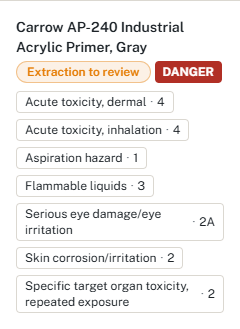
On the product page, each value says where it came from: read from the SDS, or changed by a person, with the reviewer's name and the date. When the hazard codes alone don't settle a category, HazComFast says so and lets the SDS decide. It never guesses a pictogram.
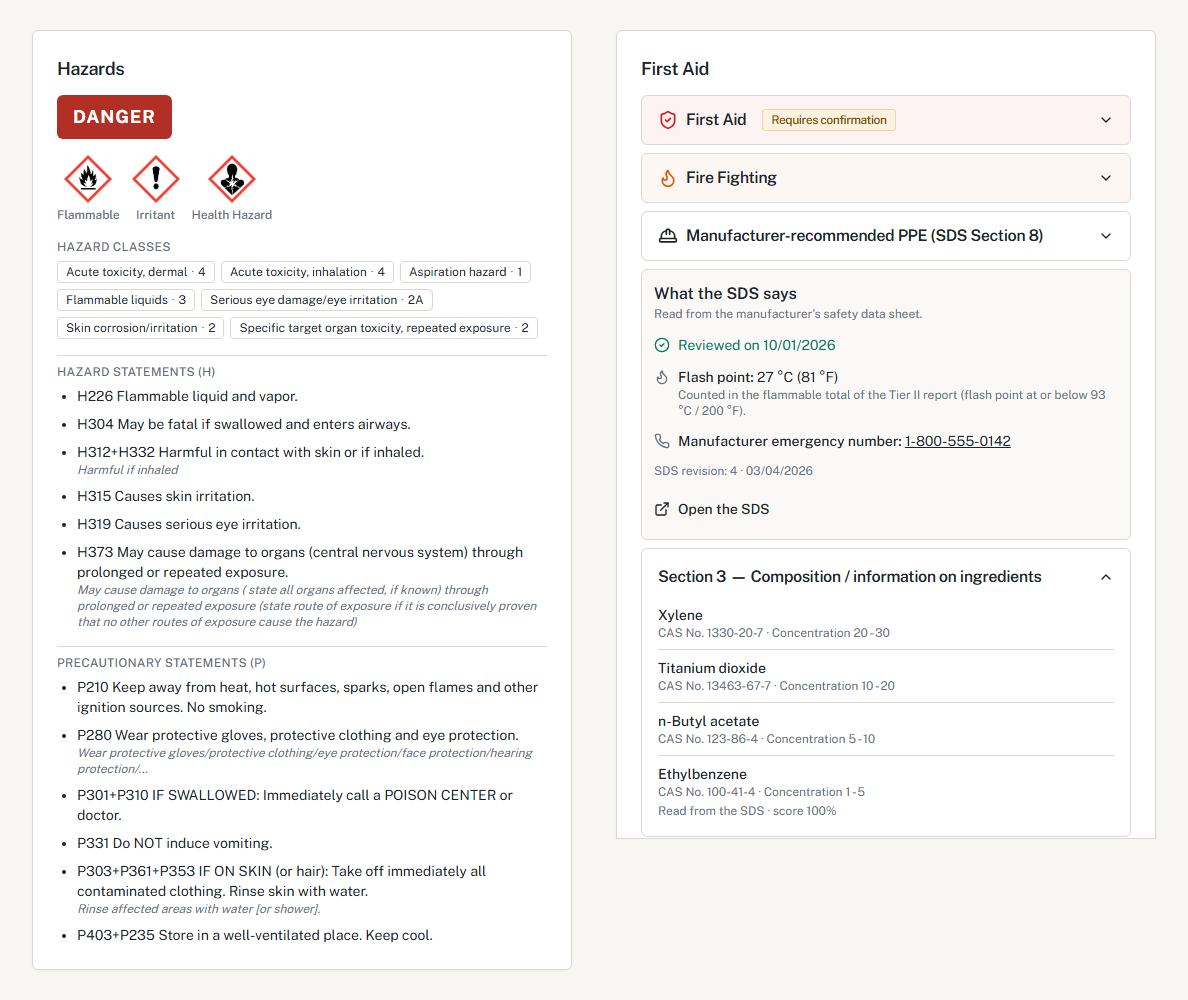
The reading itself is tested the way this article recommends. HazComFast keeps a reference set of test SDS built with the expected answer for each field, and its automated tests replay the reading on that set field by field, so a code change that breaks a field shows up as that field failing, not as a lower average.
What happens to a field that's wrong
Decide while the SDS is still open. A value the software misread is corrected from the sheet, and the correction carries your name. A supplier SDS that contradicts itself, or contradicts the drum's label, goes back to the supplier, whose accuracy duty sits in 29 CFR 1910.1200(g)(5): the supplier's SDS has an error explains why you fix your record and not their document.
Hold what depends on the open question, and only that. A label that needs the unresolved signal word waits. The rest of the library doesn't. And if a label was already printed from the old value, correcting the record doesn't change the label on the bottle. Reprint it under the method your program uses for workplace containers, 1910.1200(f)(6).
Read by software, checked by a person
Check an SDS against the 16 sections free, or bring your supplier SDSs into HazComFast, where each value is traced to the sheet and confirmed before it's used.
Related: How to read a safety data sheet · The supplier's SDS has an error · The chemical inventory template
Sources & verification: 29 CFR 1910.1200(e)(1)(i), (f), (f)(6), (g)(1), (g)(8), (h); Appendix C, C.2.1.1; Appendix D; NIST AI Risk Management Framework, "Valid and Reliable". General guidance, not legal advice.*
Frequently Asked Questions
How accurate is AI at reading safety data sheets?
It depends on the documents, the fields and how the check was done, so a single rate says little. 29 CFR 1910.1200 sets no accuracy standard for software. Ask which fields were checked against what, count omissions as well as wrong values, and have a person confirm the fields that feed labels and work instructions.
Does a high confidence score mean a field is correct?
No. A confidence score is the software's own estimate, not a check against the document. A field is checked when a person compared it with the supplier's SDS. Under 29 CFR 1910.1200(g)(8), the SDS itself stays readily accessible to employees during each work shift.
Which fields should be checked first?
The product identifier, then Section 2: signal word, pictograms, hazard statements and classifications. Then the fields the crew acts on, such as first aid in Section 4 and protective equipment in Section 8. Appendix D to 29 CFR 1910.1200 lists what each section contains.
Can the extracted record replace the supplier's SDS?
No. Your inventory record is a summary. 29 CFR 1910.1200(g)(1) and (g)(8) require the employer to maintain the SDS for each hazardous chemical and keep it accessible, and the chemical list uses the identifier referenced on that SDS under 1910.1200(e)(1)(i).
Does OSHA require a person to approve every extracted field?
29 CFR 1910.1200 prescribes no approval process for software. The duties stay the same: correct labels under (f), accessible SDSs under (g)(8), training under (h). Deciding who checks extracted values before they're used is how you meet those duties with software in the middle.
Site-wide regulatory figures such as compliance dates and penalty amounts come from our regulatory source-of-truth modules, last checked against the eCFR, OSHA.gov, and the Federal Register on October 5, 2026. Last reviewed October 13, 2026.
About This Article
Published by: HazComFast
Published: October 13, 2026
Last Updated: October 13, 2026
This content is for informational purposes only and does not constitute legal advice.