
The SDS for a parts degreaser says "Warning" in Section 2. The drum's label says "Danger". Your inventory says "Warning" because that's what was copied from the SDS last spring. Someone on the crew noticed and asked which one is right. The quick fix is to open the PDF and change the word. Don't. The moment you edit the supplier's SDS and hand it out, you've taken on their responsibility for it. There's a cleaner path, and OSHA's own inspection directive spells out why.
An employer that receives an SDS isn't responsible for its content and accuracy unless the employer changes it, according to OSHA's inspection directive CPL 02-02-079 (2026), section X.G.4.b. Accuracy belongs to the manufacturer, importer or employer preparing the SDS under 29 CFR 1910.1200(g)(5). Fix your own records to match the source, and ask the supplier to fix the source.
At a glance: Accuracy of an SDS: the preparer, under 1910.1200(g)(5). Receiving employers: not responsible for content and accuracy unless they change the SDS (CPL 02-02-079, effective May 19, 2026, X.G.4.b). You may rely on the supplier's classification (1910.1200(d)(1)). Fix your record to match the source; ask the supplier to fix the source. New significant hazard information: added by the preparer within three months ((g)(5)). Keep the received SDS accessible meanwhile ((g)(8)).
First, find out which document is wrong
Most "SDS errors" turn out to be one of three things, and each has a different fix.
Your record doesn't match the SDS. The inventory says Warning, the SDS says Danger. That's a transcription or reading error on your side. Open the received PDF, not the summary, and correct the record to match it.
You have the wrong SDS. A similar trade name can be a different grade or formulation. Check Section 1, the product identifier, against the container, and Section 16, the date of preparation or last revision required by Appendix D to 1910.1200. Under 1910.1200(e)(1)(i), your chemical list uses the identifier referenced on the appropriate SDS, so the match has to be exact.
The supplier's documents contradict each other. Same product, same revision date, and the label says Danger while the SDS says Warning. That one is the supplier's to fix.
What the accuracy rule says, and who it's about
29 CFR 1910.1200(g)(5) names "the chemical manufacturer, importer or employer preparing the safety data sheet" and requires the information to accurately reflect the scientific evidence used in making the hazard classification. It's about the preparer. Paragraph (d)(1) lets employers rely on the classification of the manufacturer or importer, unless they choose to classify chemicals themselves.
OSHA's inspection directive CPL 02-02-079, revised for HCS 2024 and in effect since May 19, 2026, replacing the July 2015 edition, says it in so many words. Section X.G.4.b: "Employers assume no responsibility for the content and accuracy of the SDS provided to them by the manufacturer, importer or distributor, unless the employer changes the SDS." The same section says distributors who put their own name in place of the manufacturer's become responsible for the accuracy and completeness of the SDS.
The directive tells compliance officers how to enforce the standard. It doesn't settle a contract dispute or a lawsuit. What it does settle is the practical question: leave the supplier's document as it is.
Your record and the supplier's SDS are two different things
Your inventory holds a product identifier, hazard fields and a link to the supplier's PDF. Correcting a field so it matches that PDF restores your record to its source. It doesn't touch the SDS.
Editing the PDF and circulating it as the SDS is a different act. You've changed the document the crew relies on, and you're now the one whose changes have to reflect the scientific evidence under (g)(5), in a document that meets 1910.1200(g)(2) and Appendix D. A corrected signal word in an otherwise unchanged supplier PDF doesn't meet that.
When you correct a record, keep a note of which field changed, what the source says and who made the change. HazCom doesn't prescribe that note. It's what lets the next person tell a transcription fix from a decision to use different hazard information.
Danger, Warning, and when both appear
Two signal words in one document aren't always an error. Appendix C to 1910.1200, C.2.1.1, sets the rule for the label: if Danger applies, Warning doesn't appear on the label. On an SDS, different hazard classes can carry different signal words, a flammable liquid category 2 with Danger next to an eye irritant with Warning, and the label shows Danger. The Danger and Warning guide explains the precedence.
What is an error is an overall label section that contradicts the label on the same product and revision. Ask the supplier which classification and label elements apply to this product identifier and this revision date.
Ask the supplier something they can answer
A good request names the product, the identifier in Section 1, the revision date in Section 16, the page, and what disagrees with what. "The label on drum lot 2219 says Danger; Section 2 of your SDS dated 03/14/2026 says Warning; which applies?" gets an answer. "Please send a compliant SDS" gets a form letter.
Attach the SDS you received and a legible photo of the label. When a replacement arrives, check that its Section 1 and Section 16 match the product you have before you swap it in.
If the problem is an unreadable scan, ask for a legible copy. If the SDS never came, that's another situation, covered by 1910.1200(g)(6) and the missing SDS guide.
The three-month rule, and the crew in the meantime
Under 1910.1200(g)(5), the preparer who becomes newly aware of significant information about a chemical's hazards or about ways to protect against them adds it to the SDS within three months. For a chemical not currently produced or imported, the information is added before the chemical is introduced into the workplace again.
That clock is the supplier's. Your crew still works with the product today. Keep the received SDS readily accessible under 1910.1200(g)(8), treat the product by the more protective reading while the question is open, and have the person who prepares workplace labels under 1910.1200(f)(6) look at it. If the answer brings a new hazard the crew hasn't been trained on, 1910.1200(h)(1) calls for that training.
How HazComFast keeps your record and the supplier's SDS apart
In HazComFast, the supplier's PDF stays attached to the product exactly as you received it. What the product page shows is read from that SDS, scanned or not, English or Spanish, and each value says where it came from: read from the SDS, or changed by a person, with the reviewer's name and the review date.
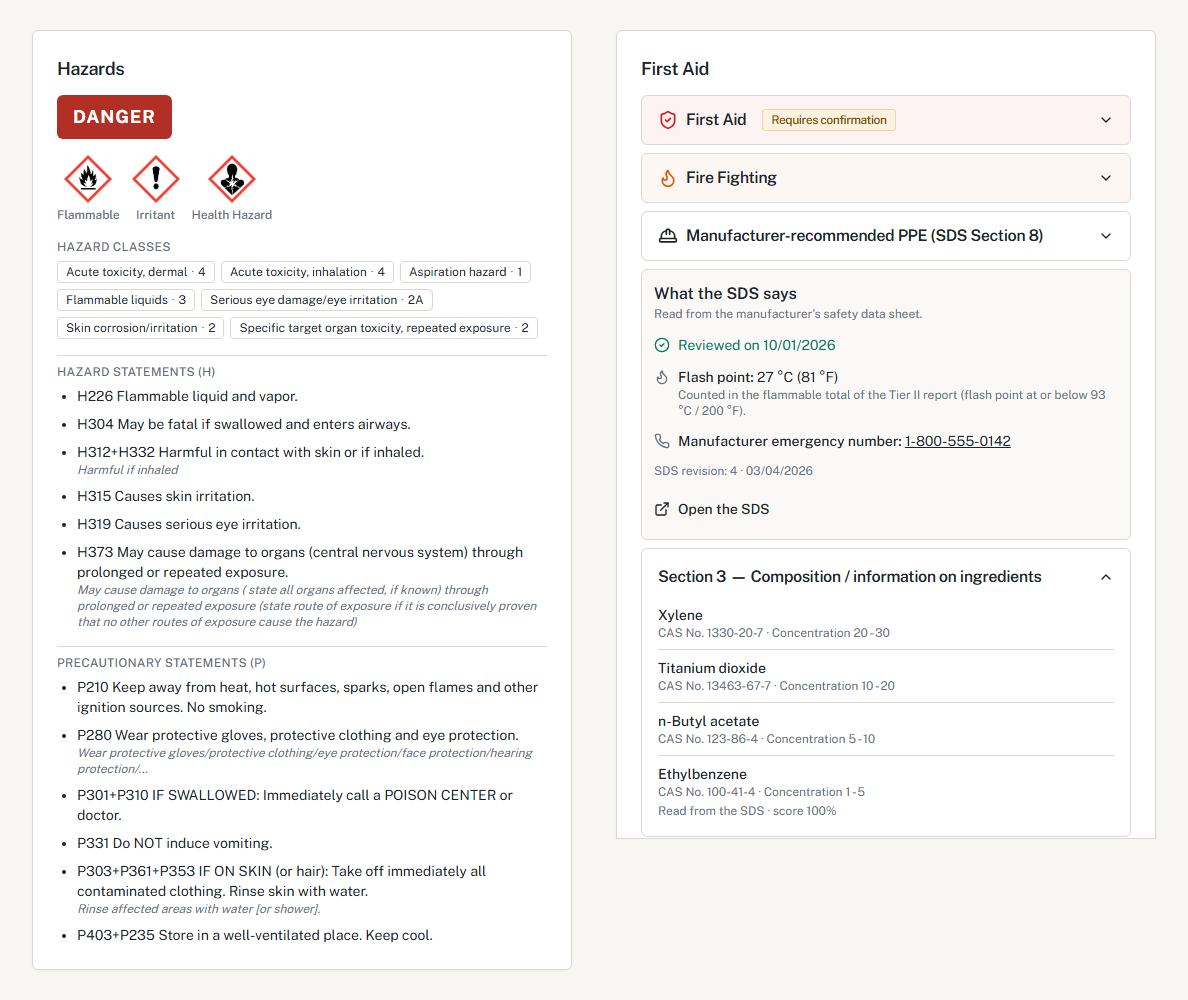
Before a new SDS's values are saved, a person checks each field against the PDF, and the screen counts what's left to review. When the hazard codes alone don't settle a category, HazComFast says so and lets the SDS decide. It never guesses a pictogram. Correcting your record to match the source is a change to your record, signed with your name. The supplier's document doesn't move.
Your records, checked against the supplier's SDS
Check an SDS against the 16-section format free, or keep each supplier SDS in HazComFast as received, with every value traced to its source and reviewed by a person.
Related: How to read a safety data sheet · Supplier won't provide an SDS · Shipped labels and workplace labels
Sources & verification: 29 CFR 1910.1200(d)(1), (e)(1)(i), (f)(6), (g)(2), (g)(5), (g)(6), (g)(8), (h)(1); Appendix C, C.2.1.1; Appendix D; OSHA Instruction CPL 02-02-079, Inspection Procedures for the Hazard Communication Standard (HCS 2024), effective May 19, 2026, section X.G.3 and X.G.4.b (read 2026-10-13). General guidance, not legal advice.*
Frequently Asked Questions
Who is responsible for the accuracy of an SDS?
The chemical manufacturer, importer or employer preparing it. 29 CFR 1910.1200(g)(5) requires the information to accurately reflect the scientific evidence used in the hazard classification. OSHA's inspection directive CPL 02-02-079 (2026), section X.G.4.b, says employers assume no responsibility for the content and accuracy of an SDS they receive, unless they change it.
Does correcting my inventory record mean I changed the SDS?
No. Making an internal field match the unchanged supplier document is record-keeping. Editing the supplier's PDF and handing it out as the SDS is a change to the SDS, and the preparer duties of 29 CFR 1910.1200(g)(2) and (g)(5) and Appendix D come with it.
Can Danger and Warning both appear on a label?
Not as the label's signal word. Appendix C to 29 CFR 1910.1200, C.2.1.1, says that if the signal word Danger is used, Warning shall not appear on the label. Different hazard classes on an SDS can carry different signal words; the label shows Danger when any of them requires it.
Do I have to audit every supplier SDS?
No. 29 CFR 1910.1200(d)(1) lets employers rely on the classification of the manufacturer or importer unless they choose to classify chemicals themselves. When something looks wrong, ask the supplier; you don't take on their classification work by asking.
How fast must a supplier correct an SDS?
When the preparer becomes newly aware of significant information about the hazards or about protection, 29 CFR 1910.1200(g)(5) gives three months to add it to the SDS. For a chemical not currently produced or imported, the information is added before it's introduced into the workplace again.
Site-wide regulatory figures such as compliance dates and penalty amounts come from our regulatory source-of-truth modules, last checked against the eCFR, OSHA.gov, and the Federal Register on October 5, 2026. Last reviewed October 13, 2026.
About This Article
Published by: HazComFast
Published: October 13, 2026
Last Updated: October 13, 2026
- https://www.osha.gov/laws-regs/regulations/standardnumber/1910/1910.1200
- https://www.osha.gov/laws-regs/regulations/standardnumber/1910/1910.1200AppD
- https://www.osha.gov/laws-regs/regulations/standardnumber/1910/1910.1200AppC
- https://www.osha.gov/sites/default/files/enforcement/directives/CPL-02-02-079_0.pdf
This content is for informational purposes only and does not constitute legal advice.