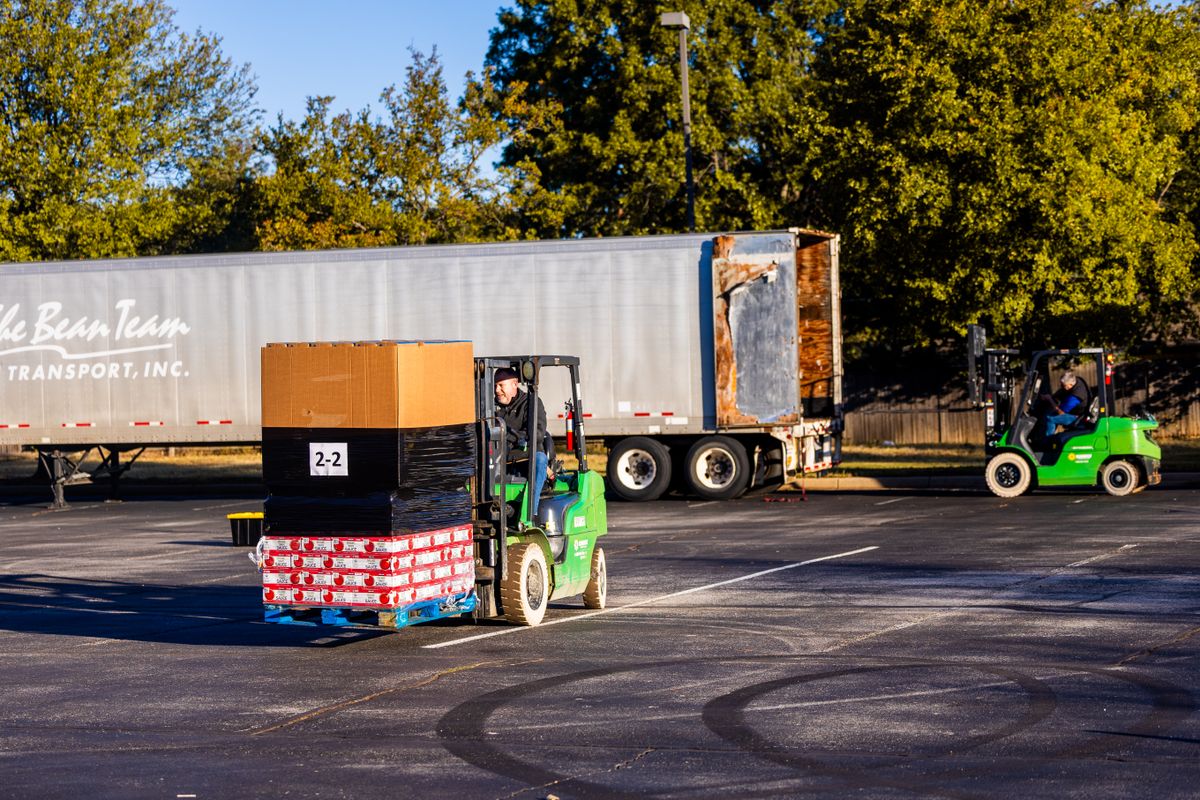
No — there is no passing score for an OSHA forklift evaluation, because there is no scoring. 29 CFR 1910.178(l), the training and evaluation paragraph of the powered industrial truck standard, contains no percentage, no grade and no pass mark anywhere in its text. What it requires instead is written in its first sentence: the employer "shall ensure that each powered industrial truck operator is competent to operate a powered industrial truck safely, as demonstrated by the successful completion of the training and evaluation specified in this paragraph (l)." Competence is a condition someone verifies, not a number someone earns. The training market sells it differently, and the difference is not cosmetic: a pass mark can quietly convert a mandatory retraining trigger into a green light.
29 CFR 1910.178(l) sets no passing score, no percentage and no grade for forklift operator training or evaluation. It requires demonstrated competence, an evaluation OSHA says cannot be a written exam alone, refresher training whenever an evaluation reveals unsafe operation, and an employer certification containing exactly four items: operator name, training date, evaluation date, and the identity of the trainer or evaluator.
Sixteen out of twenty
An operator finishes an online course and a twenty-question quiz. He misses four questions — all four in the pedestrian safety module — and the platform stamps the certificate: PASSED, 80%. On paper the company now holds a document that says its operator was tested on pedestrian safety, got it wrong, and was certified anyway, with the arithmetic doing the certifying. If that operator later strikes someone in a travel lane, the certificate is not a defense. It is the plaintiff's Exhibit A.
Search "forklift certification" today and the pass mark is everywhere: 70% to pass this exam, 80% to pass that quiz, retake until you clear the bar. None of those numbers appears in the standard those courses invoke.
What the rule actually requires
The structure of 1910.178(l) has three moving parts, and none of them grades anything:
| Element | What the text says | Where |
|---|---|---|
| The obligation | Operator "competent to operate a powered industrial truck safely, as demonstrated by the successful completion of the training and evaluation" | (l)(1)(i) |
| Who trains and evaluates | "persons who have the knowledge, training, and experience to train powered industrial truck operators and evaluate their competence" | (l)(2)(iii) |
| The recurring check | "An evaluation of each powered industrial truck operator's performance shall be conducted at least once every three years" | (l)(4)(iii) |
OSHA has twice explained what that evaluation is, in ways that leave no room for a scoreboard. Asked whether a written exam alone could satisfy the three-year evaluation, the agency's August 1, 2005 letter answered that it cannot: the evaluation of performance requires a demonstration of both knowledge and skills — the evaluator observes the operator running the truck during normal operations and asks pertinent questions. And asked whether drivers doing simple tasks could be evaluated to a different level than drivers doing complex ones, the July 28, 2004 letter said the standard "does not distinguish between different levels of evaluating the employees' training on the same type of truck used at the same workplace, regardless of different task complexities." An evaluation has no levels. A percentage scale is nothing but levels.
Where a pass mark actively works against you
The sharpest problem with grading is hiding in the refresher-training paragraph. 1910.178(l)(4)(ii) commands refresher training in relevant topics when, among other triggers, "the operator has received an evaluation that reveals that the operator is not operating the truck safely" — that is trigger (C), sitting alongside observed unsafe operation (A), an accident or near-miss (B), a different type of truck (D), and changed workplace conditions (E).
Now put the market's scoring next to that sentence, in its two common forms. The graded practical evaluation is the direct collision: an evaluator watches the operator, marks pedestrian awareness as failed on the scorecard, and the sheet still totals 80% and prints PASSED. That document is an evaluation revealing unsafe operation — the exact event trigger (C) describes — certified as its opposite. The rule's response to the deficiency is targeted refresher training; the pass mark averaged it away with sixteen correct boxes about load capacity and ramps, and manufactured the evidence that the employer knew and moved on. The online-quiz version fails one step earlier: under the 2005 letter, a written exam alone is not the evaluation at all, so the "80%, certified" e-mail records a training quiz, not the performance evaluation the standard demands — and the pedestrian-safety miss it papered over is still waiting to be observed on the floor.
An evaluation form that computes a percentage and prints "Result: PASSED" on a PDF titled 29 CFR 1910.178 is writing a rule the standard does not contain and signing the employer's name to it. A stricter number would be no better: a 100 percent bar is as invented as an 80 percent one, only harsher. In HazComFast the evaluation ends where the standard ends it, with the evaluator's verdict on the operator's performance, and no arithmetic stands in for that judgment.
What gets certified: four fields, no score
When training and evaluation are done, 1910.178(l)(6) tells the employer exactly what to certify: "the name of the operator, the date of the training, the date of the evaluation, and the identity of the person(s) performing the training or evaluation." That is the whole list. No score field exists because no score exists.
Two market habits are worth measuring against that sentence. First, there is no OSHA forklift license: nothing in the paragraph creates a card, a registry, or any role for a third party — the certification is the employer's own record, and the laminated wallet cards that come with courses are vendor merchandise. Second, "OSHA-approved training" is not a thing the text provides for; no paragraph of (l) approves, accredits or endorses any provider. On construction sites none of this softens: 1926.602(d) makes the requirements "identical to those set forth at § 1910.178(l)."
None of which makes written quizzes useless. A quiz is a reasonable teaching tool inside the formal-instruction part of training, and keeping one on file shows the lecture content landed. It becomes a liability only when its percentage is promoted into the thing the rule never made it: the decision.
Certify what the rule certifies
The document OSHA actually requires is a record: operator, training date, evaluation date, evaluator. The free generator below produces that certification with the training-topic checklist and the three-year re-evaluation date, and HazComFast keeps operator training records filed per worker, so the certification is findable three years later when the next evaluation comes due. No score field, by design.
What a forklift evaluation must show, since no score is set
| Question | Answer |
|---|---|
| Passing score in 1910.178(l) | None — no percentage, grade or pass mark anywhere in the text |
| What is required | Competence "demonstrated by the successful completion of the training and evaluation" — (l)(1)(i) |
| Written exam alone | Does not satisfy the evaluation — OSHA letter, August 1, 2005 |
| Evaluation method | Observe during normal operations + pertinent questions — OSHA letter, August 1, 2005; evaluator qualifications per (l)(2)(iii) |
| Evaluation reveals a problem | Mandatory refresher training — (l)(4)(ii)(C); a pass mark can average this trigger away |
| The certification | Name, training date, evaluation date, evaluator identity — (l)(6). No score field |
| OSHA license or approved provider | Neither exists in the text |
| Construction | Identical requirements — 1926.602(d) |
Related reading
- The full training rule: OSHA forklift certification requirements and training guide
- The classes and construction specifics: Forklift PIT classes, construction cheat sheet
- The clocks: Forklift evaluations and respirator fit tests, the two-clock problem
- Free tool: Forklift operator certification record generator
Sources and verification (verified 2026-08-27): 29 CFR 1910.178(l)(1)(i), (l)(2)(iii), (l)(4)(ii)(A)-(E), (l)(4)(iii), (l)(6) and 1926.602(d), quoted from the current regulation; OSHA standard interpretation letters of July 28, 2004 and August 1, 2005 (osha.gov). General guidance, not legal advice; State-Plan states may impose additional requirements.
Frequently Asked Questions
Is there a passing score for an OSHA forklift evaluation?
No. 29 CFR 1910.178(l) contains no percentage, score or grade anywhere in its text. The requirement is competence: the employer must ensure each operator is competent to operate the truck safely, as demonstrated by the successful completion of the training and evaluation the paragraph specifies. Passing thresholds like 80% are creations of training vendors and quiz software, not of the standard.
Can a written test alone satisfy the evaluation requirement?
No. In an interpretation letter dated August 1, 2005, OSHA answered that exact question: the evaluation of performance required by 1910.178(l)(4)(iii) cannot be met by a written exam alone. The evaluation is a demonstration of both knowledge and skills — the evaluator observes the operator during normal operations and asks pertinent questions, which is also why it happens in your workplace, on your trucks, not in a browser.
What happens when an evaluation reveals a problem?
Refresher training, not a grade adjustment. 1910.178(l)(4)(ii)(C) requires refresher training in relevant topics when the operator has received an evaluation that reveals that the operator is not operating the truck safely. The other triggers are unsafe operation observed (A), an accident or near-miss (B), assignment to a different type of truck (D), and a workplace change that could affect safe operation (E). The rule's response to a deficiency is instruction; it has no concept of passing despite one.
What does the forklift certification have to contain?
Four things, none of them a score. Under 1910.178(l)(6), the certification shall include the name of the operator, the date of the training, the date of the evaluation, and the identity of the person or persons performing the training or evaluation. A certificate that prints a percentage is adding a field OSHA never asked for — and creating a document that can be read against you.
Does OSHA issue forklift licenses?
No. Nothing in 1910.178(l) creates a license, a card, or any role for a third party. The 'certification' in the rule is the employer's own record that training and evaluation happened, and the wallet cards sold with training courses are vendor products. Vendors advertising 'OSHA-approved certification' are describing something the text does not contain.
Do the same rules apply on construction sites?
Yes, word for word. 29 CFR 1926.602(d) states that the requirements applicable to construction work under this paragraph are identical to those set forth at § 1910.178(l) of this chapter.
Would requiring 100% instead of 80% fix the problem?
No — a 100% threshold is just as invented as an 80% one, simply stricter. The defect is not the number, it is grading itself: any pass mark lets arithmetic overrule the evaluator's observation. The standard's own mechanism is cleaner — a deficiency triggers targeted refresher training under 29 CFR 1910.178(l)(4)(ii), and the operator is certified when the evaluator can honestly say the operation is safe.
Can different drivers be evaluated to different levels?
OSHA addressed this in its July 28, 2004 interpretation letter: the standard does not distinguish between different levels of evaluating the employees' training on the same type of truck used at the same workplace, regardless of different task complexities. Tiered scoring schemes read a structure into the rule that OSHA says is not there.
OSHA figures and citations here come from our regulatory source-of-truth modules, last checked against the eCFR, OSHA.gov, and the Federal Register on October 5, 2026. Last reviewed October 5, 2026.
About This Article
Published by: HazComFast
Published: August 27, 2026
Last Updated: October 5, 2026
This content is for informational purposes only and does not constitute legal advice.