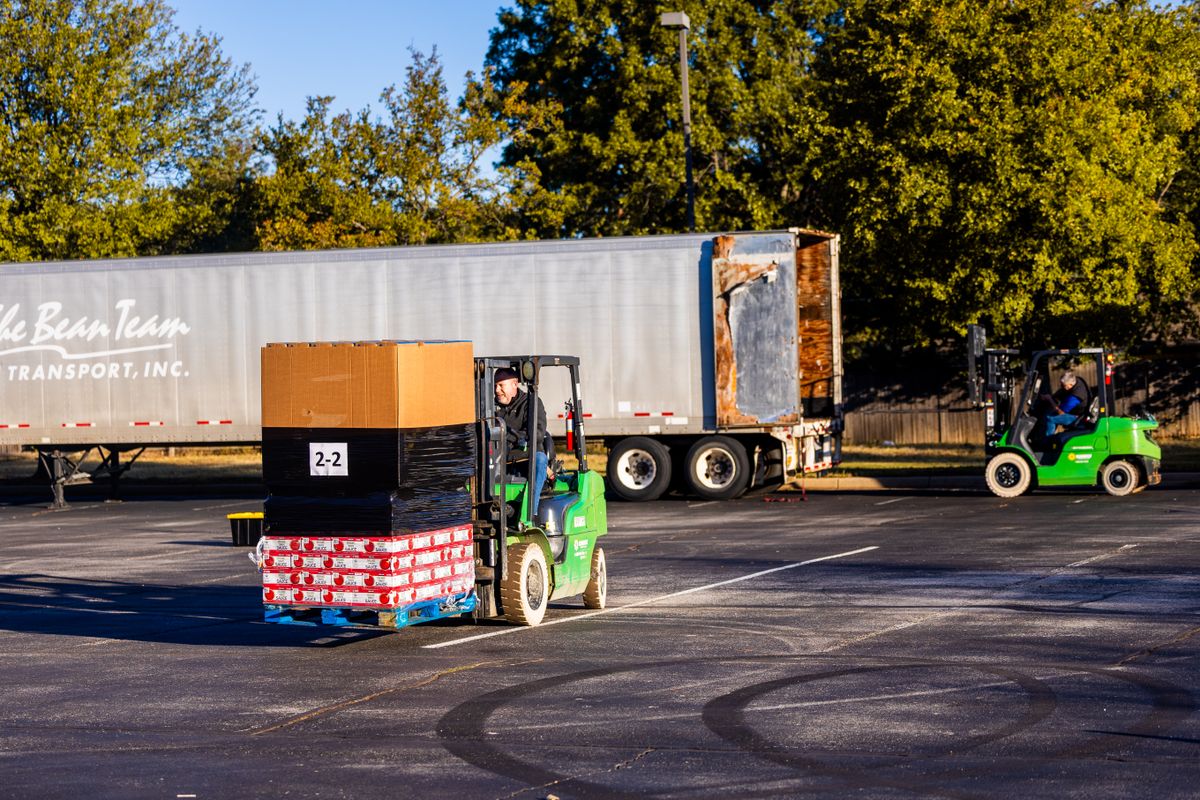
Forklift operator evaluations and respirator fit tests are two renewals that run on two different clocks. A powered-industrial-truck operator must be re-evaluated at least every 3 years (29 CFR 1910.178(l)(4)(iii)); a tight-fitting respirator wearer must be fit tested before first use and at least every 12 months (29 CFR 1910.134(f)(2)). Knowing the rule is the easy part; the hard part is tracking which worker is due for which test, when. This guide gives you both rules side-by-side, every early-reset trigger, and a system to never miss either deadline. (And if anyone asks what score passes the forklift evaluation: there isn't one.)
The two-clock problem in one table
Both programs require an initial qualification, a periodic renewal, and unscheduled re-tests when something changes. But the intervals and triggers are completely different, which is exactly why paper rosters fail.
| Element | Forklift operator (PIT) | Respirator (tight-fitting) |
|---|---|---|
| Governing standard | 29 CFR 1910.178(l) (construction: identical, via 29 CFR 1926.602(d)) | 29 CFR 1910.134 (construction via 29 CFR 1926.103) |
| Initial qualification | Formal + practical training, then evaluation before solo operation (1910.178(l)(1)) | Medical evaluation, then fit test before first use (1910.134(e)/(f)) |
| Routine renewal interval | Every 3 years — evaluation (1910.178(l)(4)(iii)) | At least every 12 months — fit test (1910.134(f)(2)) |
| Who pays | Employer | Employer (1910.134(c)(4); construction via 1926.103) |
| Record kept | Operator name, training/eval dates, evaluator (1910.178(l)(6)) | Fit-test record until next test (1910.134(m)(2)(ii)); medical record employment + 30 yrs (1910.1020) |
| Pre-use check | Daily / each shift truck inspection (1910.178(q)(7)) | User seal check every time the respirator is donned (1910.134(g)(1)(iii)) |
Notice the asymmetry: the forklift clock is 3 years, the respirator clock is 1 year, and each has its own daily/per-use check on top of the periodic renewal. A worker who drives a reach truck and wears a half-mask for silica work has four independent compliance obligations at once.
Two renewals, two clocks — don't let one cover the other
A worker who drives and wears a respirator has four independent obligations at once. One roster with both clocks is how renewals get missed.
Forklift operator evaluations (29 CFR 1910.178)
OSHA's powered-industrial-truck standard applies to forklifts, reach trucks, order pickers, tow tractors, and rough-terrain telehandler-type trucks used to lift, stack, or tier materials. It ranked eighth on OSHA's FY2025 list of most-cited standards, and its training and evaluation paragraph is 1910.178(l).
What "certification" actually means
There is no OSHA card. Compliance is a documented determination of competence on the specific truck type, in the actual workplace:
- Formal instruction (lecture, video, written material, or online) — 1910.178(l)(2)(ii).
- Practical, hands-on training on the truck — this part cannot be done online.
- A workplace performance evaluation of the operator's competence (1910.178(l)(1)(ii)).
- Truck-type and site specific — training on a sit-down counterbalanced forklift does not authorize a stand-up reach truck or a rough-terrain telehandler.
The 3-year clock and what resets it early
The routine evaluation is due at least once every 3 years (1910.178(l)(4)(iii)). But refresher training plus a new evaluation are required immediately, resetting nothing on the 3-year calendar, whenever (1910.178(l)(4)(ii)):
- The operator is involved in an accident or near-miss.
- The operator is observed operating unsafely.
- An evaluation finds the operator needs additional training.
- The operator is assigned a different type of truck.
- A workplace condition changes in a way that affects safe operation.
After any of those, the next routine 3-year evaluation runs from the new date.
Daily inspection is separate
Independent of training, each truck must be examined before being placed in service and at least daily (or after each shift when used around the clock) under 1910.178(q)(7) and (p)(1). A missing pre-shift inspection log is its own citation, separate from any training gap.
Respirator fit testing (29 CFR 1910.134)
For construction, the respiratory-protection standard is adopted by reference through 29 CFR 1926.103, which states the requirements are identical to 1910.134. The sequence is strict and not interchangeable.
Medical evaluation → fit test → use
- Medical evaluation determines the worker can physically tolerate a respirator — required before fit testing or use (1910.134(e)(1)).
- Fit test with the same make, model, style, and size the worker will actually wear (1910.134(f)(2)/(f)(4)).
- Use — only after medical clearance, a passed fit test, and training.
QLFT vs QNFT — the APF-100 line
| Method | What it measures | Valid for | Pass criterion |
|---|---|---|---|
| Qualitative (QLFT) | Wearer's taste/smell/irritant reaction — pass/fail | Negative-pressure air-purifying respirators relied on for an APF of 10 or less (e.g., a half-mask) — 1910.134(f)(6). Also permitted on tight-fitting PAPRs and supplied-air respirators, run in the negative-pressure mode — 1910.134(f)(8) | Wearer cannot detect the agent (fit factor not measured) |
| Quantitative (QNFT) | Instrument-measured leakage → numeric fit factor | Required for a negative-pressure air-purifying respirator relied on above an APF of 10 — a QLFT cannot qualify it higher. Optional, not mandatory, on tight-fitting PAPRs and SARs | ≥ 100 half-mask; ≥ 500 full facepiece |
A half-mask air-purifying respirator has an APF of 10 and may be qualitatively fit tested. A full-facepiece negative-pressure respirator relied on for its APF of 50 must be quantitatively fit tested — a QLFT can only qualify it at an APF of 10. (For the full method logic, see the Respirator Fit-Test Method & Schedule Selector.)
The 12-month clock and what resets it early
The fit test is due at least annually (1910.134(f)(2)). A new fit test before next use is required immediately whenever (1910.134(f)(2)/(f)(3)):
- The facepiece make, model, style, or size changes.
- The employee, supervisor, or PLHCP reports a physical change affecting the seal — a noticeable weight change, dental work, facial scarring, or cosmetic surgery.
A clean-shaven seal area is also a use-condition: facial hair that crosses the sealing surface voids the fit (1910.134(g)(1)(i)).
One scope limit worth knowing. The medical evaluation, the fit test, and the 12-month clock all apply to tight-fitting respirators that are required. If a forklift operator voluntarily grabs an N95 for nuisance dust when no respirator is required, there is no fit test and no medical evaluation — the employer only owes them the Appendix D information (1910.134(c)(2)). A loose-fitting hood or PAPR helmet also needs no fit test, because it forms no face seal.
Worked example: one worker, two clocks
A concrete contractor employs Maria, who runs a rough-terrain telehandler and wears a half-mask P100 when tuck-pointing (silica). Her records:
- Forklift evaluation: passed 2024-03-10.
- Respirator fit test (half-mask, QLFT): passed 2025-08-15.
Forklift: next routine evaluation due 2027-03-10 (3 years). Currently current.
Respirator: next fit test due 2026-08-15 (12 months). As of 2026-06-26, that is about 50 days out — squarely in the renewal window.
Now a change: on 2026-07-01 Maria is assigned a different, larger telehandler model and her employer switches her to a full-facepiece respirator for an enclosed-cab grinding task.
- The truck-type change triggers refresher training + a new forklift evaluation now (1910.178(l)(4)(ii)) — the 2027 date is moot.
- The new facepiece triggers a new fit test now (1910.134(f)(2)). And because a full facepiece relied on at APF 50 exceeds the QLFT ceiling, she must be quantitatively fit tested (1910.134(f)(7)) — a QLFT no longer suffices.
One operational change just reset both clocks and upgraded the fit-test method. That is the scenario a roster spreadsheet quietly misses.
What it costs to miss either one
OSHA penalty maximums are unchanged for 2026 (no CPI adjustment — OMB Memo M-26-11). These are maximums, before size/good-faith/history reductions:
| Scenario | Likely classification | 2026 maximum |
|---|---|---|
| Operator with no training/evaluation record | Serious | $16,550 |
| Forklift evaluation past 3 years | Serious | $16,550 |
| No daily/pre-shift truck inspection record | Other-than-serious | up to $16,550 |
| Respirator user never fit tested / fit test lapsed | Serious | $16,550 |
| Using a respirator with no prior medical evaluation | Serious | $16,550 |
| Knowingly allowing untrained operation as a pattern | Willful | up to $165,514 |
Per-instance citations can multiply a single program gap across every affected worker. (For how OSHA actually builds and reduces a penalty, see the OSHA Fine Calculator.)
Why this lives next to your HazCom program
Respiratory protection is downstream of hazard communication, so the two programs share data:
- SDS Section 8 specifies the respiratory protection a chemical requires.
- Exposure assessments (e.g., silica, lead, hexavalent chromium) determine who needs a respirator and therefore who needs fit testing.
- Adding a new inhalation-hazard chemical to a jobsite can create a new fit-test population overnight.
That is why a fit-test roster that isn't linked to the chemical inventory drifts out of date the moment a new product arrives. (Background: OSHA Respiratory Protection Program: Complete Guide.)
Common mistakes to avoid
- Treating "certified" as a card with an expiration date. Forklift compliance is a documented competence determination, not a wallet card — and it is truck-type specific.
- Assuming the 3-year clock survives an incident. An accident, near-miss, or observed unsafe operation forces a re-evaluation now.
- Skipping the medical evaluation. It must precede the fit test — a fit test on an un-cleared worker is a citation even if the fit passes.
- Using a QLFT for a high-APF respirator. A full facepiece relied on above APF 10 needs a quantitative test.
- Re-using a fit test after a facepiece or weight change. Any seal-affecting change requires a new test before next use.
- Storing only the latest record. Keep the fit-test record until the next test; keep the medical record for employment + 30 years.
- One spreadsheet, two clocks. Forklift (3-yr) and respirator (12-mo) deadlines on the same sheet are the classic missed-renewal setup.
What to do next
- Build two separate due-date registers — a 3-year forklift cycle and a 12-month respirator cycle — and set alerts well before each date.
- Confirm method per respirator. Run each respirator through the Respirator Fit-Test Method & Schedule Selector so half-masks vs full facepieces get the right test (QLFT vs QNFT).
- Log fit tests in the field with the Respirator Fit-Test Log, and clear workers first with the Respirator Medical Evaluation Questionnaire.
- Keep training records audit-ready with the HazCom Training Record generator and reinforce with a quick Toolbox Talk.
- Verify retention windows with the Record Retention Calculator — fit-test vs medical records are kept for very different periods.
Related reading: Respiratory Protection hub (OSHA 1910.134) · OSHA Respirator Fit Testing in Construction: QLFT vs QNFT & Who Pays · OSHA Forklift Certification Requirements: Complete Training Guide · OSHA Forklift PIT Classes: Construction Cheat Sheet.
Note: This is general guidance, not legal advice. OSHA-approved State Plans may have requirements at least as effective as the federal standards; verify your state's rules.
Sources & verification: 29 CFR 1910.178(l) (operator training/evaluation), 1910.178(q)(7)/(p)(1) (daily inspection); 29 CFR 1910.134(e)/(f)/(g)/(m) (medical, fit test, seal check, records), adopted for construction via 29 CFR 1926.103; respirator payment 29 CFR 1910.134(c)(4), fit testing via the program duty (c)(1) — the general PPE payment rules 29 CFR 1910.132(h) / 1926.95(d) reach the equipment only; medical record retention 29 CFR 1910.1020; penalty maximums per 29 CFR 1903.15(d) (2026, unchanged from 2025). Facts verified against the HazComFast regulatory source of truth (respiratory, standardsCitations, oshaPenalties), last verified 2026-06-26. Not legal advice.
Frequently Asked Questions
How often do forklift operators have to be re-evaluated vs. fit tested?
They run on two different clocks. A powered-industrial-truck operator must have a performance evaluation at least every 3 years under 29 CFR 1910.178(l)(4)(iii). A respirator wearer must be fit tested before first use and at least every 12 months under 29 CFR 1910.134(f)(2). The forklift evaluation is a 3-year cycle; the respirator fit test is an annual cycle — never assume one renewal covers the other.
Does an accident reset the forklift 3-year clock?
An accident, near-miss, observed unsafe operation, a change of truck type, or a change in workplace conditions all trigger refresher training and a fresh evaluation under 29 CFR 1910.178(l)(4)(ii) — regardless of where you are in the 3-year cycle. The next routine evaluation is then due 3 years from that re-evaluation.
What resets the respirator 12-month clock early?
A new fit test is required whenever the facepiece make/model/style/size changes, and whenever the employee, a supervisor, or the PLHCP reports a physical change that could affect the seal — weight change, dental work, facial scarring, or cosmetic surgery (29 CFR 1910.134(f)(2)/(f)(3)). Any of these requires a new fit test before the worker uses the respirator again, even if the annual date is months away.
Who pays for forklift evaluations and respirator fit testing?
The employer pays for both. For respirators, 29 CFR 1910.134(c)(4) requires the employer to provide the respirator, training, and medical evaluations at no cost; fit testing sits inside the written program required by (c)(1), so it cannot be charged either. Construction reaches the identical rule through 29 CFR 1926.103. Forklift training and evaluation are an employer duty under 29 CFR 1910.178(l) and cannot be charged to the operator.
How long do I keep the records?
OSHA requires you to keep the forklift operator's training/evaluation certification current (date, operator, evaluator) under 29 CFR 1910.178(l)(6). A respirator fit-test record is kept until the NEXT fit test is administered (29 CFR 1910.134(m)(2)(ii)), while the respirator medical-evaluation record is kept for the duration of employment plus 30 years (29 CFR 1910.1020).
Does this apply to construction?
Yes. The powered-industrial-truck standard 29 CFR 1910.178 applies across industries including construction. The respiratory-protection standard 29 CFR 1910.134 is adopted for construction by reference through 29 CFR 1926.103, which makes the requirements identical. Cite the construction reference where the audience is construction.
OSHA figures and citations here come from our regulatory source-of-truth modules, last checked against the eCFR, OSHA.gov, and the Federal Register on October 5, 2026. Last reviewed October 5, 2026.
About This Article
Published by: HazComFast
Published: February 27, 2026
Last Updated: October 5, 2026
This content is for informational purposes only and does not constitute legal advice.