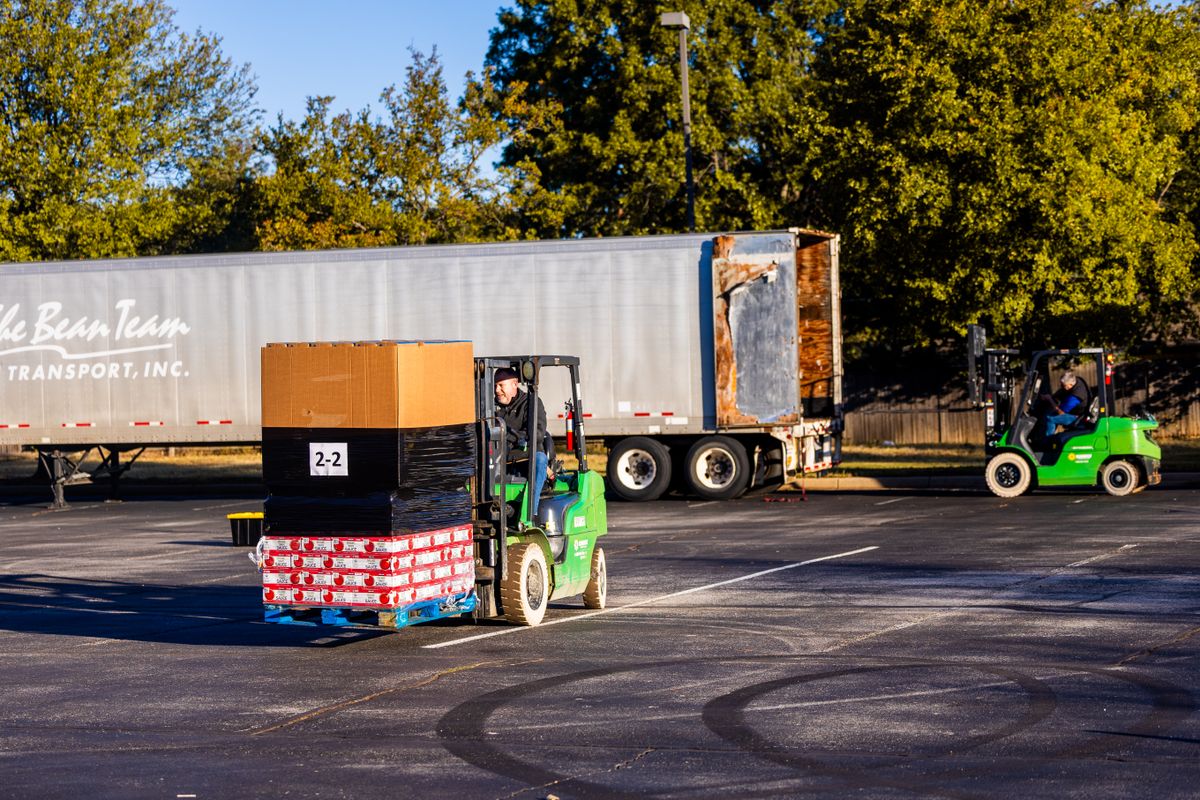
Introduction to OSHA Forklift Requirements
Powered industrial trucks, commonly known as forklifts, injure and kill workers every year across every industry. OSHA's forklift page names the recurring scenarios: trucks driven off loading docks, lifts falling between a dock and an unsecured trailer, workers struck by a lift truck, and falls from elevated pallets and tines. Tip-overs, the reason vehicle stability is a required training topic (1910.178(l)(3)(i)(I)), round out the list.
Under 29 CFR 1910.178(l), and 1926.602(d) in construction, only trained and evaluated operators may run a forklift: training combines formal instruction, practical training, and an evaluation in the workplace, each operator is re-evaluated at least every three years, and the employer certifies the training with the operator's name, the dates of training and evaluation, and the trainer's identity.
OSHA's Powered Industrial Truck standard (29 CFR 1910.178) establishes comprehensive requirements for forklift operation, including the operator training and certification provisions in 1910.178(l). These training requirements reach every industry where forklifts are used: construction gets the identical text through 1926.602(d), and warehousing, manufacturing, and retail work under 1910.178 itself.
Powered industrial trucks (1910.178) ranked eighth on OSHA's FY2025 list of most-cited standards.
OSHA forklift training has three required parts · 1910.178(l)
Online-only training does not comply: the operator must be evaluated in the workplace (1910.178(l)(2)(ii)). Re-evaluate at least every 3 years (1910.178(l)(4)(iii)).
Who Must Be Trained?
Covered Equipment
The standard covers fork trucks, tractors, platform lift trucks, motorized hand trucks, and other specialized industrial trucks powered by electric motors or internal combustion engines (1910.178(a)(1)). It does not cover compressed-air or nonflammable compressed-gas trucks, farm vehicles, or vehicles intended primarily for earth moving or over-the-road hauling, and OSHA's forklift page adds that earth-moving equipment modified to accept forks is not a powered industrial truck. Covered trucks include:
- Sit-down counterbalanced forklifts (most common)
- Stand-up (reach) trucks
- Order pickers
- Pallet jacks (powered/electric; manual pallet jacks are not powered and fall outside the standard)
- Rough terrain forklifts (construction sites)
- Telescopic handlers (telehandlers)
- Platform trucks (powered)
- Motorized hand trucks
Who Needs Training
Every operator must be trained before operating a forklift, including:
- Full-time employees
- Part-time employees
- Temporary workers (the staffing agency and the host employer are joint employers and share the duty; OSHA's temporary worker guidance has the host provide the training specific to its own equipment)
- Employees who "only drive it occasionally"
- Employees transferring from another location or employer: earlier training counts only for topics that fit your trucks and conditions, and only once you have evaluated them and found them competent (1910.178(l)(5))
One group cannot be trained into the seat at all. In nonagricultural work, federal child labor rules declare operating a high-lift truck, forklifts included, particularly hazardous for workers under 18 (Hazardous Occupations Order No. 7, 29 CFR 570.58(a)(1)), and OSHA's forklift page states that it is a violation of federal law for anyone under 18 to operate one.
Employer Responsibility
The employer is responsible for ensuring compliance — not the operator. This means:
- Employers cannot rely solely on a previous employer's training (1910.178(l)(5))
- Employers must verify competence on their specific equipment and in their specific workplace
- Temporary staffing agencies and host employers share responsibility
Training Program Requirements
OSHA's training requirements have three mandatory components (1910.178(l)(2)(ii)). All three must be completed before an operator is permitted to operate a forklift independently (1910.178(l)(1)(ii)).
Component 1: Formal Instruction
Formal instruction can be delivered through (the rule's own examples are lecture, discussion, interactive computer learning, video tape, and written material):
- Classroom lectures
- Video/DVD/online presentations
- Written materials and study guides
- Interactive computer-based training
Required formal instruction topics (1910.178(l)(3)), except topics the employer can show do not apply to safe operation in its workplace:
Truck-Related Topics (1910.178(l)(3)(i)):
- Operating instructions, warnings, and precautions for the specific truck type
- Differences between the truck and an automobile
- Truck controls and instrumentation (location, function, operation)
- Engine or motor operation
- Steering and maneuvering
- Visibility (including restrictions due to loading)
- Fork and attachment adaptation, operation, and limitations
- Vehicle capacity and stability
- Vehicle inspection and maintenance requirements
- Refueling and charging procedures
- Operating limitations
- Any other operating instructions, warnings, or precautions listed in the operator's manual
Workplace-Related Topics (1910.178(l)(3)(ii)):
- Surface conditions where the truck will be operated
- Composition of loads and load stability
- Load manipulation, stacking, and unstacking
- Pedestrian traffic in areas where the truck operates
- Narrow aisles and other restricted areas
- Hazardous locations where the truck will be operated
- Ramps and other sloped surfaces
- Closed environments and other areas where poor ventilation or maintenance could build up carbon monoxide or diesel exhaust
- Other unique or potentially hazardous environmental conditions
The third required topic is the requirements of 1910.178 itself (1910.178(l)(3)(iii)).
Component 2: Practical Training
Practical training means demonstrations performed by the trainer and practical exercises performed by the trainee (1910.178(l)(2)(ii)), on the type of truck the operator will use. A typical session covers:
- Equipment familiarization (controls, gauges, warning devices)
- Pre-operation inspection procedures
- Starting, stopping, and steering
- Load picking, carrying, and placing at various heights
- Maneuvering in actual workplace conditions (aisles, docks, ramps)
- Refueling/recharging procedures
- Parking and shutdown procedures
The trainee rule: a trainee may operate a truck only under the direct supervision of someone with the knowledge, training, and experience to train and evaluate operators, and only where the operation does not endanger the trainee or other employees (1910.178(l)(2)(i)). A clear practice area is the usual way to meet the second condition.
Component 3: Evaluation
The employer must evaluate each operator's performance in the workplace (1910.178(l)(2)(ii)). In practice the evaluation covers:
- Observation of the operator performing all truck functions
- Assessment of the operator's knowledge of workplace hazards
- Verification that the operator can safely operate the specific truck type
- Written or oral testing on formal instruction content (recommended but not explicitly required)
The evaluation must be conducted by a person with the knowledge, training, and experience to train operators and evaluate their competence (1910.178(l)(2)(iii)); the rule does not use the term "qualified person" here. Note what is absent from this list: a score. The standard sets no passing percentage for the evaluation, and grading it can work against you.
Trainee Operation Restrictions
While in training, operators may only operate a forklift (1910.178(l)(2)(i)):
- Under the direct supervision of a person with the knowledge, training, and experience to train operators and evaluate their competence
- Where the operation does not endanger the trainee or other employees
Refresher Training and Re-Evaluation
Mandatory Refresher Triggers
Refresher training, with an evaluation of its effectiveness, is required when (1910.178(l)(4)(i)-(ii)):
- Unsafe operation observed — The operator is seen operating the truck in an unsafe manner
- Accident or near-miss — The operator is involved in an incident or near-miss
- Different truck type — The operator is assigned to a different type of forklift
- Workplace changes — Conditions change in a way that could affect safe operation (new racking, different surfaces, new traffic patterns)
- Evaluation deficiency — An evaluation reveals the operator is not operating the truck safely
3-Year Re-Evaluation
OSHA requires that a performance evaluation be conducted at least once every 3 years for all forklift operators (1910.178(l)(4)(iii)), regardless of whether any of the above triggers apply. This is not just a "recertification quiz" — it must include actual observation of the operator's performance.
What Refresher Training Must Cover
Refresher training covers the relevant topics (1910.178(l)(4)(ii)): the deficiency or change that triggered it. For example:
- If an operator was involved in a tip-over, training should focus on stability, load capacity, and terrain assessment
- If assigned to a new truck type, training should cover the differences in controls, capacity, and operation
- If workplace conditions changed, training should address the new hazards
Types of Powered Industrial Trucks
Powered Industrial Truck Classifications
OSHA's Powered Industrial Trucks eTool groups trucks into seven classes (the classification used in OSHA guidance; the regulatory text sorts trucks into eleven fire-safety designations instead, covered next):
| Class | Type | Power Source | Typical Use |
|---|---|---|---|
| I | Electric Motor, Sit-down, Counterbalanced | Battery | Indoor warehousing |
| II | Electric Motor, Narrow Aisle | Battery | Narrow aisle operations |
| III | Electric Motor, Hand or Rider | Battery | Order picking, pallet moving |
| IV | Internal Combustion, Cushion Tires | Gas/LP/Diesel | Indoor on smooth floors |
| V | Internal Combustion, Pneumatic Tires | Gas/LP/Diesel | Indoor/outdoor, rough surfaces |
| VI | Electric and Internal Combustion Engine Tractors (tow tractors / tuggers) | Electric/IC | Towing/pulling loads, baggage and material trains |
| VII | Rough Terrain Forklift Trucks (includes telehandler-type trucks) | Diesel | Construction, lumber yards, agriculture |
Fire-Safety Designations (1910.178(b))
The regulation sorts trucks into eleven designations by power source and fire safeguards, and only approved trucks may be used in hazardous locations (1910.178(m)(11)). The letters describe the truck, not the location:
- D, G, LP — diesel, gasoline, or LP-gas units with minimum acceptable safeguards against inherent fire hazards (1910.178(b)(1), (b)(8), (b)(10))
- DS, GS, LPS — the same fuels with additional safeguards to the exhaust, fuel, and electrical systems (1910.178(b)(2), (b)(9), (b)(11))
- DY — diesel units with all the DS safeguards, no electrical equipment including the ignition, and temperature limitation features (1910.178(b)(3))
- E — electric units with minimum acceptable safeguards against inherent fire hazards (1910.178(b)(4))
- ES — electric units with added safeguards against hazardous sparks and high surface temperatures (1910.178(b)(5))
- EE — electric units whose motors and other electrical equipment are completely enclosed (1910.178(b)(6))
- EX — electric units built so they can be used in certain atmospheres containing flammable vapors or dusts (1910.178(b)(7))
Which designations a location allows depends on how the location is classified (1910.178(c) and Table N-1). In Class I, Division 1 locations, where vapors such as gasoline, propane, or acetone reach ignitable concentrations under normal operating conditions, only approved EX trucks may be used (1910.178(c)(2)(iii)); where those vapors normally stay in closed containers or systems, the Class I, Division 2 case, DY, EE, or EX trucks may be used (1910.178(c)(2)(iv)). Using the wrong truck in a classified location can cause fires and explosions and draw OSHA citations.
Daily Pre-Operation Inspection
Required Inspections
Trucks must be examined before being placed in service, at least daily, and after each shift when they run around the clock; a truck whose examination shows a condition adversely affecting safety may not be placed in service (1910.178(q)(7)). The inspection should cover:
Visual inspection (with truck off):
- Tires (condition, inflation for pneumatic)
- Forks (cracks, bends, wear, locking pins)
- Mast and chains (wear, lubrication, damage)
- Hydraulic cylinders and hoses (leaks)
- Overhead guard (damage, secure mounting)
- Load backrest (secure, undamaged)
- Data plate (legible, present)
- Safety devices (lights, horn, backup alarm)
- Fluid levels (engine oil, coolant, hydraulic, fuel/battery)
- Battery connections and electrolyte level (electric trucks)
Operational check (with truck running):
- Brakes (service and parking)
- Steering
- Lift and tilt mechanisms
- Horn
- Lights (headlights, tail lights, warning lights)
- Gauges and warning indicators
- Unusual noises or vibrations
Defective Truck Procedures
Defects are reported and corrected immediately (1910.178(q)(7)). If any defect could affect safe operation, the truck must be:
- Removed from service until restored to safe operating condition (1910.178(p)(1), (q)(1))
- Tagged or locked out to prevent use (good practice)
- Repaired by authorized personnel before returning to service (1910.178(q)(1)), with replacement parts equivalent in safety to the originals (1910.178(q)(5))
- Re-inspected after repair
Safe Operating Procedures
Load Handling
- Never exceed rated capacity (1910.178(o)(2)); check the data plate for the truck's capacity at the specific load center
- Handle only stable or safely arranged loads, and take care with off-center loads that cannot be centered (1910.178(o)(1))
- Place the forks under the load as far as possible and tilt the mast back carefully to stabilize it (1910.178(o)(5))
- Travel with forks low, a few inches off the ground (common practice; on grades, raise the load only as far as needed to clear the surface, 1910.178(n)(7)(iii))
- Never raise or lower a load while traveling
- Approach loads squarely — never at an angle
Stability Triangle
The stability triangle explains most tip-overs (Appendix A to 1910.178, non-mandatory):
- A counterbalanced forklift has three points of stability: the two front wheels and the center of the rear axle, where the steer axle pivots on a pin
- The combined center of gravity (truck + load) must remain within this triangle
- Factors that shift the center of gravity: load weight, load height, speed, turning, grades, and uneven surfaces
Travel Safety
- Observe all traffic regulations and authorized plant speed limits, at a speed that lets you stop safely (1910.178(n)(1), (n)(8))
- Slow down at intersections, corners, and blind spots, and never pass another truck going the same way there (1910.178(n)(3))
- Slow down and sound the horn at cross aisles and other blind spots (1910.178(n)(4))
- Keep approximately three truck lengths from the truck ahead (1910.178(n)(1))
- Travel with the load trailing when it obstructs the forward view (1910.178(n)(4))
- Yield to pedestrians at all times (company rule; the regulation itself gives right of way to emergency vehicles, 1910.178(n)(2))
- No unauthorized riders; where riding is authorized, provide a safe place to ride (1910.178(m)(3))
- Keep arms and legs out from between the mast uprights and inside the running lines of the truck (1910.178(m)(4))
Ramps and Grades
- Ascend and descend grades slowly (1910.178(n)(7))
- On grades over 10 percent, drive a loaded truck with the load upgrade, going up or down (1910.178(n)(7)(i))
- On all grades, tilt the load back and raise it only as far as needed to clear the road surface (1910.178(n)(7)(iii))
- Never turn on a ramp (common practice)
- Avoid parking on a ramp; if you must, block the wheels (1910.178(m)(5)(i))
Parking and Shutdown
When a truck is left unattended, the load engaging means are fully lowered, controls neutralized, power shut off, and brakes set (1910.178(m)(5)(i)); it is unattended once the operator is 25 feet or more away, or out of sight (1910.178(m)(5)(ii)).
- Park on level ground in designated areas
- Lower forks flat on the floor
- Set parking brake
- Turn off engine/key
- Block wheels if parked on an incline
- Never leave a truck unattended with the motor running and forks elevated
Forklifts and Struck-By: the Pedestrian Problem
Most forklift training focuses on the operator: tip-overs, stability, load capacity. But many of the worst forklift events are struck-by: a pedestrian struck or pinned by the truck, or a worker crushed between the truck and a fixed surface. OSHA's construction struck-by eTool calls struck-by "another leading cause of construction-related deaths," and the forklift is one of the machines behind it.
OSHA's operating rules target exactly this. The truck must not be driven up to anyone standing in front of a bench or other fixed object (1910.178(m)(1)), and no one may stand or pass under the elevated portion of any truck, loaded or empty (1910.178(m)(2)). While traveling, all traffic regulations and plant speed limits apply, about three truck lengths of distance is kept from the truck ahead, and the truck stays under control at all times (1910.178(n)(1)); the driver must look in the direction of travel and keep a clear view of the path (1910.178(n)(6)), and an operator whose forward view is blocked by the load travels with the load trailing (1910.178(n)(4)).
The controls that make this real on site are physical and administrative: separated pedestrian walkways, barricaded travel lanes, spotters at blind corners, high-visibility apparel, and a working horn and backup alarm caught on the pre-shift inspection. See the Struck-By Safety hub for how the same logic governs vehicles, cranes, and scaffolds.
Construction-Specific Requirements
Rough Terrain Forklifts
On a construction site the truck itself falls under 29 CFR 1926.602(c)(1): rated capacity clearly posted (1926.602(c)(1)(i)), no modification affecting capacity or safe operation without the manufacturer's written approval (1926.602(c)(1)(ii)), and ANSI B56.1-1969 for design, inspection, testing, maintenance, and operation (1926.602(c)(1)(vi)). Construction sites add their own challenges:
- Uneven terrain — Use rough terrain forklifts (Class VII) with pneumatic tires
- Soft ground — Check ground capacity before operating; use cribbing or mats
- Overhead hazards — Keep the power-line clearances of 1926.600(a)(6), at least 10 feet for lines rated 50 kV or below, and watch for steel beams and cranes
- Congested areas — Coordinate with crane operators, other equipment, and pedestrians
- Grade changes — Assess slopes before operating; observe maximum grade recommendations
Telehandlers
Telescopic handlers are common on construction sites but have different stability characteristics:
- Reach capability changes the load capacity — always consult the load chart for the specific boom angle and extension
- Outriggers must be fully extended and on solid ground for maximum capacity
- Never travel with boom extended and load elevated
- Operators must be trained on the type of truck they will run (1910.178(l)(3)(i)(A)); telehandler controls and load charts differ between models, so familiarization on the specific machine is good practice
Common OSHA Violations and Penalties
Common Citation Areas
- Operator training and evaluation (1910.178(l)(1)-(2)) — operators running trucks without completed training and a workplace evaluation
- Daily examination (1910.178(q)(7)) — trucks placed in service without the examination, or with defects not reported and corrected
- Unsafe trucks kept in service (1910.178(p)(1)) — a defective truck still in use
- No refresher training (1910.178(l)(4)(ii)) — failing to retrain after incidents, near-misses, or condition changes
- No 3-year evaluation or certification (1910.178(l)(4)(iii), (l)(6)) — a missing triennial evaluation, or a certification without the names and dates
Penalty Calculations
Under the maximums in effect since January 15, 2025 (29 CFR 1903.15(d)):
- Serious violation: up to $16,550
- Willful violation: up to $165,514 (for example, knowingly allowing untrained operation)
- Several untrained operators: normally cited as instances of one item, with the number of employees exposed raising the probability rating behind the penalty (Field Operations Manual, Chapters 4 and 6)
Example scenario: An employer with 5 untrained forklift operators normally faces one serious item, up to $16,550. Five separate willful penalties at the maximum, 5 × $165,514 = $827,570, would require OSHA to handle the case as egregious under its violation-by-violation policy (CPL 02-00-080), which for a willful case needs the Assistant Secretary's concurrence.
Documentation and Recordkeeping
The Required Certification
The employer must certify that each operator has been trained and evaluated, and the certification must include (1910.178(l)(6)):
- Name of the operator trained and evaluated
- Date of the training and date of the evaluation
- Identity of the person(s) performing the training or evaluation
Worth adding, though not required:
- Type of truck(s) the operator is authorized to operate
- Training content covered (topics list)
- Evaluation results, with the specific competencies assessed
Record Retention
OSHA does not specify a retention period, but best practices include:
- Retain current training records for the duration of employment
- Retain records for terminated employees for at least 3 years
- Keep records readily accessible for OSHA inspection
Digital Record Management
Using digital tools to manage forklift training records ensures:
- Automatic alerts for 3-year re-evaluation deadlines
- Tracking of refresher training triggers (incidents, truck changes)
- Easy retrieval during OSHA inspections
- Proof of training for workers' compensation defense
The standard & related reading
- The hub: OSHA training requirements — how often is each one due?
- Powered Industrial Trucks — 29 CFR 1910.178 (the standard itself)
- OSHA Forklift & PIT Classes: Construction Cheat Sheet
- Glossary: competent person
- Produce the 1910.178(l)(6) certification with the Forklift Operator Certification Record · estimate exposure with the OSHA Fine Calculator
- 2026 OSHA penalty schedule · penalties by state
Conclusion
OSHA forklift training is not a one-time event — it's an ongoing program requiring formal instruction, hands-on training, workplace evaluation, and regular refresher training. The cost of a comprehensive training program is minimal compared to penalties of up to $16,550 per serious violation, the workers'-compensation and lost-time cost of a single serious forklift injury, and the immeasurable cost of a preventable fatality.
Invest in quality training, maintain meticulous records, enforce daily inspections, and use digital tracking tools to stay ahead of certification deadlines. Your workers' lives depend on it.
Sources & verification (read on the eCFR and osha.gov, October 6, 2026): operator training, the three-year evaluation, refresher triggers and employer certification per 29 CFR 1910.178(l), applied to construction by 29 CFR 1926.602(d); designations per 1910.178(b); operating, travel, loading, and maintenance rules per 1910.178(m)-(q); injury scenarios and the under-18 rule from OSHA's powered industrial trucks page, with 29 CFR 570.58(a)(1); temporary workers from OSHA's Protecting Temporary Workers page; penalty maximums per 29 CFR 1903.15(d), with grouping and the violation-by-violation policy per OSHA's Field Operations Manual, Chapters 4 and 6. There is no federal forklift license: 1910.178(l)(6) is employer certification. General guidance, not legal advice.
Frequently Asked Questions
Is OSHA forklift certification required by law?
Yes. Under 29 CFR 1910.178(l)(1), employers must ensure that each powered industrial truck operator is competent to operate the truck safely, as demonstrated by successful completion of training and evaluation, and only trained and evaluated operators may run one except for training purposes; 1926.602(d) applies the identical requirements to construction. OSHA does not issue the certification: the employer certifies that each operator was trained and evaluated (1910.178(l)(6)).
How often does forklift certification need to be renewed?
29 CFR 1910.178(l)(4)(iii) requires an evaluation of each operator's performance at least once every three years. Refresher training, with an evaluation of its effectiveness, is required sooner when the operator is observed operating unsafely, is involved in an accident or near-miss, receives an evaluation showing unsafe operation, is assigned a different type of truck, or faces a workplace change that could affect safe operation (1910.178(l)(4)(i)-(ii)).
Who can train forklift operators under OSHA?
29 CFR 1910.178(l)(2)(iii) requires that all operator training and evaluation be conducted by persons who have the knowledge, training, and experience to train operators and evaluate their competence. OSHA does not require trainers to hold a specific certification.
Can forklift training be done online?
The formal instruction can be delivered online, since 29 CFR 1910.178(l)(2)(ii) lists interactive computer learning among its examples, but training must also include practical training and an evaluation of the operator's performance in the workplace. Online training alone does not meet the rule: the operator must show competence on the truck, in the conditions where it will be used.
What is the OSHA penalty for an untrained forklift operator?
Under the maximums in effect since January 15, 2025 (29 CFR 1903.15(d)), a serious violation carries up to $16,550 and a willful one up to $165,514. Several untrained operators are normally cited as instances of one item, with the number of employees exposed weighing on the penalty; a separate penalty for each operator comes only under OSHA's egregious, violation-by-violation policy (CPL 02-00-080), and a willful case of that kind needs the Assistant Secretary's concurrence.
OSHA figures and citations here come from our regulatory source-of-truth modules, last checked against the eCFR, OSHA.gov, and the Federal Register on October 5, 2026. Last reviewed October 6, 2026.
About This Article
Published by: HazComFast
Published: March 22, 2026
Last Updated: October 6, 2026
This content is for informational purposes only and does not constitute legal advice.