
How often OSHA had already cited the same establishment, for the same safety requirement, before a worker died there: an analysis of 24,031 fatal incidents investigated from 2011 through 2025
HazComFast Research · Data current as of November 22, 2026
Executive summary
This study links OSHA-investigated fatal incidents from 2011 through 2025 to earlier citations at the same physical establishment. It asks how often OSHA had already cited a requirement that it cited again in connection with a later death.
The cohort contains 24,031 fatal incidents and 24,658 recorded worker deaths. In 82 incidents (0.34%; 95% confidence interval 0.28–0.42%), an earlier citation under the identical provision had been issued at the same establishment within five years before the incident. Those incidents involved 87 workers. Of the 82 matches, 67 use OSHA's related-event designation and 15 use the study's hazard-classification rule where that designation is absent.
Broader definitions identify 167 incidents (0.69%) with an earlier citation under the same section, 225 (0.94%) in the same hazard category, and 1,322 (5.50%) with any earlier citation.
Most fatal worksites had no recent inspection history: 22,186 incidents (92.3%) had no matched OSHA inspection at the same establishment in the preceding five years. Manufacturing accounted for 66 of the 82 identical-provision cases. Construction accounted for one among 7,888 fatal incidents.
Two identical-provision matches have an unresolved relationship between the precise citation item and the accident. Excluding them leaves 80 incidents (0.33%; 95% CI 0.27–0.41%), involving 85 workers. These counts describe recorded citations and worksite matches. They do not establish that an earlier condition persisted or that a citation prevented or failed to prevent a death.
Key findings
| Finding | Figure |
|---|---|
| Fatal incidents, 2011–2025 | 24,031 |
| Recorded worker deaths | 24,658 |
| Identical provision in the previous five years | 82 (0.34%); 87 workers |
| … using OSHA’s related-event designation | 67 of 82 |
| … excluding two item-to-accident relationships not fully established | 80 (0.33%); 85 workers |
| Same section | 167 (0.69%) |
| Same hazard category | 225 (0.94%) |
| Any earlier OSHA citation | 1,322 (5.50%) |
| No matched OSHA inspection in the preceding five years | 22,186 (92.3%) |
| Identical-provision cases in manufacturing | 66 of 82 (80%) |
| Median interval from the latest identical-provision citation | 920.5 days |
| Earlier identical-provision citation final before the death | 55 of 82 |
Percentages use all eligible incidents unless noted. Source: Tables 1–10 in the workbook.
All tables, chart data and the 82 identical-provision cases are available in the Excel workbook.
Why this question matters
The Occupational Safety and Health Act gives OSHA one main tool after it finds a hazard: the citation. A citation is the agency's formal written allegation that an employer violated a specific standard. It names the provision, describes the condition, sets a date by which the condition must be corrected, and proposes a penalty. Under the federal OSH Act, the employer has fifteen working days to contest. An uncontested federal citation becomes a final order of the Occupational Safety and Health Review Commission (Sec. 10). State Plan procedures can differ.
A citation formally sets out OSHA's allegation that a particular safeguard was missing at a particular place. OSHA's enforcement rules build on that idea. A new violation of a requirement for which the employer has already been cited can be classified as repeated, with higher penalties. The Severe Violator Enforcement Program singles out fatality inspections that find willful or repeated violations, and calls for follow-up inspections of the employers involved.
When OSHA cites a workplace after a death under a requirement it had recently cited there, the records show a second citation under the same provision. They do not show whether the earlier condition was never corrected or was corrected and later reappeared. The study counts these sequences by cited provision and physical establishment.
Earlier research has asked related questions. Studies in California, Pennsylvania and Oregon found that inspections, particularly those that resulted in penalties, were followed by fewer injuries at the workplaces inspected (Levine, Toffel and Johnson, 2012; Haviland and colleagues, 2012; Veltri, Pagell and Parkinson, 2026). Those studies estimate average effects on injury rates. Mendeloff and Kagey (1990) cautioned that changes in the share of OSHA-investigated deaths with cited violations reflected the agency's citation policy and were not a valid measure of deaths caused by violations. This study asks a narrower question: whether a death occurred at a worksite already cited for the same provision.
How we measured it
We kept four questions separate:
- Any citation. Had OSHA cited the establishment for anything in the five years before the death?
- Same section. Had it cited the establishment under the same section of a standard that was later cited in connection with the death, such as 29 CFR 1910.147, the lockout/tagout standard?
- Identical provision. Had it cited the establishment for the exact same provision, such as 1910.147(c)(4)(i), which requires employers to develop, document and use energy-control procedures? This is the headline measure.
- Same hazard category. Had it cited the establishment for any provision in the same broad hazard category, identical or not, for example any fall-protection rule? This measure covers federal standards and the California and Washington rules; other State Plan rules are not grouped by hazard.
The counts follow these rules:
- Timing. An earlier citation counts only if OSHA issued it before the worker died. A citation issued after the death never counts, even if the condition existed earlier.
- Deleted items. Citation items that OSHA later deleted are excluded.
- Which citations belong to the death. Only provisions cited in connection with the death count. OSHA's field manual instructs inspectors to flag every citation item "directly related to the occurrence of the fatality or catastrophe," and we used that flag. Some State Plan states rarely record it. For inspections without the flag, we used Serious, Willful or Repeat citations for specific hazards, provided they fit the documented accident mechanism. This fallback rule is the study’s classification. Citation descriptions that identify a different hazard from the fatal event are excluded, including where a related-event designation is present.
- Non-specific provisions. Provisions that do not identify a specific hazard do not count as a match: the General Duty Clause, injury-reporting rules, and generic training or safety-program rules.
- Same establishment. The earlier inspection had to be of the same establishment: the same street address, plus either a matching name or OSHA's own establishment number. Two branches of the same company are different establishments.
- State Plans. Under 22 OSHA-approved State Plans, state agencies rather than federal OSHA enforce workplace safety rules for most private employers in their states and territories. Their inspections and citations are recorded in OSHA's enforcement data and are included here. In this article, "OSHA" covers federal OSHA and these state programs together, except where a case names the state agency.
What "warned" means here. The question in the title frames the study; it is not a legal finding. An earlier citation records an allegation issued to the employer under the same requirement at the same establishment. The issuance date does not establish when the employer received it. The match does not show that the worker who died knew of it, that the citation concerned the same machine or task, or that the condition was never corrected in between.
This is not OSHA's "repeat" test. OSHA's own classification of a violation as repeated follows stricter rules (Field Operations Manual, Chapter 4). The earlier citation must qualify as a final order under the timing rules in the Field Operations Manual, and the later condition or hazard must be the same or substantially similar. OSHA generally applies a five-year look-back from the earlier final order or final abatement date, whichever is later; this is enforcement policy, not a statutory time limit. Citations at the employer's other establishments can count. A State Plan citation cannot be the basis for a federal repeat citation. This study instead counts an earlier citation from the day it was issued, final or not, and only at the same establishment. Table 10b reports whether the earlier citation was final before the incident. That descriptive count is not a determination of eligibility for a Repeat citation.
The methods are described in more detail at the end of this article.
Main findings
Few deaths followed a citation for the same rule at the same site
The cohort contains 24,031 fatal incidents and 24,658 recorded worker deaths. It excludes 2,851 investigations of COVID-19 illness deaths.
| Earlier citation at the same establishment within five years | Incidents | Share | 95% CI (%) | Workers killed |
|---|---|---|---|---|
| Any OSHA citation | 1,322 | 5.50% | 5.22–5.80 | 1,370 |
| Same section linked to the death | 167 | 0.69% | 0.60–0.81 | 172 |
| Identical provision linked to the death | 82 | 0.34% | 0.28–0.42 | 87 |
| Same hazard category | 225 | 0.94% | 0.82–1.07 | 233 |
Tables 2–4.
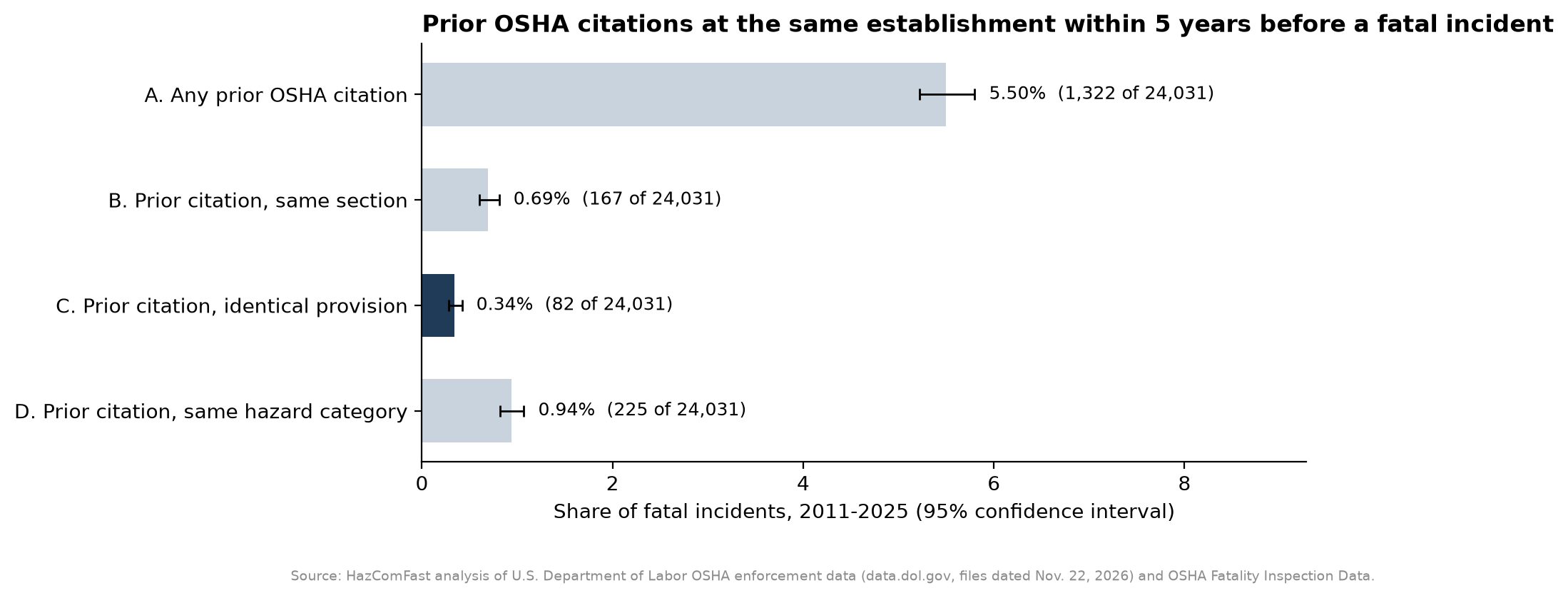
The main definition identifies a hazard-specific citation linked to the death in 10,385 incidents. Of the other 13,646 incidents, 7,735 had no citation, 3,315 had citations but none for a specific hazard, and 2,596 had a hazard-specific citation without a link to the death under this definition. Among the 10,385 incidents with a related hazard-specific citation, the identical-provision share is 0.79%.
For 2011–2024, 78 of 22,493 incidents meet the identical-provision definition (0.35%). For 2025, the count is 4 of 1,538 (0.26%).
The two unresolved item-to-accident relationships concern Wilbert Plastic Services and United Granite. The accident summaries describe a running CNC tool and a falling stone slab, respectively, but do not establish how the precise periodic-inspection, forklift-modification or operator-training items relate to those events. Both matches use the fallback classification. Excluding these incidents leaves 80 incidents (0.33%; 95% CI 0.27–0.41%), involving 85 workers (Table 10e).
Martinrea is retained because the precise item carries OSHA’s related-event code. Alexander Valley Cellars is classified under the fallback rule: the storage provision corresponds to a falling wine-pallet event reported by police through contemporaneous news coverage. Its later citation was contested and has no final-order date in the record used here. This is a classification of a citation and an accident mechanism, not a finding of legal liability.
Of the 82 identical-provision cases, 55 have at least one matching earlier citation that became a final order before the incident. In 9, the recorded final-order dates are on or after the incident. In 18, no final-order date is recorded (Table 10b).
Most fatal worksites had no recent OSHA history at all
For 22,186 of the 24,031 incidents (92.3%), we found no OSHA inspection of the same establishment in the five years before the death. Even counting looser, medium-confidence matches, the share without a recent inspection stays near 90%.
That reflects how rarely OSHA and its state partners reach any individual workplace. Federal and State Plan inspectors together opened between about 69,500 and 76,300 inspections a year in 2022–2025, according to the Labor Department's inspection file, for millions of U.S. workplaces. A worksite that has not been inspected cannot have been cited. In most fatal incidents, then, the records show no earlier citation of the same worksite within five years. That does not mean the employer had never been cited, at another address or earlier.
Where warnings existed, they were in factories
| Industry (NAICS sector) | Fatal incidents | Any prior citation | Identical provision | 95% CI (%) |
|---|---|---|---|---|
| Construction | 7,888 | 47 (0.60%) | 1 (0.01%) | 0.00–0.07 |
| Manufacturing | 3,261 | 811 (24.87%) | 66 (2.02%) | 1.59–2.57 |
| Administrative, support & waste management services | 2,687 | 36 (1.34%) | 3 (0.11%) | 0.04–0.33 |
| Transportation & warehousing | 2,021 | 120 (5.94%) | 2 (0.10%) | 0.03–0.36 |
| Agriculture, forestry, fishing & hunting | 1,515 | 50 (3.30%) | 4 (0.26%) | 0.10–0.68 |
| Wholesale trade | 1,035 | 93 (8.99%) | 4 (0.39%) | 0.15–0.99 |
| All other sectors | 5,624 | 165 (2.93%) | 2 (0.04%) | 0.01–0.13 |
Table 6. All other sectors combines the remaining sectors.
Manufacturing accounts for 14% of the fatal incidents and 80% of the identical-provision cases. Fixed plants can accumulate an inspection history at one address. Construction projects often move between addresses, and this study treats each physical worksite separately.
The single construction match does not measure how often a contractor was cited across different projects. A roofing contractor cited at one address and involved in a death at another address does not meet this study’s same-establishment definition.
Which hazards recur?
Lockout/tagout and machine guarding account for the largest numbers of identical-provision matches. These categories cover hazards associated with equipment that can remain at the same establishment for years.
| Hazard category linked to the death | Incidents with such a citation | Same section | Identical provision | 95% CI, identical (%) |
|---|---|---|---|---|
| Lockout/tagout (hazardous energy) | 1,038 | 63 (6.07%) | 35 (3.37%) | 2.43–4.65 |
| Machine guarding | 860 | 40 (4.65%) | 25 (2.91%) | 1.98–4.26 |
| Fire, explosion & flammables | 368 | 10 (2.72%) | 5 (1.36%) | 0.58–3.14 |
| Powered industrial trucks | 826 | 20 (2.42%) | 4 (0.48%) | 0.19–1.24 |
| Toxic exposure & respiratory | 536 | 8 (1.49%) | 4 (0.75%) | 0.29–1.90 |
| State Plan standards without a mapped category | 963 | 6 (0.62%) | 4 (0.42%) | 0.16–1.06 |
| Confined spaces & engulfment | 411 | 7 (1.70%) | 3 (0.73%) | 0.25–2.12 |
| Falls | 3,316 | 17 (0.51%) | 2 (0.06%) | 0.02–0.22 |
| Electrical | 1,163 | 12 (1.03%) | 2 (0.17%) | 0.05–0.62 |
| Personal protective equipment (general) | 1,004 | 5 (0.50%) | 1 (0.10%) | 0.02–0.56 |
| Cranes, hoists & rigging | 474 | 2 (0.42%) | 1 (0.21%) | 0.04–1.19 |
| Materials handling & storage | 206 | 1 (0.49%) | 1 (0.49%) | 0.09–2.70 |
| Vehicles & mobile equipment | 379 | 0 (0.00%) | 0 (0.00%) | 0.00–1.00 |
| Trenching & excavation | 288 | 0 (0.00%) | 0 (0.00%) | 0.00–1.32 |
| Logging & tree work | 223 | 0 (0.00%) | 0 (0.00%) | 0.00–1.69 |
Table 5. An incident can appear in more than one category.
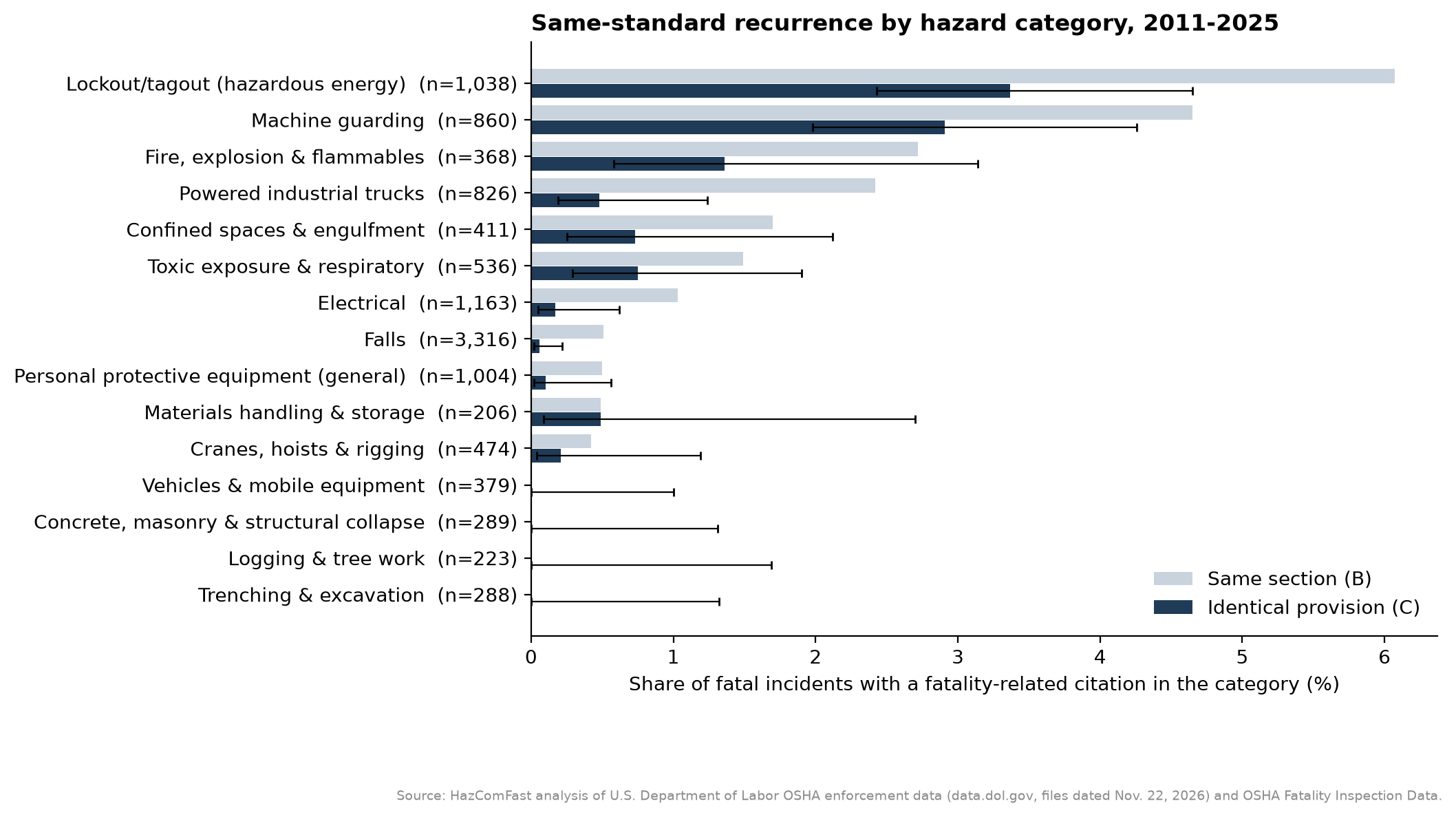
A zero means no match was identified under the stated rules. It does not establish the absence of earlier hazards or employer-wide citation history. The confidence intervals reflect the number of recorded incidents; they do not include uncertainty from worksite matching or citation classification.
How long before the death was the establishment cited?
For the 82 identical-provision cases, the median interval from the most recent matching citation to the death was 920.5 days. In 22 cases, that citation had been issued less than one year before the incident.
| Interval from citation to death | Identical provision | Same section | Any citation |
|---|---|---|---|
| Less than 1 year | 22 (26.8%) | 52 (31.1%) | 449 (34.0%) |
| 1–2 years | 14 (17.1%) | 32 (19.2%) | 300 (22.7%) |
| 2–3 years | 17 (20.7%) | 31 (18.6%) | 231 (17.5%) |
| 3–4 years | 16 (19.5%) | 26 (15.6%) | 189 (14.3%) |
| 4–5 years | 13 (15.9%) | 26 (15.6%) | 153 (11.6%) |
| Median | 920.5 days | 691 days | 623.5 days |
Table 7.
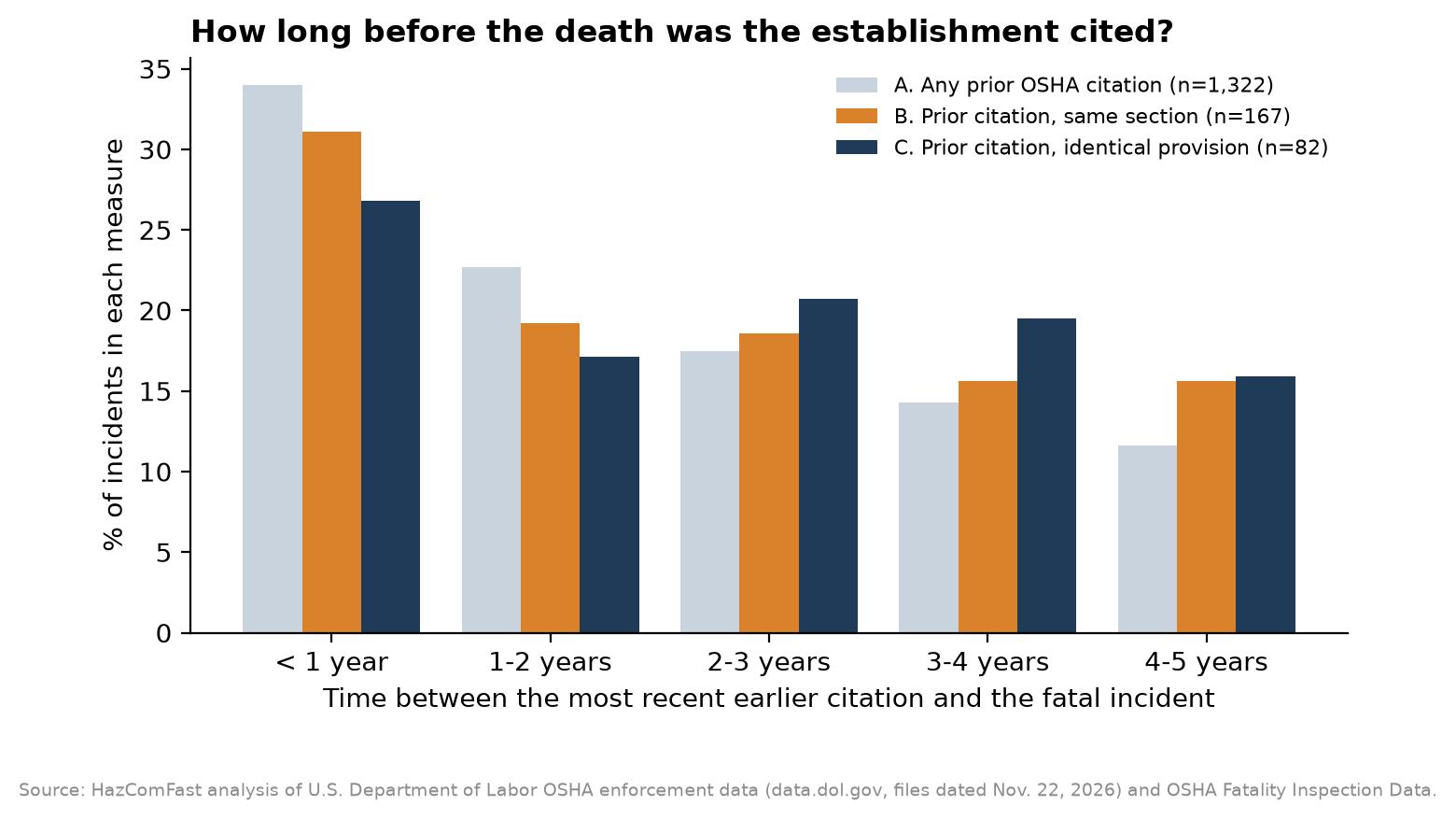
Some earlier citations were issued only weeks before a death, while a contest period or settlement was still pending. The interval alone does not establish whether the employer had corrected the condition or had a realistic opportunity to act.
Repeated citations
| Earlier inspections citing the identical provision | Fatal incidents |
|---|---|
| 1 earlier inspection | 75 |
| 2 | 6 |
| 3 or more | 1 |
Table 8.
The workbook also identifies the type of the most recent earlier inspection and the current classification and outcome of matching citation items (Tables 8b–8c). Earlier citations are counted from their issuance dates. This measure is distinct from a later citation’s legal classification as Repeat, which requires additional conditions.
Current classifications and penalties may reflect settlements. A zero-dollar item remains a citation unless it was deleted; proposed penalties and current penalties are reported separately.
Industry and state differences
| Jurisdiction | Fatal incidents | Identical provision | 95% CI (%) |
|---|---|---|---|
| Federal | 13,720 | 48 (0.35%) | 0.26–0.46 |
| State | 10,148 | 33 (0.33%) | 0.23–0.46 |
| Unknown | 163 | 1 (0.61%) | 0.11–3.39 |
Table 6b.
State-by-state results are in the workbook. Most states have fewer than five identical-provision cases, too few to support a reliable ranking. Industry mix, inspection frequency and the recording of citation relationships all affect these comparisons.
Under the main definition, 15 of the 82 identical-provision cases depend on the fallback rule. Table 10c separates results using the related-event designation from those adding the fallback classification. Differences in recording practices affect the counts, particularly in State Plan jurisdictions. Two fallback-dependent cases have unresolved item-to-accident relationships; Table 10e excludes them.
Case studies
These cases illustrate different hazards, citation intervals and case outcomes in public OSHA records. Workers are not identified.
1. Rescue procedures for confined spaces: Alpha Technical Services, Pasadena, Texas
- May 24, 2019. An employee of this waste-management company was sickened by aniline exposure while digging out residue from a tanker trailer.
- May 29, 2019. OSHA opened an inspection following a referral.
- Oct. 25, 2019. OSHA cited the company for violations including 29 CFR 1910.146(d)(9). That provision of the permit-required confined space standard requires procedures for rescuing entrants and summoning emergency services. OSHA also cited a hazard-communication training provision.
- Nov. 14, 2019. In an informal settlement, the penalty on each of those items was reduced from $11,934 to $8,951, and the hazard-communication item was reclassified from Serious to Other-than-serious.
- Dec. 28, 2019, 64 days after the citations. Two employees were killed by chemical exposure and asphyxiation inside a tanker truck. According to OSHA's investigation summary, one of them had entered the tank to rescue the other, and five other employees involved in rescue attempts were hospitalized.
- June 24, 2020. OSHA issued citations from the fatality investigation, including Repeat citations for the same two provisions, with proposed penalties of $134,937 each. The company contested them. A formal settlement in February 2021 left both items classified as Repeat, at $134,937 each.
2. Lockout eleven days later: Rich Products Corporation, Crest Hill, Illinois
- February 2021. An employee at this frozen-food plant broke a wrist and forearm when a glove was pulled into a running conveyor during cleaning, according to OSHA's investigation summary. OSHA opened an inspection after a referral.
- July 9, 2021. OSHA cited the plant for a Serious violation of 1910.147(d), the paragraph setting out the sequence of steps for shutting down, isolating and locking out machinery before servicing, with a proposed penalty of $13,653.
- July 20, 2021, eleven days after that citation. An employee hand-cleaning a conveyor belt was pulled into machine rollers when a coworker started the machine, according to OSHA's investigation summary. The employee died. The earlier citation was not yet final; fewer than fifteen working days had elapsed since issuance.
- Aug. 3, 2021. An informal settlement reduced the July penalty to $12,000.
- Jan. 19, 2022. OSHA cited the same provision again, this time as a Willful violation, with a proposed penalty of $145,027. The company contested. A formal settlement in August 2022 reclassified the item as Repeat, with the penalty unchanged.
3. Grain bin entry, four and a half years apart: Prinz Grain & Feed, West Point, Nebraska
- September 2011. A planned OSHA inspection led to Serious citations under the grain-handling standard. One was for 1910.272(g)(1)(i), which requires an entry permit for bins, silos and tanks unless the employer, or the employer's representative who would otherwise authorize the permit, is present during the entire operation. Another was for 1910.272(g)(4), which requires rescue equipment suited to the bin. An informal settlement cut both penalties in half, to $2,100 and $1,500.
- May 18, 2016. An employee was engulfed and killed in a grain bin.
- Nov. 3, 2016. OSHA cited the permit provision as Willful, with a proposed penalty of $124,709, and the rescue-equipment provision as Serious. After a formal settlement in 2017, the two penalties stood at $53,208 and $5,321.
The 2016 citations also included, as a Willful violation, the provision barring entry where grain built up on the walls could fall and bury a worker, 1910.272(g)(6). That provision had not been cited in 2011.
4. Two deaths in seven months: Mohawk Industries, Chatsworth, Georgia
- Sept. 1, 2017. A worker at this carpet plant was caught between a machine and another surface and killed, according to OSHA's investigation summary.
- Feb. 28, 2018. OSHA's investigation produced a Serious citation under the general machine-guarding requirement, 1910.212(a)(1), with a proposed penalty of $12,934.
- March 20, 2018, three weeks after that citation. Another worker at the plant was struck and killed by a steel carrier roll weighing about 1,000 pounds. The February citation was not yet final; an informal settlement on March 29 left its penalty unchanged.
- Sept. 19, 2018. OSHA cited the same provision as a Repeat violation, with a proposed penalty of $71,137, which an informal settlement also left unchanged.
The Goodyear Tire & Rubber plant in Danville, Virginia, shows a similar sequence with lockout/tagout. Virginia enforces workplace safety through its own State Plan, so these citations came from the state program. After a death in August 2015, it issued Serious citations for two lockout provisions in February 2016. Goodyear contested them, and they were settled only in February 2017. In the meantime, a second worker died in April 2016 and a third in August 2016. After the third death, the state program cited the same two provisions as Willful, with proposed penalties of $140,000 and $750,000. Goodyear contested those citations as well. The public record retains contest entries and the original penalty amounts, while listing the inspection as closed on August 15, 2022. Those fields alone do not establish the final legal disposition of the individual items.
5. A citation changed in settlement: Hy-Tech Mushroom Compost, West Grove, Pennsylvania
- November 2024. After a referral inspection, OSHA cited this compost producer for lockout/tagout violations, including 1910.147(c)(4)(i), grouped with two related lockout items under a single penalty. An informal settlement in February 2025 reduced that penalty from $11,292 to $7,340.
- May 1, 2025. A worker was killed at the facility.
- Oct. 30, 2025. OSHA cited the same provision as a Repeat violation, with a $39,720 proposed penalty. OSHA's inspection page shows this original classification.
- April 2026. The company had contested, and a formal settlement reclassified the item as Serious at $23,832.
This case shows why a citation, a proposed penalty and a final outcome must be kept distinct. The same citation item can be recorded three different ways over the life of one case.
Full records for these and other cases, including citation numbers, dates, classifications, proposed and current penalties and the latest recorded event, are in the downloadable workbook.
Were fatality sites cited more often than similar sites where no one died?
The comparison starts with 10,549 fatality inspections covering 10,385 incidents with a related hazard-specific citation. Some incidents involve several inspected employers.
Each case inspection is matched to up to three nonfatal inspections citing the same section, in the same state, enforcement jurisdiction, industry sector and year. Employer size is matched where enough controls exist. The case index date is the incident date; the control index date is the inspection opening date. Earlier citations use the same five-year timing and worksite-matching rules in both groups.
Controls were found for 6,932 case inspections (66%), including 5,104 with three controls, for a total of 17,781 controls. Each matched set receives equal weight. Confidence intervals resample entire incidents so that inspections arising from the same incident remain together.
| Earlier citation within five years | Fatality establishments | Matched controls | Difference, points (95% CI) | Ratio (95% CI) |
|---|---|---|---|---|
| Any citation | 6.90% | 7.73% | -0.83 (-1.46 to -0.16) | 0.89 (0.81–0.98) |
| Same section | 1.80% | 2.21% | -0.41 (-0.77 to -0.06) | 0.82 (0.67–0.97) |
| Identical provision | 0.88% | 1.00% | -0.12 (-0.37 to 0.15) | 0.88 (0.66–1.15) |
Table 9.
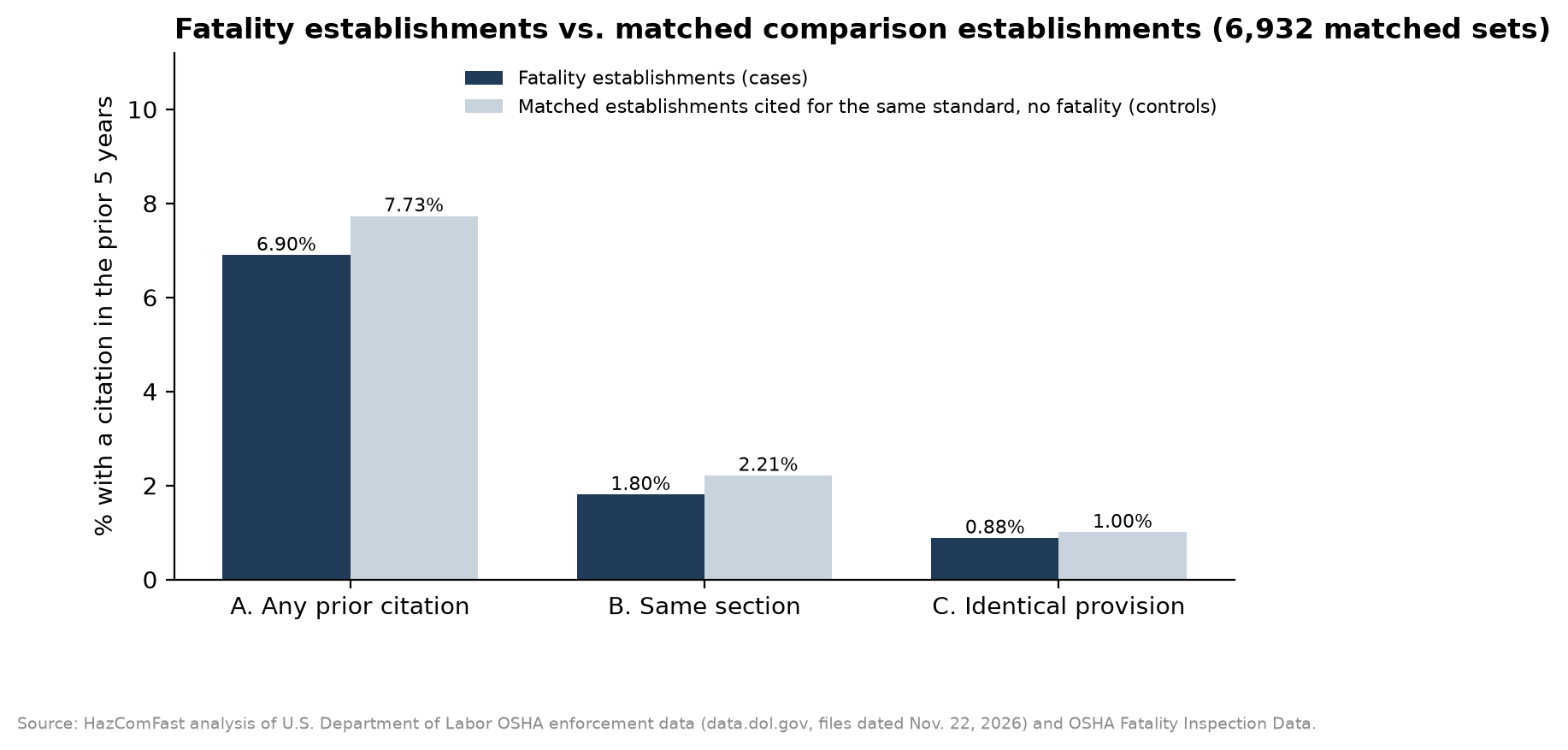
The primary, identical-provision comparison did not establish a difference: its interval includes a ratio of one and a difference of zero. In the secondary comparisons, prior citations under any provision and under the same section were less frequent among fatality establishments than among the selected controls; their bootstrap difference intervals exclude zero. Conventional Mantel–Haenszel p-values are 0.503 for the identical provision, 0.043 for the same section and 0.025 for any citation.
When controls are limited to complaint, referral and nonfatal-accident inspections, the identical-provision rates are 1.10% for cases and 1.40% for controls. Same-section rates are 2.17% and 2.97%, respectively (Table 9b).
Both groups consist of inspected establishments cited under the same standard. They are not a representative sample of U.S. employers. The reasons for inspection differ, and follow-up inspections are excluded from controls. Results depend on the matching criteria and selected controls. The comparison cannot estimate an employer’s risk of a fatal incident or determine the preventive effect of a citation.
What the numbers do not tell us
- Worksite matching. Company names, addresses and establishment identifiers can change or refer to several physical sites. Missed matches can lower the count; incorrect matches can raise it. The intervals do not include these classification errors.
- The identical provision can cover different conditions. A match does not establish that both citations concern the same machine, task or department, or that the earlier condition persisted until the death.
- Citations are allegations. Employers can contest them. Settlements can delete or reclassify items and reduce penalties. The study excludes deleted items and distinguishes proposed penalties from current amounts. A contested citation is not presented as a final finding.
- Citation relationships. OSHA’s designation is used where recorded, with exclusions where detailed citation text identifies a different hazard. Elsewhere, the fallback rule classifies hazard-specific items against the accident mechanism. The exact relationship is unresolved in two of the 82 identical-provision cases; excluding them gives 80 cases.
- Inspection coverage. The cohort includes OSHA-investigated deaths, not all U.S. occupational fatalities. It excludes COVID-19 illness deaths, incidents without a usable inspection link and deaths outside the records used here. Inspections are not random.
- State Plan rules. Federal provisions and California and Washington rules are grouped by hazard. Other State Plan rules contribute to the same-section and identical-provision measures but are not grouped by hazard category. Rare state codes may be misclassified.
- 2025 records. These incidents come from OSHA’s fatality inspection list. Its bulk records lack accident-mechanism codes. The fallback-dependent Alexander Valley case is corroborated by contemporaneous reporting attributed to police, and its citation remains contested in the record used. One separate 2025 incident has two possible spelling variants treated as one victim; treating them as distinct people would increase the recorded worker total by one, without changing incident counts or incident-based percentages.
- Records change. The results describe the source versions listed in the workbook. Later settlements, corrections and additions can change counts.
- Causality. These descriptive data cannot show that a citation prevented or failed to prevent a death.
Conclusion
An identical-provision citation at the same establishment in the preceding five years appears in 82 of 24,031 eligible fatal incidents (0.34%). Excluding two unresolved item-to-accident relationships leaves 80 (0.33%). Any earlier citation appears in 1,322 incidents (5.50%).
The largest constraint on these counts is the absence of recent worksite inspection history: 92.3% of incidents had no matched inspection at the same establishment within five years. Identical-provision matches are concentrated in manufacturing. The matched comparison does not establish an identical-provision difference. The lower prevalence of any prior citation and same-section citations among fatality establishments is a descriptive association within the selected inspection groups.
The workbook identifies the inspections and citation items supporting each match, including issuance dates, case outcomes and the evidence basis for the relationship to the incident.
How the analysis was done
Data
We used the U.S. Department of Labor's OSHA enforcement files: inspections, citation items, accident investigations, the workers injured or killed, and the history of each citation item. We used the versions dated Nov. 22, 2026, downloaded from data.dol.gov on Nov. 23, 2026. The Labor Department's accident tables end in March 2025, so incidents from 2025 come from OSHA's Fatality Inspection Data, retrieved from osha.gov/fatalities on Nov. 23, 2026. The same OSHA page supplied the agency's internal establishment numbers for inspections opened since 2011. The workbook lists the version and checksum of every file used.
Who is included
| Step | Incidents | Workers killed |
|---|---|---|
| Accident investigations in the Labor Department files marked as fatal or with a worker recorded as killed, all years | 72,614 | 74,965 |
| Excluded: incident date outside 2011–2024 | 47,086 | 48,866 |
| Excluded: no worker recorded as killed | 142 | 0 |
| Excluded: COVID-19 illness deaths | 2,851 | 3,002 |
| Excluded: no linked inspection record | 13 | 14 |
| Excluded: duplicate records | 29 | 30 |
| Included, 2011–2024 | 22,493 | 23,053 |
| Incidents on OSHA's fatality list dated 2025 | 1,728 | |
| Excluded: no fatality recorded, typically because OSHA lacked jurisdiction | 179 | |
| Excluded: duplicate records | 11 | |
| Included, 2025 | 1,538 | 1,605 |
| Included, 2011–2025 | 24,031 | 24,658 |
Table 1.
An incident is a single event. It can kill more than one worker and lead OSHA to inspect more than one employer, so incidents, workers and inspections are counted separately. COVID-19 illness deaths were excluded from the study population. The results therefore describe the remaining OSHA-investigated fatal incidents and should not be generalized to all occupational diseases. Deaths that may have had natural causes, such as heart attacks, were kept because OSHA investigated them; excluding them changes little (Table 10).
The 2025 incidents come from OSHA's list of fatality inspections, linked to the Labor Department's files by inspection number. The overlapping years provide a comparison of the two source populations; Table 10 reports the result restricted to incidents also appearing on OSHA’s fatality list. The 2025 source has different fields and coverage, so its figures are reported separately as well as in the combined cohort.
When OSHA inspected several employers after one incident, a victim can appear under more than one inspection. The worker count combines victim entries across inspections and removes duplicate entries. For 2025, this meant comparing the victims OSHA lists under each inspection of the same incident.
Matching the same establishment
Public OSHA data have no reliable identifier for a physical worksite. A field that resembles one holds a placeholder for every inspection opened since 2016, and OSHA's internal establishment number often follows a contractor from one job site to the next. We therefore compared standardized addresses and names. An earlier inspection was treated as the same establishment when it had the same street address, with the same ZIP code or city, and either a closely matching name or the same OSHA establishment number. Only these high-confidence matches count in the results; looser matches appear only in Table 10.
Citations linked to the death, and hazard categories
OSHA's field manual tells inspectors to flag each citation item directly related to a fatality, and we used that flag. When an inspection had no flagged item, we used its Serious, Willful or Repeat citations for specific hazards, provided the hazard fit the accident as OSHA recorded it, for example a fall-protection citation for a fall. The 2025 bulk records have no accident-mechanism codes. The sole fallback-dependent 2025 identical-provision case is corroborated by a contemporaneous account attributed to police. Two citation items whose detailed descriptions identify hazards different from the fatal event are excluded from the related-citation definitions; they remain in the deliberately broader variant that includes every hazard-specific item.
Standards were grouped into hazard categories by their place in the Code of Federal Regulations, for example 1926.500–.503 for falls and 1910.147 for lockout/tagout. California and Washington rules were grouped by their official titles. Rules from other State Plans were not grouped: they count in the same-section and identical-provision measures, but not in the hazard-category measure.
Statistics
Shares of incidents are reported with 95% Wilson confidence intervals. Shares of workers use intervals from 2,000 bootstrap samples of whole incidents, because deaths in the same incident are not independent. In the comparison group, each matched set counts equally, intervals come from 2,000 bootstrap samples of whole incidents, and conventional Mantel–Haenszel tests compare the two groups. The Mantel–Haenszel p-values do not adjust for dependence between matched sets arising from the same incident; interpretation relies on the incident-cluster bootstrap intervals. The tests are not adjusted for multiple comparisons; the identical-provision measure is the primary comparison.
How sensitive are the results?
| Definition, 2011–2024 unless noted | Incidents | Share (95% CI) |
|---|---|---|
| Main definition | 78 of 22,493 | 0.35% (0.28–0.43) |
| Look-back 1 year | 20 of 22,493 | 0.09% (0.06–0.14) |
| Look-back 3 years | 52 of 22,493 | 0.23% (0.18–0.30) |
| Related-event designation, with documented exclusions | 64 of 22,493 | 0.28% (0.22–0.36) |
| Every hazard-specific item of the inspection | 131 of 22,493 | 0.58% (0.49–0.69) |
| High- and medium-confidence establishment matches | 91 of 22,493 | 0.40% (0.33–0.50) |
| Same OSHA establishment record at any site (employer level) | 106 of 22,493 | 0.47% (0.39–0.57) |
| Deleted citation items included | 84 of 22,493 | 0.37% (0.30–0.46) |
| Excluding apparent natural-cause / medical deaths | 76 of 19,851 | 0.38% (0.31–0.48) |
| Incidents 2015-2024 also on OSHA's fatality list (same source as 2025) | 52 of 15,238 | 0.34% (0.26–0.45) |
Table 10. The every-item variant intentionally includes hazard-specific citations without requiring a relationship to the accident. Confidence intervals quantify sampling variation in the recorded observations, not worksite-linkage or citation-classification error.
Data availability
The tables behind every figure in this article, the chart data, the list of the 82 identical-provision cases with links to OSHA's inspection pages, and the versions of the source files are in the downloadable Excel workbook. Table numbers in this article refer to the sheets of the workbook.
Sources
- U.S. Department of Labor, OSHA enforcement data: Inspection, Violation, Accident, Accident Injury, Accident Abstract, Violation Event and related datasets, versions dated Nov. 22, 2026. https://data.dol.gov/. Downloaded Nov. 23, 2026.
- Occupational Safety and Health Administration, Fatality Inspection Data. https://www.osha.gov/fatalities. Accessed Nov. 23, 2026.
- Occupational Safety and Health Act of 1970, Sec. 5 (General Duty Clause) and Sec. 10 (enforcement procedure). https://www.osha.gov/laws-regs/oshact/. Accessed Nov. 23, 2026.
- 29 CFR 1904.39, Reporting fatalities, hospitalizations, amputations, and losses of an eye. https://www.osha.gov/laws-regs/regulations/standardnumber/1904/1904.39. Accessed Nov. 23, 2026.
- OSHA Field Operations Manual, CPL 02-00-164: Chapter 4 (Violations), Chapter 7 (Post-Citation Procedures and Abatement Verification), Chapter 9 (Complaint and Referral Processing) and Chapter 11 (Imminent Danger, Fatality, Catastrophe, and Emergency Response). https://www.osha.gov/fom/chapter-4, https://www.osha.gov/fom/chapter-7, https://www.osha.gov/fom/chapter-9 and https://www.osha.gov/fom/chapter-11. Accessed Nov. 23, 2026.
- OSHA, Severe Violator Enforcement Program. https://www.osha.gov/enforcement/svep. Accessed Nov. 23, 2026.
- OSHA, State Plans. https://www.osha.gov/stateplans. Accessed Nov. 23, 2026.
- Electronic Code of Federal Regulations, 29 CFR 1910.146, 1910.147, 1910.212, 1910.272 and 1910.1200 (as of Nov. 19, 2026). https://www.ecfr.gov/. Accessed Nov. 23, 2026.
- OSHA establishment inspection detail pages for the case studies, accessed Nov. 23, 2026:
- Alpha Technical Services: https://www.osha.gov/ords/imis/establishment.inspection_detail?id=1404259.015 and https://www.osha.gov/ords/imis/establishment.inspection_detail?id=1453365.015
- Rich Products: https://www.osha.gov/ords/imis/establishment.inspection_detail?id=1515904.015 and https://www.osha.gov/ords/imis/establishment.inspection_detail?id=1543088.015
- Prinz Grain & Feed: https://www.osha.gov/ords/imis/establishment.inspection_detail?id=314062696 and https://www.osha.gov/ords/imis/establishment.inspection_detail?id=1149329.015
- Mohawk Industries: https://www.osha.gov/ords/imis/establishment.inspection_detail?id=1263259.015 and https://www.osha.gov/ords/imis/establishment.inspection_detail?id=1303268.015
- Goodyear Tire & Rubber: https://www.osha.gov/ords/imis/establishment.inspection_detail?id=1089281.015, https://www.osha.gov/ords/imis/establishment.inspection_detail?id=1139753.015 and https://www.osha.gov/ords/imis/establishment.inspection_detail?id=1172502.015
- Hy-Tech Mushroom Compost: https://www.osha.gov/ords/imis/establishment.inspection_detail?id=1755357.015 and https://www.osha.gov/ords/imis/establishment.inspection_detail?id=1822221.015
- Mendeloff JM, Kagey BT. Using Occupational Safety and Health Administration accident investigations to study patterns in work fatalities. Journal of Occupational Medicine. 1990;32(11):1117–1123. doi:10.1097/00043764-199011000-00015.
- Levine DI, Toffel MW, Johnson MS. Randomized government safety inspections reduce worker injuries with no detectable job loss. Science. 2012;336(6083):907–911. doi:10.1126/science.1215191.
- Haviland AM, Burns RM, Gray WB, Ruder T, Mendeloff J. A new estimate of the impact of OSHA inspections on manufacturing injury rates, 1998–2005. American Journal of Industrial Medicine. 2012;55(11):964–975. doi:10.1002/ajim.22062.
- Veltri A, Pagell M, Parkinson M. Do regulatory inspections make workers safer? Journal of Safety Research. 2026;97:67–73. doi:10.1016/j.jsr.2026.01.019.
Additional sources for citation classification: OSHA citation descriptions in the Labor Department’s Violation General Duty Standard file (version listed in the workbook); OSHA QuickTakes, August 15, 2016, https://obis.osha.gov/as/opa/quicktakes/qt081516.html; California Title 8, section 3241, https://www.dir.ca.gov/title8/3241.html; Bay City News / ABC7, April 3, 2025, https://abc7news.com/amp/post/windsor-forklift-operator-crushed-death-pallet-wine-authorities-say/16125604/.
Federal OSHA penalty limits were last checked against the eCFR, OSHA.gov and the Federal Register on October 19, 2026, and HCS transition dates on June 23, 2026. Last reviewed November 24, 2026.
About This Article
Published by: HazComFast
Published: November 24, 2026
Last Updated: November 24, 2026
This content is for informational purposes only and does not constitute legal advice.