
No, OSHA does not require safety data sheets in Spanish. It requires the training to be in a language your workers understand. The two obligations live in the same standard, 29 CFR 1910.1200, and employers get them backwards all the time: they pay to translate a binder that the rule says must be in English, then deliver the training in English to a crew that reads Spanish. The first spend is optional. The second gap is the one a compliance officer writes up.
29 CFR 1910.1200(g)(2) requires the safety data sheet to be in English and only permits copies in other languages. The same standard's training paragraph, (h)(1), requires effective information and training, and OSHA has read "effective" since 1998 to mean training in a language and vocabulary the employee understands. An inspector who finds a Spanish-speaking crew trained only in English cites the training paragraph; an inspector who finds English SDSs and no Spanish copies cites nothing under 1910.1200(g).
The question the inspector asks first
A framing crew on a mid-rise in Houston. Eleven workers, seven of whom read Spanish and get their instructions from the foreman in Spanish. The general contractor's binder holds the SDS for the construction adhesive, the PVC primer and the muriatic acid the masons use, all in English, all current. The compliance officer does not open the binder first. She pulls two of the seven aside and asks, in Spanish, what the pictogram on the acid drum means and where they would find the sheet if it splashed. That interview is the test. The binder is the exhibit.
That order is not an accident. OSHA's inspection directive for the standard, CPL 02-02-079 (the HCS 2024 edition, signed April 30, 2026 and effective May 19, 2026), tells the officer what to focus on under the training paragraph, and the first two items are questions about people, not paper: "Is a training program in place? Have workers been trained in a language and at a literacy level they understand?"
What the standard actually says about language
Four passages of 1910.1200 mention language. Read them together and the pattern is consistent: the documents are required in English and merely permitted in other languages; the training has no language named, because it is judged on whether it worked.
| Element | What the text says | Where |
|---|---|---|
| Safety data sheet, 1910.1200(g)(2) | "The chemical manufacturer or importer shall ensure that the safety data sheet is in English (although the employer may maintain copies in other languages as well)" | (g)(2) |
| Shipped-container label, 1910.1200(f)(2) | Information must be "prominently displayed, and in English (other languages may also be included if appropriate)" | (f)(2) |
| Workplace label, 1910.1200(f)(10) | "legible, in English, and prominently displayed on the container... Employers having employees who speak other languages may add the information in their language to the material presented, as long as the information is presented in English as well" | (f)(10) |
| Training, 1910.1200(h)(1) | "Employers shall provide employees with effective information and training on hazardous chemicals in their work area at the time of their initial assignment, and whenever a new chemical hazard the employees have not previously been trained about is introduced" | (h)(1) |
Notice who owes what. The SDS language duty in 1910.1200(g)(2) sits on the manufacturer or importer, not on you. Your duty under 1910.1200(g)(1) is to "have a safety data sheet in the workplace for each hazardous chemical" you use. Nothing in (g) asks you to produce a second version of it.
The word that carries the training obligation is effective. It appears in 1910.1200(h)(1) without a definition, and that is where OSHA's policy documents take over.
"Effective" means understood, and OSHA has said so since 1998
On April 28, 2010, OSHA's Assistant Secretary issued the Training Standards Policy Statement, a memorandum to every regional administrator that still governs enforcement. Its core sentence:
"In practical terms, this means that an employer must instruct its employees using both a language and vocabulary that the employees can understand. For example, if an employee does not speak or comprehend English, instruction must be provided in a language the employee can understand."
The memo is explicit that the wording of the individual standard does not matter: "regardless of the precise regulatory language, the terms 'train' and 'instruct,' as well as other synonyms, mean to present information in a manner that employees receiving it are capable of understanding." And it names HazCom as the oldest example, quoting the 1998 compliance directive CPL 2-238(D): "[i]f the employees receive job instructions in a language other than English, then training and information to be conveyed under the [hazard communication standard] will also need to be conducted in a foreign language."
The 2026 directive turns that policy into inspection procedure. CPL 02-02-079 lists what a written hazard communication program must cover under (h)(1) through (h)(3), "including how to train employees in a language and at a literacy level they understand." On the training itself: "Training must be conducted in a language and at a literacy level employees understand. If an employer has employees who speak different languages or are at different literacy levels, the employer may need to create different materials for different groups of employees." And on citations: where "the training wasn't provided in a language and at a literacy level employees understand, citations should normally be issued under (h)(1)."
Literacy is the part employers miss. The 2010 memo adds that "if employees are not literate, telling them to read training materials will not satisfy the employer's training obligation." Handing a Spanish-speaking worker a Spanish SDS and calling it training fails on both counts: it is not training, and it assumes he reads.
Do you have to translate the sheet? The directive answers
The same directive answers the SDS question in one line, under employee access: "There is no requirement to translate SDSs (e.g., into a foreign language, braille)." It follows with a recommendation, not a rule: "it is recommended that the employer ensure that information from the SDS is available to employees in a manner they would understand easily in case of emergency."
That sentence is the practical boundary. You are not required to translate the sheet. You are required to make its content reach the worker, and the standard gives you the mechanism: training on how to read an SDS, in the worker's language, plus labels and pictograms that carry the hazard without words. OSHA publishes its own Spanish-language QuickCard on the sixteen SDS sections (OSHA 3518, Hojas de datos de seguridad), which tells you how the agency expects the gap to be closed: teach the format in Spanish, keep the sheet in English.
A Spanish copy of the SDS is still a reasonable thing to add for a bilingual crew. Just file it as what (g)(2) calls it, a copy "in other languages as well", next to the English original, never instead of it. If the two ever disagree, the English sheet is the compliance document.
Labels: English required, Spanish welcome on top
Workplace labels are the one place a Spanish-first approach creates a citation. Paragraph 1910.1200(f)(10) requires the label to be "in English" and lets you "add the information in their language... as long as the information is presented in English as well." The directive is blunt about the failure mode: the employer "shall be cited for paragraph (f)(10) if the in-house labeling is not legible (e.g., font size too small), written only in a language other than English, or not prominently displayed."
So a secondary container relabeled in Spanish alone is a violation, even though it is the more useful label for the crew that uses it. The fix costs nothing: print both. The GHS pictograms are identical in either language, which is the point of the harmonized system; the signal word is the one element that translates (Danger / Peligro, Warning / Atención), and it goes next to the English, not in its place.
Construction sites: 1926.59 and the 2010 letter
Nothing above changes on a jobsite. 29 CFR 1926.59 says the requirements applicable to construction work "are identical to those set forth at § 1910.1200," so (g)(2), (f)(10) and (h)(1) apply word for word. The construction training duty in 1926.21(b)(2) is broader still: "The employer shall instruct each employee in the recognition and avoidance of unsafe conditions and the regulations applicable to his work environment."
OSHA answered the language question for construction specifically in a July 26, 2010 interpretation letter, when an employer asked whether workers had to be able to communicate in English. The answer: "there are no OSHA construction standards that specifically require that such information be conveyed and understood in English," and "there is no OSHA requirement that the communication system be based on the English language." What the letter does require is the same thing as the 2010 memo, which it cites: the duty to train "necessarily means that employers must present information in a manner that employees are able to understand."
Read the two letters together and the direction of the obligation is clear. OSHA does not require your workers to learn English. It requires you to reach them in the language they have. The fatality data explains why the agency holds that line: Hispanic and Latino workers die on the job at a rate about a third above the national average, and most of those deaths are among the foreign-born.
Four things the training market sells that the rule leaves out
Search the question that titles this article and the first page is a row of course vendors selling "HazCom in Spanish" without ever saying which part of the standard requires it. Four things they imply are not in the rule:
- A Spanish SDS. Not required; permitted as a copy. 1910.1200(g)(2), and the directive's "no requirement to translate."
- English-speaking workers. Not required. The July 26, 2010 letter says so for construction, and the 2010 memo says the obligation runs to the employer, not the worker.
- A Spanish-only label. Not permitted. 1910.1200(f)(10) requires English, and Spanish may only be added to it.
- An "OSHA-approved" Spanish course. OSHA approves no HazCom course in any language. The standard asks whether your training was effective for your workers, a question a generic certificate cannot answer.
One more thing that is not the rule, at least not yet: on July 11, 2024, H.R. 9006, the Hazardous Workplace Accountability Act of 2024, was introduced to direct OSHA to require manufacturers and importers to produce SDSs in both English and Spanish. It was not enacted. If a vendor tells you bilingual SDSs are mandatory, ask for the citation; there is none in 1910.1200 as it stands in 2026.
A defensible bilingual HazCom program
The written program is where the inspector looks first, and the directive now names language as one of its required elements. Six pieces, each tied to the text that asks for it:
- Write it down. Your written program under 1910.1200(e)(1) must say how you train, and CPL 02-02-079 lists "how to train employees in a language and at a literacy level they understand" among the required elements. One paragraph naming the languages on your crews and how each group is trained does it.
- Train in Spanish, chemical by chemical. 1910.1200(h)(1) is triggered at initial assignment and whenever a new hazard is introduced. Use a Spanish-speaking trainer or a qualified interpreter, and cover the 1910.1200(h)(3) content: how to detect a release, the hazards of the specific chemicals, the protective measures, and how to read the label and the SDS. The construction HazCom guide walks through each element.
- Verify comprehension, in Spanish, and document it. The directive says training "should include an opportunity for employees to ask questions to ensure that they understand." A short oral check in the worker's language, recorded with the date and trainer, is the proof that survives the interview. The training-file checklist shows what that record needs to contain.
- Keep the English SDS on file; add Spanish copies where they help. The English sheet satisfies 1910.1200(g)(1) and (g)(2). A Spanish copy is optional and useful, and it must never replace the original. If you are unsure which products need a sheet at all, start with the exemptions.
- Label in English, add Spanish. 1910.1200(f)(10) in both directions: English is required, Spanish is allowed on top. Same signal word, same pictograms.
- Close the emergency gap. The directive's recommendation is that SDS information be "available to employees in a manner they would understand easily in case of emergency." Teach the crew, in Spanish, where Section 4 (first aid) and Section 6 (spill response) sit on every sheet, using OSHA's own Spanish QuickCard, and make the sheet reachable from the point of use. How to read an SDS covers the sixteen sections in order.
Do those six and the Houston interview ends the way it should: the worker names the pictogram, points to where the sheet lives, and the officer moves on to the binder, which is in English, as required.
How HazComFast fits a bilingual crew
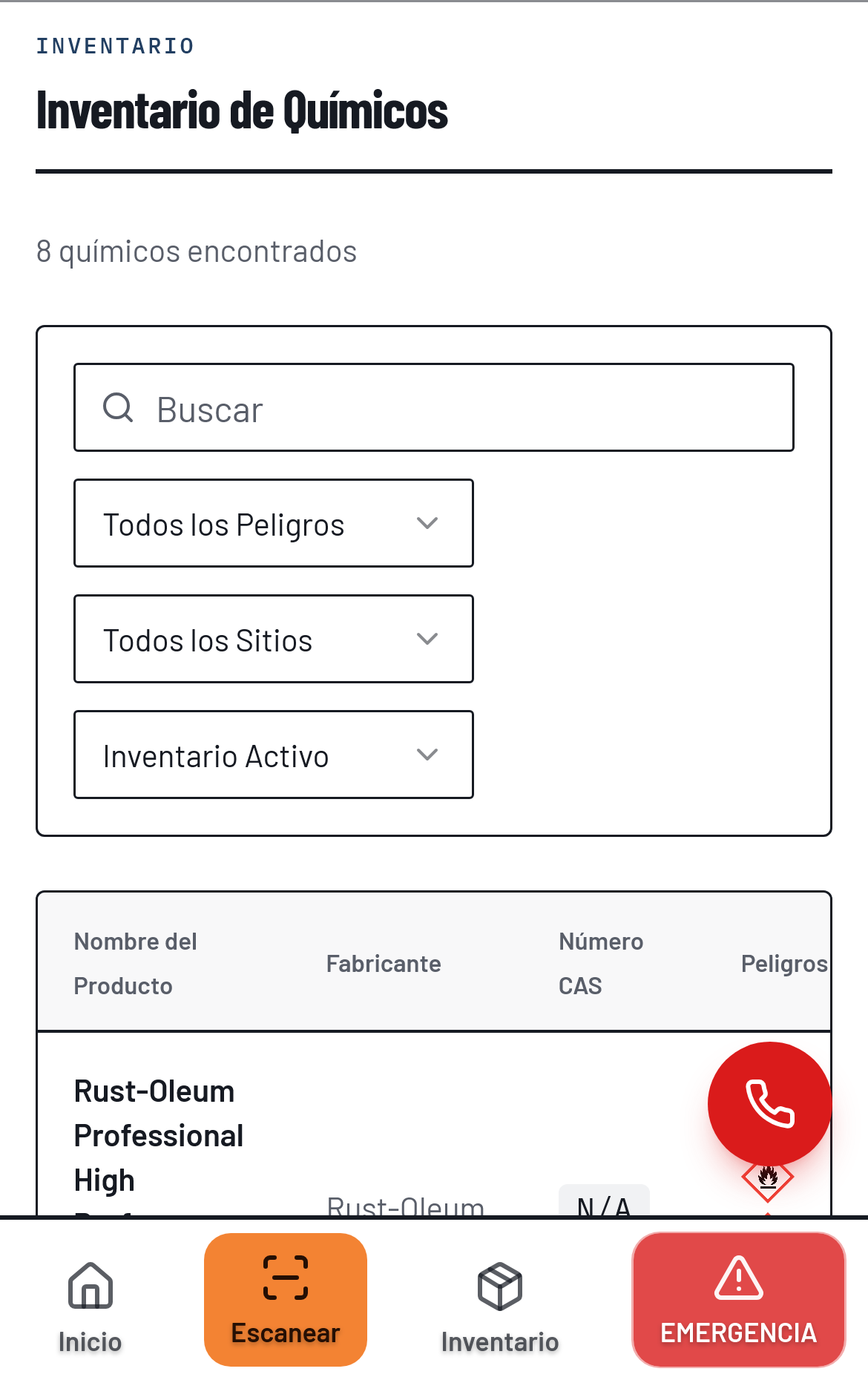
HazComFast keeps the two halves of the rule where the standard puts them. The safety data sheet you upload is stored and served exactly as the manufacturer wrote it, in English, because (g)(2) requires that document and nothing else. The screens your crew uses in the field are a different matter: the app can be set to Spanish at sign-in, and it stays that way on that phone, so the chemical inventory, its search and filters, and the field navigation read in the language the worker actually uses, with the same GHS pictograms next to every product. The sheet stays the compliance document; the path to it is in Spanish.
Training records sit next to the inventory, per employee, with the date and the trainer, which is the record a 1910.1200(h)(1) citation turns on. The free HazCom Training Record generator builds the chemical-specific session sheet if you are not on the platform yet, and the OSHA training requirements hub collects the other standards that carry the same understood-language duty.
Frequently Asked Questions
Does OSHA require safety data sheets in Spanish?
No. 29 CFR 1910.1200(g)(2) requires the chemical manufacturer or importer to ensure the safety data sheet is in English, and adds that the employer may maintain copies in other languages as well. OSHA's HazCom inspection directive, CPL 02-02-079, states it directly: there is no requirement to translate SDSs. A Spanish SDS is permitted, and often a good idea, but the English sheet is the one the standard requires you to have.
Does HazCom training have to be in Spanish if my crew speaks Spanish?
Yes, in the sense that it must be in a language the employee understands. 1910.1200(h)(1) requires effective information and training. OSHA's Training Standards Policy Statement of April 28, 2010 says an employer must instruct its employees using both a language and vocabulary that the employees can understand, and CPL 02-02-079 tells compliance officers that training must be conducted in a language and at a literacy level employees understand. Training a Spanish-only crew in English is cited under (h)(1).
Can I put workplace labels in Spanish only?
No. 1910.1200(f)(10) requires workplace labels to be legible, in English, and prominently displayed. Employers with employees who speak other languages may add the information in their language, as long as the information is presented in English as well. The directive instructs inspectors to cite (f)(10) when in-house labeling is written only in a language other than English.
Does OSHA require my workers to speak or read English?
No. In a July 26, 2010 interpretation letter on English proficiency at construction sites, OSHA answered that there are no construction standards that specifically require training information to be conveyed and understood in English, and that there is no OSHA requirement that the site's communication system be based on the English language. The obligation runs the other way: the employer has to present the information so the worker can understand it.
Do the same rules apply on construction sites?
Yes. 29 CFR 1926.59 states that the requirements applicable to construction work under this section are identical to those set forth at 1910.1200. The general duty to instruct in 1926.21(b)(2) carries the same reading: OSHA's 2010 letter says the duty to train and instruct necessarily means that employers must present information in a manner that employees are able to understand.
Is there a law coming that will require bilingual SDSs?
A bill was introduced. H.R. 9006 in the 118th Congress, the Hazardous Workplace Accountability Act of 2024, would have directed OSHA to require manufacturers and importers to produce SDSs in both English and Spanish. It would have amended section 6(b)(7) of the OSH Act (29 U.S.C. 655(b)(7)). It was not enacted, and the HazCom rule in force in 2026 still requires the SDS in English, with copies in other languages optional (29 CFR 1910.1200(g)(2)). Until a rule changes, treat any claim that Spanish SDSs are mandatory as a sales pitch, not a citation.
OSHA figures and citations here come from our regulatory source-of-truth modules, last checked against the eCFR, OSHA.gov, and the Federal Register on October 5, 2026. Last reviewed October 5, 2026.
About This Article
Published by: HazComFast
Published: August 29, 2026
Last Updated: October 5, 2026
- https://www.ecfr.gov/current/title-29/section-1910.1200
- https://www.ecfr.gov/current/title-29/section-1926.59
- https://www.ecfr.gov/current/title-29/section-1926.21
- https://www.osha.gov/laws-regs/standardinterpretations/2010-04-28
- https://www.osha.gov/laws-regs/standardinterpretations/2010-07-26
- https://www.osha.gov/sites/default/files/enforcement/directives/CPL-02-02-079_0.pdf
- https://www.govinfo.gov/content/pkg/BILLS-118hr9006ih/html/BILLS-118hr9006ih.htm
This content is for informational purposes only and does not constitute legal advice.