
The mechanic clocked out at 3:30. Their lock is still on the disconnect, and production wants the line back for the night shift. The spare key in the supervisor's desk opens the lock. It doesn't answer who is allowed to use it. OSHA's general industry rule does: removal under the employer's direction is allowed, through a written procedure, with three steps that have to happen in order and a fourth thing to arrange before the mechanic walks back in.
Under 29 CFR 1910.147(e)(3), the employee who applied a lockout device removes it. When that employee isn't available, the employer may direct removal through a documented procedure and training that provide equivalent safety, after verifying the employee isn't at the facility, making all reasonable efforts to reach them, and ensuring they know before they resume work.
At a glance: Normal rule: the employee who applied the device removes it (1910.147(e)(3)). Exception: removal under the employer's direction, with specific procedures and training already documented in the energy control program, and equivalent safety. Minimum steps: verify the employee is not at the facility ((e)(3)(i)); all reasonable efforts to reach them ((e)(3)(ii)); they know before they resume work ((e)(3)(iii)). The release checks of (e)(1) and (e)(2) still apply. Construction is outside 1910.147.
The rule, and the exception
29 CFR 1910.147(e)(3) starts with the normal rule: each lockout or tagout device is removed from each energy isolating device by the employee who applied it. Devices are labeled so it's clear whose they are; under 1910.147(c)(5)(ii)(D), they indicate the identity of the employee applying them.
The exception covers one situation: that employee isn't available to remove it. Then the device may be removed under the direction of the employer, provided that specific procedures and training for such removal have been developed, documented and incorporated into the energy control program, and that the employer shows the procedure provides equivalent safety to removal by the employee who applied it.
Two things follow. The procedure exists before the event, written into the program, not drafted at 3:45 on the day. And the people who carry it out have been trained on it. A production deadline doesn't create either one.
The procedure, step by step:
| Step | What the written procedure records | Rule |
|---|---|---|
| Verify the employee isn't at the facility | The method (timeclock, sign-in log, a supervisor who checked), who checked and when | 1910.147(e)(3)(i) |
| Make every reasonable effort to reach them | Each attempt, with the channel, the time and the outcome | 1910.147(e)(3)(ii) |
| Make sure they know before they resume work | Who tells them, when, and a signed or recorded acknowledgment | 1910.147(e)(3)(iii) |
| Run the release checks before energy returns | Area inspected, employees safely positioned or removed, affected employees notified | 1910.147(e)(1), (e)(2) |
Step one: verify the employee isn't at the facility
Under 1910.147(e)(3)(i), the employer verifies that the authorized employee who applied the device is not at the facility. "Their shift ended" is an assumption. People stay for overtime, move to another area, or step out to the parking lot to take a call.
Use the method your procedure names: the timeclock, a supervisor who checked, the site sign-in log. Write down which one, who did it and when. If the employee turns out to be on site, the exception is off, and the normal rule applies: find them and have them remove their lock.
Step two: every reasonable effort to reach them
Under 1910.147(e)(3)(ii), the employer makes all reasonable efforts to contact the employee to inform them that their lockout device has been removed. The rule sets no number of calls and no channel. A phone call, a text, a message through a coworker who carpools with them: whatever reaches people in your workforce.
Record each attempt, including the ones that got no answer. "Called twice, no answer, left voicemail at 3:52 and texted at 3:55" is a record. "Tried to reach him" isn't.
Step three: they know before they resume work
1910.147(e)(3)(iii) requires the employer to ensure the employee has knowledge of the removal before they resume work at that facility. Before work, at that facility, whatever the task. The mechanic who comes back the next morning to a different machine still has to hear it first.
So the procedure names who tells them, and when: the supervisor who meets the crew at the start of the next shift, the gate where everyone badges in, the front office. A voicemail left yesterday isn't knowledge. A conversation is, and a signed or recorded acknowledgment documents it.
The release checks still apply
The exception changes who removes the lock. It doesn't change what happens before energy comes back. Under 1910.147(e)(1), the work area is inspected so nonessential items are removed and the machine's components are operationally intact. Under (e)(2)(i), the work area is checked so all employees are safely positioned or removed. Under (e)(2)(ii), affected employees are notified after the devices are removed and before the machine starts.
OSHA's release from lockout/tagout eTool walks the sequence. The person who directs the removal walks the area, the same way the mechanic would have.
Can the exception cover a shift change?
If the servicing continues on the next shift, that's a different rule. 29 CFR 1910.147(f)(4) requires specific procedures for shift or personnel changes that keep lockout protection continuous, with the orderly transfer of protection between the off-going and oncoming employees. The exception is for an employee who left with the work done, or abandoned, and their lock still on.
Two other paragraphs matter when more than one crew is involved. Under 1910.147(f)(3), group lockout gives each authorized employee the same protection as a personal device. Removing one person's lock settles nothing about the others. And under (f)(2), an outside contractor and the on-site employer inform each other of their lockout procedures. If the absent employee works for a contractor, their employer is part of the removal.
How HazComFast handles a lock left on
In HazComFast, a lockout is removed by the employee who applied it. When they aren't there, a supervisor-directed removal records your written removal procedure, how the absence was verified and by whom, who directed the removal, and each attempt to reach the employee, with the method, the outcome and the time. Until each of those is filled in, the screen lists what's missing and the removal won't record. If no written procedure is on file, the removal waits until you record one, with its title, its text as your organization wrote it, and its effective date.
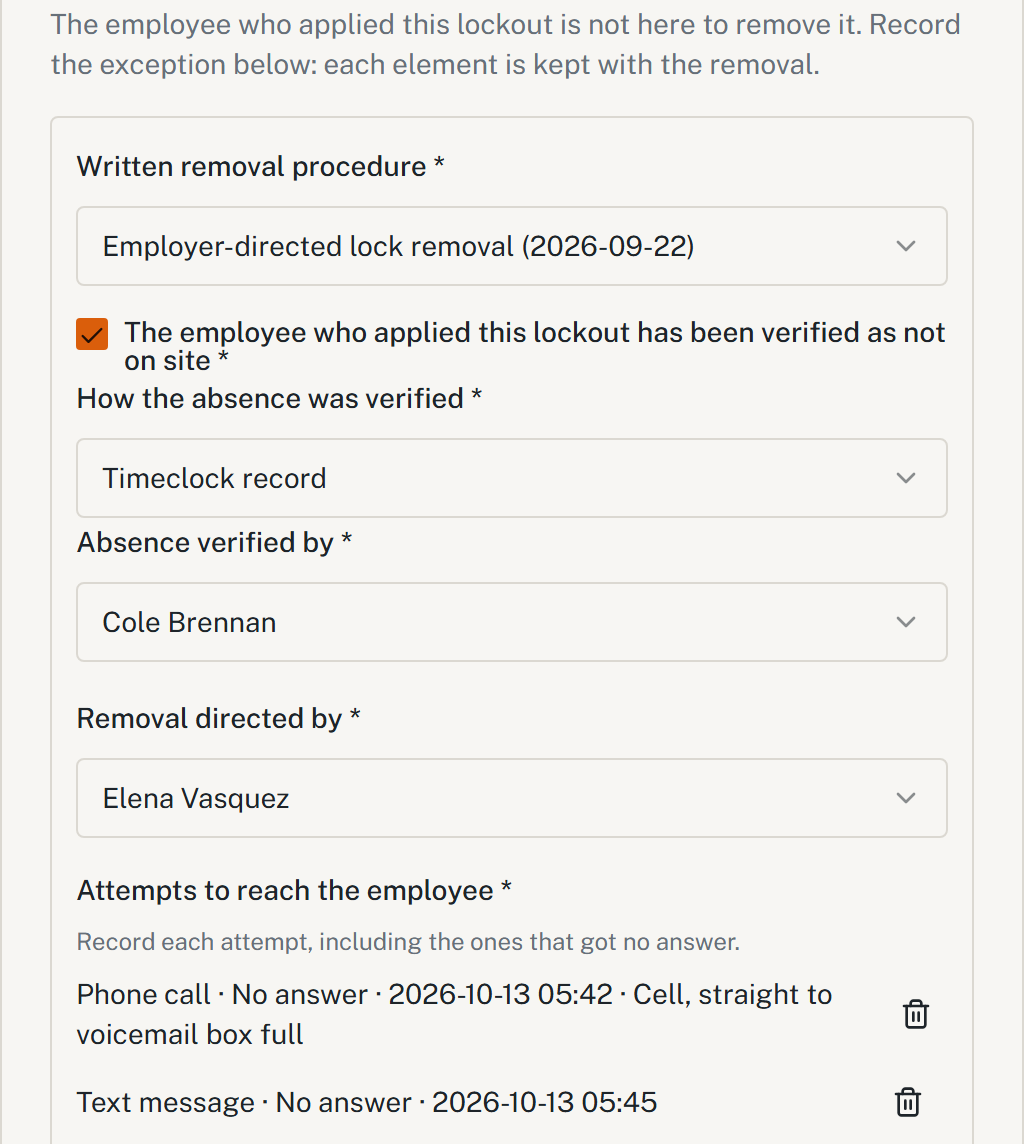
The removal itself still asks for the two release confirmations, "Work area inspected: nonessential items removed and components operationally intact" and "All employees safely positioned or removed", and a signature. If the lockout is linked to a work permit, the permit stays open until the lock is off, and the permit supervisor is notified of the removal.
When the employee comes back, HazComFast shows them what happened: "A lockout you applied was removed while you were away", with the equipment, the work, when it was removed and the reason given. They acknowledge it, and the acknowledgment is dated. Until they do, they can't apply a new lockout. Your procedure names who tells them in person at the start of the shift, and the acknowledgment records that they know.
The exception, recorded the way the rule reads
Write your lockout procedure free, or run lockouts in HazComFast with the removal exception, the contact attempts and the employee's acknowledgment kept together.
Related: Does OSHA require a lockout/tagout log? · Lockout/tagout: the complete guide · Does 1910.147 apply to construction?
Sources & verification (read on the eCFR, edition of 2026-10-01): 29 CFR 1910.147(a)(1)(ii), (c)(5)(ii)(D), (e)(1) to (e)(3), (f)(2) to (f)(4); OSHA release from lockout/tagout eTool. General guidance, not legal advice.*
Frequently Asked Questions
Can a supervisor remove an employee's lockout lock?
Only under the exception of 29 CFR 1910.147(e)(3): when the employee who applied the device isn't available, removal may be done under the employer's direction, following specific procedures and training that were developed, documented and incorporated into the energy control program, and that provide equivalent safety. A supervisor's title alone doesn't meet it.
What are the three minimum steps of the exception?
Under 29 CFR 1910.147(e)(3)(i) to (iii): verify that the authorized employee who applied the device is not at the facility; make all reasonable efforts to contact them to say the device was removed; and make sure they know about the removal before they resume work at that facility.
How many calls count as all reasonable efforts?
29 CFR 1910.147(e)(3)(ii) sets no number. Follow your written procedure, use the channels that fit the situation, and record each attempt, including the ones that got no answer. Reaching the employee is the goal, and (e)(3)(iii) still requires them to know before they resume work.
What else must happen before energy is restored?
The release steps of 29 CFR 1910.147(e)(1) and (e)(2) still apply: inspect the work area so nonessential items are removed and components are operationally intact, check that all employees are safely positioned or removed, and notify affected employees after the devices are removed and before the machine starts.
Does this exception apply on a construction site?
No. 29 CFR 1910.147(a)(1)(ii)(A) excludes construction and agriculture employment, and (a)(1)(ii)(B) excludes employment covered by Parts 1915, 1917 and 1918. Check which standard covers the work before adopting the procedure.
Site-wide regulatory figures such as compliance dates and penalty amounts come from our regulatory source-of-truth modules, last checked against the eCFR, OSHA.gov, and the Federal Register on October 5, 2026. Last reviewed October 14, 2026.
About This Article
Published by: HazComFast
Published: October 13, 2026
Last Updated: October 14, 2026
This content is for informational purposes only and does not constitute legal advice.