
The auditor from the insurance carrier asks for "your LOTO log". The maintenance supervisor hands over a binder of lock sign-out sheets going back three years. It's a good binder. It's also not what an OSHA compliance officer asks for under 1910.147, which names three other documents and never mentions a log. The only federal lockout rule that requires a log is the shipyard standard.
OSHA's general industry lockout standard, 29 CFR 1910.147, requires three documents: written energy control procedures under (c)(4), a certification of the periodic inspection under (c)(6)(ii), and a certification of training under (c)(7)(iv). A log of each lock applied and removed is required in shipyard employment, under 1915.89(c)(7).
At a glance: Procedures for each machine, documented under 1910.147(c)(4), with a narrow exception when all eight conditions of the note to (c)(4)(i) are met. Periodic inspection, at least yearly, certified with the machine, date, employees and inspector ((c)(6)). Training certification, names and dates, kept current ((c)(7)(iv)). Lockout log: required for shipyards under 1915.89(c)(7), a company choice elsewhere. Construction is outside 1910.147 ((a)(1)(ii)(A)).
The three records 1910.147 asks for
For general industry work covered by 29 CFR 1910.147, paragraph (c)(1) requires an energy control program made of procedures, training and periodic inspections. Each of the three has its own document.
| Record | What it contains | Rule |
|---|---|---|
| Energy control procedure | Scope, purpose, authorization, rules and techniques for each machine; shutdown, isolation, blocking and securing steps; placement, removal and transfer of devices; testing to verify the controls | 29 CFR 1910.147(c)(4)(ii) |
| Periodic inspection certification | The machine or equipment, the date of the inspection, the employees included, the person who performed it | 1910.147(c)(6)(ii) |
| Training certification | Each employee's name and dates of training, kept up to date | 1910.147(c)(7)(iv) |
When an inspector asks for "your lockout records", those are the three to have ready. A register of every lock is useful, and it answers a different question.
Where OSHA does require a log: shipyards
29 CFR 1915.89 covers the control of hazardous energy in shipyard employment. When the lockout/tags-plus coordination of 1915.89(c)(7)(i) applies, mostly concurrent servicing on several systems of a vessel or several operations on the same system, (c)(7)(ii) requires a coordinator and a log specific to each vessel, vessel section and landside work area. Under (c)(7)(iv), the coordinator keeps a continuous log of each lockout and tags-plus system, including the location and type of equipment, who applied it and when, and who removed it and when.
OSHA's November 20, 2012 interpretation, question 5, explains that coordination turns on whether concurrent servicing can endanger employees through energization or startup, not on the headcount alone. That's a shipyard rule. It doesn't carry over into 1910.147.
What a lockout register is good for
In general industry, a register of each lockout is a company choice, and a good one. It answers the questions a supervisor has at 6 a.m.: which equipment is locked out right now, which isolation points belong to that lockout, who applied each lock, and whether a removal has been recorded.
It helps at two moments the standard does regulate. At a shift change, 1910.147(f)(4) requires specific procedures for the orderly transfer of lockout protection between the off-going and oncoming employees. And when the employee who applied a lock isn't there to remove it, 1910.147(e)(3) allows removal under the employer's direction only through a specific written procedure: verify the employee isn't at the facility, make all reasonable efforts to reach them, and make sure they know before they resume work.
What the register can't do is the work itself. A row marked "removed" isn't the inspection of the work area under 1910.147(e)(1) or the check that everyone is clear under (e)(2). The record should show that those steps happened, at the moment they happened.
How HazComFast keeps the three records and the register
HazComFast keeps the records 1910.147 names in their own place: written energy control procedures, training authorizations and periodic inspections, each in its own tab under "LOTO Procedures", citing 29 CFR 1910.147(c)(4), (c)(6) and (c)(7). A retraining interval you set is labeled as company policy, because 1910.147 sets none.
The register then enforces the steps the records describe. Applying a lockout is reserved to employees with an active LOTO authorization. A lockout can't go active until every isolation point has its zero-energy check recorded, with the method used, and on an electrical point only a test instrument reading counts, with the instrument, its ID, the reading and whether it was checked on a known live source before and after. Stored energy is either relieved or marked absent, with the reason.
Removal won't record until the area check and the all-clear are both confirmed, in the wording of 1910.147(e)(1) and (e)(2): "Work area inspected: nonessential items removed and components operationally intact" and "All employees safely positioned or removed", in English or in Spanish. Only the employee who applied the lock removes it. When they're not there, a supervisor-directed removal records your written procedure, how the absence was verified and by whom, and each attempt to reach the employee. That employee then sees the removal and must acknowledge it before applying a new lockout.
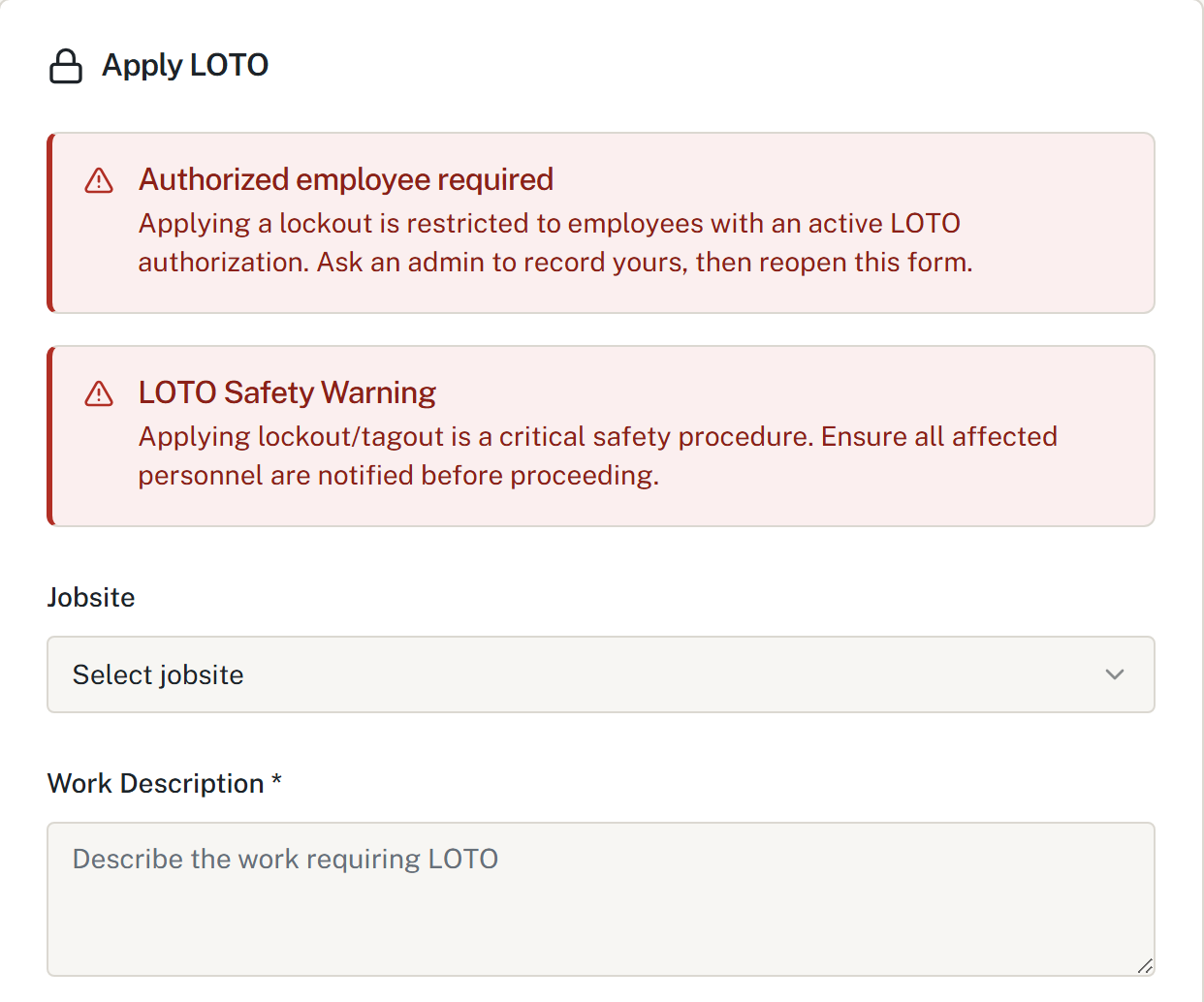
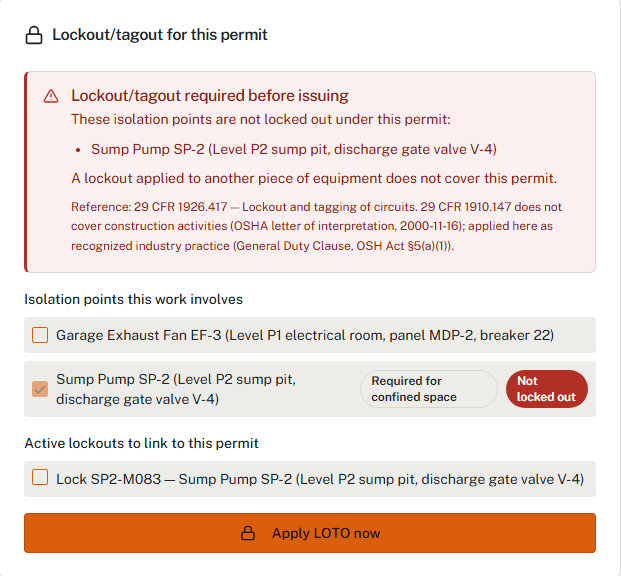
Lockouts tie into permits too. Name the isolation points on a permit and it won't issue until each one is locked out under that permit, and it won't close while any of those locks is still on.
Older records that don't meet the current rules, such as a lockout applied without an active authorization or a removal without its two confirmations, are listed to be regularized. Regularizing adds a signed, dated statement and keeps the original record as it was.
The procedure, and its eight-condition exception
Under 29 CFR 1910.147(c)(4)(i), procedures are developed, documented and used for the control of hazardous energy. Paragraph (c)(4)(ii) asks for a clear and specific description: the steps for shutting down, isolating, blocking and securing the machine ((c)(4)(ii)(B)), for placing, removing and transferring lockout devices and who is responsible for them ((C)), and for testing the machine to verify the controls work ((D)).
The note to (c)(4)(i) allows one exception: the procedure for a particular machine need not be documented when all eight listed conditions exist. They are: no stored or residual energy, or reaccumulation, that could endanger employees; a single energy source that can be readily identified and isolated; isolating and locking out that source completely deenergizes the machine; the machine stays isolated and locked out during servicing; a single lockout device achieves the locked-out condition; that device is under the exclusive control of the authorized employee; the servicing creates no hazard for other employees; and no accidents involving unexpected activation or reenergization during servicing while the exception was used. All eight, not one. A single disconnect on a machine with a gravity-loaded ram doesn't qualify, and 1910.147(d)(5) separately requires stored energy to be relieved and its reaccumulation watched.
The exception covers the writing of that one procedure. The training and the periodic inspection still apply.
The periodic inspection
Under 29 CFR 1910.147(c)(6)(i), each energy control procedure is inspected at least annually, by an authorized employee other than the ones using the procedure being inspected, and any deviations or inadequacies are corrected. Where lockout is used, the inspection includes a review with each authorized employee of their responsibilities under that procedure ((c)(6)(i)(C)). Where tagout is used, the review extends to affected employees and the limitations of tags ((c)(6)(i)(D)).
The certification under (c)(6)(ii) names the machine or equipment, the date, the employees included and the inspector. A list of active locks shows none of those.
The training certification
Under 29 CFR 1910.147(c)(7)(iv), the employer certifies that training has been accomplished and kept up to date, with each employee's name and dates of training. Paragraph (c)(7) sets the content by role, authorized, affected and other employees, and (c)(7)(iii) requires retraining when a job assignment, a machine or a procedure changes, or when the employer sees gaps in knowledge or use.
A hundred lockouts recorded under a name show that the person applied locks. The training certification shows they were trained for it, and when. The training files guide covers how to keep sign-in evidence that holds up.
OSHA's May 10, 2005 letter discusses the same three documents, but OSHA marks it as an archive document that may no longer reflect current policy. The regulation is the reference.
Check the standard before the form
29 CFR 1910.147(a)(1)(ii)(A) excludes construction and agriculture employment, and (a)(1)(ii)(B) excludes employment covered by Parts 1915, 1917 and 1918. A contractor working on a plant's equipment under general industry rules one week and on a jobsite the next may fall under two different standards. Does 1910.147 apply to construction? covers the construction side, and the complete LOTO guide the full procedure.
Procedures, certifications and the register, in one place
Write a lockout procedure free, or keep procedures, authorizations, periodic inspections and every lockout in HazComFast, with the zero-energy check and both removal confirmations recorded.
Related: Lockout/tagout: the complete guide · Does 1910.147 apply to construction? · Digital permits for hot work and confined spaces
Sources & verification (read on the eCFR, edition of 2026-10-01): 29 CFR 1910.147(a)(1)(ii), (c)(1), (c)(4), (c)(6), (c)(7), (d)(5), (e)(1) to (e)(3), (f)(4); 29 CFR 1915.89(c)(7); OSHA interpretations of November 20, 2012 and May 10, 2005 (archived). General guidance, not legal advice.*
Frequently Asked Questions
Does 1910.147 require a log of every lockout?
No. 29 CFR 1910.147 asks for three documents: energy control procedures under (c)(4), a certification of the periodic inspection under (c)(6)(ii), and a certification of training under (c)(7)(iv). A register of each lock applied and removed is a company choice in general industry.
Where does OSHA require a lockout log?
In shipyard employment. 29 CFR 1915.89(c)(7)(ii) requires a lockout/tags-plus coordinator and a log specific to each vessel, vessel section and landside work area when the coordination of (c)(7)(i) applies, and (c)(7)(iv) lists what the continuous log contains, including who applied and removed each system and when.
What goes in the periodic inspection certification?
Under 29 CFR 1910.147(c)(6)(ii): the machine or equipment on which the procedure was used, the date of the inspection, the employees included and the person who performed it. The inspection is at least annual under (c)(6)(i), done by an authorized employee other than those using the procedure.
What goes in the LOTO training certification?
Under 29 CFR 1910.147(c)(7)(iv), each employee's name and dates of training, with the training kept up to date. Paragraph (c)(7)(iii) adds retraining when assignments, machines or procedures change, or when the employer sees gaps in knowledge or use.
Does 1910.147 apply on a construction site?
No. 29 CFR 1910.147(a)(1)(ii)(A) excludes construction and agriculture employment, and (a)(1)(ii)(B) excludes employment covered by Parts 1915, 1917 and 1918. Construction work on electrical circuits falls under 1926.417, among other Part 1926 rules.
Site-wide regulatory figures such as compliance dates and penalty amounts come from our regulatory source-of-truth modules, last checked against the eCFR, OSHA.gov, and the Federal Register on October 5, 2026. Last reviewed October 13, 2026.
About This Article
Published by: HazComFast
Published: October 13, 2026
Last Updated: October 13, 2026
This content is for informational purposes only and does not constitute legal advice.