HazCom Compliance for Roofing Contractors
Roofing stacks three hazard classes on one deck: falls (the leading cause of roofing deaths), carcinogenic coal-tar and asphalt fumes, and extreme heat. This page maps the chemicals, their verified OSHA exposure limits, the standards that apply, and the path to a compliant program.
Reviewed against the eCFR, OSHA Table Z-1, and BLS data · last verified July 2026
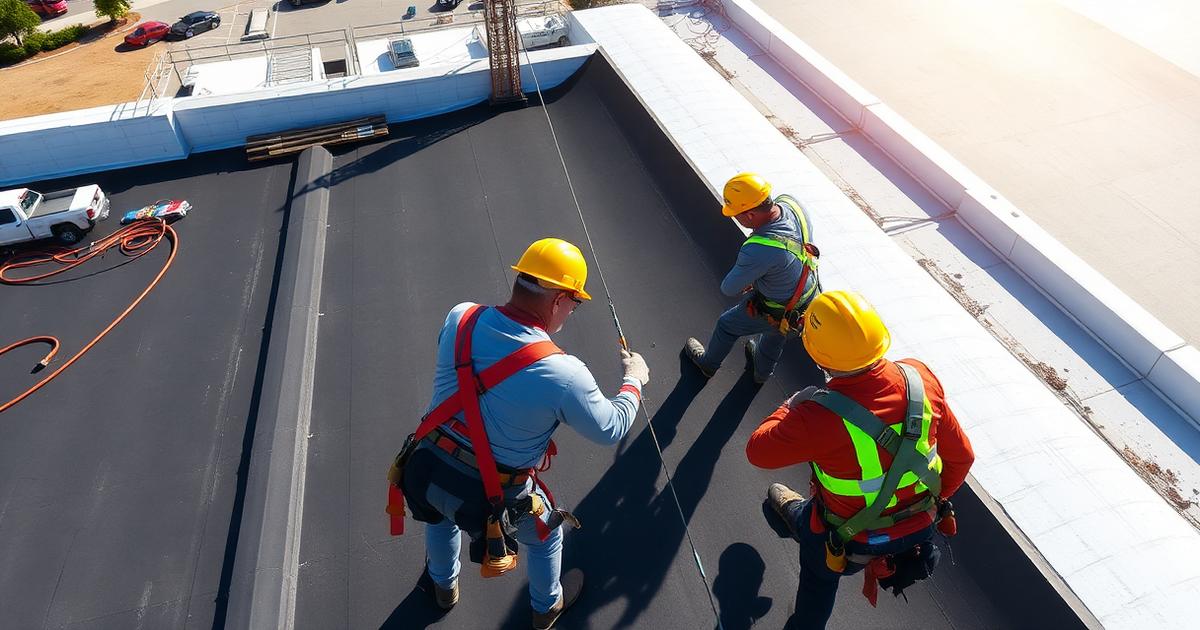
roofing-contractor fall deaths in 2023 — 26% of all construction fall fatalities (BLS)
coal tar pitch volatiles PEL — a carcinogen (Table Z-1)
per serious violation (2026 federal maximum)
fall-protection trigger — roofing stacks fall, heat, and chemical hazards
Three hazard classes on one deck
No trade compresses risk like roofing. Falls kill more roofers than any other event — 110 in 2023, a quarter of all construction fall deaths. Layered on top are the chemicals: coal tar pitch and asphalt fume are carcinogens, and spray-foam isocyanates cause occupational asthma. And it all happens on a surface that can be 30–50°F hotter than the air.
HazCom (1910.1200) is the part most roofers under-document, and it's a quiet budget killer. Below: the chemicals with their verified exposure limits, the standards that apply, and a six-step path to comply.
Chemicals on a roofing job
The regulated substances roofing crews meet most, with the OSHA permissible exposure limit for each — verified against OSHA's Table Z-1/Z-2 (asphalt fume has no OSHA PEL; the NIOSH REL is shown).
| Chemical | Hazard | PEL (8-hr TWA) | Source |
|---|---|---|---|
| Coal tar pitch volatiles — built-up roofing | Carcinogen (lung & skin) | 0.2 mg/m³ | 1910.1000 Z-1 |
| Hot asphalt (bitumen) fumes | Respiratory & eye irritant; possible carcinogen | No OSHA PEL — NIOSH REL 5 mg/m³ | NIOSH / General Duty |
| Adhesive & primer solvents (toluene) | Flammable; CNS depressant | 200 ppm | 1910.1000 Z-2 |
| Solvent-based coatings (naphtha) | Flammable; CNS; irritant | 100 ppm | 1910.1000 Z-1 |
| Spray polyurethane foam (isocyanates) | Sensitizer; occupational asthma | (C) 0.02 ppm ceiling | 1910.1000 Z-1 |
| Torch-down propane | Flammable gas; simple asphyxiant | No OSHA PEL — fire/asphyxiation | SDS / 1926.152 |
Look up any product with the CAS chemical database or read the PEL/TLV guide.
A built-up roof tear-off, step by step
A single tear-off and re-roof can put asbestos, carcinogenic fumes, a fall hazard, a fire hazard, and heat on the same crew. Here is the order to run it.
- 1
Survey the old roof before you tear it off
Built-up roofing on older buildings can hide asbestos in the felts and coal-tar pitch. A survey before disturbance decides whether this is an abatement job.
- 2
Respirator up for the fumes
Coal tar pitch volatiles (0.2 mg/m³) are carcinogenic and asphalt fume irritates the lungs and eyes (NIOSH REL 5 mg/m³). Use respiratory and skin protection, and keep the SDS at the kettle.
- 3
Fall protection is non-negotiable
Falls kill more roofers than anything else — 110 in 2023. Protect at 6 ft with guardrails, nets, personal fall arrest, or a warning-line/safety-monitor system on low-slope roofs.
- 4
Run the kettle as hot work
A kettle or torch-down is an ignition source next to combustible roofing. Post a fire watch where more than a minor fire could start, and store flammable solvents in approved containers.
- 5
Plan for the heat
A hot deck plus hot asphalt is among construction's highest heat-stress exposures. Water, rest, shade, and acclimatization — build the plan before the crew is on the roof.
- 6
Document it
The survey, SDS access, the hot-work permit, and training — the paper trail that answers an inspector.
The standards that apply to roofing work
Falls, chemicals, heat, and fire all converge on a roof — here is what each standard requires.
Fall protection — 29 CFR 1926.501
Falls are the leading cause of roofing deaths — 110 in 2023. Protection is required at 6 ft, with specific low-slope roofing rules (guardrails, safety nets, personal fall arrest, or a warning-line/safety-monitor system on low-slope roofs).
Hazard Communication — 29 CFR 1910.1200
Coal tar, asphalt, adhesives, primers, coatings, and SPF are all hazardous chemicals — each needs an SDS, a GHS label, a place in your written program, and worker training.
Respiratory protection — 29 CFR 1910.134
Coal tar pitch volatiles and asphalt fume, and SPF isocyanate spraying, can require respirators. That triggers a program: hazard assessment, medical evaluation, fit testing, and training.
Heat illness — National Emphasis Program + General Duty
A hot roof deck plus hot asphalt is among the highest heat-stress exposures in construction. There is no federal heat standard yet (the rule is still proposed), but OSHA inspects heat hazards under a National Emphasis Program, so a written heat plan is prudent.
Hot work & fire — 29 CFR 1926.352 / flammable storage 1926.152
Torch-down and kettle work are ignition sources near combustible roofing materials. A fire watch is required where more than a minor fire could start, and flammable solvents must be stored in approved containers.
Your 6-step compliance roadmap
The order to stand up an OSHA-defensible HazCom program for a roofing crew — each step linked to the free tool that does it.
- 1
Inventory the chemicals in the truck and on the kettle
Coal tar, asphalt, adhesives, primers, coatings, SPF kits, propane — list them and pull an SDS for each.
Chemical Inventory Template - 2
Write your HazCom program
A written program per 1910.1200(e) that flags the coal-tar carcinogen, asphalt fume, and SPF isocyanate hazards.
HazCom Program Generator - 3
Label secondary containers
Decanted adhesives, primers, and coatings each need a GHS workplace label with product identifier and pictograms.
GHS Label Generator - 4
Plan for heat
Build a heat illness prevention plan for the roof deck — water, rest, shade, and acclimatization.
Heat Illness Prevention Builder - 5
Make SDS reachable at the roofline
QR codes on the containers open each SDS. The jobsite's SDS also load onto the crew's phones for the spots on the roof where the signal drops.
SDS QR Code Generator - 6
Self-audit before OSHA does
Run a mock HazCom audit and price your exposure before an inspector arrives.
HazCom Audit Checklist
Key takeaways
- Roofing stacks three hazard classes on one deck: falls, carcinogenic coal-tar and asphalt fumes, and extreme heat.
- Coal tar pitch volatiles (0.2 mg/m³) are a carcinogen; asphalt fume irritates lungs and eyes (NIOSH REL 5 mg/m³).
- Falls are the leading cause of roofing deaths — 110 in 2023 — so protect at 6 ft, including low-slope options.
- Torch-down and kettle work need a fire watch; store flammable solvents in approved containers.
- A hot roof deck is among construction's highest heat-stress spots — build a written heat plan.
How HazComFast handles it
Built for the kettle, the torch, and the hot deck.
Coal tar & asphalt tracking
Flag the carcinogenic coal-tar and asphalt-fume hazards from the SDS and surface the required controls and PPE.
Hot-work fire safety
Generate the hot-work permit and fire-watch record for kettle and torch-down work in minutes.
SDS at the roofline
QR codes on kettles, kits, and containers — scan for the hazard before you heat, spray, or coat.
Heat-plan ready
Build and document a heat illness prevention plan for the deck — the highest heat-stress spot on the job.
Crew training records
HazCom and task-specific training tracked for every roofer, exportable for an inspector.
Inspection-ready program
Written program, labels, SDS access records, and training logs — all timestamped and in one place.
Go deeper
Standards & references
Sources & verification
Written and maintained by HazComFast. Every figure here is verified against the primary source — last verified July 2026:
- ·OSHA 1910.1000 Table Z-1 — Air Contaminant Limits
- ·BLS — Fatal falls in the construction industry, 2023
- ·29 CFR 1926.501 — Fall Protection
- ·29 CFR 1910.1200 — Hazard Communication
General guidance, not legal advice. OSHA-approved State Plans may have requirements at least as effective as the federal standard — verify your state's rules.
Frequently Asked Questions
Coal tar pitch, hot asphalt, adhesives and primers, solvent-based coatings, spray polyurethane foam, and propane. Each is a hazardous chemical under OSHA HazCom and needs a current SDS and a GHS label on any secondary container.
Yes. Coal tar pitch volatiles are a recognized carcinogen (lung and skin), with an OSHA PEL of 0.2 mg/m³ (29 CFR 1910.1000, Table Z-1). Built-up roofing with coal tar needs exposure controls, respiratory protection, and skin protection.
OSHA has no specific PEL for asphalt (bitumen) fume, but it is a respiratory and eye irritant and a possible carcinogen. NIOSH recommends a 5 mg/m³ ceiling, and OSHA can cite overexposure under the General Duty Clause, so controls and monitoring still apply.
6 feet above a lower level (29 CFR 1926.501). Low-slope roofing has specific options — guardrails, safety nets, personal fall arrest, or a warning-line system with a safety monitor. Falls are the leading cause of roofing deaths, with 110 in 2023.
Yes. Spray polyurethane foam contains isocyanates (MDI), respiratory sensitizers with a ceiling limit of 0.02 ppm (29 CFR 1910.1000, Table Z-1). SPF application typically requires a supplied-air respirator and skin protection.
It can. Older built-up roofing felts, mastics, and flashing cements may contain asbestos, so a survey before tear-off decides whether asbestos rules (29 CFR 1926.1101) apply. If they do, the work needs classed methods, wet techniques, and a competent person.
Torch-down and hot-kettle work are ignition sources next to combustible roofing. A fire watch is required where more than a minor fire could develop (29 CFR 1926.352), and flammable solvents must be stored in approved containers (1926.152).
In 2026 a serious violation is up to $16,550 and a willful or repeat violation up to $165,514 — unchanged from 2025. See OSHA penalties by state for local context.
Get the Binder in Order Before the Inspector Arrives. Are You Ready?
OSHA does not give advance notice of inspections (29 CFR 1903.6). Get the binder in order before the opening conference, not during it.
Serious Violation
$16,550
per violation (max)
HazComFast Pro
$199/mo
10 jobsites, unlimited chemicals, unlimited workers
New sign-ups are paused. The free tools below need no account, and customers can log in as usual.
Your account keeps working as usual. Cancel anytime.