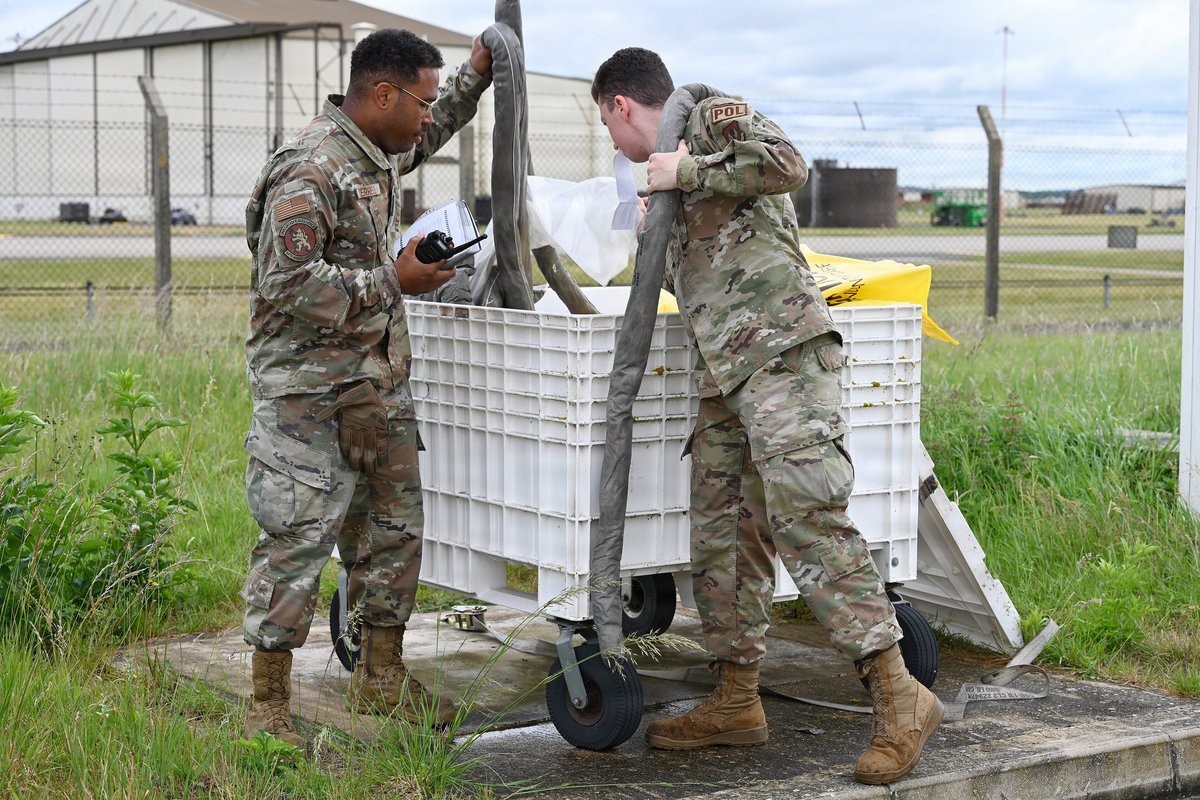
Choose a spill kit for the chemicals at the site and the releases employees are assigned to handle. Use the product SDSs to select compatible absorbents, collection containers and personal protective equipment (PPE). Establish the response limits and waste route before putting the kit into service.
A kit's capacity tells you how much liquid its materials may absorb under the manufacturer's stated conditions. The decision to send employees toward a spill also depends on toxicity, fire, reactivity, location and their training.
Define the employee's role first
Under 1910.120(a)(3), an incidental release can be controlled at the time by employees in the immediate area or maintenance personnel. The definition also distinguishes releases without potential safety or health hazards such as fire, explosion or dangerous chemical exposure. An uncontrolled release requiring emergency response needs a different program and response capability. Construction has the corresponding provisions in 1926.65(a)(3) and (q).
Assign roles before an incident:
| Role | Arrangement to establish |
|---|---|
| Report and evacuate | Alarm, reporting contact, evacuation route and accountability. |
| Handle specified incidental releases | Identified products and conditions, task training, equipment, PPE and limits for stopping. |
| Respond to hazardous-substance emergencies | The response plan, role-specific training and capabilities needed for the operation. |
The evacuation exception in paragraph (q)(1) calls for employees to evacuate, no employee assistance in handling the emergency, and an emergency action plan. That plan needs to meet 1910.38 for general industry or 1926.35 for construction. Employees assigned to respond need the training and capabilities for their response duties.
The spill response guide explains this distinction. An unknown atmosphere, a dangerous reaction or conditions beyond the assigned response capability call for escalation through the site's emergency process.
Build the specification from the chemical inventory
For each work area, record:
- Product identifiers, concentrations and current SDSs.
- Container sizes, transfer equipment and likely release points.
- Routes toward drains, traffic or occupied areas.
- Fire, vapor, reaction and contact hazards.
- The releases employees are equipped and trained to handle.
- Collection, storage and disposal arrangements.
Read SDS Section 6 with Sections 2, 7, 8 and 10. Obtain supplier advice when the release instructions leave absorbent or container compatibility unclear.
A fuel-transfer area and a laboratory may need different contents and response limits. Identify the work covered by each kit.
Match absorbents and containers to the product
| Spill type | Selection questions |
|---|---|
| Oil or fuel | Is the absorbent compatible? How will the response address ignition and contaminated water? |
| Acid or alkali | Does the material tolerate the product's concentration? Could contact generate heat or gas? |
| Solvent | Are absorbents, tools, containers and closures suitable for the chemical and fire hazard? |
| Reactive chemical | Does it need a dedicated material or specialist response? |
| Blood or OPIM | Are biological-exposure procedures, protection, sharps handling and waste controls available? |
| Unknown substance | Who will identify and assess it before employees approach? |
Read the manufacturer's exclusions for a “universal” absorbent. That label cannot replace compatibility data for the product in use. The chemical compatibility matrix can help organize storage and reaction questions; select the absorbent using its own manufacturer data.
Evaluate the waste container and closure for the material they will hold after cleanup. Contaminated pads, liquid and PPE may need different containment from dry supplies.
Compare capacity on the same basis
Ask the supplier which liquid, test and conditions support the rated capacity. Compare equivalent ratings, then account for the materials needed to limit spreading and collect the waste.
Plan replenishment and reserve supplies for the defined task. A manufacturer's absorbency figure does not establish a safe employee-response volume: even a small release can create a hazardous atmosphere or dangerous reaction.
Evaluate neutralizers separately
A neutralizer needs a known product, compatible chemistry and an established procedure. Evaluate heat, gas generation and the resulting material before including one in a kit.
Assign its use only to employees trained for that procedure. For an unidentified chemical or mixture, follow the reporting and escalation process instead of attempting on-site identification through a reaction.
Select PPE and supporting equipment
Match gloves, eye protection and clothing to the chemical, concentration and contact conditions. Obtain the evidence for any gloves supplied with the kit. In general industry, 1910.132 governs the PPE hazard assessment; construction PPE requirements include 1926.95.
Select tools for the hazards present, including ignition concerns. Include compatible collection materials, closures and identification supplies as specified by the response and waste procedures.
If the response requires respiratory protection, establish its selection, medical evaluation, fit testing and training through the applicable respiratory protection program under 1910.134(c)(1). A respirator stored in a kit needs that same program support before required use.
Position and inspect the kit
Place the kit where employees can reach it without crossing the expected release area. Check access during each shift, and protect supplies from moisture, heat or other conditions that can damage them.
Assign an inspection owner. Use the manufacturer's storage and shelf-life instructions, verify the contents and record replacements. After a seal is broken, confirm what remains before returning the kit to service.
Review the location when equipment, storage or traffic patterns change.
Establish the waste route
Used absorbents and cleanup materials need a waste determination based on their resulting composition and characteristics. 40 CFR 262.11 sets federal hazardous-waste determination requirements. State rules may add requirements.
Record who identifies the waste, the compatible container, needed labels, accumulation location and authorized transfer route. The hazardous waste guide explains how cleanup waste connects to generator responsibilities.
Spill kit specification worksheet
Use this record when ordering a kit or checking the contents of one already on site. List any response equipment kept separately so employees know where to find it.
| Specification | Record for this work area |
|---|---|
| Location, products and releases covered | ____________________ |
| Absorbent model, form, quantity and chemical compatibility evidence | ____________________ |
| Capacity rating, test liquid and test basis | ____________________ |
| Spreading-control materials and safe access for placing them | ____________________ |
| Collection tools, compatible waste containers and closures | ____________________ |
| Selected gloves, eye protection, clothing and other needed protection | ____________________ |
| Waste identification supplies and collection route | ____________________ |
| Instructions, emergency contacts and limits of employee response | ____________________ |
| Inspection owner, storage limits, shelf lives and replenishment process | ____________________ |
Before putting the kit into service, confirm that employees have been instructed in its assigned use, the supplies are accessible without crossing the release area, and the waste arrangements are in place. Recheck the specification after use or a change in products or work.
Frequently Asked Questions
Does OSHA call for a spill kit in every workplace?
There is no single general OSHA requirement for an identical commercial kit wherever chemicals are used. Identify the standards governing the work, the expected releases and the employer's response duties. Those findings determine the supplies, procedures and training needed.
What happens after the kit is used?
Address exposure concerns through the site's medical and reporting procedures. Identify and manage the collected waste, replenish supplies and inspect equipment. Review the cause of the release and whether the response worked as planned. Update containment, transfer methods, kit contents or training where the review identifies a problem.
Site-wide regulatory figures such as compliance dates and penalty amounts come from our regulatory source-of-truth modules, last checked against the eCFR, OSHA.gov, and the Federal Register on October 19, 2026. Last reviewed November 16, 2026.
About This Article
Published by: HazComFast
Published: November 16, 2026
Last Updated: November 16, 2026
- https://www.osha.gov/laws-regs/regulations/standardnumber/1910/1910.120
- https://www.osha.gov/laws-regs/regulations/standardnumber/1926/1926.65
- https://www.osha.gov/laws-regs/regulations/standardnumber/1910/1910.132
- https://www.osha.gov/laws-regs/regulations/standardnumber/1926/1926.95
- https://www.ecfr.gov/current/title-40/chapter-I/subchapter-I/part-262/subpart-A/section-262.11
This content is for informational purposes only and does not constitute legal advice.