Mixing bleach and ammonia can release harmful chloramine gases. Bleach mixed with an acid can release chlorine gas. Keep bleach separate from other cleaners and follow each product's label. The Washington State Department of Health describes both reactions and their health hazards.
If fumes are present after products have mixed, leave the affected area immediately and get to fresh air. Warn others from a safe location. Call 911 for breathing difficulty, difficulty swallowing or another medical emergency. For exposure advice in the United States, contact Poison Control at 1-800-222-1222. The Washington Poison Center's chloramine guidance gives these response steps.
Keep people out of the area. Do not enter to neutralize the mixture, open windows or retrieve a bottle. Give responders the product names if they are available without re-entry.
What happens when bleach meets another cleaner?
Chlorine bleach commonly contains sodium hypochlorite. Some glass cleaners contain ammonia. Products for rust, scale and toilet cleaning may contain acids. Check the ingredients and warnings for each formulation; a description such as “bathroom cleaner” gives too little information to establish compatibility.
Chloramines and chlorine can injure the eyes and respiratory tract. Irritation, coughing or chest symptoms after cleaning warrant leaving the exposure and obtaining medical advice. Trying to identify the reaction by smell keeps the worker close to the source.
The CDC advises against mixing bleach or disinfectants with other cleaners. Follow the dilution and application directions on the product being used.
Mixing can happen through residue
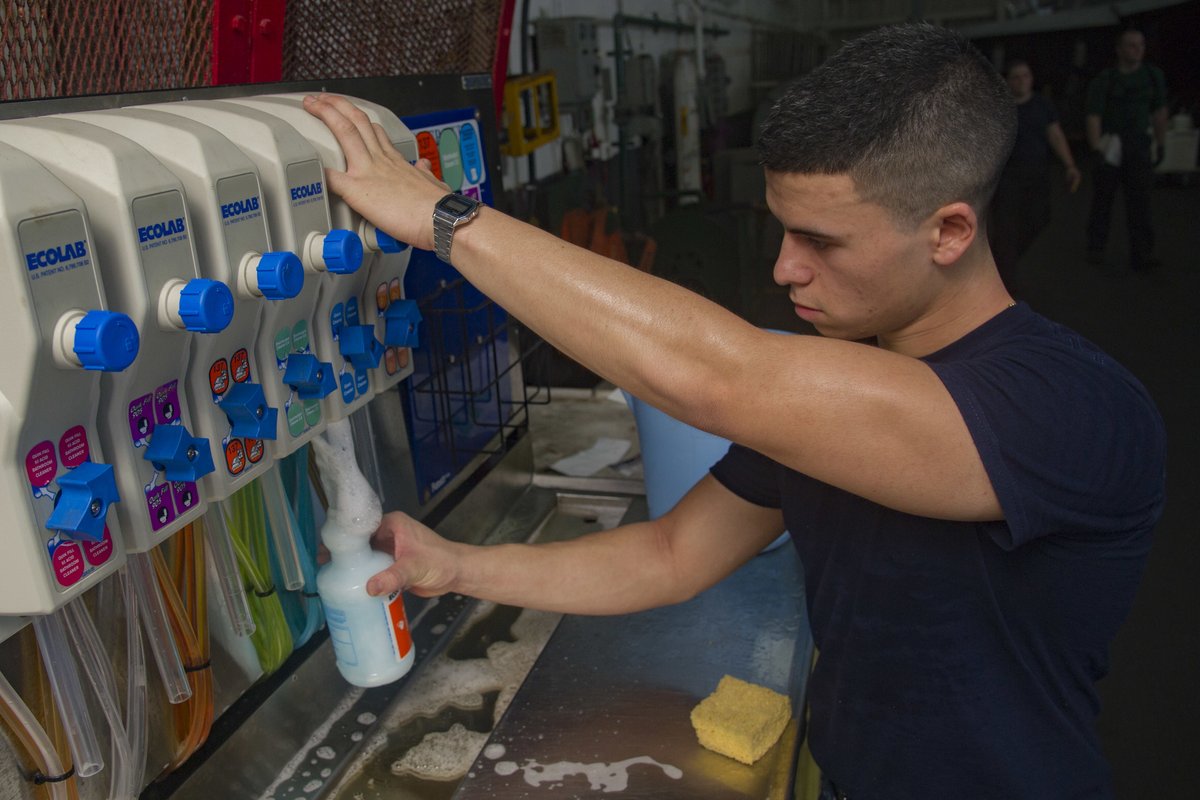
Workers can follow a one-product-at-a-time rule and still bring incompatible chemicals together. Residue may remain in a bucket, a spray bottle, a mop, a dispensing hose or a cleaning machine. Products can also meet in a drain or on a surface.
Assign containers to their intended products and establish how equipment is prepared between uses. Where a task involves more than one product, the procedure needs a sequence supported by the manufacturers' instructions, including any needed rinsing. Give the crew a clear procedure for an unidentified residue or unreadable container: stop the task and report it.
Read the label and these SDS sections
| Source | What to look for |
|---|---|
| Container label | Product identity, directions, dilution and warnings against mixing. |
| SDS Section 2 | Hazards of that formulation. |
| SDS Section 4 | First-aid instructions to have available after exposure. |
| SDS Section 6 | Supplier instructions for an accidental release. |
| SDS Section 7 | Handling and storage precautions. |
| SDS Section 10 | Incompatible materials and hazardous reactions. |
Match the SDS to the container's product identifier. Products from the same brand can have different formulations. HazComFast's Clorox bleach SDS reference can help locate supplier information; verify the product name against the bottle in use.
Set up the cleaning cart and storage area
Keep incompatible products separated so leakage, spills or dispensing mistakes cannot bring them together. Follow the labels and SDSs when deciding where and how to store them. Secure containers upright where needed and use clearly identified equipment for dispensing and dilution.
For hazardous chemicals covered by the workplace HazCom program, 1910.1200(f), (g) and (h) address labels, SDS access and employee information and training. Under (f)(8) and the definition of immediate use in (c), the immediate-use labeling exception applies to a portable container only when the chemical remains under the control of, and is used only by, the employee who transferred it, within that work shift. Label a shared spray bottle under the workplace-container requirements; it does not meet that immediate-use exception.
Before the shift, confirm:
- The approved product for each task and surface.
- The designated bottle, dispenser and dilution instructions.
- How buckets, mops and machines are prepared for use.
- Where workers can read the label and SDS.
- Which protective equipment the task calls for.
- Who receives a report about a leak, unknown liquid or suspected mixing.
The chemical storage guide covers storage planning. Product-specific incompatibilities belong in the workplace procedure.
Train with the products the crew uses
Bring the approved containers and instructions to the briefing. Have employees identify the product, explain its dilution method and find the warning against mixing. Include the procedure for a missing label or an unavailable product so substitutions go through a supervisor.
OSHA and NIOSH's cleaning-chemical guidance covers mixing hazards, dilution, protective equipment and training. Apply it to the crew's products and equipment.
Give temporary and replacement workers the same task instructions. Use language and demonstrations they can understand. Confirm understanding by asking them to show the correct bottle and explain what they would do with an unidentified cleaner.
Responding to an accidental release
From fresh air, report the location, products involved and anyone who may have been exposed. Keep workers and occupants away and follow the site's emergency procedures. Responders determine how to assess the area, control the release and authorize return.
An ordinary cleaning spill can become an emergency when a reaction produces a hazardous atmosphere. The distinction between an incidental release and an emergency depends on the hazard and the circumstances of control. OSHA addresses that distinction in 1910.120(a)(3) for general industry and 1926.65(a)(3) for construction. Bucket size alone cannot settle the decision.
The spill response guide explains how workplace response roles are established. Employees assigned only to report and evacuate should follow that role.
Cleaning-product checklist
- Containers are identifiable and labels are readable.
- The SDS matches each product in use.
- Approved products match the task and surface.
- Storage and cart arrangements separate incompatible products.
- Buckets, dispensers and tools are prepared according to product instructions.
- Workers know the dilution and application procedure.
- The protection needed is available.
- Workers know when to stop and whom to contact.
- Emergency contacts are accessible during the shift.
Frequently Asked Questions
What gas can bleach and ammonia produce?
Bleach and ammonia can produce chloramine gases. Bleach and acids can produce chlorine gas. Both combinations are dangerous; the prevention rule is to keep bleach from mixing with other cleaners.
Is a small amount safe?
A small quantity does not establish a safe exposure. The formulations and concentrations affect the reaction, while ventilation and time in the area affect exposure. If cleaners have mixed and fumes are present, leave the affected air and obtain exposure advice.
Can workers return when the smell is gone?
Use the site's emergency process for clearance. Odor is an unreliable basis for deciding that an affected room is safe to occupy, and checking it by entering creates another exposure.
Site-wide regulatory figures such as compliance dates and penalty amounts come from our regulatory source-of-truth modules, last checked against the eCFR, OSHA.gov, and the Federal Register on October 19, 2026. Last reviewed November 16, 2026.
About This Article
Published by: HazComFast
Published: November 16, 2026
Last Updated: November 16, 2026
- https://doh.wa.gov/community-and-environment/contaminants/bleach-mixing-dangers
- https://www.wapc.org/what-to-do-for/chloramine-gas/
- https://www.cdc.gov/hygiene/about/cleaning-and-disinfecting-with-bleach.html
- https://www.osha.gov/laws-regs/regulations/standardnumber/1910/1910.1200
- https://www.osha.gov/sites/default/files/publications/OSHA3512.pdf
- https://www.osha.gov/laws-regs/regulations/standardnumber/1910/1910.120
- https://www.osha.gov/laws-regs/regulations/standardnumber/1926/1926.65
This content is for informational purposes only and does not constitute legal advice.