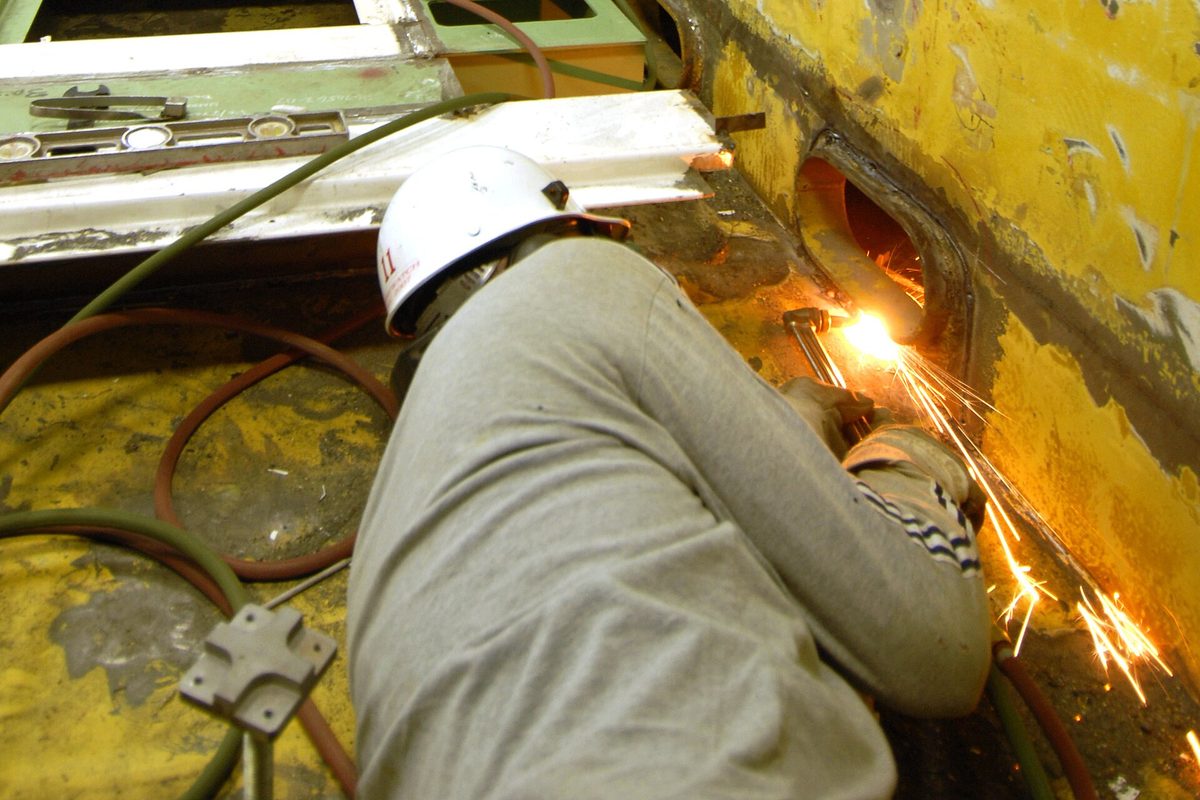
A foreman puts the welder's name in both boxes on a hot-work permit. The crew is small, the weld will take only a few minutes, and the welder has an extinguisher beside the machine. None of those facts establishes that one person can perform the welding and the needed fire watch at the same time.
For construction work that triggers 29 CFR 1926.352(e), OSHA requires additional personnel to guard against fire during the operation and for a sufficient period afterward. General industry and shipyard provisions use different wording, so the applicable work standard must be identified before assigning the roles.
Assign coverage for both the work and the period after it stops. Before issuing the permit, check who will be available at each stage. Copying a name into both fields can leave part of the operation unwatched.
Identify the work before choosing the rule
Construction welding, cutting and heating are addressed by 29 CFR 1926.352. General-industry welding and cutting precautions appear in 29 CFR 1910.252. Shipyard fire watches have their own provision at 29 CFR 1915.504.
A contractor's business name does not settle which standard governs a particular operation. Identify the work being performed, the setting and the applicable jurisdiction. State-plan requirements and the local fire code may add conditions. The employer's permit procedure or the owner's contract can also call for a separate watch in circumstances beyond the federal minimum.
Use the construction hot-work guide for the broader permit and fire-prevention process. Inspect the work area before choosing the staffing arrangement; the hazards and sight lines determine what the assigned watcher needs to cover.
Construction calls for additional personnel when the trigger is met
Paragraph (e) of 29 CFR 1926.352 applies when the operation makes normal fire-prevention precautions insufficient. It calls for additional personnel to guard against fire while welding, cutting or heating is being performed and for a sufficient period after completion. Those personnel need to receive instruction about the anticipated fire hazards and use of the firefighting equipment provided.
For that triggered construction duty, the welder working alone does not supply the additional person. Calling the welder a watcher in a second field does not change what the person is doing. A worker concentrating on the joint may also lack visibility of a lower level, a wall opening or the back of a partition where sparks can travel.
Evaluate the other precautions as part of the staffing decision. Paragraphs (a) and (b) of 29 CFR 1926.352 address moving combustibles or protecting them against sparks and heat. Paragraph (d) calls for suitable extinguishing equipment ready for use. Paragraph (e) calls for additional personnel when the normal precautions are insufficient.
General industry specifies duties without the same sentence
Under 29 CFR 1910.252(a)(2)(iii)(A), a fire watch is required where more than a minor fire might develop or where one of the listed combustible-exposure conditions exists. These include nearby combustible materials, easily ignited material farther away, openings and material on the opposite side of metal surfaces.
Paragraph 1910.252(a)(2)(iii)(B) calls for the watch to have suitable equipment available, training in its use and familiarity with alarm arrangements. The watcher monitors exposed areas, handles only fires within the capability of the available equipment and otherwise sounds the alarm. It also calls for at least a half hour of watch after welding or cutting ends.
The paragraph does not state the same express other-duties prohibition found in shipyard rules. That difference does not establish that a person actively welding can fulfill all the watch duties. Assess the actual visibility, access, distraction and ability to respond. A separate-person assignment is a sound employer control where simultaneous duties would prevent effective watching; describe it as that policy when the provision does not state the staffing detail expressly.
Check where the assigned person will be during the work. A watcher sent to fetch material at the other end of the shop is unavailable, even if the permit identifies that person correctly. Under 29 CFR 1910.252, the needed coverage still has to be provided.
The shipyard prohibition is explicit
29 CFR 1915.504(c)(1) prohibits assigning other duties to the fire watch while hot work is in progress. Its neighboring provisions address clear view and access, communication, stop-work authority and post-work coverage. The section applies to shipyard employment.
This is why a general search for “welder own fire watch OSHA” can produce an apparently simple answer that needs its scope attached. An OSHA shipyard publication may accurately explain the shipyard duty while leaving a construction reader unaware that the cited text belongs to Part 1915.
Use the correct citation in your procedure. For construction's additional-personnel requirement, cite 29 CFR 1926.352(e). For a shipyard prohibition on assigning other work, cite 29 CFR 1915.504(c)(1). Preserve the regulatory distinction even when your company chooses the same separate-person policy across its operations.
Assign coverage to the areas where fire could start
For example, a construction weld takes place above a service opening, with combustible material on the level below. The permit names one watcher beside the welder. The reviewer then finds that the lower area cannot be seen or quickly reached from that position. The reviewer needs to resolve who will cover the lower area before releasing the work.
Change the work setup, protect or remove the exposure, or provide coverage that can monitor the relevant areas. The number and positions of personnel should follow the hazards and applicable rule. 29 CFR 1926.352(e) provides no universal one-watcher-per-welder ratio.
Record the protected areas, the assigned people and their communication method. Discuss what should cause the work to stop, how an alarm will be raised and which fire conditions exceed the watch's ability to intervene. The welding safety guide addresses the wider work assessment, including fumes and confined spaces that call for additional controls.
Keep after-work coverage assigned during the handoff
When the arc stops, the worker may still be finishing another heat-producing task, moving hot material or handling equipment. Record when the relevant hot work has actually ended, then apply the governing post-work requirement. The end of a scheduled permit window does not establish that the fire hazard has ended.
29 CFR 1926.352(e) requires the watch to continue for a sufficient period so that no possibility of fire exists. It supplies no numerical duration. General-industry 29 CFR 1910.252(a)(2)(iii)(B) supplies a minimum for its covered work. A fire code, contract or company procedure may require longer coverage. Identify the source of the selected period instead of labeling every number an OSHA construction requirement.
A welder who will take a post-work monitoring assignment needs the appropriate instruction, visibility, equipment and freedom to carry out that assignment. Check the applicable requirements and the written permit conditions before making the change. Do not assume that the person's welding qualifications establish fire-watch preparation.
A useful handoff records the outgoing watcher, the incoming watcher, the area condition and the remaining coverage requirement. If no qualified replacement is available, the existing assignment cannot simply disappear because a shift is ending. Resolve coverage before releasing either person.
Avoid combining different NFPA editions and OSHA provisions
General-industry 29 CFR 1910.252(a)(1) incorporates a specified historic edition of NFPA 51B. A current edition of NFPA 51B may be applied through a different authority, such as an adopted fire code or a contract. These are not interchangeable legal routes.
Do not tell a construction crew that the general-industry incorporation in 29 CFR 1910.252(a) automatically makes the latest NFPA edition a construction OSHA rule. Our article on NFPA 51B and OSHA construction requirements follows that question separately. Use it when selecting the source for a company post-work period.
Likewise, do not use a duration as a substitute for the area assessment. An assigned watcher must still recognize changes and respond within the relevant instructions. Under 29 CFR 1926.352(e), the employer's instruction concerns the specific anticipated fire hazards, not just a stopwatch.
Review the permit by asking who is available
The Hot Work Permit Generator can organize the assignment. Before accepting the completed permit, use it to check actual coverage. The following questions are an EHS review aid rather than an additional federal form requirement.
| Review question | Problem it can expose |
|---|---|
| Who is performing the hot work? | A blank operator field or an unclear work scope |
| Who watches while heat and sparks are produced? | One person assigned to incompatible simultaneous tasks |
| Which exposed areas can each watcher cover? | A lower level, opening or concealed exposure left out of the review |
| What equipment, instruction and alarm method are available? | An assigned person unable to perform the needed duties |
| Who covers breaks and shift changes? | A permitted job continuing without the assigned watch |
| Who owns the post-work period? | Everyone leaving when the welding equipment is shut down |
At the pre-task meeting, have the operator and watcher describe their positions and the handoff. Under 29 CFR 1926.352(e), the instruction must address the actual fire hazards. A response such as “I watch whenever I lift my hood” should send the reviewer back to the staffing plan before the work begins.
Frequently Asked Questions
Can the only welder also be the needed construction fire watch?
29 CFR 1926.352(e) requires additional personnel when normal fire prevention precautions are insufficient. The operator working alone does not provide that additional personnel during the welding, cutting or heating operation. Assess whether that duty is triggered for the actual work.
Does general industry use the same wording as construction?
No. 29 CFR 1910.252(a)(2)(iii) states the fire-watch triggers, duties and a post-work minimum. It does not use the same additional-personnel sentence as 1926.352(e). The assigned watcher still needs to perform the required watch duties throughout the operation.
Can a shipyard fire watch perform other work while hot work continues?
29 CFR 1915.504(c)(1) expressly prohibits assigning other duties to a fire watch while hot work is in progress. This is the shipyard provision and should not be quoted as though it were the wording of 1910.252 or 1926.352.
Can the welder take over after welding stops?
Evaluate the applicable rule and the person's assigned duties. 29 CFR 1926.352(e) requires sufficient post-work coverage, while 1910.252(a)(2)(iii)(B) specifies at least a half hour for covered general-industry work. A handoff must maintain the required watch and any stricter applicable conditions.
Site-wide regulatory figures such as compliance dates and penalty amounts come from our regulatory source-of-truth modules, last checked against the eCFR, OSHA.gov, and the Federal Register on October 19, 2026. Last reviewed November 15, 2026.
About This Article
Published by: HazComFast
Published: November 15, 2026
Last Updated: November 15, 2026
This content is for informational purposes only and does not constitute legal advice.