
No OSHA rule requires you to hand your 300 Log to a general contractor. The access provisions of Part 1904 name every party who holds a right to your injury and illness records, and the list is short: your own employees, former employees, their personal representatives and their authorized employee representatives under 29 CFR 1904.35(b)(2), and authorized government representatives under 1904.40. A GC, a project owner, a construction manager and a prequalification platform hold no OSHA right at all. When the bid packet demands three years of 300 Logs, that demand is a contract term, which means its scope is negotiable, and knowing exactly where the regulation stops is what lets you negotiate it.
Part 1904 gives three audiences a right to your injury records, each on its own clock: your employees and their representatives get Log copies by the end of the next business day under 1904.35(b)(2), an authorized employee representative gets the case-description section of a 301 within seven calendar days, and government representatives get copies within four business hours under 1904.40. A general contractor appears on none of those lists, so a prequalification request is answered on contract terms you can negotiate. And if you do share the forms, 1904.29(b)(10) requires the employee names to come off first: outside of auditors, claim processors and public-health or law-enforcement agencies, an outsider is not entitled to identified records.
The prequal packet on the estimator's desk
A mechanical sub is invited to bid a hospital job. The GC's prequalification portal wants three years of OSHA 300 Logs and 300A summaries uploaded, plus TRIR, DART and EMR, before the bid will even open. The estimator forwards it to the safety director with one question: are we required to give them this?
The honest answer has two halves. OSHA does not require it, and the GC may nonetheless insist on it as a condition of doing business, exactly the way they insist on bonding capacity or insurance certificates. What the regulation gives you is not a way out of prequalification; it is a clear map of what is legally compelled (nothing, for a GC), what is customary (summaries and rates), and what is yours to protect (names and case details).
Who actually holds a right to your records
Three audiences, three different rules, three different clocks:
| Who is asking | Their right | Your deadline |
|---|---|---|
| Your employee, a former employee, their personal representative | Copy of the relevant 300 Logs, 1904.35(b)(2)(iii); their 301 report, 1904.35(b)(2)(v)(A) | End of the next business day; first copy free, 1904.35(b)(2)(vi) |
| An authorized employee representative, such as a union rep | 300 Log copies; 301 forms limited to the "Tell us about the case" section, all other information removed, 1904.35(b)(2)(v)(B) | Log: next business day; 301 section copies: within 7 calendar days |
| Authorized government representatives: DOL/OSHA in an inspection, HHS/NIOSH in an investigation, a State-Plan agency | Copies of everything kept under Part 1904, 1904.40(b)(1) | Four business hours, 1904.40(a) |
| A GC, owner, CM or prequalification platform | None under Part 1904 | Whatever the contract says |
| An insurer or claims administrator | No right of access, but 1904.29(b)(10)(ii) lets you disclose identified forms to the extent necessary to process a claim | Set by the policy, not by OSHA |
OSHA underlined the first row in a September 9, 2005 letter of interpretation: when your own workforce or their representatives ask, access reaches the entire Log, and 1904.35(b)(2)(iv) requires the names left on it, union and non-union alike, with one exception covered below. The duty of openness inside the company is broad, though it is not unlimited — a worker has a right to his own 301, not to a colleague's, and the internal picture is worked through in who can see your OSHA 300 Log and injury records. What matters here is the boundary: that duty runs inside the company, plus the government, and stops there.
What to offer a GC instead of the named Log
Prequalification math runs on totals, not on names. Every figure a GC computes comes off the 300A annual summary: total recordable cases, days-away cases, days of restriction or transfer, hours worked. That is the arithmetic behind TRIR and DART, and the 300A was designed to circulate; it is the form you already post where your own crews see it from February 1 to April 30 each year.
So the counteroffer that resolves most prequalification requests: certified 300A summaries for the years requested, your computed TRIR and DART, and your EMR letter from the carrier. The full 300 Log adds employee names, injury descriptions and body parts — none of which the prequalification arithmetic uses.
Two facts strengthen your position at the negotiating table:
- Part of your data is already public. Covered establishments submit 300A data electronically each year, and OSHA publishes establishment-specific submitted data on its website; since 2024, larger establishments in designated high-hazard industries also submit certain 300 and 301 case details. A GC insisting on your paper is often asking for numbers OSHA already posts.
- Recording duties do not follow the org chart of the jobsite. Under 1904.31 and OSHA's April 25, 2017 letter, an injury goes on the log of the employer supervising the worker day to day, and 1904.31(b)(4) tells the two companies to coordinate so that each case is recorded only once, on that employer's log. A GC collecting your logs has not taken over your recordkeeping, and nothing about the multi-employer citation doctrine transfers a recordable off your Log. Temp and leased labor follow the same supervision test, covered in our 1904.31 guide.
What the rule requires when you do share the Log
Most prequalification conversations treat redaction as a courtesy the sub may or may not extend. Part 1904 treats it as a duty. 1904.29(b)(10) is written for this exact situation, and its language is mandatory: "If you decide to voluntarily disclose the Forms to persons other than government representatives, employees, former employees or authorized representatives … you must remove or hide the employees' names and other personally identifying information."
The rule then names the only outsiders who may receive identified forms:
- an auditor or consultant hired by the employer to evaluate the safety and health program, 1904.29(b)(10)(i)
- to the extent necessary for processing a claim for workers' compensation or other insurance benefits, 1904.29(b)(10)(ii)
- a public health authority or law enforcement agency, for the uses and disclosures that need no consent or authorization under the HIPAA privacy standards at 45 CFR 164.512, 1904.29(b)(10)(iii)
A general contractor running prequalification is none of those three. Neither is a project owner, a construction manager or a bidding portal. So the safety director who uploads a scanned, fully named 300 Log to satisfy a bid packet is not being generous with the crew's information; they are disclosing it in a way Part 1904 does not permit.
That changes the tone of the whole exchange. Sending totals instead of names is not a concession you are asking the GC to accept — it is what the regulation tells you to do with those forms.
The redaction machinery the rule already runs inside your company
The same regulation forces certain redactions even for disclosures it requires, which tells you how seriously it takes the point:
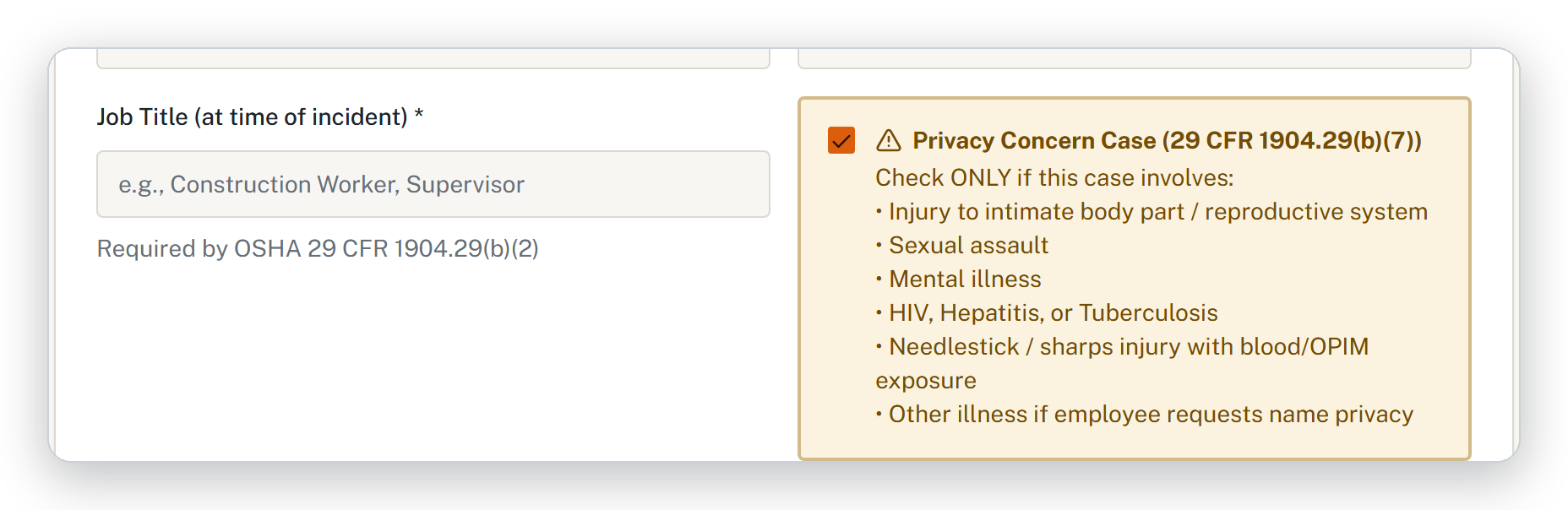
- Privacy concern cases never carry a name on the Log. Under 1904.29(b)(6) you enter "privacy case" in place of the employee's name and keep a separate confidential case list. The qualifying cases are listed in 1904.29(b)(7): injuries to intimate body parts or the reproductive system, injuries from sexual assault, mental illnesses, HIV, hepatitis and tuberculosis, contaminated needlestick and sharps injuries, and other illnesses when the employee asks for privacy. Per 1904.29(b)(8), "this is a complete list."
- The description can be generalized too. When removing the name is not enough to prevent identification, 1904.29(b)(9) lets you use discretion in describing the injury, keeping enough to show cause and severity while dropping details of an intimate nature.
- Even union representatives never see the whole 301. The 1904.35(b)(2)(v)(B) rule quoted above strips everything except the case-description section before a 301 copy goes to an authorized employee representative.
One more boundary worth knowing before someone asks: the confidential list matching case numbers to names is not a document anyone gets on request. 1904.29(b)(6) requires you to keep it so that you can update those cases and provide the information to the government if asked — employees, former employees and their representatives have no right to it, and a general contractor is not even in the conversation. It stays in your own file, for the five years 1904.33(a) requires.
So the practical answer to the bid packet: send the certified 300A summaries and your computed rates; if the GC insists on Logs, send them with names removed, and say in the response that the redaction is made under 1904.29(b)(10) rather than leaving it to be noticed as an omission.
Building the 1904.29 privacy machinery into the 301 form itself
The redaction rules above fail at exactly one moment, the day a recordable is entered by whoever is available rather than whoever knows 1904.29. HazComFast builds the rule into the 301 form itself: the six privacy-concern categories of 1904.29(b)(7) sit beside the entry fields as a checklist, and a dedicated field prompts for the generalized Log description that 1904.29(b)(9) permits. The person entering the case gets the regulation as a checklist instead of a memory test, at the one moment the decision is actually made.
The same design principle runs through the whole account: your Log, your 301 reports and your privacy case list live in your company's own HazComFast account, under your control, not inside a GC's portal. Each company sees only its own records. A GC sees exactly what you choose to send, nothing else. So when a prequalification packet arrives, nothing has already leaked into a shared portal, and the 300A summary that answers most of the packet is built from the same records as the Log, one level up in detail. Disclosure stays what this article argues it should be: a deliberate act, at a scope you chose.
Answer the prequal packet without opening the filing cabinet
What a general contractor needs is the 300A totals and your rates; what they have no right to is the named Log. HazComFast keeps your records inside your own account, applies the 1904.29 privacy rules at entry time rather than at disclosure time, and gives you the summary figures the packet actually asks for. Start with the free tools, or run your recordkeeping on trial.
What a GC can ask for, and what OSHA requires you to share
| Question | Answer |
|---|---|
| Does OSHA require sharing the 300 Log with a GC? | No — 1904.35 and 1904.40 name employees, their representatives and the government, nobody else |
| Can the GC require it anyway? | Yes, by contract — prequalification is a business condition, not a regulation |
| What satisfies most prequal requests? | Certified 300A summaries, TRIR/DART, EMR letter |
| Must you redact a Log shared with a GC? | Yes — 1904.29(b)(10) requires the identifying information off before an outsider sees the 300/301; only auditors, claim processors and public-health or law-enforcement agencies may see names |
| Does the GC's oversight move injuries onto their log? | No — day-to-day supervision decides, 1904.31 |
Related reading
- The rates the GC is really after: How to calculate TRIR and DART
- The forms behind the request: OSHA 300, 300A and 301 guide · OSHA recordkeeping hub
- When the government asks instead: The four-business-hour rule
- Jobsite responsibility questions: Multi-employer citation doctrine · Temp and leased workers under 1904.31
Sources and verification (verified 2026-08-26): 29 CFR 1904.35(b)(2), 1904.40(a)-(b), 1904.29(b)(6)-(9), 1904.31, 1904.32(b), 1904.33(a), quoted from the current regulation; OSHA letters of interpretation of September 9, 2005 and April 25, 2017; OSHA Establishment-Specific Injury and Illness Data (ITA). General guidance, not legal advice; State-Plan states may impose additional requirements.
Frequently Asked Questions
Does OSHA require me to give my 300 Log to a general contractor?
No. Part 1904 defines exactly who can demand your injury and illness records: your employees, former employees, their personal representatives and their authorized employee representatives under 1904.35(b)(2), and authorized government representatives under 1904.40. A general contractor, project owner or prequalification platform appears nowhere in that list. If you provide records to a GC, you are meeting a contract term, not an OSHA requirement.
Can I refuse a prequalification request for my OSHA logs?
Legally, yes; commercially, that usually means losing the bid. Prequalification requirements are private contract conditions, and the GC can make your records a condition of working for them. The regulatory point is about bargaining power and scope: since no rule dictates what you hand over, you can negotiate to provide the 300A summary and your TRIR and DART rates instead of the full named 300 Log. The only parties with a right of access are those in 29 CFR 1904.35(b)(2) and 1904.40.
Should I share the 300 Log or the 300A summary?
When the requester accepts it, the 300A. The annual summary carries the totals a GC actually uses, total cases, days away, restricted days, hours worked, without any employee names or case detail. The 300 Log lists names, injury descriptions and body parts row by row. Most prequalification math needs the 300A, whose totals and hours worked 29 CFR 1904.32(b)(2) requires, and your rate calculations, nothing more.
If I do share my 300 Log, can I remove employee names?
You must. 29 CFR 1904.29(b)(10) covers giving access to the 300 and 301 forms to anyone other than government representatives, employees, former employees and authorized representatives: the personally identifying information has to come off first. The rule leaves only three outsiders who may see names — an auditor or consultant evaluating your safety and health program, someone processing a workers' compensation or insurance claim, and public health or law enforcement agencies. A prequalification portal is none of them. Note the contrast inside your own company: under 1904.35(b)(2)(iv) you must leave the names on for employee and representative access, except for privacy concern cases.
Can the GC find our injury data on their own?
Some of it, yes. Establishments covered by electronic submission rules send their 300A data to OSHA's Injury Tracking Application each year, and OSHA publishes establishment-level submitted data on its website. In construction, that generally reaches establishments with 20 or more employees for 300A summaries, because Appendix A to Subpart E lists all of NAICS 23 (29 CFR 1904.41(a)(1)(i)). A GC can also simply require your EMR from your insurer, which no OSHA rule controls at all.
Whose log does an injury go on when my crew works under a GC's supervision?
The employer who supervises the worker day to day. Under 1904.31 and OSHA's April 25, 2017 letter of interpretation, an injury is recorded by the employer providing day-to-day supervision of the injured worker, and 1904.31(b)(4) requires the two employers to coordinate so the case is recorded only once. The GC being a controlling employer for citation purposes does not move your employee's injury onto the GC's log, and it does not move it off yours.
OSHA figures and citations here come from our regulatory source-of-truth modules, last checked against the eCFR, OSHA.gov, and the Federal Register on October 5, 2026. Last reviewed October 5, 2026.
About This Article
Published by: HazComFast
Published: August 26, 2026
Last Updated: October 5, 2026
- https://www.ecfr.gov/current/title-29/section-1904.35
- https://www.ecfr.gov/current/title-29/section-1904.40
- https://www.ecfr.gov/current/title-29/section-1904.29
- https://www.osha.gov/laws-regs/standardinterpretations/2005-09-09-0
- https://www.osha.gov/laws-regs/standardinterpretations/2017-04-25
- https://www.osha.gov/Establishment-Specific-Injury-and-Illness-Data
This content is for informational purposes only and does not constitute legal advice.