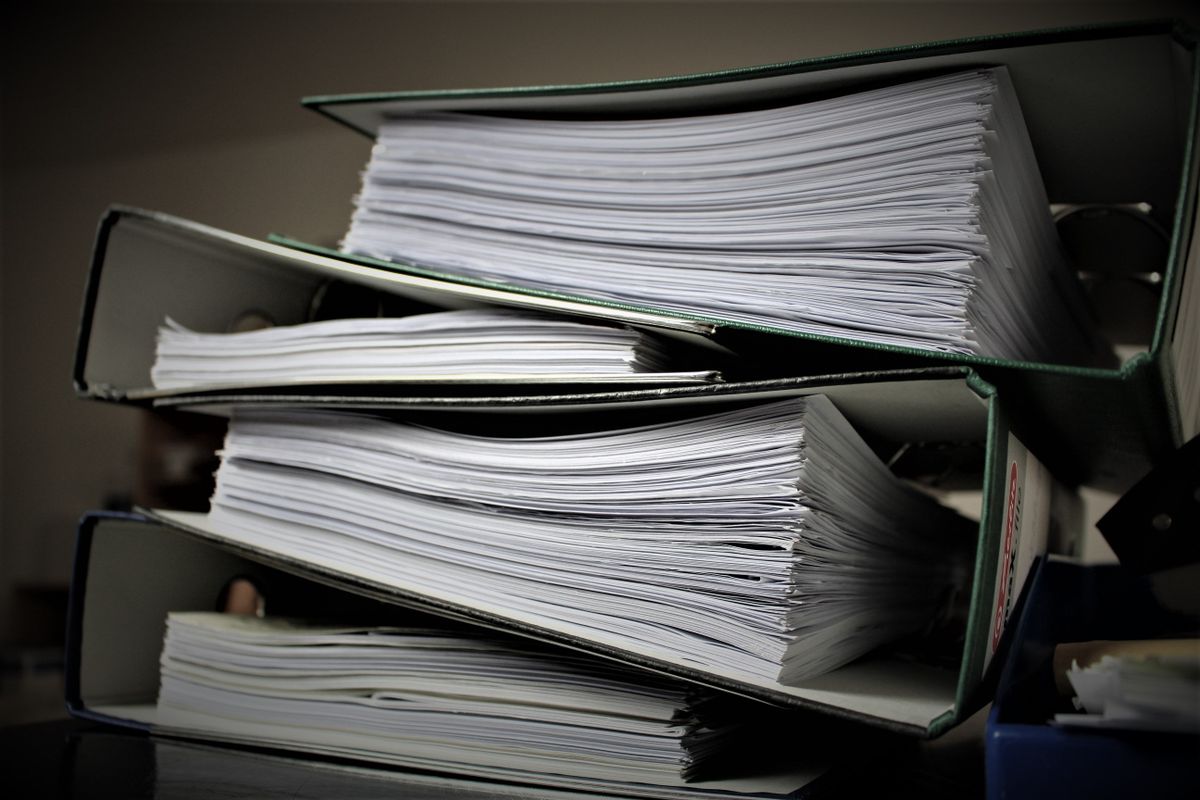
A paper SDS binder looks cheap — about $50 — but in the worked example below, a 200-chemical contractor with 3 sites spends about $3,820 in year one on the labor to build and maintain it, printing and toner, and duplicate binders, before any missing-SDS fine (a serious violation reaches $16,550 under 29 CFR 1903.15(d)(3)). The binder is not the cost; the humans feeding it are. Whether digital beats that depends on what the subscription costs, and the paper cost grows with every new chemical and every additional jobsite. OSHA does not require paper SDS binders: 29 CFR 1910.1200(g)(8) requires safety data sheets to be readily accessible during each work shift and permits electronic access as long as it creates no barriers to immediate employee access. Below is the line-item math so you can run the numbers for your own operation.
The Hidden Cost of Paper Is the Labor
The familiar yellow binder is a comfort to some and a financial black hole to the business. The mistake almost everyone makes is pricing the binder (~$50) instead of pricing the process that keeps it current. Every SDS in that binder represents a person who searched for it, downloaded it, printed it, hole-punched it, and filed it in the right place — and who will repeat part of that work every time the manufacturer revises the sheet.
Those minutes are invisible on any invoice, which is exactly why they get ignored. But labor is real money, and an SDS library is never "done": suppliers reformat sheets, you swap products, new chemicals arrive on the truck, and old binders drift out of date the moment they're printed.
To make this honest rather than hand-wavy, the table below uses one realistic profile — a contractor with 200 chemicals across 3 active jobsites, an administrator loaded at $25/hour — and conservative time estimates you can adjust to your own reality.
The Full ROI Calculation (200 Chemicals, 3 Sites)
| Cost driver | Manual / paper | Digital | Basis |
|---|---|---|---|
| Initial library build | 50–67 hrs × $25 = $1,250–$1,675 (one-time) | Bulk import / supplier lookup, a few hours = ~$100 | 200 SDS × 15–20 min each to source, print, punch, file |
| Annual updates | 30–50 SDS × ~18 min × $25 = $225–$375/yr | Revision monitoring flags the sheets to replace; uploading each revised sheet stays a manual step | 15–25% list turnover per year |
| Printing & toner | $150–$300/yr | $0 | New + revised sheets, color GHS pictograms |
| Duplicate binders per site | 3 sites × (binder + reprint labor) = $600–$1,200/yr | $0 (one library, all sites) | Each site needs its own physical copy |
| Search time | 5–10 min/lookup × ~300 lookups/yr × $25 = $625–$1,250/yr | Seconds; negligible | Workers/supervisors pulling SDSs |
| Missing-SDS risk premium | Expected fine exposure, $1,000s | Mitigated (cloud backup, no lost pages) | Up to $16,550 per serious violation |
| Approx. all-in Year 1 | ~$4,000–$8,000+ | ~Software subscription + minimal labor | Labor dominates both columns |
The headline: in this profile, paper costs about $2,850 to $4,800 a year in labor and materials (the sum of the five cost rows) before any fine risk. The two biggest line items, library labor and search time, are the ones a paper process can never reduce, because they scale with headcount and chemical count.
1. Labor inefficiency (the big one)
This is where paper bleeds.
- Manual: It takes ~15–20 minutes to locate, download, print, hole-punch, and file a single SDS correctly. For a 200-chemical site that's 50–67 hours just to stand the library up — over a full work-week of one person's time.
- Ongoing: A moderately active site turns over 15–25% of its chemical list a year. That's 30–50 sheets to re-source and re-file annually — another 8–17 hours.
- Digital: Bulk import collapses the build to a few hours; revision monitoring tells you which sheets to replace, and the replacement upload stays a manual step.
2. Search time
- Manual: Finding the right (current) SDS in a thick binder takes 5–10 minutes — longer if the binder is out of order or the page was never filed.
- Digital: Keyword/QR search returns the current sheet in seconds.
- Impact: Cutting lookup time ~90% removes downtime when a crew is waiting on safety info — and removes the temptation to "skip the binder" during a fast-moving job, which is how gaps start.
3. Printing, toner, and duplication
A single binder refresh — printing 50 new or revised SDSs, several with full-color GHS pictograms — can run $100+ in toner and paper alone. Now multiply by every jobsite, because each physical location needs its own copy. Three sites means three binders, three reprint cycles, and three chances for one of them to fall out of date. Digital keeps one library that every site reads from.
OSHA Doesn't Require Paper — So Why Pay For It?
A persistent myth keeps binders alive: that OSHA "requires" a physical book on site. It does not. The Hazard Communication Standard requires that safety data sheets be "readily accessible to employees ... during each work shift when they are in their work area(s)" — see 29 CFR 1910.1200(g)(8). The standard is about access, not medium.
The rule itself permits it: "Electronic access and other alternatives to maintaining paper copies of the safety data sheets are permitted as long as no barriers to immediate employee access in each workplace are created by such options" (29 CFR 1910.1200(g)(8)). OSHA's 2015 HazCom inspection directive (CPL 02-02-079, now archived) set out what that takes:
- No barriers to access: every employee has adequate device access, with no restrictions, in the work area.
- A backup procedure or system, such as paper or another electronic system, for when the device or network is down. Reading the information over the phone was not enough.
- Training on how to get the SDSs, both on the device and through the backup, as part of HazCom training (29 CFR 1910.1200(h)(3)(iv)).
- A hard copy on request, and in an emergency for medical personnel.
This is why digital is not a compliance risk but a compliance upgrade: it removes the missing-page problem while still satisfying the "readily accessible" test. (For a deeper treatment, see our guide on whether digital SDS are legal under OSHA.)
The Risk Premium: What a Missing SDS Actually Costs
The line item budgets leave out: If a compliance officer opens your binder and finds it missing SDSs for chemicals in use, that's a citable violation of 29 CFR 1910.1200(g). Under the current federal penalty schedule, a serious violation carries a maximum penalty of $16,550, and a willful or repeated violation reaches $165,514 per violation. (These are federal maximums; state-plan states may differ — verify your state.)
A single serious citation can carry up to $16,550 before the reductions OSHA applies. A digital library has no loose pages to fall out: a sheet is either in the library or it isn't, which makes a gap easier to see. Pair that with a gap analysis and you close holes before an inspector finds them — see the gap-analysis method.
Note: penalty figures are current federal OSHA maximums and are estimates of exposure, not legal advice. Actual penalties depend on gravity, employer size, good-faith, and history.
The Cost Paper Keeps After the Project Ends
There's a cost even the table above understates: paper doesn't stop billing you when the job closes. Under 29 CFR 1910.1020(d)(1)(ii)(B), the SDS of a chemical you no longer use need not be kept for any set period as long as some record of the chemical's identity, where it was used and when it was used is kept for at least 30 years; the SDS of a chemical still in use stays on hand under 1910.1200(g). So the binder you'd instinctively recycle at demobilization can't simply be thrown out unless that identity/where/when record survives elsewhere. In paper terms that means boxes in storage, retrieval labor if a claim surfaces in 2046, and the real risk that a discarded binder becomes a retention violation on top of everything else. A digital library "sunsets" those records into a searchable archive at essentially no marginal cost — the 30-year obligation is met by a database field, not a storage unit. (More on the rule in SDS management best practices.)
A Worked Example: The Break-Even Calculation
Let's make it concrete for the 200-chemical, 3-site contractor above.
Year-1 paper cost (conservative, mid-range):
| Item | Amount |
|---|---|
| Initial library build (one-time) | $1,460 |
| Annual updates | $300 |
| Printing & toner | $225 |
| Duplicate binders (3 sites) | $900 |
| Search time | $935 |
| Subtotal (excludes fine risk) | $3,820 |
That's $3,820 in Year 1 labor and materials before a single dollar of fine exposure — and roughly $2,360/year on an ongoing basis (everything except the one-time build).
Against that, compare your subscription. The break-even is reached when the annual software cost, plus a few hours of import labor, is below the ~$2,360 of recurring paper cost; the further below, the faster the payback. Avoided-fine risk is upside on top. Run your own figures with the SDS ROI Calculator.
Where paper actually bleeds — 200 chemicals, 3 sites
About $2,850–$4,800/yr in labor and materials in this example, vs. a subscription. Labor dominates — and it's the part paper can never reduce. (Illustrative estimates; run your own numbers.)
Common Mistakes & Myths
- Pricing the binder, not the process. The $50 binder is a rounding error; the labor and search time are the cost.
- Assuming OSHA requires paper. It requires ready access (29 CFR 1910.1200(g)(8)), which electronic systems satisfy.
- Forgetting per-site duplication. Every jobsite needs its own current copy; paper multiplies, digital doesn't.
- Ignoring revision drift. A printed sheet is a snapshot; manufacturers reissue SDSs, and your binder silently goes stale.
- Going digital with no offline plan. "Readily accessible" still applies when the network is down — keep a backup access method. See why offline SDS access matters.
- Skipping training on the new method. Workers must know how to pull an SDS for either medium to count as accessible under 1910.1200(h).
What To Do Next
- Count your real numbers. Total chemicals, number of sites, and an honest hourly loaded rate for whoever maintains the binders.
- Run the ROI. Use the SDS ROI Calculator to compare your paper labor against a subscription.
- Find your gaps first. Before you migrate, run an SDS gap analysis so you import a complete library, not a copy of the holes.
- Plan offline access. Decide your downtime backup (paper or another electronic system, such as copies cached on the device) so you stay "readily accessible."
- Train and document. Update HazCom training on the new access method and keep proof — that's what an inspector asks for.
Count your chemicals, then run the numbers
Switching to digital isn't "going green" — it's going lean. Paper SDS management carries a labor cost that grows with every chemical and every site, and it leaves you one missing page away from a citation. Whether digital pays back, and how fast, comes down to its price against that recurring cost. Start by counting your chemicals and running the numbers.
Related: SDS Management hub · SDS ROI Calculator · SDS Gap Analyzer · Are Digital SDS Legal Under OSHA? · SDS Management Best Practices · Why Offline SDS Access Matters
Sources & verification (verified October 5, 2026): OSHA Hazard Communication Standard, 29 CFR 1910.1200(g)(1) and (g)(8) (SDS access) and (h) (training); CPL 02-02-079 (2015, archived) on electronic access; 29 CFR 1910.1020(d)(1)(ii)(B) on the 30-year identity record; penalty maximums per 29 CFR 1903.15(d) (serious $16,550; willful/repeated $165,514). Figures here are cost estimates for planning, not legal advice; state-plan states may set different penalties — verify your jurisdiction.
Frequently Asked Questions
How much does a paper SDS binder cost per year?
The binder itself is cheap (~$50); keeping it current is not. In this article's worked example (200 chemicals, 3 sites, $25 an hour), year one comes to about $3,820 in labor and printing before any fine exposure, and about $2,360 a year after that. OSHA requires access, not paper: SDSs readily accessible during each work shift (29 CFR 1910.1200(g)(8)).
What is the ROI of digital SDS management?
It depends on the subscription price, which the example does not assume. Recurring paper cost in the example is about $2,360 a year, roughly $197 a month: a subscription that costs less than that pays for itself, and the larger the gap, the faster. A missing SDS adds risk on top, since a serious violation can carry up to $16,550 (29 CFR 1903.15(d)(3)).
Are digital SDS systems actually allowed by OSHA instead of paper?
Yes. OSHA's Hazard Communication Standard, 29 CFR 1910.1200(g)(8), requires that SDSs be 'readily accessible' to employees in their work area during each shift — it does not mandate paper. The rule itself permits electronic access 'as long as no barriers to immediate employee access in each workplace are created.' OSHA's 2015 HazCom inspection directive (CPL 02-02-079, now archived) spelled out what that takes: device access with no restrictions, a backup procedure or system such as paper or another electronic system, training on both, and a way to get a hard copy; reading the information over the phone was not enough.
How many hours does manual SDS management really take?
In the example's assumptions, 15 to 20 minutes per SDS to source, print, punch and file: 50 to 67 hours to build a 200-SDS library, then 8 to 17 hours a year for 30 to 50 new or revised sheets. Your numbers will differ. The duty behind the work is fixed: an SDS in the workplace for each hazardous chemical you use (29 CFR 1910.1200(g)(1)), readily accessible during each shift (g)(8).
What does a missing or outdated SDS page cost?
Time during an incident, and a citation risk: 29 CFR 1910.1200(g)(8) requires the SDS to be readily accessible in the work area during each shift, and a serious violation can carry up to $16,550 (29 CFR 1903.15(d)(3)). Digital search returns the current document in seconds and has no loose pages, as long as a backup covers a dead device or network.
OSHA figures and citations here come from our regulatory source-of-truth modules, last checked against the eCFR, OSHA.gov, and the Federal Register on October 5, 2026. Last reviewed October 5, 2026.
About This Article
Published by: HazComFast
Published: February 11, 2026
Last Updated: October 5, 2026
This content is for informational purposes only and does not constitute legal advice.