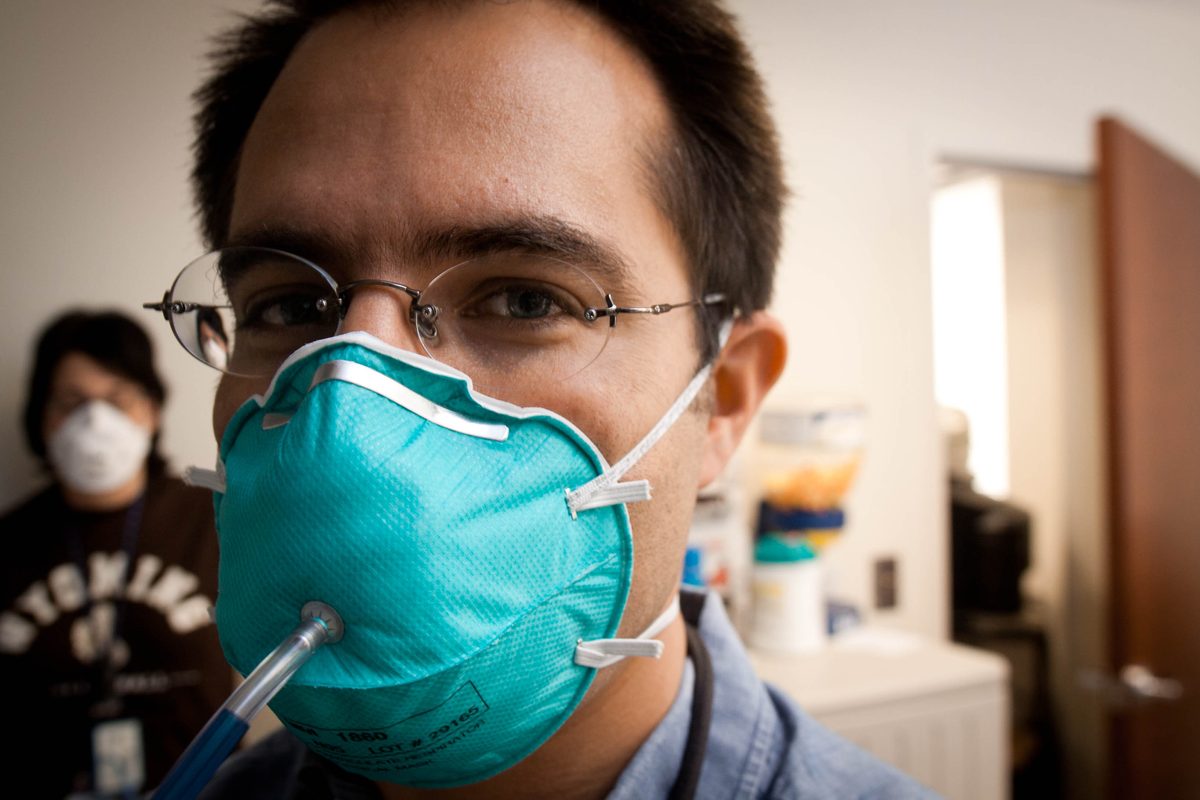
Yes, for a worker who moves from job to job within the year, if the new employer obtains a copy of the original fit test record and the same respirator make, model and size is available and appropriate for use at the new work site. Those conditions are written in OSHA's inspection directive for the respiratory protection standard, CPL 02-00-158. The standard itself, 29 CFR 1910.134, has no rule on fit tests done by another employer, and when the test was done in time but the record never came over, the directive tells inspectors to cite the new employer under 1910.134(m)(2).
A concrete finisher arrives at a parking garage repair job with a fit-test card from March. It names a half-face respirator and says he passed. The new crew starts chipping concrete that morning. Before relying on the test, the employer needs the original test record and enough detail to match it to the respirator and work at this site.
Does 29 CFR 1910.134 say anything about a fit test done by another employer?
No. Paragraph (f) of 29 CFR 1910.134 covers fit testing and paragraph (m) the records. Neither mentions a test run by a previous employer, and Appendix A, with the test procedures, doesn't either. The timing rule is (f)(2): "The employer shall ensure that an employee using a tight-fitting facepiece respirator is fit tested prior to initial use of the respirator, whenever a different respirator facepiece (size, style, model or make) is used, and at least annually thereafter."
The duty in that sentence sits with "The employer," and so does the one in (f)(1): "The employer shall ensure that employees using a tight-fitting facepiece respirator pass an appropriate qualitative fit test (QLFT) or quantitative fit test (QNFT) as stated in this paragraph." Appendix A says the same: "The employer shall conduct fit testing using the following procedures."
Training shows what the standard looks like when it does carry something over from another job. Paragraph (k)(4) reads: "An employer who is able to demonstrate that a new employee has received training within the last 12 months that addresses the elements specified in paragraph (k)(1)(i) through (vii) is not required to repeat such training provided that, as required by paragraph (k)(1), the employee can demonstrate knowledge of those element(s)." It even sets the clock: "Previous training not repeated initially by the employer must be provided no later than 12 months from the date of the previous training." The fit test paragraphs have no sentence like either one.
The same text applies to a construction crew. 1910.134 states its own scope: "This section applies to General Industry (part 1910), Shipyards (part 1915), Marine Terminals (part 1917), Longshoring (part 1918), and Construction (part 1926)." OSHA's page for the inspection directive lists 1926 and 1926.103 among the standard numbers it covers, and the directive says "The standard applies to all respirator usage in General Industry, Shipyards, Marine Terminals, Longshoring and Construction workplaces." The 1910.134 paragraphs quoted below apply on a 1926 job as written.
What does OSHA's inspection directive say about a fit test from a previous employer?
It lets the new employer skip the repeat test under three conditions, and it keeps the citations pointed at the new employer. CPL 02-00-158 carries an information date of June 26, 2014, and its abstract says what kind of document it is: "This Instruction establishes agency interpretations and enforcement policies, and provides instructions to ensure uniform enforcement of the Respiratory Protection Standard, 29 CFR 1910.134." It's written for OSHA's inspectors, whom it calls CSHOs. The passage that answers it sits in the directive's fit testing section (IX.F, p. 26):
"Where employees move from job to job within the year (e.g., temporary or construction workers), their fit test need not be repeated if the employer obtains a copy of the original fit test record and the same respirator make, model and size is available and appropriate for use at their new work site."
The worker moves between jobs within the year, and construction is one of the two examples. The new employer obtains a copy of the original record. The same make, model and size has to be on hand at the new site, and it has to suit the work there.
The citation guidelines right below it cover the two ways this goes wrong:
"a. If fit testing was done by a previous employer within the required time, but no fit test record was obtained by the current employer, a citation for (m)(2) should be issued. b. If the CSHO determines the fit testing was not appropriate for the present respirator usage, citations for the appropriate requirements of paragraph (f) should be issued."
Both land on the current employer. A valid test from March can still leave you with an (m)(2) citation in November if the copy never reached your file. The directive is enforcement policy, and the regulation's text stays silent on the point.
Is a fit test card from the last job enough?
The directive's word is "record," and the standard spells out what a fit test record holds. Under 1910.134(m)(2)(i), "The employer shall establish a record of the qualitative and quantitative fit tests administered to an employee including:"
- (A) "The name or identification of the employee tested"
- (B) "Type of fit test performed"
- (C) "Specific make, model, style, and size of respirator tested"
- (D) "Date of test"
- (E) "The pass/fail results for QLFTs or the fit factor and strip chart recording or other recording of the test results for QNFTs"
Line those up against the March card. A name, a date and a pass cover (A) and (D), and (E) only if the test was qualitative. Nothing on the card says which test was run, and "half-face respirator" isn't a make, a model, a style or a size. The directive's condition turns on item (C), and the card doesn't have it.
The directive reads the record the same way. Its recordkeeping section (IX.M, p. 37-38) says: "Each fit test record must contain the employee identification, type of fit test, date last tested, the results of the test, and the make, model and size of the respirator tested." Then: "Lack of a fit test record or lack of information on a fit test record would be cited under (m)(2)."
So the card can be true and still not be the record. Ask for the record itself: the form or printout his last employer filed, with the respirator named down to the size and, for a quantitative test, the fit factor and its recording.
What counts as "the same respirator"?
The standard names four things. The opening of paragraph (f) says the employee "must be fit tested with the same make, model, style, and size of respirator that will be used," and (f)(2) calls for a new test "whenever a different respirator facepiece (size, style, model or make) is used." The directive's portability sentence lists three: "make, model and size." Style is the one it leaves out, and (f)(2) still lists it. A different style is a different facepiece under (f)(2), and that means a new fit test.
The directive's recordkeeping section adds: "If an employee is wearing a respirator different from that found in his fit test records then (f)(2) should be cited." On the garage job, a matching brand gives you the make and nothing else. Without the model, style and size from the record, there's no way to check the directive's condition.
The harness counts too. An OSHA interpretation letter of February 8, 2016, written about harnesses, says: "Each respirator model needs to be fit tested separately for each different harness. The harness and facepiece configuration used during the job task must be the same type as used during the fit test."
The test itself has to suit the new job. Guideline b. above cites the new employer when "the fit testing was not appropriate for the present respirator usage." 1910.134(f)(6) says "QLFT may only be used to fit test negative pressure air-purifying respirators that must achieve a fit factor of 100 or less," and the directive gives inspectors the example: "Using QLFT for negative pressure APRs used in atmospheres greater than 10 times the PEL would be cited as (f)(6)." A qualitative pass from the last job doesn't cover a negative-pressure air-purifying respirator that the new job puts in an atmosphere above 10 times the PEL.
The protocol is checked too. 1910.134(f)(5) says "The fit test shall be administered using an OSHA-accepted QLFT or QNFT protocol," the directive says "For not following prescribed protocol, cite (f)(5)," and it tells the inspector to "determine which protocol was used for fit testing." A record that names the test lets you answer that before the inspector asks. The QLFT and QNFT guide for construction walks through the methods.
When is the next fit test due for a worker who brings one?
1910.134(f)(2) says "at least annually thereafter," and for a test done elsewhere no written federal rule says when that year starts. The directive points one way without saying it outright. Its portability sentence covers workers who move "within the year," says their fit test "need not be repeated," and rests on "the original fit test record." Its inspection guideline has the CSHO check whether employees "have been fit tested in the last twelve months for the respirator they are wearing."
Use the original test date for scheduling the next test. The test is being accepted as an existing test, and 1910.134(f)(2) still requires testing at least annually. The directive has inspectors check for a test in the last twelve months. Hiring the worker does not provide a basis for adding another year. Washington’s rule, discussed below, expressly limits accepted results to twelve months old.
Some events bring the next test forward. Under 1910.134(f)(3), "The employer shall conduct an additional fit test whenever the employee reports, or the employer, PLHCP, supervisor, or program administrator makes visual observations of, changes in the employee's physical condition that could affect respirator fit." The examples given are "facial scarring, dental changes, cosmetic surgery, or an obvious change in body weight," and the list is open: "include, but are not limited to." Under 1910.134(f)(4), a worker who passed and later tells the employer, program administrator, supervisor or PLHCP that the fit is unacceptable "shall be given a reasonable opportunity to select a different respirator facepiece and to be retested." A March test is eight months old in November. Ask the finisher on day one whether anything on that list has changed since.
Can the previous employer have thrown the record away?
It may have had no duty to keep it. Under 1910.134(m)(2)(ii), "Fit test records shall be retained for respirator users until the next fit test is administered." The preamble to the 1998 final rule adds: "If the employee's use of a respirator is discontinued (e.g., because of a change of duties or successful implementation of engineering controls), fit test records need not be retained for the employee" (63 FR 1264). OSHA held the same line in an interpretation letter on record retention dated June 2, 2009: "There are no additional requirements. 29 CFR 1910.134(m)(2)(ii) only requires fit testing records to be retained by the employer until the next fit test is administered."
Read with the preamble, the old employer's duty to keep the record ends once the worker no longer wears a respirator there. A copy requested months after the worker left may already be gone.
Getting a copy is a separate question. Under 1910.134(m)(4), "Written materials required to be retained under this paragraph shall be made available upon request to affected employees and to the Assistant Secretary or designee for examination and copying." The directive spells out who that means (IX.M, p. 37): "The employer must also make an employee's fit testing records available to that employee and to OSHA. The standard does not intend for the employer to make an employee's medical or fit testing records available to any other individual unless that individual is the employee's "designated representative," as defined in 1910.1020(c)(3)."
Nothing in 1910.134 entitles a new employer to the copy. The route the standard opens runs through the worker, and it has gaps. Paragraph (m)(4) sets no deadline for answering a request and says nothing about cost. It doesn't say whether a former employee still counts among the "affected employees," and nothing in 1910.134 tells the old employer to hand the record to a worker on the way out. The copy is easiest to get while the worker still wears a respirator on the old job. Ask the worker for it when you make the offer.
Does a fit test from a union hall or a fit-test vendor count the same way?
The texts don't reach that far. The directive speaks of "a previous employer" and "the original fit test record." The standard keeps the duty on the employer: (f)(1) and (f)(2) both begin "The employer shall ensure," and Appendix A says "The employer shall conduct fit testing using the following procedures."
OSHA did note in 1998 that outside testers exist: "Contractors who perform QNFT services are located throughout the country, and an employer can arrange a schedule to ensure that fit testing will be available when required" (63 FR 1227). That sentence describes an employer booking a contractor for its own fit tests. A test the worker arranged on their own, or one run through a union hall, isn't addressed by the standard or by the directive's passage. When the paper in front of you isn't a previous employer's record, the safe call is a fit test under your own program.
Does the medical evaluation carry over the same way?
It has its own rule, with different conditions. Under 1910.134(e)(1), "The employer shall provide a medical evaluation to determine the employee's ability to use a respirator, before the employee is fit tested or required to use the respirator in the workplace." The directive's medical section (IX.E, p. 22-23) has its own passage on transient workers:
"Where employers use a transient workforce (e.g., temporary or construction workers), the employer may accept the written medical recommendation of the employee's ability to use a respirator as determined by the employee's previous employer's physician or other licensed health care professional (PLHCP) only if the work conditions and type and weight of the respirator remains the same and appropriate for use at the employee's new work site. In this situation, the employer must obtain from the previous employer a copy of the PLHCP's written recommendation."
The medical passage looks at the work and at the type and weight of the respirator. The fit test passage looks at the facepiece. One can carry over while the other doesn't: same half mask, but the new job is heavier work in hotter conditions than the one the old recommendation was written for.
OSHA's interpretation letter of December 4, 2014, which deals with the medical recommendation, adds: "The current employer must exercise due diligence when receiving another employer's PLHCP's written recommendations." Either way, under (e)(1), the medical side has to be settled before the worker is required to wear the respirator on your site. The respiratory protection program guide covers the rest of 1910.134.
What does Washington's state plan say?
Washington writes the acceptance into its own rule. A note in WAC 296-842-15005, part of its respirator chapter, reads:
"You may accept a fit test completed by a previous employer IF: 1. You obtain written documentation of the fit test; 2. The results of the fit test are not more than twelve months old; 3. The employee will use the same respirator (the same type, model, style, and size); and 4. The fit test was conducted in a way that meets the requirements of WAC 296-842-15005 and 296-842-22010."
That's Washington's text, for employers under its state plan. It isn't federal, and it says nothing about other state plans. It does settle two points the federal directive leaves open: the twelve months are counted on the results, and style is on the list. On a job in another state-plan state, read that state's own rule before you lean on the federal directive.
What should you do with what the worker brings?
| What the worker brings | What the texts say | The safe call |
|---|---|---|
| A copy of the original record, less than 12 months old, for the make, model, style and size you'll issue | CPL 02-00-158, IX.F: the test "need not be repeated" if the record is obtained and the respirator is available and appropriate at the new site | Accept it, file the copy, and schedule the next test from the original test date |
| A wallet card with a name, a date and a pass | 1910.134(m)(2)(i) lists five items for the record, and CPL IX.M cites a missing record or missing information under (m)(2) | Get the record, or fit test |
| A record for the same model in another size | 1910.134(f)(2): a new fit test whenever a different facepiece (size, style, model or make) is used | Fit test on the size the worker will wear |
| A record for the same facepiece with a different harness | OSHA letter of February 8, 2016: each model fit tested separately for each different harness | Fit test with the harness the worker will wear |
| A qualitative pass, for a negative-pressure air-purifying respirator to be worn above 10 times the PEL | 1910.134(f)(6), and CPL IX.F cites QLFT in that use under (f)(6) | Quantitative fit test |
| A record more than 12 months old | 1910.134(f)(2): at least annually, and CPL IX.F checks for a test in the last twelve months | Fit test |
| A test from a union hall, or from a vendor the worker hired directly | Not addressed by 1910.134 or by the directive's passage | Fit test under your own program |
| The previous employer's PLHCP written recommendation | Its own rule in CPL IX.E: same work conditions, same type and weight of respirator, copy obtained from the previous employer | Apply IX.E, separately from the fit test |
Where does a worker get a copy of the original fit test record?
From the employer that ran the test: 1910.134(m)(4) makes it available to affected employees on request. HazComFast hands it over before anyone has to ask. On "My respirator," a worker sees their fit tests, their retest date and the record itself, and "Download my record" produces the Respirator Fit Test Record as a PDF. It carries the employee and the tester, the respirator's manufacturer, model, style and size, the method, the protocol, the instrument, the result and the fit factor, the test date, the retest due date and the linked medical evaluation. The signed form and the QNFT recording are reproduced inside it, and a record printed from a screen in Spanish comes out in both languages. A worker who downloads it before moving on carries the copy of the original fit test record that CPL 02-00-158 refers to, with the exact respirator spelled out.
On the employer's side, the dates hold. "Retest due" is set from the test date, 12 months later, and follows it if the test date is corrected. A retest date further out is refused, and so is a test date in the future. A passed fit test stays tied to the respirator it was done with, so the record always says which make, model and size passed.
Paragraphs (f)(3) and (f)(4) each get a button. Record a change that could affect the fit, such as facial scarring, dental changes or an obvious change in body weight, and the passes it affects are marked invalidated. A worker whose respirator doesn't fit can report it from their own screen, and the program team is notified.
And the retest stops sneaking up on anyone. The worker, the admins and the managers are notified 60, 30, 14, 7 and 0 days before it's due, and the dashboard lists every test that's overdue or due within 30 days. Each jobsite gets a "Respiratory readiness" count of who is overdue, due within 30 days, without a valid fit test, or current.
Before the next hire hands you a card
Decide once which fit test records you accept and when you fit test instead, and write that into the program. The Respiratory Protection Program Builder drafts a written respiratory protection program: you enter your site's details on the page and download the program as a PDF. Read every section against your own site before it goes out. The tool is free.
Related reading: The respiratory protection program guide · QLFT vs QNFT in construction · Facial hair and tight-fitting respirators
Frequently Asked Questions
Can a new employer accept a respirator fit test done by a previous employer?
29 CFR 1910.134 has no rule on it. OSHA's inspection directive CPL 02-00-158 says that for workers who move from job to job within the year, such as temporary or construction workers, the fit test need not be repeated if the new employer obtains a copy of the original fit test record and the same respirator make, model and size is available and appropriate for use at the new work site. When the test was done in time but the record was never obtained, the directive tells inspectors to cite the current employer under 1910.134(m)(2).
Is a fit test card from the last job enough?
The directive's condition is a copy of the original fit test record, and 29 CFR 1910.134(m)(2)(i) lists what that record holds: the employee's name or identification, the type of fit test, the specific make, model, style and size of respirator tested, the date, and the pass/fail result for a QLFT or the fit factor and recording for a QNFT. A card that shows a name, a date and a pass leaves out the type of test and the respirator's make, model, style and size, and CPL 02-00-158 cites a missing record, or missing information on a record, under 1910.134(m)(2).
Does the annual fit test clock restart when a worker changes employers?
Accepting the test does not provide a basis for adding a year to its original date. 29 CFR 1910.134(f)(2) requires testing at least annually, and CPL 02-00-158 has inspectors check for a test in the last twelve months. Schedule the next test from the original date. Washington’s WAC 296-842-15005 expressly limits accepted test results to twelve months old.
Does a fit test from a union hall or a fit-test vendor count the same way?
Neither 29 CFR 1910.134 nor the portability passage of CPL 02-00-158 addresses it. The directive speaks of a previous employer and the original fit test record. 1910.134(f)(1) and (f)(2) put the fit test duty on the employer, and Appendix A says the employer shall conduct fit testing using its procedures. When the test didn't come from a previous employer, a fit test under the new employer's own program is the safe call.
Does the respirator medical evaluation carry over like the fit test?
It has its own rule. 29 CFR 1910.134(e)(1) requires the medical evaluation before the employee is fit tested or required to use the respirator in the workplace. CPL 02-00-158 lets the employer accept a previous employer's PLHCP written recommendation only if the work conditions and the type and weight of the respirator remain the same and appropriate at the new site, and the employer must obtain a copy of that recommendation from the previous employer.
How long does an employer have to keep a fit test record?
Until the next fit test. 29 CFR 1910.134(m)(2)(ii) says fit test records shall be retained for respirator users until the next fit test is administered, and OSHA's June 2, 2009 interpretation letter on record retention says there are no additional requirements. The 1998 preamble adds that when an employee's respirator use is discontinued, fit test records need not be retained for that employee, so a copy requested long after a worker leaves may no longer exist.
Site-wide regulatory figures such as compliance dates and penalty amounts come from our regulatory source-of-truth modules, last checked against the eCFR, OSHA.gov, and the Federal Register on October 19, 2026. Last reviewed November 14, 2026.
About This Article
Published by: HazComFast
Published: November 11, 2026
Last Updated: November 14, 2026
- https://www.ecfr.gov/current/title-29/part-1910/section-1910.134
- https://www.osha.gov/sites/default/files/enforcement/directives/CPL_02-00-158.pdf
- https://www.osha.gov/enforcement/directives/cpl-02-00-158
- https://www.govinfo.gov/content/pkg/FR-1998-01-08/html/97-33843.htm
- https://www.osha.gov/laws-regs/standardinterpretations/2009-06-02-0
- https://www.osha.gov/laws-regs/standardinterpretations/2016-02-08
- https://www.osha.gov/laws-regs/standardinterpretations/2014-12-04
- https://lawfilesext.leg.wa.gov/Law/WAC/WAC%20296%20%20TITLE/WAC%20296%20-842%20%20CHAPTER/WAC%20296%20-842%20-15005.htm
This content is for informational purposes only and does not constitute legal advice.