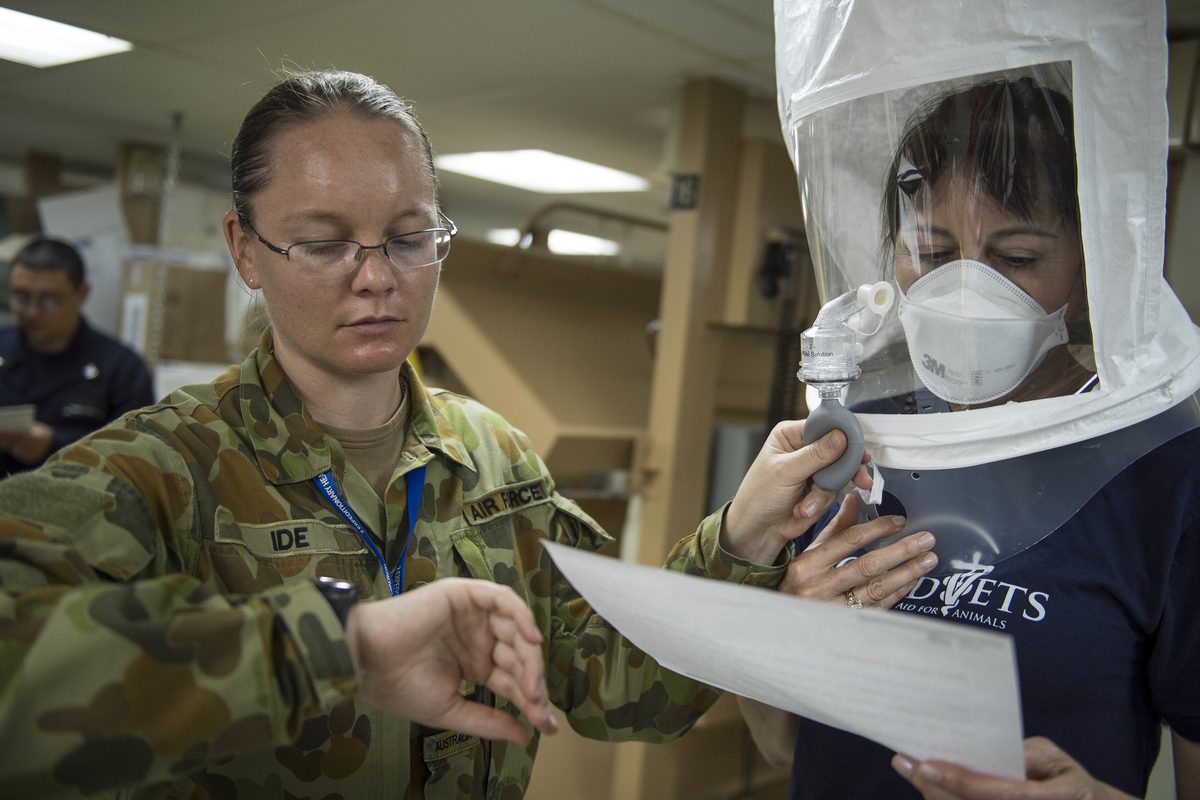
Yes. 29 CFR 1910.134(e)(1) tells the employer to provide a medical evaluation "before the employee is fit tested or required to use the respirator in the workplace." On a construction job the text is the same, because 29 CFR 1926.103 says the construction requirements "are identical to those set forth at 29 CFR 1910.134." The fit test waits until a physician or other licensed health care professional (PLHCP) has given a written recommendation on whether the worker can use the respirator.
A demolition contractor has booked the fit-test vendor for Tuesday morning, with six laborers starting Monday. None has completed the medical evaluation. The clinic’s recommendation has to come first; sending questionnaires after the fit tests reverses the order required by 1910.134(e)(1).
Why does the medical evaluation have to come before the fit test?
The order comes straight from the regulation. 29 CFR 1910.134(e)(1) reads: "The employer shall provide a medical evaluation to determine the employee's ability to use a respirator, before the employee is fit tested or required to use the respirator in the workplace." In the preamble to the final rule, OSHA put it as plainly: "every employee must be medically evaluated prior to fit testing and initial use of a respirator" (63 FR 1208).
OSHA heard the opposite argument during the rulemaking and turned it down. One commenter proposed running the evaluation after the fit test. OSHA kept the evaluation first and gave its reason: "the initial medical evaluation must be conducted prior to fit testing to identify those employees who have medical conditions that contraindicate even the limited amount of respirator use associated with fit testing" (63 FR 1209). During a fit test the worker wears the respirator and goes through the exercises in Appendix A to 1910.134. That is respirator use, short as it is. The electricians' union said it more bluntly in the record: "The physical fitness of respirator users must be known prior to them donning a respirator, not after they become injured" (IBEW, Ex. 54-441, quoted at 63 FR 1209).
Hours of use don't change the order. Some of the alternatives in OSHA's proposal would have skipped the evaluation for workers who wore a respirator five hours a week or less. The final rule dropped them: "A medical evaluation must be performed on every employee required to use a respirator, regardless of the duration and frequency of respirator use" (63 FR 1209).
OSHA's inspection directive for the standard, CPL 02-00-158, in effect since June 26, 2014, repeats that the evaluation comes before the initial fit test and before the respirator is first used. It also settles the case of the worker who won't fill out the form: "Employees who refuse to be medically evaluated cannot be assigned to work in areas where they are required to wear a respirator" (CPL 02-00-158, p. 22). When no evaluation was provided at all, the directive tells inspectors that "a violation of (e)(1) exists."
Does the same order apply on a construction site?
Yes. Construction has no separate respirator text. 29 CFR 1926.103 carries a single note: "The requirements applicable to construction work under this section are identical to those set forth at 29 CFR 1910.134 of this chapter." The general industry section says the same from its side: "This section applies to General Industry (part 1910), Shipyards (part 1915), Marine Terminals (part 1917), Longshoring (part 1918), and Construction (part 1926)." The paragraph numbers in 1910.134(e) are the ones that govern a construction crew.
Crews turn over, and OSHA had them in mind. When it chose not to put the evaluation on a fixed schedule, the agency said the approach "will greatly simplify evaluations for employees who frequently change employment, as is the case with many construction workers" (63 FR 1163).
The inspection directive goes a step further for transient crews. Where employers use "a transient workforce (e.g., temporary or construction workers)," the new employer may accept the written recommendation from the previous employer's PLHCP "only if the work conditions and type and weight of the respirator remains the same and appropriate for use at the employee's new work site." The new employer must also obtain a copy of that written recommendation from the previous employer (CPL 02-00-158, pp. 22-23). A laborer cleared for a half-mask on the last job who now gets a full-facepiece respirator doesn't meet that condition, because the respirator changed. The directive is written for inspectors, and it shows what a compliance officer will accept as proof of an evaluation done elsewhere.
What does the PLHCP need from the employer before signing off?
Start with who does the evaluation and how. 1910.134(e)(2)(i) has the employer identify a PLHCP "to perform medical evaluations using a medical questionnaire or an initial medical examination that obtains the same information as the medical questionnaire." The Appendix C questionnaire is one route. An examination that gathers the same information is the other, and CPL 02-00-158 notes that an employer who opts for physical examinations "need not also administer the medical questionnaire."
Either way, 1910.134(e)(2)(ii) sets the floor: the evaluation "shall obtain the information requested by the questionnaire in Sections 1 and 2, part A of appendix C." Section 1 has 12 items for every employee selected to use any type of respirator. In Section 2, questions 1 to 9 also go to every employee. Questions 10 to 15 "must be answered by every employee who has been selected to use either a full-facepiece respirator or a self-contained breathing apparatus (SCBA)," and they're voluntary for everyone else. Part B is a list of 19 more questions that may be added "at the discretion of the health care professional who will review the questionnaire." When the questionnaire is the only means of evaluation, the directive says the employer "may not change the wording of questions in Part A."
A "yes" to any of questions 1 through 8 in Section 2 triggers 1910.134(e)(3)(i): the employer provides a follow-up medical examination. Under 1910.134(e)(3)(ii), that examination includes "any medical tests, consultations, or diagnostic procedures that the PLHCP deems necessary to make a final determination." The questions in Section 2 cover conditions such as seizures, diabetes and wheezing. Appendix C's note to the employer marks the other side: "Answers to questions in Section 1, and to question 9 in Section 2 of part A, do not require a medical examination."
The PLHCP also needs the job described. 1910.134(e)(5)(i) lists what the employer provides before the recommendation is made:
- the type and weight of the respirator the employee will use
- the duration and frequency of respirator use, "including use for rescue and escape"
- the expected physical work effort
- additional protective clothing and equipment to be worn
- temperature and humidity extremes that may be encountered
1910.134(e)(5)(iii) adds a copy of the written respiratory protection program and a copy of 1910.134 itself. Under 1910.134(e)(5)(ii), information already given to the PLHCP doesn't have to be sent again for a later evaluation if the information and the PLHCP are unchanged. Under the directive's citation guidelines, a PLHCP who wasn't given this information means "a violation of (e)(5) exists," and an evaluation that doesn't obtain the information in Part A, Sections 1 and 2 of Appendix C is a violation of 1910.134(e)(2)(ii) (CPL 02-00-158, p. 25).
Who counts as a PLHCP depends on state licensing. CPL 02-00-158 (p. 23) says the PLHCP "may be a physician, a registered nurse, a nurse practitioner, a physician assistant, or other licensed health care professional acting within the scope of his or her state license, registration, or certification." If the PLHCP works outside that scope, or the license has expired or is invalid, the directive says the employer "should be cited under paragraph (e)(2)(i) for choosing an inappropriate PLHCP" (CPL 02-00-158, p. 25).
What does the employer get back from the PLHCP?
A written recommendation limited to three points. 1910.134(e)(6)(i) has the employer obtain a written recommendation from the PLHCP, and the recommendation "shall provide only the following information":
- any limitations on respirator use related to the employee's medical condition or to the workplace conditions, "including whether or not the employee is medically able to use the respirator" (1910.134(e)(6)(i)(A))
- "The need, if any, for follow-up medical evaluations" (1910.134(e)(6)(i)(B))
- a statement that the PLHCP has given the employee a copy of the written recommendation (1910.134(e)(6)(i)(C))
The diagnosis and the answers stay with the PLHCP. The worker gets a copy of the recommendation, and 1910.134(e)(4)(ii) gives the worker a chance to discuss the questionnaire and examination results with the PLHCP.
One outcome sends the worker to different equipment. If the respirator is a negative pressure respirator and the PLHCP finds a medical condition that may place the employee's health at increased risk, 1910.134(e)(6)(ii) requires the employer to provide a powered air-purifying respirator (PAPR) if the PLHCP's evaluation finds the employee can use one. If a later evaluation finds the employee medically able to use a negative pressure respirator, the PAPR is no longer required.
During an inspection, CPL 02-00-158 has the compliance officer interview a number of employees about whether they received a confidential evaluation, then ask the employer for the written recommendation. "The employee should have also received a copy. The recommendation must contain only the information required by subparagraph (e)(6)" (CPL 02-00-158, p. 24).
Who is allowed to see the questionnaire answers?
The worker and the PLHCP who reviews them. Supervisors and managers are kept out. Appendix C speaks to the employee directly: "To maintain your confidentiality, your employer or supervisor must not look at or review your answers, and your employer must tell you how to deliver or send this questionnaire to the health care professional who will review it." The same paragraph says the employer "must allow you to answer this questionnaire during normal working hours, or at a time and place that is convenient to you." Appendix C is mandatory under 1910.134(o), and 1910.134(e)(4)(i) states the same rule for questionnaires and examinations alike: they "shall be administered confidentially during the employee's normal working hours or at a time and place convenient to the employee."
The directive describes the employer's part as narrow. It "is limited to distributing the blank questionnaire to the employee for him or her to fill out, or providing it to the PLHCP." When the employer hands the form to the worker, the directive adds that "an addressed and postage-paid envelope should also be provided" so the worker can mail it to the PLHCP. That envelope is a recommendation in a directive, and the word is "should." The confidentiality comes from Appendix C and 1910.134(e)(4)(i). An employer medical office may keep the questionnaires and findings if it is "administratively separate from the employer's central administration offices" (CPL 02-00-158, p. 23).
CPL 02-00-158 tells compliance officers to determine "what mechanism the employer is using" so that the employer does not see the answers. A stack of completed questionnaires in a folder on the trailer desk is a poor answer to that question. If the compliance officer suspects that workers didn't answer honestly, for example that they were "coached" by the employer on the mandatory questions, the directive says to ask for an interview with the PLHCP. If questions remain after that interview, the compliance officer "may wish to obtain a Medical Access Order" and review the questionnaires or examination records (p. 24).
What if the worker reads Spanish better than English?
1910.134(e)(4)(i) requires the questionnaire to be "administered in a manner that ensures that the employee understands its content." OSHA's enforcement directive is more specific for a worker who cannot understand English: "the employer must have the questionnaire translated into the employee's language either through a translator or a translated written copy" (CPL 02-00-158, p. 23). If the worker cannot read, the directive says the employee "can request someone other than the employer to orally read him or her the questionnaire," or the PLHCP "may obtain through an interview or examination the same information requested on the medical questionnaire." The 1998 preamble gives examples. The PLHCP may help the worker complete the questionnaire, "perhaps with the aid of an employer-supplied interpreter." The employer "also may have the medical questionnaire translated into the employee's language or administer a physical examination" that meets 1910.134(e)(2). The preamble also says "OSHA is not requiring employers to hire professional interpreters." Employers may use "an English-speaking employee who can translate the medical questionnaire" into the worker's native language, or another nonprofessional translator, "for example, a friend or family member of the test taker" (63 FR 1215).
OSHA has put two Spanish versions of Appendix C online, and neither has regulatory force. The text that applies is the English Appendix C in the eCFR. One Spanish version is Attachment 4 of OSHA's memorandum "Questions and Answers on the Respiratory Protection Standard," dated August 3, 1998 and revised August 17, 1998 (qna.pdf, pp. 74-79). The other is an undated page on osha.gov.
Neither Spanish text matches the current English one. In 2012, OSHA removed the line "Can you read (circle one): Yes/No" from Appendix C (77 FR 46948, August 7, 2012). Both Spanish versions still carry "Puede usted leer." The web page has a bigger gap. Its introduction to questions 10 to 15 speaks of a "máscara con cartucho químico" or an SCBA, and tells other workers they "no tienen que contestar." The English text requires those questions from every worker selected for a full-facepiece respirator or an SCBA and makes them voluntary for the rest. Attachment 4 follows the English numbering item for item. If a crew answers in Spanish, the PLHCP should know which text they had in hand.
Washington, a state plan, has its own questionnaire. WAC 296-842-22005 says "Use the medical questionnaire in Table 10 when conducting medical evaluations," and the Department of Labor & Industries publishes it as form F414-172-000 in English and F414-172-999 in Spanish. The Spanish form is Washington's own questionnaire in four parts, and its structure differs from the federal Appendix C.
Does the medical evaluation have to be redone every year?
Not under 1910.134. The fit test is annual: 1910.134(f)(2) requires one "prior to initial use of the respirator, whenever a different respirator facepiece (size, style, model or make) is used, and at least annually thereafter." Retraining is annual too, under 1910.134(k)(5). Paragraph (e) of 1910.134 sets no interval for the medical evaluation. Instead, 1910.134(e)(7) lists the minimum events that call for another one:
- an employee reports medical signs or symptoms related to the ability to use a respirator, 1910.134(e)(7)(i)
- a PLHCP, supervisor or the respirator program administrator informs the employer that the employee needs to be reevaluated, 1910.134(e)(7)(ii)
- information from the respiratory protection program, "including observations made during fit testing and program evaluation," indicates a need, 1910.134(e)(7)(iii)
- a change in workplace conditions "(e.g., physical work effort, protective clothing, temperature)" may substantially increase the physiological burden on the employee, 1910.134(e)(7)(iv)
The PLHCP can also set a follow-up for one worker. The written recommendation states "The need, if any, for follow-up medical evaluations" under 1910.134(e)(6)(i)(B), and a PLHCP who tells the employer a worker needs reevaluation is one of the events in 1910.134(e)(7)(ii).
OSHA chose this on purpose. The proposal would have required reevaluation on an annual basis in two of its alternatives, and most of the comments on that point asked for a change. OSHA "decided to revise the proposed requirement and to make medical reevaluation contingent on specific events that may occur during respirator use, regardless of the duration of respirator use" (63 FR 1219-1220).
1910.134(e)(7)(iii) is the loop back to the fit test. A fit tester who watches a worker struggle to breathe through the exercises has program information that can send that worker back to the PLHCP. OSHA said so in 1998: "If medical problems are observed during fit testing, the employee must be medically reevaluated" (63 FR 1209). A change of clinic doesn't call for a new evaluation by itself. The note to 1910.134(e)(5)(iii) says "OSHA does not expect employers to have employees medically reevaluated solely because a new PLHCP has been selected."
| Question | Medical evaluation, 1910.134(e) | Fit test, 1910.134(f) |
|---|---|---|
| When is the first one due? | Before the fit test and before use in the workplace, 1910.134(e)(1) | Before initial use of a tight-fitting respirator, 1910.134(f)(2) |
| Is there a calendar interval? | None in paragraph (e) | At least annually, 1910.134(f)(2) |
| What else calls for a new one? | The four events of 1910.134(e)(7), or a follow-up the PLHCP sets under 1910.134(e)(6)(i)(B) | A different facepiece (size, style, model or make), 1910.134(f)(2), or changes such as facial scarring, dental changes, cosmetic surgery or an obvious change in body weight, 1910.134(f)(3) |
| How is the result decided? | The PLHCP's written recommendation, 1910.134(e)(6) | Pass or fail for a QLFT, 1910.134(b), or a fit factor of at least 100 (half facepiece) or 500 (full facepiece) for a QNFT, 1910.134(f)(7) |
| What record does the employer keep? | A record that includes the PLHCP's written recommendation (CPL 02-00-158, p. 37), retained and made available under 29 CFR 1910.1020 per 1910.134(m)(1) | The fit test record of 1910.134(m)(2)(i), kept until the next fit test under 1910.134(m)(2)(ii) |
If a substance-specific standard also applies to the job, use its requirements when setting the medical surveillance schedule.
Do voluntary N95 users need a medical evaluation?
Not for a filtering facepiece worn voluntarily. 1910.134(c)(2)(ii) says employers "are not required to include in a written respiratory protection program those employees whose only use of respirators involves the voluntary use of filtering facepieces (dust masks)." Those workers receive the information in Appendix D to 1910.134. Any other respirator worn voluntarily keeps the worker in the written program for two things: under the same paragraph, the employer has to make sure the worker "is medically able to use that respirator," and that the respirator is cleaned, stored and maintained so that it doesn't become a health hazard. A worker who chooses an elastomeric half mask where no respirator is required still needs the medical evaluation.
CPL 02-00-158 also excepts from the evaluation workers "whose only respirator would be the use of escape-only respirators," and adds that "A self-contained breathing apparatus (SCBA) is not considered an escape-only respirator" (p. 22). An N95 that the job or the employer requires is a different case. 1910.134(c)(1) calls for the written program where respirators are necessary to protect health or "whenever respirators are required by the employer," and the medical evaluation comes before that worker's fit test.
What records show the order to an inspector?
Two dates, on two different records. For the evaluation, 1910.134(m)(1) says "Records of medical evaluations required by this section must be retained and made available in accordance with 29 CFR 1910.1020." The directive explains how that works in practice: the actual medical evaluations "will normally be maintained with the PLHCP, not the employer," and the employer "must retain a record of the medical evaluation which includes the PLHCP's written recommendation" (CPL 02-00-158, p. 37).
For the fit test, 1910.134(m)(2)(i) requires a record with the name or identification of the employee, the type of fit test, the "specific make, model, style, and size of respirator tested," the date, and the pass or fail result for a QLFT or the fit factor and recording for a QNFT. Under 1910.134(m)(2)(ii), that record is kept "until the next fit test is administered."
When the evaluation record can't be found, the directive has the inspector work out whether it was never kept or the evaluation never happened. If it wasn't maintained, 1910.134(m)(1) "would normally be cited." If no record can be found and the worker confirms there was no evaluation, the citation goes under 1910.134(e)(1) (CPL 02-00-158, p. 38). Put the date of the recommendation beside the date of the fit test and the order reads in one line. The QLFT and QNFT guide for construction covers the fit test side, and the facial hair rule covers what 1910.134(g)(1)(i)(A) says about beards and the seal, which no medical clearance changes.
How can you keep the evaluation ahead of the fit test across a crew?
HazComFast checks the order on the fit test itself. A fit test, pass or fail, can't be saved until it's linked to a PLHCP written recommendation that clears the worker for the type of respirator being tested and is dated on or before the test. The refusal names the rule, 29 CFR 1910.134(e)(1). Older passes saved without one are flagged until a recommendation is linked.
Getting that recommendation starts with a request that carries what the PLHCP needs. "Request a medical evaluation" records the reason, an initial evaluation or one of the cases in 1910.134(e)(7), along with the information 1910.134(e)(5) has the employer provide: the respirator's weight, how long and how often it's worn, the expected physical work effort, any additional protective clothing and equipment, and temperature and humidity extremes. For a full facepiece or an SCBA, questions 10 to 15 of Part A are added for the worker.
The worker answers the Appendix C questionnaire alone, in English or Spanish. The Spanish text is OSHA's own translation, presented as an aid, with the English text of Appendix C as the one that applies. Managers and administrators see only the PLHCP's written recommendation, never the answers, and the worker can see who opened them and when.
The clinic doesn't need an account. The worker sends the PLHCP a link to the answers, and the employer sends a separate link that records the written recommendation without showing a single answer. The PLHCP answers the questions of 1910.134(e)(6)(i), and HazComFast keeps that decision exactly as written.
Before the PLHCP gets the packet
Under 1910.134(e)(5)(iii), the PLHCP receives a copy of the written respiratory protection program. The Respiratory Protection Program Builder drafts a written program under 1910.134(c)(1): you enter your site's details on the page and download the program as a PDF. Read every section against your own site before it goes out. The tool is free.
Related reading: The respiratory protection program guide · QLFT vs QNFT in construction · Facial hair and tight-fitting respirators
Frequently Asked Questions
Does OSHA require a medical evaluation before a respirator fit test?
Yes. 29 CFR 1910.134(e)(1) requires the employer to provide a medical evaluation before the employee is fit tested or required to use the respirator in the workplace. Construction follows the same text through 29 CFR 1926.103. The fit test comes after the PLHCP's written recommendation.
Does the respirator medical evaluation have to be repeated every year?
Not under 29 CFR 1910.134, whose paragraph (e) sets no interval. A new evaluation is required at minimum on the events listed in 1910.134(e)(7): reported symptoms, a PLHCP, supervisor or program administrator who says the employee needs reevaluation, observations made during fit testing or program evaluation, or a change in workplace conditions that may substantially increase the physiological burden. The PLHCP can also call for a follow-up evaluation in the written recommendation, under 1910.134(e)(6)(i)(B). The fit test itself is annual under 1910.134(f)(2).
Can the employer see the answers on the respirator medical questionnaire?
No. Appendix C to 29 CFR 1910.134, made mandatory by 1910.134(o), tells the employee that the employer or supervisor must not look at or review the answers. The employer receives only the PLHCP's written recommendation, which 1910.134(e)(6)(i) limits to any limitations on use, the need for follow-up evaluations and a statement that the employee got a copy.
Does the medical evaluation have to use the Appendix C questionnaire?
No. 29 CFR 1910.134(e)(2)(i) allows a medical questionnaire or an initial medical examination that obtains the same information. Either way, 1910.134(e)(2)(ii) requires the evaluation to obtain the information in Sections 1 and 2 of Part A of Appendix C.
Do workers who wear an N95 voluntarily need a medical evaluation?
Not for voluntary use of a filtering facepiece. 29 CFR 1910.134(c)(2)(ii) leaves those workers out of the written program, and they receive the information in Appendix D. A worker who voluntarily wears any other respirator must still be medically able to use it under the same paragraph.
Is there an official Spanish version of the OSHA respirator medical questionnaire?
No Spanish text has regulatory force. The English Appendix C to 29 CFR 1910.134 is the text that applies. OSHA has published two Spanish translations, Attachment 4 of its 1998 questions and answers memorandum and an undated osha.gov page, and both still carry the line asking whether the employee can read, which 77 FR 46948 removed from the English in 2012. 1910.134(e)(4)(i) requires that the employee understand the questionnaire. When the employee cannot understand English, OSHA's enforcement directive CPL 02-00-158 says the employer must have it translated, through a translator or a translated written copy, and the 1998 preamble says OSHA is not requiring employers to hire professional interpreters.
Site-wide regulatory figures such as compliance dates and penalty amounts come from our regulatory source-of-truth modules, last checked against the eCFR, OSHA.gov, and the Federal Register on October 19, 2026. Last reviewed November 14, 2026.
About This Article
Published by: HazComFast
Published: November 8, 2026
Last Updated: November 14, 2026
- https://www.ecfr.gov/current/title-29/part-1910/section-1910.134
- https://www.osha.gov/laws-regs/regulations/standardnumber/1926/1926.103
- https://www.govinfo.gov/content/pkg/FR-1998-01-08/html/97-33843.htm
- https://www.osha.gov/sites/default/files/enforcement/directives/CPL_02-00-158.pdf
- https://www.osha.gov/sites/default/files/qna.pdf
- https://www.osha.gov/respiratory-protection/medical-evaluation-sp
- https://www.osha.gov/laws-regs/federalregister/2012-08-07
- https://app.leg.wa.gov/wac/default.aspx?cite=296-842-22005&full=true
- https://lni.wa.gov/forms-publications/F414-172-999.pdf
This content is for informational purposes only and does not constitute legal advice.